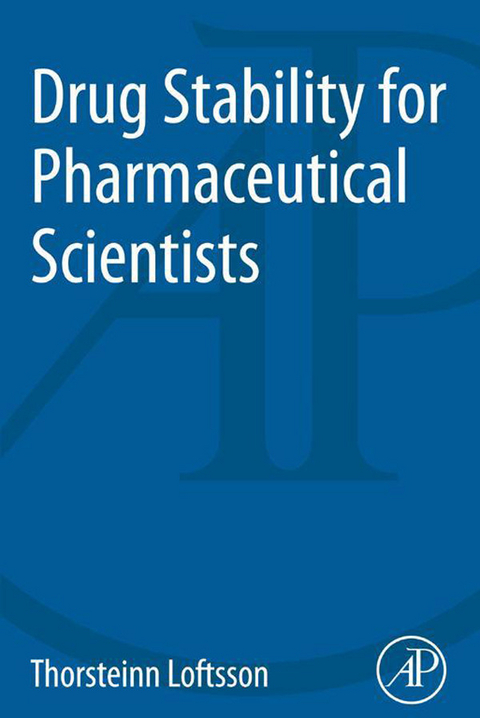
Drug Stability for Pharmaceutical Scientists (eBook)
170 Seiten
Elsevier Science (Verlag)
978-0-12-411562-0 (ISBN)
Dr. Thorsteinn Loftsson is a Professor of Physical Pharmacy at the University of Iceland in Reykjavik. He received his MS Pharm degree from University of Copenhagen and his MS and PhD degrees from the Department of Pharmaceutical Chemistry at the University of Kansas. Dr. Loftsson has authored or co-authors over 200 papers in peer-reviewed journals, numerous book chapters and 20 patents and patent applications. His main research areas include the pharmaceutical applications of cyclodextrins, marine lipids, prodrugs and soft drugs. He has conducted over 100 lectures and is a Fellow of the American Association of Pharmaceutical Scientists (AAPS). Dr. Loftsson is also a member for the editorial board of Journal of Pharmaceutical Sciences, International Journal of Pharmaceutics, Journal of Pharmacy and Pharmacology, die Pharmazie and Journal of Drug Delivery Science and Technology (formerly STP Pharma Sciences).
Drug Stability for Pharmaceutical Scientists is a clear and easy-to-follow guide on drug degradation in pharmaceutical formulation. This book features valuable content on both aqueous and solid drug solutions, the stability of proteins and peptides, acid-base catalyzed and solvent catalyzed reactions, how drug formulation can influence drug stability, the influence of external factors on reaction rates and much more. Full of examples of real-life formulation problems and step-by-step calculations, this book is the ideal resource for graduate students, as well as scientists in the pharmaceutical and related industries. - Illustrates important theoretical concepts with numerous examples, figures, calculations, learning problems and questions for self-study and retention of material- Provides answers and explanations to test your knowledge- Enables you to better understand key concepts such as rate and order of reaction, reaction equilibrium, complex reaction mechanisms and more- Includes an in-depth discussion of both aqueous and solid drug solutions and contains the latest international regulatory requirements on drug stability
Principles of Drug Degradation
In this chapter, the kinetics of drug degradation is reviewed, and it is shown how various excipients, such as buffer salts and complexing agents, the phase distribution of the drug such as in suspensions and emulsions, and external factors such as temperature, oxygen, and light, can influence reaction rates. It is shown how the shelf-life of drug products can be enhanced through proper formulation. The chapter contains numerous practical examples of how various equations and theories are used to solve problems encountered during drug stability testing.
Keywords
Kinetics; order of reaction; complex reaction; steady state; rate-limiting step; shelf-life estimation; effect of temperature; specific acid/base catalysis; general acid/base catalysis; media effect; complexation; light
The rate of reaction may be defined as the rate of concentration changes of the reactants or products:
(2.1)
where a and b represent number of molecules, A and B the reactants, and P the product. The rate is expressed as −d[A]/dt, −d[B]/dt, and d[P]/dt, where t is the time and [A], [B], and [P] represent concentrations. The minus sign indicates a decrease in concentration. The rate has units of concentration divided by time (i.e., M s−1, M h−1, or mg ml−1 h−1). The order of reaction is the sum of a and b (i.e., the number of molecules participating in the reaction). For example, hydrolysis of methyl salicylate in aqueous solution follows the chemical equation:
(2.2)
where methyl salicylate and water are the reactants and salicylic acid and methanol the products. The reaction is first order with respect to methyl salicylate and first order with respect to water, but overall the reaction is second order. A reaction involving only one reactant molecule is called unimolecular; a reaction involving two molecules is called bimolecular; and a reaction involving three molecules is called termolecular. Radioactive decay, in which particles are emitted from an atom, is an example of a unimolecular reaction. Bimolecular reactions, in which two molecules react to form product(s), are very common chemical reactions. Ester hydrolysis, shown in Eq. 2.2, is an example of bimolecular reaction. Termolecular reactions, in which three molecules collide simultaneously to react, are rare.
2.1 Zero-Order Reactions
A zero-order reaction is a reaction in which rate is independent of the reactant concentration:
(2.3)
where k0 is the rate constant for the zero-order reaction. Although “pure” zero-order reactions are rather uncommon, apparent (or pseudo) zero-order reactions are frequently observed in pharmaceutical products, such as drug suspensions. Under these conditions, the drug degradation follows first-order kinetics, but the solid drug present in the suspension dissolves and maintains the concentration of dissolved drug ([A]) constant:
(2.4)
where k1 is the first-order rate constant and [A] is the concentration of dissolved drug. Rearrangement of Eq. 2.3 gives Eq. 2.5:
(2.5)
where [A]0 is the total drug concentration at time zero. The rate constant is obtained by plotting the change in [A] over time (Fig. 2.1).
Figure 2.1 Zero-order plot of [A] versus time. [A]0 is the y-intercept.
The half-life (t½) of the reaction is the time required for the total drug concentration to fall to half of its value as measured at the beginning of the time period (i.e., [A]0 to ½[A]0), and the shelf-life (t90 or t95) is the time required for the total drug concentration to fall to 90% or 95% of its initial value.
(2.6)
(2.7)
(2.8)
Thus, both the half-life and the shelf-life of zero-order reactions depend on the initial drug concentration.
2.2 First-Order Reactions
The rate of a first-order reaction is directly proportional to a single reactant concentration:
(2.9)
(2.10)
where k1 is the first-order rate constant and [A] is the reactant (i.e., drug) concentration. The rate of drug disappearance is equal to the rate of product formation (Fig. 2.2):
(2.11)
where [A]=[P] at t½. Rearrangement of Eq. 2.10 and integration from t=0 ([A]0) to time t ([A]) gives:
(2.12)
(2.13)
(2.14)
(2.15)
Figure 2.2 Plot of [A] and [P] versus time.
Eq. 2.15 describes a linear plot (Fig. 2.3).
Figure 2.3 First-order plot of ln[A] versus time. ln[A]0 is the y-intercept.
Eq. 2.15 can also be written as:
(2.16)
where ln[A]=2.303log[A]. The common logarithm (log) is based on 10 (also called the decimal logarithm) and is generally used in older textbooks, as well as by some drug regulatory authorities, to describe drug degradation kinetics. However, in this book we mainly use the natural logarithm (ln) that is based on e (=2.7183…) avoiding the conversion factor of 2.303.
For first-order reactions t½, t90, and t95 are independent of the initial drug concentration. For example, according to Eq. 2.15 t½ (the time it takes [A]0 to reach ½[A]0) can be calculated as follows:
(2.17)
Rearranging Eq. 2.17 gives:
(2.18)
Likewise, the following equations for t90 and t95 can be obtained:
(2.19)
(2.20)
Example 2.1
Hydrolysis of homatropine in aqueous solution
Homatropine is an ester that undergoes hydrolysis in aqueous solutions [1]. Samples were collected and the homatropine concentration at various time points calculated:
| Time (h) | [Homatropine] (M) | ln[Homatropine] |
| 1.4 | 0.026 | −3.650 |
| 3.0 | 0.024 | −3.730 |
| 6.0 | 0.021 | −3.863 |
| 9.0 | 0.018 | −4.017 |
| 12 | 0.015 | −4.200 |
| 17 | 0.012 | −4.423 |
The following values can then be calculated from the graph:
The initial homatropine concentration=e−3.575=0.028 M
The first-order rate constant=k1=5.05×10⁻² h−1
Example 2.2
Hydrolysis of amoxicillin in aqueous drug suspension
Amoxicillin (MW 365.4 g/mol) is a β-lactam antibiotic that undergoes hydrolysis in aqueous solutions [2]. Due to its instability, aqueous amoxicillin mixtures are prepared in the pharmacy just before dispensing by suspending drug granules in purified water. At pH 6.0 and 25°C, the value of the first-order rate constant (k1) is 1.26×10⁻³ h−1. Under these conditions, the solubility of amoxicillin is 3.4 mg/ml (=3.4 g/l). What is the shelf-life (t90) of an amoxicillin mixture that contains 50 mg/ml of amoxicillin in an aqueous suspension?
Answer:
In a suspension, the amoxicillin degradation follows apparent zero-order kinetics (Eq. 2.4) in which [Amox] is constant and equal to the amoxicillin solubility 3.4 mg/ml. The zero-order rate constant is calculated as follows:
The initial amoxicillin concentration in the suspension:
The solid amoxicillin in the suspension is essentially stable in comparison to dissolved amoxicillin and, thus, amoxicillin degradation in the solid state can be ignored. t90 is defined as the time for the original potency of the active drug to be reduced to 90% (i.e., from 0.1368 to 0.1232 mol/liter) (Eq. 2.7):
If all amoxicillin is in solution, then t90 will be independent of [Amox]0 (Eq. 2.19):
Thus, formulating amoxicillin as an aqueous suspension instead of an aqueous solution increases t90 from 3.5 to 49 days. The expiration date after forming an amoxicillin mixture is frequently 14 days. Small changes in pH and temperature can have significant affect on the shelf-life. For example, an increase in pH from 6.0 to 7.0 can result in a 10 fold decrease in the shelf-life, or from 49 days to 4.9 days. The shelf-life will increase if we lower the temperature from room temperature (about 25°C) to refrigerator termperature (about 5°C). Thus, due to variable storage conditions, the expiration date is often much shorter than the shelf-life at a given storage condition.
The half-life of amoxicillin in the mixture at pH 6.0 and 25°C is (Eq. 2.6):
Example 2.3
Calculation of a first-order rate constant from peak heights
Since rates of first-order drug degradations are independent of the actual drug concentration in the reaction media, the actual drug concentration does not need to be known for the calculation of constants. For example, an anticancer drug was dissolved in pure water at 80°C and the amount of drug in the aqueous solution determined at various time points by injecting samples into HPLC is:
| Time (min) | Peak... |
| Erscheint lt. Verlag | 25.1.2014 |
|---|---|
| Sprache | englisch |
| Themenwelt | Medizin / Pharmazie ► Gesundheitsfachberufe |
| Medizin / Pharmazie ► Medizinische Fachgebiete ► Pharmakologie / Pharmakotherapie | |
| ISBN-10 | 0-12-411562-4 / 0124115624 |
| ISBN-13 | 978-0-12-411562-0 / 9780124115620 |
| Informationen gemäß Produktsicherheitsverordnung (GPSR) | |
| Haben Sie eine Frage zum Produkt? |
 EPUB (Adobe DRM)
Kopierschutz: Adobe-DRM
Adobe-DRM ist ein Kopierschutz, der das eBook vor Mißbrauch schützen soll. Dabei wird das eBook bereits beim Download auf Ihre persönliche Adobe-ID autorisiert. Lesen können Sie das eBook dann nur auf den Geräten, welche ebenfalls auf Ihre Adobe-ID registriert sind.
Details zum Adobe-DRM
Dateiformat: EPUB (Electronic Publication)
EPUB ist ein offener Standard für eBooks und eignet sich besonders zur Darstellung von Belletristik und Sachbüchern. Der Fließtext wird dynamisch an die Display- und Schriftgröße angepasst. Auch für mobile Lesegeräte ist EPUB daher gut geeignet.
Systemvoraussetzungen:
PC/Mac: Mit einem PC oder Mac können Sie dieses eBook lesen. Sie benötigen eine
eReader: Dieses eBook kann mit (fast) allen eBook-Readern gelesen werden. Mit dem amazon-Kindle ist es aber nicht kompatibel.
Smartphone/Tablet: Egal ob Apple oder Android, dieses eBook können Sie lesen. Sie benötigen eine
Geräteliste und zusätzliche Hinweise
Buying eBooks from abroad
For tax law reasons we can sell eBooks just within Germany and Switzerland. Regrettably we cannot fulfill eBook-orders from other countries.
aus dem Bereich