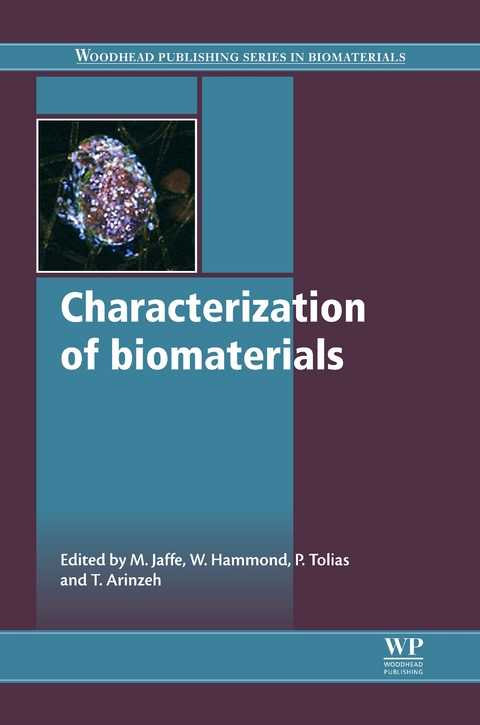
Characterization of Biomaterials (eBook)
334 Seiten
Elsevier Science (Verlag)
978-0-85709-368-4 (ISBN)
Biomaterials and medical devices must be rigorously tested in the laboratory before they can be implanted. Testing requires the right analytical techniques. Characterization of biomaterials reviews the latest methods for analyzing the structure, properties and behaviour of biomaterials.Beginning with an introduction to microscopy techniques for analyzing the phase nature and morphology of biomaterials, Characterization of biomaterials goes on to discuss scattering techniques for structural analysis, quantitative assays for measuring cell adhesion, motility and differentiation, and the evaluation of cell infiltration and tissue formation using bioreactors. Further topics considered include studying molecular-scale protein-surface interactions in biomaterials, analysis of the cellular genome and abnormalities, and the use of microarrays to measure cellular changes induced by biomaterials. Finally, the book concludes by outlining standards and methods for assessing the safety and biocompatibility of biomaterials.With its distinguished editors and international team of expert contributors, Characterization of biomaterials is an authoritative reference tool for all those involved in the development, production and application of biomaterials. - Reviews the latest methods for analyzing the structure, properties and behaviour of biomaterials- Discusses scattering techniques for structural analysis, quantitative assays for measuring cell adhesion, and motility and differentiation- Examines the evaluation of cell infiltration and tissue formation using bioreactors
Woodhead Publishing Series in Biomaterials
1. Sterilisation of tissues using ionising radiations
Edited by J. F. Kennedy, G. O. Phillips and P. A. Williams
2. Surfaces and interfaces for biomaterials
Edited by P. Vadgama
3. Molecular interfacial phenomena of polymers and biopolymers
Edited by C. Chen
4. Biomaterials, artificial organs and tissue engineering
Edited by L. Hench and J. Jones
5. Medical modelling
Edited by R. Bibb
6. Artificial cells, cell engineering and therapy
Edited by S. Prakash
7. Biomedical polymers
Edited by M. Jenkins
8. Tissue engineering using ceramics and polymers
Edited by A. R. Boccaccini and J. Gough
9. Bioceramics and their clinical applications
Edited by T. Kokubo
10. Dental biomaterials
Edited by R. V. Curtis and T. F. Watson
11. Joint replacement technology
Edited by P. A. Revell
12. Natural-based polymers for biomedical applications
Edited by R. L. Reiss et al.
13. Degradation rate of bioresorbable materials
Edited by F. J. Buchanan
14. Orthopaedic bone cements
Edited by S. Deb
15. Shape memory alloys for biomedical applications
Edited by T. Yoneyama and S. Miyazaki
16. Cellular response to biomaterials
Edited by L. Di Silvio
17. Biomaterials for treating skin loss
Edited by D. P. Orgill and C. Blanco
18. Biomaterials and tissue engineering in urology
Edited by J. Denstedt and A. Atala
19. Materials science for dentistry
Edited by B. W. Darvell
20. Bone repair biomaterials
Edited by J. A. Planell, S. M. Best, D. Lacroix and A. Merolli
21. Biomedical composites
Edited by L. Ambrosio
22. Drug-device combination products
Edited by A. Lewis
23. Biomaterials and regenerative medicine in ophthalmology
Edited byT.V. Chirila
24. Regenerative medicine and biomaterials for the repair of connective tissues
Edited by C. Archer and J. Ralphs
25. Metals for biomedical devices
Edited by M. Ninomi
26. Biointegration of medical implant materials: science and design
Edited by C. P. Sharma
27. Biomaterials and devices for the circulatory system
Edited by T. Gourlay and R. Black
28. Surface modification of biomaterials: methods analysis and applications
Edited by R. Williams
29. Biomaterials for artificial organs
Edited by M. Lysaght and T. Webster
30. Injectable biomaterials: science and applications
Edited by B. Vernon
31. Biomedical hydrogels: biochemistry, manufacture and medical applications
Edited by S. Rimmer
32. Preprosthetic and maxillofacial surgery: biomaterials, bone grafting and tissue engineering
Edited by J. Ferri and E. Hunziker
33. Bioactive materials in medicine: design and applications
Edited by X. Zhao, J. M. Courtney and H. Qian
34. Advanced wound repair therapies
Edited by D. Farrar
35. Electrospinning for tissue regeneration
Edited by L. Bosworth and S. Downes
36. Bioactive glasses: materials, properties and applications
Edited by H. O. Ylanen
37. Coatings for biomedical applications
Edited by M. Driver
38. Progenitor and stem cell technologies and therapies
Edited by A. Atala
39. Biomaterials for spinal surgery
Edited by L. Ambrosio and E. Tanner
40. Minimized cardiopulmonary bypass techniques and technologies
Edited by T. Gourlay and S. Gunaydin
41. Wear of orthopaedic implants and artificial joints
Edited by S. Affatato
42. Biomaterials in plastic surgery: breast implants
Edited by W. Peters, H. Brandon, K. L. Jerina, C. Wolf and V. L. Young
43. MEMS for biomedical applications
Edited by S. Bhansali and A. Vasudev
44. Durability and reliability of medical polymers
Edited by M. Jenkins and A. Stamboulis
45. Biosensors for medical applications
Edited by S. Higson
46. Sterilisation of biomaterials and medical devices
Edited by S. Lerouge and A. Simmons
47. The hip resurfacing handbook: a practical guide to the use and management of modern hip resurfacings
Edited by K. De Smet, P. Campbell and C. Van Der Straeten
48. Developments in tissue engineered and regenerative medicine products
Edited by J. Basu and J. W. Ludlow
49. Nanomedicine: technologies and applications
Edited by T. J. Webster
50. Biocompatibility and performance of medical devices
Edited by J-P. Boutrand
51. Medical robotics: minimally invasive surgery
Edited by P. Gomes
52. Implantable sensor systems for medical applications
Edited by A. Inmann and D. Hodgins
53. Non-metallic biomaterials for tooth repair and replacement
Edited by P. Vallittu
54. Joining and assembly of medical materials and devices
Edited by Y. Norman Zhou and M.D. Breyen
55. Diamond-based materials for biomedical...
| Erscheint lt. Verlag | 19.12.2012 |
|---|---|
| Sprache | englisch |
| Themenwelt | Medizin / Pharmazie ► Pflege |
| Medizin / Pharmazie ► Physiotherapie / Ergotherapie ► Orthopädie | |
| Medizin / Pharmazie ► Studium ► 1. Studienabschnitt (Vorklinik) | |
| Technik ► Maschinenbau | |
| Technik ► Medizintechnik | |
| Technik ► Umwelttechnik / Biotechnologie | |
| ISBN-10 | 0-85709-368-1 / 0857093681 |
| ISBN-13 | 978-0-85709-368-4 / 9780857093684 |
| Informationen gemäß Produktsicherheitsverordnung (GPSR) | |
| Haben Sie eine Frage zum Produkt? |
 EPUB (Adobe DRM)
Kopierschutz: Adobe-DRM
Adobe-DRM ist ein Kopierschutz, der das eBook vor Mißbrauch schützen soll. Dabei wird das eBook bereits beim Download auf Ihre persönliche Adobe-ID autorisiert. Lesen können Sie das eBook dann nur auf den Geräten, welche ebenfalls auf Ihre Adobe-ID registriert sind.
Details zum Adobe-DRM
Dateiformat: EPUB (Electronic Publication)
EPUB ist ein offener Standard für eBooks und eignet sich besonders zur Darstellung von Belletristik und Sachbüchern. Der Fließtext wird dynamisch an die Display- und Schriftgröße angepasst. Auch für mobile Lesegeräte ist EPUB daher gut geeignet.
Systemvoraussetzungen:
PC/Mac: Mit einem PC oder Mac können Sie dieses eBook lesen. Sie benötigen eine
eReader: Dieses eBook kann mit (fast) allen eBook-Readern gelesen werden. Mit dem amazon-Kindle ist es aber nicht kompatibel.
Smartphone/Tablet: Egal ob Apple oder Android, dieses eBook können Sie lesen. Sie benötigen eine
Geräteliste und zusätzliche Hinweise
Buying eBooks from abroad
For tax law reasons we can sell eBooks just within Germany and Switzerland. Regrettably we cannot fulfill eBook-orders from other countries.
aus dem Bereich