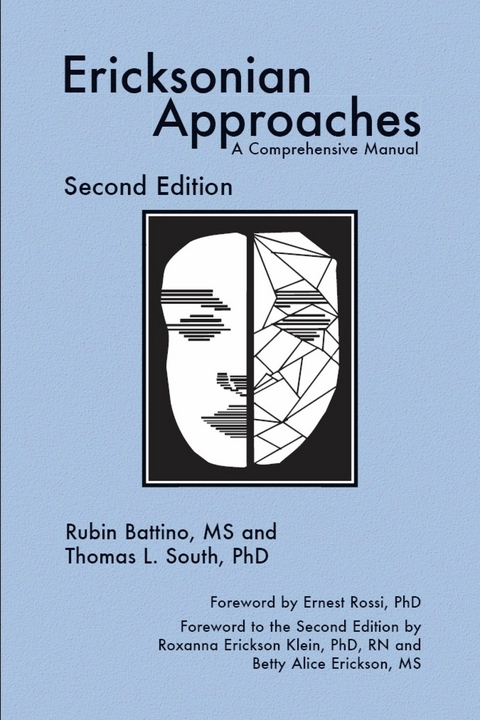
Ericksonian Approaches (eBook)
624 Seiten
Crown House Publishing (Verlag)
978-1-84590-190-5 (ISBN)
Rubin Battino MS has a private practice in Yellow Springs, Ohio. He is an Adjunct Professor for the Department of Human Services at Wright State University, and has over twenty five years of experience as a facilitator of a support group for people who have life-challenging diseases and for caregivers. He is a Fellow of the National Council for Hypnotherapy (UK), and also a Fellow of two chemistry societies. Other publications by Rubin include: Healing Language. A Guide for Physicians, Dentists, Nurses, Psychologists, Social Workers, and Counselors; Howie and Ruby. Conversations 2000 - 2007; That's Right, Is it Not? A Play About the Life of Milton H. Erickson, MD. and Guided Imagery and Hypnosis in Brief Therapy and Palliative Care.
This outstanding manual on Ericksonian hypnotherapy has been thoroughly revised and updated. There are two new chapters - one on Metaphor Therapy and Guided Metaphor and the other on Ernest Rossi`s work on the psychobiology of gene expression. The latter chapter also contains a section on the brain and hypnosis. Thomas South has extended his chapter on utilization with another section on pain control and the chapter on ethics and the law has also been signigicantly updated. Finally there is a new foreword by Roxanna Erickson Klein and Betty Alice Erickson. `This work is the stately tree, supporting individuality, cooperation and diversity. It is filled with common sense and uncommon sense, with atmosphere and sunhsine, with metaphors for more individual growth, with practice exercises for the present and with thoughts for the future. It gives us all lessons in becoming better therapists, better people,.a and better members of our world.`Roxanna Erickson Klein and Betty Alice Erickson - from the new foreword.
A. Introduction
Hypnosis is as old as the human race. The phenomenon known as hypnosis has existed since the beginning of recorded history, as found in the folklore of ancient cultures. In ancient times, as well as in the “primitive” tribes of today, it has been and continues to be associated with religious ceremonies, magic, the supernatural, and the occult. The ancient Egyptians and Greeks had dream centers (Udolf, 1981) where people came to fast and pray with the hope that their dreams could be interpreted so as to solve their problems and give them guidance. Under these circumstances their dreams were probably hypnotically induced. Even today, Hindu medicine men practice their ageless forms and variations of hypnosis for healing purposes. Magicians in the time of Genghis Khan (Erickson and Rossi, 1980c, p. 3) practiced group suggestion to obtain visual and auditory hallucinations. According to Marco Polo, medieval men used hypnosis in mystic rites to produce fear and to intensify beliefs in the supernatural and the occult. With this long history of supernaturalism and mysticism, it is no wonder that the general public’s attitude toward hypnosis, as well as that of many professionals, has been and still is one of misunderstanding, antagonism, and fear.
Gauld’s history of hypnosis (1992) from Mesmer to about the time of the First World War is an impressive scholarly work. There is a final summary chapter covering contributions through the 1980s. M.A. Gravitz has written many articles about the history of hypnosis; two of them are 1987, and 1987–8. The Wall Street Journal (7 October 2003), under a heading of “Altered States: Hypnosis Goes Mainstream”, indicates that major hospitals are now using hypnosis for fractures, cancer, burns, pain relief, gastrointestinal disorders, childbirth, treatment of hemophilia, and treatment of phobias. Many hospitals now have staff hypnotists. This is encouraging.
B. Franz Anton Mesmer (1734–1815)
The scientific study of hypnosis began with Franz Anton Mesmer (1734–1815). Pattie (1994) has written a well-researched biography of Mesmer that makes fascinating reading. The term “Mesmerism” is still in current usage. Mesmer was a Viennese physician who used his mesmeric techniques in the treatment of psychiatric patients. His practice of suggestion therapy consisted of what he called “the natural qualities of animal magnetism”. He attributed his beneficial therapeutic results to the transferring of this quality of animal magnetism to his patients. Since Mesmer was greatly influenced by Newton’s discovery of the gravitational attraction of the heavenly bodies toward each other, he generalized Newton’s ideas to explain how certain diseases were due to an imbalance of hormones in the body due to the influence of gravity. In 1779, Mesmer (1980) defined animal magnetism as a “force which is the cause of universal gravitation and which is, very probably, the foundation of all corporal properties, a force which actually strains, relaxes and agitates the cohesion, elasticity, irritability, magnetics, and electricity in the smallest fluid and solid particles of our machine”. To illustrate how such subtle forces affect the human body, he gave the following two examples: “(1) when the nervous system is exposed to emanating light, changes take place in the mind and body; (2) a stream of air affects the nerves in the ear and is capable of disturbing the entire animal body.” He postulated that the same forces which caused the expansion of the ocean and the atmosphere, created a tide in the human body in such a way that it agitated the blood vessels that carried blood to the brain and caused sickness. He used the increase in the number of epileptic seizures during a full moon as an example of this phenomenon. Since he believed that magnetism and electricity had similar properties that disturbed the fluid in the body in such a manner to cause disharmony of the nervous system, he placed magnets on various parts of the body, and claimed to have restored menstrual periods, decreased hemorrhoids, cured hypochondriasis, blindness, convulsions, hysterical irregularities, and spasmodic paralysis of the legs.
Mesmer later came to the conclusion that all people have magnetic properties such as himself in greater or lesser amounts that affected the bodies of others, e.g. hair can stand up on end, electrical sparks fly from the body. Thus, a human body sick from weakened fluids can be rejuvenated by the magnetism from another. He also believed that magnetism could be transferred to such materials as paper, glass, water, metals, or any chosen object, as well as to others. Thus, a human body that was sick from imbalanced or weakened fluids could be rejuvenated by the transfer of magnetism.
The documented case of Miss Paradis (Mesmer, 1980) was considered as one of his most significant cures utilizing animal magnetism. Miss Paradis was born with normal vision but had developed hysterical blindness at an early age. Prior treatment consisted of blistering, leeches, cauterization, purgatives, and diuretics for years, but with continued failure. She had intense pain from spasms in the eyes, and also suffered states of delirium. The spasms were described as causing the eyes to bulge so much that only the whites could be seen. The medieval medical society considered her condition as incurable.
Mesmer visited her home for three days and placed her in a trance by stroking her eyes and arms. He also moved a stick reflected in a mirror across her eyes. The patient watched the movement of the stick in the mirror. On the fourth day, she relaxed and her eyes resumed natural positioning, with one eye smaller than the other. The eyes became the same with continued treatment. After she reported continued headaches and eye aches with trembling in her limbs, he began treatment in a darkened room. In her home as she gradually adjusted to the sensation of light, she learned to distinguish colors. He had her gradually learn to use the motor muscles of her eyes by having her slowly search for objects, fixing sight on them and giving their positions. He then reinforced her visual memory by having her touch the objects. He also trained her to observe the movements of objects. She eventually learned to endure daylight. When her parents were informed of their daughter’s favorable progress, they demanded that she be returned home since a substantial royal pension would be forfeited upon the daughter’s recovery! When she could not name colors to her father’s satisfaction and refused to return home, her father struck her and denounced Mesmer as a quack. Her blindness returned, and she continued to receive her pension; Mesmer was publicly declared a charlatan. Miss Paradis was an excellent pianist and her concert career continued for many years.
The media promoted Mesmer as a fraud and illusionist. Physicians who had attempted his animal magnetism technique and failed reported their experiences. They reported his cures as imaginary and his theory as an illusion. This caused Mesmer to stop using magnets and electricity due to the futility of attempting to influence medical committees.
Mesmer believed that he was ostracized and accused of eccentricity because he did not follow the traditional path of medicine, and that the community construed this as a crime. However, he believed that he had advanced the knowledge of medicine and had made discoveries in healing. Mesmer believed that most physicians had superstitious confidence in their traditional treatment of patients and this made them “despotic and presumptuous”. He believed that physicians were “sheltered in traditional medicine” and were afraid to go outside of that tradition to help their patients. Thus, they failed to admit or explain how patients became cured without the help of medicine.
Mesmer was well before his time. Although he successfully treated with animal magnetism large numbers of patients on whom traditional procedures had failed, he had no realization of the psychological nature of his therapy. Unfortunately, his personality and the mystical character of his therapy served to bring him unjustly into disrepute. A royal committee (Erickson and Rossi, 1980c, pp. 3–4; also see Franklin, 1837) that included Benjamin Franklin, John Guillotine, and Antoine Lavoisier was sent to investigate Mesmer. They observed that patients sent out to touch “magnetized” trees became healed. However, they also noticed that patients were cured even though they touched the wrong trees! Consequently, they came to the conclusion that Mesmer was a charlatan, and there was no realization of the psychological truths of this type of therapy. Despite the unfortunate reputation Mesmer received, many physicians who had visited his clinic during the height of its success were impressed with this form of psychotherapy.
The failure of contemporary societies to discover anything of medical or scientific worth in Mesmer’s theories and claims did not deter the public or physicians in other countries from practicing animal magnetism. Mesmeric societies (Mesmer, 1980) were organized in other countries than France, Germany, and Austria. Although official condemnation of Mesmerism had spread throughout Europe during the 1820s, there was always one respected physician who revived Mesmerism due to the remarkable results obtained by its usage.
C. John Elliotson (1791–1868)
The next great figure in hypnosis was an English physician. John Elliotson (1791–1868) was assistant physician at St. Thomas Hospital and professor of medicine at...
| Erscheint lt. Verlag | 31.8.2005 |
|---|---|
| Verlagsort | London |
| Sprache | englisch |
| Themenwelt | Geisteswissenschaften ► Psychologie ► Allgemeine Psychologie |
| Geisteswissenschaften ► Psychologie ► Biopsychologie / Neurowissenschaften | |
| Geisteswissenschaften ► Psychologie ► Humanistische Psychotherapien | |
| Medizin / Pharmazie ► Gesundheitsfachberufe | |
| Medizin / Pharmazie ► Medizinische Fachgebiete ► Psychiatrie / Psychotherapie | |
| Medizin / Pharmazie ► Naturheilkunde | |
| ISBN-10 | 1-84590-190-8 / 1845901908 |
| ISBN-13 | 978-1-84590-190-5 / 9781845901905 |
| Informationen gemäß Produktsicherheitsverordnung (GPSR) | |
| Haben Sie eine Frage zum Produkt? |
 EPUB (Wasserzeichen)
DRM: Digitales Wasserzeichen
Dieses eBook enthält ein digitales Wasserzeichen und ist damit für Sie personalisiert. Bei einer missbräuchlichen Weitergabe des eBooks an Dritte ist eine Rückverfolgung an die Quelle möglich.
Dateiformat: EPUB (Electronic Publication)
EPUB ist ein offener Standard für eBooks und eignet sich besonders zur Darstellung von Belletristik und Sachbüchern. Der Fließtext wird dynamisch an die Display- und Schriftgröße angepasst. Auch für mobile Lesegeräte ist EPUB daher gut geeignet.
Systemvoraussetzungen:
PC/Mac: Mit einem PC oder Mac können Sie dieses eBook lesen. Sie benötigen dafür die kostenlose Software Adobe Digital Editions.
eReader: Dieses eBook kann mit (fast) allen eBook-Readern gelesen werden. Mit dem amazon-Kindle ist es aber nicht kompatibel.
Smartphone/Tablet: Egal ob Apple oder Android, dieses eBook können Sie lesen. Sie benötigen dafür eine kostenlose App.
Geräteliste und zusätzliche Hinweise
Buying eBooks from abroad
For tax law reasons we can sell eBooks just within Germany and Switzerland. Regrettably we cannot fulfill eBook-orders from other countries.
aus dem Bereich