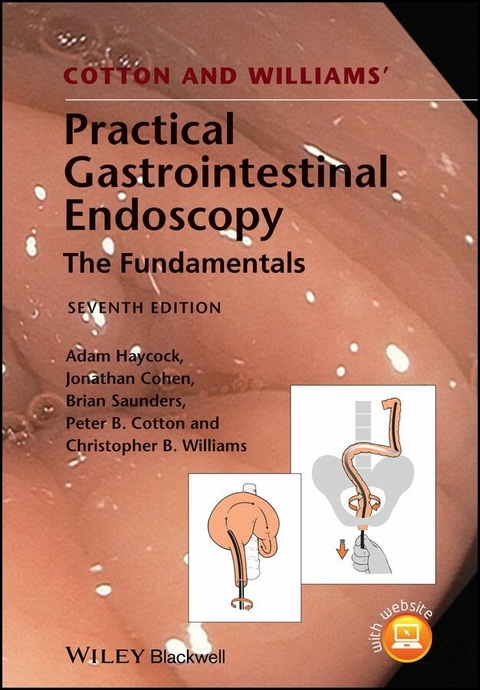
Cotton and Williams' Practical Gastrointestinal Endoscopy (eBook)
John Wiley & Sons (Verlag)
978-1-118-40644-1 (ISBN)
Translated into seven languages, Cotton and Williams' Practical Gastrointestinal Endoscopy has for the last 25 years been the basic primer for endoscopy around the world, providing clear, clinical and practical guidance on the fundamentals of endoscopy practice, from patient positioning and safety, how to perform different endoscopic procedures, and the latest in therapeutic techniques and advances in technology.
It's key strength and reason for its popularity is its step-by-step, practical approach, especially with the use of outstanding colour artwork to illustrate the right and wrong ways to perform endoscopy. Add to this the weight and expertise of its author team, led by Peter Cotton and Christopher Williams, and the final result is an essential tool for all gastroenterologists and endoscopists, particularly trainees looking to improve their endoscopic technique.
Joining Peter Cotton, Christopher Williams and Brian Saunders in the seventh edition are two exciting stars in UK and US endoscopy, Adam Haycock and Jonathan Cohen. New to this edition are:
- Approximately 35 high-quality videos illustrating optimum endoscopy practice, all referenced via “video eyes” in the text
- Self-assessment MCQs to test main learning points
- An online clinical photo imagebank to complement the line illustrations, perfect for downloading into scientific presentations
- Key learning points in every chapter
- Much more information on mucosal resection techniques and small bowel endoscopy—for capsule and “deep” enteroscopy
- The latest recommendations and guidelines from the ASGE, ASG, UEGW and BSG.
Cotton and Williams' Practical Gastrointestinal Endoscopy, seventh edition is fully modernised, masterful as ever, and once again, the number one endoscopy manual for a whole new generation of gastroenterologists and endoscopists.
Translated into seven languages, Cotton and Williams' Practical Gastrointestinal Endoscopy has for the last 25 years been the basic primer for endoscopy around the world, providing clear, clinical and practical guidance on the fundamentals of endoscopy practice, from patient positioning and safety, how to perform different endoscopic procedures, and the latest in therapeutic techniques and advances in technology. It's key strength and reason for its popularity is its step-by-step, practical approach, especially with the use of outstanding colour artwork to illustrate the right and wrong ways to perform endoscopy. Add to this the weight and expertise of its author team, led by Peter Cotton and Christopher Williams, and the final result is an essential tool for all gastroenterologists and endoscopists, particularly trainees looking to improve their endoscopic technique. Joining Peter Cotton, Christopher Williams and Brian Saunders in the seventh edition are two exciting stars in UK and US endoscopy, Adam Haycock and Jonathan Cohen. New to this edition are: Approximately 35 high-quality videos illustrating optimum endoscopy practice, all referenced via video eyes in the text Self-assessment MCQs to test main learning points An online clinical photo imagebank to complement the line illustrations, perfect for downloading into scientific presentations Key learning points in every chapter Much more information on mucosal resection techniques and small bowel endoscopy for capsule and deep enteroscopy The latest recommendations and guidelines from the ASGE, ASG, UEGW and BSG. Cotton and Williams' Practical Gastrointestinal Endoscopy, seventh edition is fully modernised, masterful as ever, and once again, the number one endoscopy manual for a whole new generation of gastroenterologists and endoscopists.
Adam Haycock, Consultant Physician & Gastroenterologist, St Mark's Hospital for Colorectal and Intestinal Disorders, London, UK Jonathan Cohen, Clinical Professor of Medicine, New York University School of Medicine, New York, USA Brian P. Saunders, Consultant Gastroenterologist, St Mark's Hospital for Colorectal and Intestinal Disorders, London, UK Peter B. Cotton, Professor of Medicine, Medical University of South Carolina, Charleston, USA Christopher B. Williams, Honorary Physician, St Mark's Hospital for Colorectal and Intestinal Disorders, London, UK
List of Video Clips, xi
Preface to the Seventh Edition, xii
Preface to the First Edition, xiv
Acknowledgments, xv
About the Companion Website, xvi
1 The Endoscopy Unit, Staff, and Management, 1
2 Endoscopic Equipment, 6
3 Patient Care, Risks, and Safety, 19
4 Upper Endoscopy: Diagnostic Techniques, 33
5 Therapeutic Upper Endoscopy, 54
6 Colonoscopy and Flexible Sigmoidoscopy, 78
7 Therapeutic Colonoscopy, 153
8 Resources and Links, 180
Websites, 180
Endoscopy books, 180
Journals with major endoscopy/clinical focus, 180
Epilogue: The Future? Comments from the Senior
Authors, 181
Intelligent endoscopes, 181
Colonoscopy--boon or bubble?, 181
Advanced therapeutics, cooperation, and multidisciplinary
working, 181
Quality and teaching, 182
Index, 183
CHAPTER 1
The Endoscopy Unit, Staff, and Management
Most endoscopists, and especially beginners, focus on the individual procedures and have little appreciation of the extensive infrastructure that is now necessary for efficient and safe activity. From humble beginnings in adapted single rooms, most of us are lucky enough now to work in large units with multiple procedure rooms full of complex electronic equipment, with additional space dedicated to preparation, recovery, and reporting.
Endoscopy is a team activity, requiring the collaborative talents of many people with different backgrounds and training. It is difficult to overstate the importance of appropriate facilities and adequate professional support staff, to maintain patient comfort and safety, and to optimize clinical outcomes.
Endoscopy procedures can be performed almost anywhere when necessary (e.g. in an intensive care unit), but the vast majority take place in purpose-designed “endoscopy units.”
Endoscopy units
Details of endoscopy unit design are beyond the scope of this book, but certain principles should be stated.
There are two types of unit. Private clinics (called ambulatory surgical centers in the USA) deal mainly with healthy (or relatively healthy) outpatients, and should resemble cheerful modern dental suites. Hospital units have to provide a safe environment for managing sick inpatients, and also more complex procedures with a therapeutic focus, such as endoscopic retrograde cholangiopancreatography (ERCP). The more sophisticated units resemble operating suites. Units that serve both functions should be designed to separate the patient flows as far as possible.
The modern unit has areas designed for many different functions. Like a hotel or an airport (or a Victorian household), the endoscopy unit should have a smart public face (“upstairs”), and a more functional back hall (“downstairs”). From the patient's perspective, the suite consists of areas devoted to reception, preparation, procedure, recovery, and discharge. Supporting these activities are many other “back hall” functions, which include scheduling, cleaning, preparation, maintenance and storage of equipment, reporting and archiving, and staff management.
Procedure rooms
The rooms used for endoscopy procedures should:
- not be cluttered or intimidating. Most patients are not sedated when they enter, so it is better for the room to resemble a modern dental office, or kitchen, rather than an operating room.
- be large enough to allow a patient stretcher/trolley to be rotated on its axis, and to accommodate all of the equipment and staff (and any emergency team), but also compact enough for efficient function.
- be laid out with function in mind, keeping nursing and doctor spheres of activity separate (Fig 1.1), and minimizing exposed trailing electrical cables and pipes (best by ceiling-mounted beams).
Fig 1.1 Functional planning—spheres of activity.
Each room should have:
- piped oxygen and suction (two lines);
- lighting planned to illuminate nursing activities but not dazzle the patient or endoscopist;
- video monitors placed conveniently for the endoscopist and assistants, but also allowing the patient to view, if wished;
- adequate counter space for accessories, with a large sink or receptacle for dirty equipment;
- storage space for equipment required on a daily basis;
- systems of communication with the charge nurse desk, and emergency call;
- disposal systems for hazardous materials.
Patient preparation and recovery areas
Patients need a private place for initial preparation (undressing, safety checks, intravenous (IV) access), and a similar place in which to recover from any sedation or anesthesia. In some units these functions are separate, but can be combined to maximize flexibility. Many units have simple curtained bays, but rooms with solid side walls and a movable front curtain are preferable. They should be large enough to accommodate at least two people other than the patient on the stretcher, and all of the necessary monitoring equipment.
The “prep-recovery bays” should be adjacent to a central nursing workstation. Like the bridge of a ship, it is where the nurse captain of the day controls and steers the whole operation, and from which recovering patients can be monitored.
All units should have at least one completely private room for sensitive interviews/consultations before and after procedures.
Equipment management and storage
There must be designated areas for endoscope and accessory reprocessing, and storage of medications and all equipment, including an emergency resuscitation cart. Many units also have fully equipped mobile carts to travel to other sites when needed.
Staff
Specially trained endoscopy assistants have many important functions. They:
- prepare patients for their procedures, physically and mentally;
- set up all necessary equipment;
- assist endoscopists during procedures;
- monitor patients' safety, sedation, and recovery;
- clean, disinfect, and process equipment;
- maintain quality control.
Most endoscopy assistants are trained nurses, but technicians and nursing aides also have roles (e.g. in equipment processing). Large units need a variety of other staff, to handle reception, transport, reporting, and equipment management, including informatics.
Members of staff need places to store their clothes and valuables, and a break area for refreshments and meals.
Procedure reports
Usually, two reports are generated for each procedure—one by the nurses and one by the endoscopist.
Nurse's report
The nurse's report usually takes the form of a preprinted “flow sheet,” with places to record all of the pre-procedure safety checks, vital signs, use of sedation/analgesia and other medications, monitoring of vital signs and patient responses, equipment and accessory usage, and image documentation. It concludes with a copy of the discharge instructions given to the patient.
Endoscopist's report
In many units, the endoscopist's report is written or dictated in the procedure rooms. In larger ones, there may need to be a separate area designed for that purpose.
The endoscopist's report includes the patient's demographics, reasons for the procedure (indications), specific medical risks and precautions, sedation/analgesia, findings, diagnostic specimens, treatments, conclusions, follow-up plans, and any unplanned events (complications). Endoscopists use many reporting methods—handwritten notes, preprinted forms, free dictation, and computer databases.
The paperless endoscopy unit
Eventually all of the documentation (nursing, administrative, and endoscopic) will be incorporated into a comprehensive electronic management system. Such a system will substantially reduce the paperwork burden, and increase both efficiency and quality control.
Management, behavior, and teamwork
Complex organizations require efficient management and leadership. This works best as a collaborative exercise between the medical director of endoscopy and the chief nurse or endoscopy nurse manager. The biggest units will also have a separate administrator. These individuals must be skilled in handling people (doctors, staff, and patients), complex equipment, and significant financial resources. They must develop and maintain good working relationships with many departments within the hospital (such as radiology, pathology, sterile processing, anesthesia, bioengineering), as well as numerous manufacturers and vendors. They also need to be fully cognizant of all of the many local and national regulations that now impact on endoscopy practice.
The wise endoscopist will embrace the team approach, and realize that maintaining an atmosphere of collegiality and mutual respect is essential for efficiency, job satisfaction, and staff retention, and for optimal patient outcomes.
It is also essential to ensure that the push for efficiency does not drive out humanity. Patients should not be packaged as mere commodities during the endoscopy process. Treating our customers (and those who accompany them) with respect and courtesy is fundamental. Always assume that patients are listening, even if apparently sedated, so never chatter about irrelevances in their presence. Never eat or drink in patient areas. Background music is appreciated by many patients and staff.
Documentation and quality improvement
The agreed policies of the unit (including regulations dictated by the hospital and national organizations) are enshrined in an Endoscopy Unit Procedure Manual. This must be easily available, constantly updated, and frequently consulted.
Day-to-day documentation includes details of staff and room usage, disinfection processes, medications, instrument and accessory use and problems, as well as the procedure reports.
A formal quality assessment and improvement process is essential for maximizing the safety and efficiency of endoscopy services. Professional societies have recommended methods and metrics. The American...
| Erscheint lt. Verlag | 2.12.2013 |
|---|---|
| Sprache | englisch |
| Themenwelt | Medizin / Pharmazie ► Allgemeines / Lexika |
| Medizinische Fachgebiete ► Innere Medizin ► Gastroenterologie | |
| Medizin / Pharmazie ► Medizinische Fachgebiete ► Radiologie / Bildgebende Verfahren | |
| Schlagworte | BASIC • Best • Book • clear • different endoscopic • Endoscopy • Endoskopie • Expert • fundamentals • Gastroenterologie • gastroenterology • gastrointestinal • Gastrointestinal endoscopy • Gastrointestinal surgery • Last • Magen-Darm-Chirurgie • Medical Science • Medizin • musthave • Patient • Positioning • Practical • Practice • Primer • Trade • Williams • World • years |
| ISBN-10 | 1-118-40644-3 / 1118406443 |
| ISBN-13 | 978-1-118-40644-1 / 9781118406441 |
| Informationen gemäß Produktsicherheitsverordnung (GPSR) | |
| Haben Sie eine Frage zum Produkt? |
 EPUB (Adobe DRM)
Größe: 7,2 MB
Kopierschutz: Adobe-DRM
Adobe-DRM ist ein Kopierschutz, der das eBook vor Mißbrauch schützen soll. Dabei wird das eBook bereits beim Download auf Ihre persönliche Adobe-ID autorisiert. Lesen können Sie das eBook dann nur auf den Geräten, welche ebenfalls auf Ihre Adobe-ID registriert sind.
Details zum Adobe-DRM
Dateiformat: EPUB (Electronic Publication)
EPUB ist ein offener Standard für eBooks und eignet sich besonders zur Darstellung von Belletristik und Sachbüchern. Der Fließtext wird dynamisch an die Display- und Schriftgröße angepasst. Auch für mobile Lesegeräte ist EPUB daher gut geeignet.
Systemvoraussetzungen:
PC/Mac: Mit einem PC oder Mac können Sie dieses eBook lesen. Sie benötigen eine
eReader: Dieses eBook kann mit (fast) allen eBook-Readern gelesen werden. Mit dem amazon-Kindle ist es aber nicht kompatibel.
Smartphone/Tablet: Egal ob Apple oder Android, dieses eBook können Sie lesen. Sie benötigen eine
Geräteliste und zusätzliche Hinweise
Buying eBooks from abroad
For tax law reasons we can sell eBooks just within Germany and Switzerland. Regrettably we cannot fulfill eBook-orders from other countries.
 PDF (Adobe DRM)
Kopierschutz: Adobe-DRM
Adobe-DRM ist ein Kopierschutz, der das eBook vor Mißbrauch schützen soll. Dabei wird das eBook bereits beim Download auf Ihre persönliche Adobe-ID autorisiert. Lesen können Sie das eBook dann nur auf den Geräten, welche ebenfalls auf Ihre Adobe-ID registriert sind.
Details zum Adobe-DRM
Dateiformat: PDF (Portable Document Format)
Mit einem festen Seitenlayout eignet sich die PDF besonders für Fachbücher mit Spalten, Tabellen und Abbildungen. Eine PDF kann auf fast allen Geräten angezeigt werden, ist aber für kleine Displays (Smartphone, eReader) nur eingeschränkt geeignet.
Systemvoraussetzungen:
PC/Mac: Mit einem PC oder Mac können Sie dieses eBook lesen. Sie benötigen eine
eReader: Dieses eBook kann mit (fast) allen eBook-Readern gelesen werden. Mit dem amazon-Kindle ist es aber nicht kompatibel.
Smartphone/Tablet: Egal ob Apple oder Android, dieses eBook können Sie lesen. Sie benötigen eine
Geräteliste und zusätzliche Hinweise
Buying eBooks from abroad
For tax law reasons we can sell eBooks just within Germany and Switzerland. Regrettably we cannot fulfill eBook-orders from other countries.
aus dem Bereich