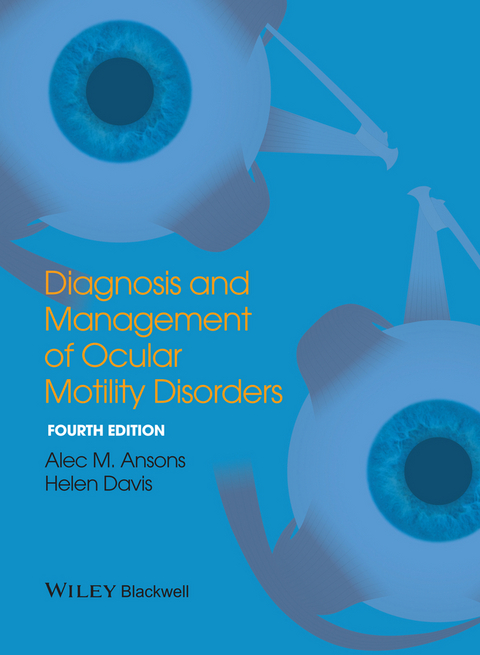
Diagnosis and Management of Ocular Motility Disorders (eBook)
John Wiley & Sons (Verlag)
978-1-118-71238-2 (ISBN)
This comprehensive, clinically-grounded textbook, now in its fourth edition, supports orthoptists and ophthalmologists in decision-making through the patient care process, from presentation to discharge.
Written by authors with extensive experience in teaching and research, Diagnosis and Management of Ocular Motility Disorders offers a clear and practical overview of assessment and management principles and further explores the clinical features of specific disorders, from amblyopia and infantile strabismus to supranuclear and infranuclear disorders, as well as other miscellaneous disorders of ocular movement. A brand new chapter on congenital cranial dysinnervation disorders reflects recent advances in gene mapping and increased understanding of this condition, and a new appendix provides surgical dose tables for easy reference.
Now in full colour throughout, with additional diagrams and photographs of surgical techniques, this remains the key reference text for orthoptic and ophthalmic professionals managing patients with eye movement disorders.
Alec Ansons is a Consultant Opthalmic Surgeon at the Manchester Royal Eye Hospital.
Helen Davis is Senior Lecturer at the Ophthalmology & Orthoptics Unit at the University of Sheffield.
Alec Ansons is a Consultant Opthalmic Surgeon at the Manchester Royal Eye Hospital. Helen Davis is Senior Lecturer at the Ophthalmology & Orthoptics Unit at the University of Sheffield.
Preface to the Fourth Edition vi
Preface to the First Edition vii
Section 1 Assessment 1
1 History 3
2 Ophthalmic Examination 9
3 Refraction 31
4 Visual Function 55
5 Ocular Deviation 97
6 Ocular Movements 121
7 Binocular Function 144
Section 2 Principles of Management 171
8 Nonsurgical Management 173
9 Surgical Management 199
Section 3 Clinical Features, Aetiology and Management of Specific Disorders 283
10 Amblyopia 285
11 Introduction to Concomitant Strabismus 304
12 Esotropia 312
13 Exotropia 344
14 Infantile Strabismus and Dissociated Strabismus Complex 380
15 Microtropia and Allied Conditions 406
16 Heterophoria and Anomalies of Convergence and Accommodation 413
17 Alphabet Patterns 431
18 Introduction to Paralytic Strabismus 451
19 Neurogenic Palsies 462
20 Myogenic Palsies 528
21 Mechanical Disorders of Ocular Motility 543
22 Congenital Cranial Dysinnervation Disorders and Other Paradoxical Innervation Conditions 589
23 Supranuclear and Internuclear Disorders 611
24 Nystagmus and Related Oscillations 641
25 Miscellaneous Disorders of Ocular Movement 690
Appendix: Surgical (Dose) Tables 706
Index 709
1 History
Patients with ocular motility disorders present for one or more of the following reasons:
- Manifest strabismus.
- Subjective symptoms.
- Defective ocular movement.
- Nystagmus.
- Abnormal head posture.
- Defective vision.
An accurate and detailed history must be recorded to aid diagnosis, assist in planning management and arrive at a correct prognosis. This first contact with the patient, or the parents if the patient is a child, gives the examiner an opportunity to assess cooperation, to establish a good relationship with the patient and to gain his or her confidence.
General principles
The reason for attendance must first be established. Subsequent questions depend largely on whether the patient is a child or an adult. Greater emphasis is placed on the obstetric history and developmental milestones in children, whereas the medical history can be of paramount importance in adults.
Children
It is important to involve the child in the history taking as much as possible: surprisingly young children are aware of the questions being asked; they can supply helpful information while allowing the examiner to form an impression of their intelligence and capabilities.
Because so many disorders of vision and ocular motility are associated with developmental anomalies, hereditary disorders or diseases of childhood, the patient must be considered as a whole, whatever the reason for presentation, and a full medical, obstetric, family and social history should be recorded.
Medical history
The following information should be obtained:
- the child’s general development, including milestones and progress at nursery or school;
- details of any significant or recent illness and its treatment;
- any ongoing conditions, for example eczema, asthma, etc.;
- any trauma, especially to the head or face;
- any allergies.
Obstetric history
Enquiries should be made about:
- The mother’s health during pregnancy, including the use of prescription medication, recreational drugs and alcohol.
- Whether the type of delivery was spontaneous vaginal and if forceps were used or caesarean section and if there were complications.
- The child’s birth weight and gestational age if known.
- The neonatal history, especially if there were postnatal problems with resuscitation and/or the child was admitted to a special care baby unit.
Family history
Particular reference should be made to a family history of any of the following disorders:
- Strabismus, which is frequently familial. Its presence in other family members makes it more likely that the child has a true rather than an apparent strabismus and should be kept under observation even if the squint is not apparent at the first visit. There may be social problems if more than one child requires treatment. Parents with strabismus or who have children with strabismus may be more reliable witnesses.
- Refractive error.
- Severe visual defects if present in early childhood are frequently hereditary. Parental consanguinity should be noted.
- Several genetic disorders have a high incidence of associated strabismus.
Social history
The examiner should enquire into relevant social background, which may affect the future management of the child. It is, for example, necessary to know if the child is in residential care rather than living with parents.
Adults
Adults are more likely to present with symptoms, particularly diplopia or concern over their appearance. In many cases the symptoms are due to acquired eye movement defects, comprising neurogenic and myogenic palsies, mechanical restriction of ocular movement. It is essential to find and treat the underlying cause if this is unknown. A detailed medical history should be taken in all cases.
Medical history
The examiner should question the patient on:
- Past and current illnesses.
- Current medication. The drug history is a good guide to the state of the patient’s health and may provide a clue to the cause of an acquired motility disorder. Patients may say that they are in good health but on questioning may admit to being on regular treatment with, for example, insulin or digitalis. Some drugs, notably anticonvulsants, can be the cause of nystagmus.
- Trauma affecting the head or face.
- Other symptoms and signs. Examples are unsteadiness of gait, weight loss or gain, or change in appearance noted by the patient’s family.
- Ophthalmic history. This may include glasses history. In particular, high levels of ametropia or anisometropia indicate that the cause of visual loss may be amblyopia and incorporated prisms that diplopia is likely to be long standing. Other aspects of the history include visual problems, a childhood squint or previous episodes of diplopia.
- Hereditary factors.
Social history
The patient’s occupation should be noted and he or she should be asked how it has been affected by the complaint; patients who hold a driving licence may require advice about continuing to drive. They should be questioned specifically about alcohol consumption, smoking and recreational drugs as these are relevant to recognised motility disorders. Alcoholism can lead to Wernicke’s syndrome, which is a rare condition, and cigarette smoking can result in lung cancer which is associated with the paraneoplastic syndromes.
Manifest strabismus
History taking is discussed below in general terms. Points relating to specific types of strabismus are referred to in subsequent chapters.
Children
The majority of patients attending with manifest strabismus are children. Most will have concomitant deviations but children with congenital and acquired defects of ocular movement can present in this way. In all cases it is necessary to ascertain:
- The direction of the strabismus.
- The age at which it was first noticed.
- Who noticed it.
- Whether the onset was sudden or gradual. A history of sudden onset is usually reliable, whereas a gradual onset probably implies a longer duration than that stated. A sudden onset of esotropia should always suggest the possibility of acquired sixth nerve palsy.
- Whether the squint is constant or intermittent. A constant deviation with a variable angle is often mistaken for an intermittent strabismus.
- When the squint is seen, for example on looking up from a book or on lateral gaze. An apparent increase on lateroversion suggests an incomitant deviation but is also a common feature in pseudoesotropia due to epicanthus.
- Whether there has been an increase or a decrease in the angle of deviation since its onset.
- If there are other features that could be related to the strabismus, such as an abnormal head posture. Older children should be asked about symptoms, particularly whether diplopia is present. This is usually but not always indicative of recent onset. Signs suggesting possible diplopia in younger children are:
In general, a history of occasional exotropia should be believed, whereas an occasional esotropia may be due to epicanthus or another cause of pseudostrabismus. If the esotropia is not seen on initial examination, risk factors should be considered. A family history of squint and/or hypermetropia, or the presence of even a small esophoria, are all reasons for believing the parent’s observations and keeping the child under review.
Adults
Adults may present with a manifest strabismus dating from childhood, either because they would like surgery to improve alignment or because the strabismus has become symptom producing: diplopia may occur if a change in the angle of deviation causes the image to fall outside the suppression scotoma. As much information as possible should be elicited about the type and onset of the strabismus and its subsequent course. The patient should also be questioned about:
- Poor ocular alignment and related psychosocial problems where the patient may complain of difficulty with communication either socially or in the workplace. Mojon-Azzi and Mojon (2009) have shown that headhunters judged that persons with strabismus are perceived as less attractive and less intelligent by potential employers and would find gaining employment more difficult. This was more significant in exotropia and females.
- The reason for attendance. A patient who is embarrassed by his or her appearance may complain instead about minor symptoms. It can be helpful if the possibility of strabismus surgery is suggested.
- Recent change in the angle of deviation. Some patients present with consecutive exotropia and should be asked when this was first noticed. Photographs taken over the past few years may help in this respect.
- The treatment already received. Particular attention should be paid to previous strabismus surgery and the patient’s records should be obtained if possible.
Defective ocular movement
Children may present because limitation of ocular movement has been noticed by the parents or another observer. Usually the defective movement is marked, congenital in origin and mechanical or innervational rather than neurogenic: examples are Brown’s syndrome and Duane’s retraction syndrome, although the restricted movement in the latter condition is often masked by head movement....
| Erscheint lt. Verlag | 25.11.2013 |
|---|---|
| Sprache | englisch |
| Themenwelt | Sachbuch/Ratgeber ► Gesundheit / Leben / Psychologie |
| Medizin / Pharmazie ► Allgemeines / Lexika | |
| Medizin / Pharmazie ► Medizinische Fachgebiete ► Augenheilkunde | |
| Schlagworte | Amblyopia • Authors • care process • Decisionmaking • disorders • Erforschung des Sehvermögens • Erforschung des Sehvermögens • Experience • extensive • Gesundheits- u. Sozialwesen • Health & Social Care • Medical Science • Medizin • Miscellaneous • Movement • Ocular • Ocular motility • Ophthalmologie u. Optometrie • Ophthalmologists • Ophthalmology & Optometry • orthoptists • Overview • Patient • Practical • presentation • Research • Sehschwäche • Sehschwäche • Strabismus • supports • Vision Sciences |
| ISBN-10 | 1-118-71238-2 / 1118712382 |
| ISBN-13 | 978-1-118-71238-2 / 9781118712382 |
| Informationen gemäß Produktsicherheitsverordnung (GPSR) | |
| Haben Sie eine Frage zum Produkt? |
 EPUB (Adobe DRM)
Kopierschutz: Adobe-DRM
Adobe-DRM ist ein Kopierschutz, der das eBook vor Mißbrauch schützen soll. Dabei wird das eBook bereits beim Download auf Ihre persönliche Adobe-ID autorisiert. Lesen können Sie das eBook dann nur auf den Geräten, welche ebenfalls auf Ihre Adobe-ID registriert sind.
Details zum Adobe-DRM
Dateiformat: EPUB (Electronic Publication)
EPUB ist ein offener Standard für eBooks und eignet sich besonders zur Darstellung von Belletristik und Sachbüchern. Der Fließtext wird dynamisch an die Display- und Schriftgröße angepasst. Auch für mobile Lesegeräte ist EPUB daher gut geeignet.
Systemvoraussetzungen:
PC/Mac: Mit einem PC oder Mac können Sie dieses eBook lesen. Sie benötigen eine
eReader: Dieses eBook kann mit (fast) allen eBook-Readern gelesen werden. Mit dem amazon-Kindle ist es aber nicht kompatibel.
Smartphone/Tablet: Egal ob Apple oder Android, dieses eBook können Sie lesen. Sie benötigen eine
Geräteliste und zusätzliche Hinweise
Buying eBooks from abroad
For tax law reasons we can sell eBooks just within Germany and Switzerland. Regrettably we cannot fulfill eBook-orders from other countries.
aus dem Bereich