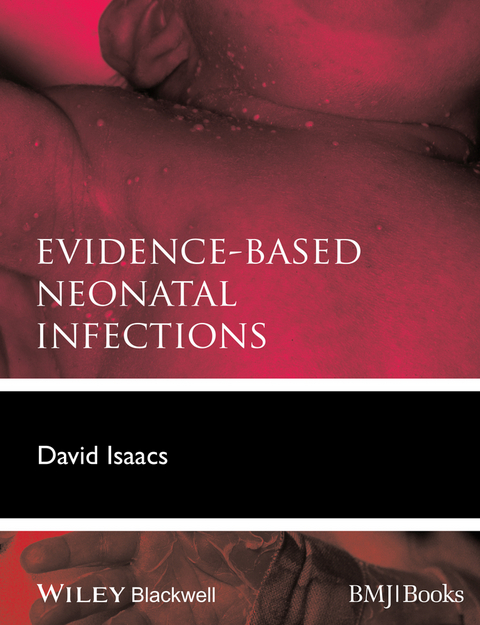
Evidence-Based Neonatal Infections (eBook)
John Wiley & Sons (Verlag)
978-1-118-63673-2 (ISBN)
Evidence-Based Neonatal Infections is expertly written by David Isaacs, an experienced author renowned for his knowledge in both pediatric infections and evidence-based medicine. It critically analyses the evidence for decision making in neonatal infections.
Evidence-Based Neonatal Infections
* The first evidence-based text on neonatal infections
* Provides practical guidance where evidence is poor
* Complements David Isaacs’ Evidence-Based Pediatric Infectious Diseases (9781405148580)
Practical and evidence-based, Evidence-Based Neonatal Infections is designed to help the clinician with day-to-day decisions on the care of newborn babies with possible, probable or proven infections. It considers clinical questions relevant to neonatologists, analysing the evidence carefully and providing recommendations for optimum management of neonatal infectious diseases, whilst reflecting on:
- Efficacy and safety
- Antibiotic resistance
- Cost effectiveness
- Adverse effects
- Ethical considerations
Evidence-Based Neonatal Infections provides a unique reference for neonatologists, pediatricians, trainees, specialist nurses; general practitioners, microbiologists, infection control doctors, and all staff in neonatal units.
Evidence-Based Neonatal Infections is expertly written by David Isaacs, an experienced author renowned for his knowledge in both pediatric infections and evidence-based medicine. It critically analyses the evidence for decision making in neonatal infections. Evidence-Based Neonatal Infections * The first evidence-based text on neonatal infections * Provides practical guidance where evidence is poor * Complements David Isaacs Evidence-Based Pediatric Infectious Diseases (9781405148580) Practical and evidence-based, Evidence-Based Neonatal Infections is designed to help the clinician with day-to-day decisions on the care of newborn babies with possible, probable or proven infections. It considers clinical questions relevant to neonatologists, analysing the evidence carefully and providing recommendations for optimum management of neonatal infectious diseases, whilst reflecting on: Efficacy and safety Antibiotic resistance Cost effectiveness Adverse effects Ethical considerations Evidence-Based Neonatal Infections provides a unique reference for neonatologists, pediatricians, trainees, specialist nurses; general practitioners, microbiologists, infection control doctors, and all staff in neonatal units.
David Isaacs is a pediatrician based at The Children's Hospital at Westmead, Sydney and is Clinical Professor of Pediatric Infectious Diseases at the University of Sydney. He has published 12 books, over 300 peer-reviewed publications on neonatal infections, pediatric infectious diseases, immunizations, bioethics and 30 humorous articles. His research interests are neonatal infections, respiratory virus infections, immunizations and ethics. Professor Isaacs is on multiple national and international committees on infectious diseases and immunizations and is a reviewer for the Cochrane Collaboration.
About the Author, vi
Preface, vii
1 How to search for evidence, 1
2 Epidemiology, 5
3 Clinical manifestations, 16
4 Laboratory tests, 21
5 Rational antibiotic use, 33
6 Adjunctive treatment, 48
7 Bacterial meningitis, 57
8 Respiratory tract infections, 70
9 Osteomyelitis and septic arthritis, 78
10 Urinary tract infections, 86
11 Necrotizing enterocolitis and gastrointestinal infections, 94
12 Eye Infections, 108
13 Skin and soft tissue Infections, 117
14 Bacterial infections, 128
15 Mycoplasmas, 153
16 Fungal infections, 159
17 Viral infections, 175
18 Other congenital infections, 199
19 Breast milk, 214
20 Surveillance, 223
21 Infection control, 229
22 Developing countries, 244
23 Prevention of neonatal infections, 250
24 Neonatal antimicrobials, 269
Index, 291
"This is a comprehensive, brief, and very clinical
approach to neonatal infections with an international
flavor." (Doody's, 12 December 2014)
"The book is a workable length and is best targeted at the
neonatal fellow or pediatric resident with an interest in
neonatology. It should be widely used in the resident's
work space as a quick definitive guide to management of neonatal
infections and as a tool for discussion of the wisdom of starting
therapeutic agents and optimal approaches to the diagnostic
challenges of the sick neonate." (Clinical
Infectious Diseases, 22 August 2014)
CHAPTER 2
Epidemiology
2.1 Incidence and mortality
Neonatal infections are an important and sadly neglected cause of mortality and morbidity globally. In 2008, neonatal infections caused an estimated 29% of the 3.6 million neonatal deaths worldwide1 (see Figure 2.1 and Table 2.1) or about one million deaths, almost all in developing countries.1 Neonates comprised 41% of the estimated 8.8 million deaths in children under 5 years old worldwide in 2008.1 Community-based studies in developing countries attribute up to 42% of neonatal deaths in the community to infection.2
Table 2.1 Causes of death in neonates globally.
| Cause of death | Number of deaths in millions (%) |
| Pre-term birth complications | 1.033 (29%) |
| Birth asphyxia | 0.814 (22%) |
| Sepsis | 0.521 (15%) |
| Other | 0.409 (11%) |
| Pneumonia | 0.386 (11%) |
| Congenital abnormalities | 0.272 (8%) |
| Diarrhoea | 0.079 (2%) |
| Tetanus | 0.059 (2%) |
| TOTAL | 3.575 |
| Source: Adapted from Reference 1 with permission from Elsevier. Copyright © 2010 Elsevier. |
Figure 2.1 Global causes of neonatal deaths. Adapted from Reference 1 with permission from Elsevier. Copyright © 2010 Elsevier.
The mortality from neonatal infections is considerably lower in resource-rich countries. Intrapartum antibiotic use to prevent group B streptococcus (GBS) infection has reduced mortality significantly in countries with a high incidence.2-4
Newborn babies have rates of infection as high as children and adults whose immunity is compromised for almost any other reason, including most oncology patients and the elderly. Although newborn babies, and particularly pre-term newborns, are immunocompromised, additional factors contribute to the high rates of neonatal infection and will be considered in Section 2.2.
Knowledge of the incidence of neonatal infections is important for planning preventive and intervention strategies and for comparisons within and between countries, which can help inform clinical practice and help assess the quality of care. However, such comparisons are not necessarily straightforward.
In developing countries, most deliveries occur in the home, so hospital-based studies of incidence and aetiology may give misleading or inaccurate results. Infections are usually diagnosed clinically without cultures, and deaths from infection are frequently under-reported. Community studies report rates of clinical neonatal sepsis ranging from 49 per 1000 live births in babies >24 hours old in Guatemala to 170 per 1000 live births in rural India.2 The reported rate of blood culture-confirmed cases is far lower: a minimum of 5.5 per 1000 live births in a rural hospital in Kenya,5 a highly uncertain figure because of incomplete sampling. Infection-specific mortality rates reported in 32 studies varied from 2.7 per 1000 live births in South Africa to 38.6 per 1000 in Somalia.2
In industrialized Western countries where most de liveries occur in hospital, hospital-based studies of incidence are more representative.
The reported incidence of neonatal infection depends on how neonatal infection is defined and reported. Definitions may vary considerably. Examples include how contaminants in blood cultures and cerebrospinal fluid (CSF) are defined; whether or not contaminants are excluded; whether or not clinical sepsis with evidence of raised inflammatory markers is accepted as being infection; and whether infections are confined to positive cultures of blood and/or CSF or also include positive cultures from normally sterile sites, such as urine, bone, joint fluid or pulmonary fluid.
2.1.1 Early-onset infection
It is conventional to divide the reporting of neonatal infections into early- and late-onset infections. Early infections are presumed to be due to organisms acquired from the mother shortly before (e.g. Listeria) or at the time of birth (e.g. GBS) whereas late infections are primarily caused by environmental organisms, acquired nosocomially (i.e. in hospital) or in the community. However, ‘early onset’ has been defined as anything from the first 2 days to the first 7 days after birth. Furthermore, environmental organisms may grow from blood cultures in the first 48 hours after birth, while the classic early-onset organisms like GBS and Listeria can cause late- as well as early-onset sepsis. Methicillin-resistant Staphylococcus aureus (MRSA), originally confined to hospitals or patients associated with hospitals, is a common community-acquired pathogen in many countries and can colonize pregnant women and cause both early- and late-onset neonatal infections.
There are two major considerations in defining early-onset infection, clinical and epidemiologic.
Figure 2.2 Timing of neonatal infection by organism. Adapted from Reference 6. CoNS, Coagulase-negative staphylococci; Other GNB, Other Gram-negative bacilli; Gp B Strep, Group B streptococci.
Figure 2.3 Pathogens according to the day of onset of infection, UK 2006–2008. Reprinted from Reference 7 with permission. CoNS, Coagulase-negative staphylococci; GBS, Group B streptococci.
| Erscheint lt. Verlag | 20.11.2013 |
|---|---|
| Reihe/Serie | Evidence-Based Medicine |
| Evidence-Based Medicine | Evidence-Based Medicine |
| Sprache | englisch |
| Themenwelt | Medizin / Pharmazie ► Medizinische Fachgebiete ► Pädiatrie |
| Schlagworte | Analyses • complements david • David • Decision • Evidence • evidencebased • experienced author • First • Infections • infectious disease • Infektionskrankheiten • isaacs • Knowledge • Medical Science • Medizin • Neonatal • Neonatal infections • Pädiatrie • Pädiatrie • Pediatric • Pediatrics • Poor • Practical • provides |
| ISBN-10 | 1-118-63673-2 / 1118636732 |
| ISBN-13 | 978-1-118-63673-2 / 9781118636732 |
| Informationen gemäß Produktsicherheitsverordnung (GPSR) | |
| Haben Sie eine Frage zum Produkt? |
 PDF (Adobe DRM)
Größe: 12,1 MB
Kopierschutz: Adobe-DRM
Adobe-DRM ist ein Kopierschutz, der das eBook vor Mißbrauch schützen soll. Dabei wird das eBook bereits beim Download auf Ihre persönliche Adobe-ID autorisiert. Lesen können Sie das eBook dann nur auf den Geräten, welche ebenfalls auf Ihre Adobe-ID registriert sind.
Details zum Adobe-DRM
Dateiformat: PDF (Portable Document Format)
Mit einem festen Seitenlayout eignet sich die PDF besonders für Fachbücher mit Spalten, Tabellen und Abbildungen. Eine PDF kann auf fast allen Geräten angezeigt werden, ist aber für kleine Displays (Smartphone, eReader) nur eingeschränkt geeignet.
Systemvoraussetzungen:
PC/Mac: Mit einem PC oder Mac können Sie dieses eBook lesen. Sie benötigen eine
eReader: Dieses eBook kann mit (fast) allen eBook-Readern gelesen werden. Mit dem amazon-Kindle ist es aber nicht kompatibel.
Smartphone/Tablet: Egal ob Apple oder Android, dieses eBook können Sie lesen. Sie benötigen eine
Geräteliste und zusätzliche Hinweise
Buying eBooks from abroad
For tax law reasons we can sell eBooks just within Germany and Switzerland. Regrettably we cannot fulfill eBook-orders from other countries.
 EPUB (Adobe DRM)
Kopierschutz: Adobe-DRM
Adobe-DRM ist ein Kopierschutz, der das eBook vor Mißbrauch schützen soll. Dabei wird das eBook bereits beim Download auf Ihre persönliche Adobe-ID autorisiert. Lesen können Sie das eBook dann nur auf den Geräten, welche ebenfalls auf Ihre Adobe-ID registriert sind.
Details zum Adobe-DRM
Dateiformat: EPUB (Electronic Publication)
EPUB ist ein offener Standard für eBooks und eignet sich besonders zur Darstellung von Belletristik und Sachbüchern. Der Fließtext wird dynamisch an die Display- und Schriftgröße angepasst. Auch für mobile Lesegeräte ist EPUB daher gut geeignet.
Systemvoraussetzungen:
PC/Mac: Mit einem PC oder Mac können Sie dieses eBook lesen. Sie benötigen eine
eReader: Dieses eBook kann mit (fast) allen eBook-Readern gelesen werden. Mit dem amazon-Kindle ist es aber nicht kompatibel.
Smartphone/Tablet: Egal ob Apple oder Android, dieses eBook können Sie lesen. Sie benötigen eine
Geräteliste und zusätzliche Hinweise
Buying eBooks from abroad
For tax law reasons we can sell eBooks just within Germany and Switzerland. Regrettably we cannot fulfill eBook-orders from other countries.
aus dem Bereich