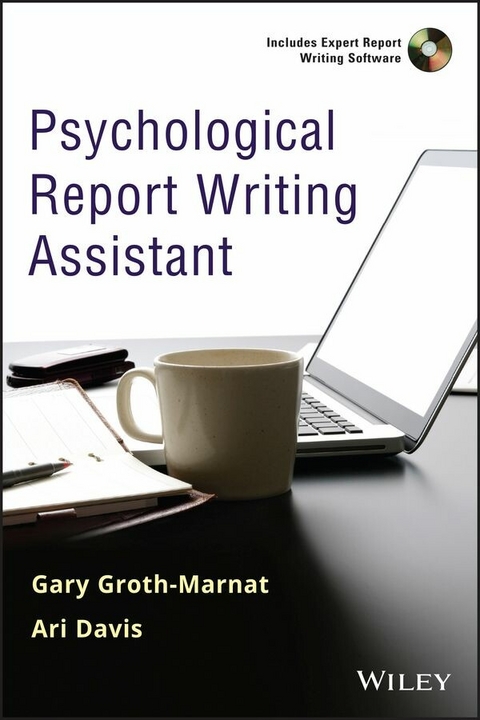
Psychological Report Writing Assistant (eBook)
John Wiley & Sons (Verlag)
978-1-118-23485-3 (ISBN)
Expert Report Writing Software-provides a step-by-step guide to writing clinically sound and rich psychological reports
The Psychological Report Writing Assistant software is a highly interactive program that guides the report writer through all phases of writing a report that is comprehensive, includes integrated interpretation, uses everyday language, and answers the referral questions. Key features include:
- A composition screen with links to resources to facilitate report writing
- Sample reports with links to guidelines on how to write sections of the report
- A comprehensive menu of treatment recommendations
- Search function to identify problem phrases with suggestions for alternative wording
- Compatible with Microsoft® Windows
Blending the best of science with an appreciation for the art of doing clinical work, the accompanying guide:
- Describes six core qualities of an optimal psychological report
- Provides an overview of cognitive, neuropsychological, personality, psychoeducational, and forensic reports
- Offers guidelines for formatting and completing various sections of a report
- Discusses recommendations for treatment and for tailoring the report to the individual
- Includes instructions for navigating the software
Filling the need for an easy-to-use, intuitive tool for organizing and writing relevant psychological reports, Psychological Report Writing Assistant will help you quickly and easily create thorough and complete psychological reports.
GARY GROTH-MARNAT, PHD, ABPP, is an author, lecturer, researcher, and practicing clinical psychologist and neuropsychologist. He is the author of the bestselling Handbook of Psychological Assessment, Fifth Edition, published by Wiley.
ARI DAVIS maintains a private practice in depth- and psychoanalytically-oriented psychotherapy in Beverly Hills and the San Fernando Valley, California. He is also a software developer specializing in the development of expert systems, analysis and reporting, and assessment/diagnostic software in the medical and psychological fields.
Expert Report Writing Software provides a step-by-step guide to writing clinically sound and rich psychological reports The Psychological Report Writing Assistant software is a highly interactive program that guides the report writer through all phases of writing a report that is comprehensive, includes integrated interpretation, uses everyday language, and answers the referral questions. Key features include: A composition screen with links to resources to facilitate report writing Sample reports with links to guidelines on how to write sections of the report A comprehensive menu of treatment recommendations Search function to identify problem phrases with suggestions for alternative wording Compatible with Microsoft Windows Blending the best of science with an appreciation for the art of doing clinical work, the accompanying guide: Describes six core qualities of an optimal psychological report Provides an overview of cognitive, neuropsychological, personality, psychoeducational, and forensic reports Offers guidelines for formatting and completing various sections of a report Discusses recommendations for treatment and for tailoring the report to the individual Includes instructions for navigating the software Filling the need for an easy-to-use, intuitive tool for organizing and writing relevant psychological reports, Psychological Report Writing Assistant will help you quickly and easily create thorough and complete psychological reports.
GARY GROTH-MARNAT, PHD, ABPP, is an author, lecturer, researcher, and practicing clinical psychologist and neuropsychologist. He is the author of the bestselling Handbook of Psychological Assessment, Fifth Edition, published by Wiley. ARI DAVIS maintains a private practice in depth- and psychoanalytically-oriented psychotherapy in Beverly Hills and the San Fernando Valley, California. He is also a software developer specializing in the development of expert systems, analysis and reporting, and assessment/diagnostic software in the medical and psychological fields.
Psychological Report Writing Assistant 5
Copyright 6
Contents 9
Preface 13
Chapter 1: Introduction 17
Who This Book and Software Are For 17
Rationale and Philosophy for Report Writing: An Integrative Approach 18
An Introduction to the Psychological Report Writing Assistant 22
From Software to the Real World 24
An Overview of How to Use This Book and Software 29
Recommended Reading 30
Chapter 2: Core Qualities of a Good Report: Principles and Strategies 31
1. Anchoring Referral Questions to the Summary/Recommendations 31
2. Making the Report Readable 34
3. Impressions and Interpretations Organized According to Domains 37
4. Minimal Reference to Tests and Testing 42
5. Integrated/Readable Expansion of Interpretations That Are Connected to Client’s World 45
6. Recommendations Sufficiently Broad, Treatment Plan Integrated With Interpretations, Related to Client’s World 46
Recommended Reading 47
Chapter 3: Format of the Psychological Report 49
Identifying Information 51
Referral Question 51
Evaluation Procedures 53
Behavioral Observations/Mental Status 54
Background Information 56
Test Results 61
Impressions and Interpretations (or Simply “Findings” for Forensic Reports) 62
Using the Integrated Information Manager 63
Integrating Contradictory Sources of Information 65
Types of Subheadings 70
Summary 76
Recommendations 77
Signature/Title 78
Appendix 78
Recommended Reading 79
Chapter 4: Recommendations 81
Tailoring Recommendations to the Client 82
Categories of Recommendations 85
Treatment 86
Treatment Planning for Psychotherapy 87
Systematic Treatment Selection/Innerlife Model 89
Best Practices and Treatment Planning 92
Education/Self-Help 93
Placement 95
Further Evaluation 96
Alteration of Environment 96
Miscellaneous 97
Recommended Reading 97
Chapter 5: Types of Psychological Reports 99
Intellectual/Cognitive Reports 100
Neuropsychological Reports 104
Psychoeducational Reports 108
Personality Reports 111
Forensic Reports 115
Vocational/Career Reports 120
Recommended Reading 125
Chapter 6: PRWA Overview and Sample Walkthrough 127
Introduction 127
Developing a Psychological Report With the PRWA Wizards 129
Sample Walkthrough: Creating a New Client Record and Developing a Psychological Report 131
Program Security 131
Creating a New Client Record 133
Enter Client Identifying Information 133
Viewing Client Personal Information 134
Starting to Work on the Psychological Report 135
Viewing the Main Report Composition Window 135
Working on Report Content 136
Start Editing Mode 137
Viewing Guidelines and Example Text for the Report Topic 137
Example of Using One of the PRWA Wizards 137
Selecting One or More Common Phrases 138
The PRWA Wizards 139
Using the Outline/Navigation Pane for Quick Positioning 139
Adding Treatment Recommendations Using the Wizard 140
Checking for Potentially Problematic (“Red Flag”) Phrases 142
Previewing, Copying, or Printing the Psychological Report 143
Viewing the Composed and Formatted Report 143
Returning to Report Composition 144
Finishing Your Work Session 144
Closing the Program 144
Conclusion 145
Appendix A: Annotated Psychological Report 147
Confidential Patient Information 147
Referral Question 147
Evaluation Procedures 148
Behavioral Observations 148
Background Information 149
Personal/Social 149
Academic/Vocational 150
Medical 150
Mental Health 151
Impressions and Interpretations 151
General Level of Intellectual Functioning 151
Verbal Abilities 151
Perceptual Reasoning 152
Attention and Concentration 152
Processing Speed 153
Memory 153
Executive Functioning 154
Personality 154
Client Strengths 154
Summary 155
Recommendations 156
Appendix B: Checklist for General Psychological Report 159
Preliminary Information 159
Referral Question 159
Evaluation Procedures 159
Behavioral Observations 160
Background Information 160
Impressions and Interpretations 160
Summary and Recommendations 161
General 161
Optional 161
Appendix C: Checklist for Forensic Psychological Report 163
Preliminary Information 163
Referral Question 163
Evaluation Procedures 163
Behavioral Observations 164
Background Information 164
Findings (Impressions and Interpretations) 164
Summary and Recommendations 165
General 165
Optional 165
Appendix D: Selected Resources for Psychological Report Writing 167
Books on Report Writing 167
Books With Sample Reports 167
Articles 168
Internet Links With Sample Reports 168
Treatment Planning 169
Best Practices/Evidence-Based Treatments for Treatment Planning 169
Self-Help Resources 169
References 171
Author Index 179
Subject Index 181
About the Author and Software Developer 189
About the CD-ROM 191
Introduction 191
System Requirements 191
Using the CD With Windows 191
Using the CD With a Mac 192
What’s on the CD 192
Content 192
Troubleshooting 192
Customer Care 193
Chapter 1
Introduction
The goal of psychological assessment is to integrate a variety of sources into a user-friendly, problem-focused, well-integrated psychological report that both describes a person and provides guidance in making optimal decisions. The above goal and associated procedures draw on a wide number of skills and knowledge ranging from technical psychometric knowledge to an ability to understand the lived experience of the persons being evaluated. Given these multiple demands, writing a high-quality psychological report is often a difficult task. This book and software will guide practitioners through the process of organizing and integrating data so as to provide accurate, user-friendly descriptions of persons being evaluated. These resources should not only improve the quality of reports, but should also make report writing more time efficient. It will also serve as a companion to and extension of Groth-Marnat’s Handbook of Psychological Assessment (5th ed.).
Who This Book and Software Are For
This book and software will be most useful for professional psychologists in training, beginning-level professional psychologists, and practicing professionals who write only occasional reports. It may also enable experienced assessment psychologists to write their reports more quickly and ensure that important dimensions of a report have not been overlooked. Specific resources included in this book are a description of the core qualities of optimal reports, report format, guidelines for completing various sections of the report, discussion of treatment recommendations, overview of different types of reports, and strategies for navigating the Psychological Report Writing Assistant (PRWA). Based on this information, a wide number of corresponding resources have been incorporated into the PRWA software. The software is divided into modules for writing the following five most common types of reports: cognitive, neuropsychological, psychoeducational, personality, and forensic (see Chapter 3). It is hoped that report writers will use these resources to easily assemble assessment data into an integrated report. Ideally, writers will find the “voice” of an expert guiding them through each step of the process. The result should be that not only will report writing proceed more quickly, but the quality of reports will be significantly better than for persons not using the PRWA.
Rationale and Philosophy for Report Writing: An Integrative Approach
The report writing rationale and philosophy incorporated in this book/software emphasizes integration and has been described by various authors (see Beutler & Groth-Marnat, 2003; Blais & Smith, 2008; Groth-Marnat, 2009a, 2009b; Harwood, Beutler, & Groth-Marnat, 2011; Kvaal, Choca, Groth-Marnat, Davis, 2011; Levak, Hogan, Beutler, & Song, 2011; Wright, 2011). Integration can be understood on several different levels. One essential feature of integration is making sense of apparent contradictions that often occur when reviewing assessment information. For example, a parent may report that his or her child has problems with attention, but, when formally assessed, the child’s test scores appear in the average/normal range. A possible reason for this discrepancy may be that the test situation is highly structured such that the child followed the directions of the assessor and did not have to compete with real-world distractions. His or her performance outside the assessment situation might be quite different. Another example might be scores on a self-report instrument such as the Personality Assessment Inventory that indicate that the client has an absence of disordered thoughts. In contrast, the Rorschach might indicate quite confused thinking, possibly consistent with an underlying thought disorder. This may be due to the more ambiguous, less structured, performance-based task of the Rorschach’s being more sensitive to the presence of a subtle, underlying thought disorder. An integrative approach would work to make sense of these contradictions, and only when these contradictions were resolved would a narrative interpretation be developed and inserted into the report. In contrast, many traditional approaches to writing a report simply discuss test results one test at a time (e.g., “Test scores on the Personality Assessment Inventory indicate . . .,” etc.). The most problematic example of this would be simply cutting and pasting from an interpretive text or a computer-generated computer narrative “interpretation.” One purpose of this book is to expand on contradictory assessment results along with suggestions on how to resolve them. In addition, the Psychological Report Writing Assistant provides an Integrated Information Manager that helps users integrate their assessment results into integrated interpretations focusing on various domains of functioning.
Another central feature of this book and software is integrating the results of assessment with the consumer. The consumer refers to both the referral source as well as the person being evaluated. Integration with the referral source first of all means understanding their needs and expectations. This typically begins with carefully clarifying the referral questions. This can often be done by exploring what client decisions need to be made. It also means understanding the context the referral source is working in (see Chapter 5). For example, reports written within a medical context would mean that the report writer should become knowledgeable regarding options for cognitive and other forms of rehabilitation. This should be reflected in the type of assessment information that is obtained as well as the choice of recommendations. Another example is that sometimes referrals from school settings don’t want recommendations included in reports because it is often felt that recommendations should be developed by a team rather than by the individual psychologist. These and many other considerations are discussed and will enable report writers to best integrate their reports into various assessment settings.
Another example of integrating the report with referral sources is to make sure that the interpretations made about the client are accurate. While this may seem obvious, reports that focus solely on tests and test scores can potentially provide considerable inaccurate information by providing cut-and-paste “interpretations” and qualify these by saying “People with these types of profiles . . . .” The inaccuracy of unintegrated cut-and-paste interpretations is highlighted in that typically half of all interpretations generated by computer-based reports will not be accurate for the person being assessed (see the section on core strategy 3 in Chapter 2). However, the referral source may mistakenly believe that all or most of the descriptors listed will be accurate. Thus, it is incumbent on clinicians to work with interpretive descriptors to determine which ones are, and which ones are not, accurate for their client. The Psychological Report Writing Assistant’s Integrated Information Manager will help clinicians to organize their information and thus more easily make these differentiations. It should also be emphasized that for some reports, particularly in forensic settings, it may be desirable and even necessary to stay close to the “facts” by describing test scores and then detailing the reasoning process the clinician used in coming to their opinions. In these cases, the integration of results is typically placed in the summary rather than the impressions and interpretations (and summary).
Integration also involves using language that connects with and makes sense to both the referral source and the client. Thus, an integrative report is typically written in user-friendly, everyday language that is clear while still being sufficiently professional. There is minimal use of jargon, tests scores, statistics, and the clinician’s reasoning processes. For example, instead of simply stating the defense mechanism of “rationalization,” report writers are encouraged to write something like “. . . the client convinces himself that no wrongs were done by developing convenient excuses that make himself look acceptable to himself and others.” The PRWA uses a search function to identify common examples of overly technical and other forms of problematic language. Once these are highlighted, a rationale is given for why the phrases might be problematic, and alternative language is provided that can be easily extracted, edited, and integrated into the report. User-friendly language is also encouraged in the form of giving everyday examples of the types of problems the client might confront. For example, a client with poor spatial skills might have problems following maps, understanding directions, or finding where something is in a house. In addition, user-friendly language is encouraged in reports through using wording that indicates empathy, is likely to facilitate change, and tries to understand the world through the perspective of the client (see Finn, 2012; Finn, Fischer, & Handler, 2012; Fischer, 2012; Levak, Siegel, Nichols, & Stolberg, 2011). For example, instead of stating that a histrionic-type client is “somatizing,” “dissociating,” and “converting,” report writers might alternatively describe the person as follows: “. . . She is working so hard to hold her feelings inside and trying to stay positive that these efforts are putting stress on her body, and this is most likely why she is experiencing headaches, backaches, and neck aches.” (Levak et al., 1991)
A further goal of integration is that components of the report...
| Erscheint lt. Verlag | 8.10.2013 |
|---|---|
| Sprache | englisch |
| Themenwelt | Geisteswissenschaften ► Psychologie ► Test in der Psychologie |
| Medizinische Fachgebiete ► Innere Medizin ► Pneumologie | |
| Medizinische Fachgebiete ► Radiologie / Bildgebende Verfahren ► Sonographie / Echokardiographie | |
| Schlagworte | Ari Davis • Assessment • Clinical psychology • Cognitive report • Cross-Battery Assessment • Executive Function • Forensic psychological report • Gary Groth-Marnat • Handbook of Psychological Assessment • Klinische Psychologie • MMPI • MMPI-2 • MMPI-A • neuropsychological assessment • Neuropsychological report • Personality assessment • Psychoeducational report • Psychological Assessment • psychological report writing • Psychologie • Psychologische Gutachten • Psychologisches Gutachten • Psychology • Rorschach • School psychology • WAIS-IV • WISC-IV • WJ-III |
| ISBN-10 | 1-118-23485-5 / 1118234855 |
| ISBN-13 | 978-1-118-23485-3 / 9781118234853 |
| Informationen gemäß Produktsicherheitsverordnung (GPSR) | |
| Haben Sie eine Frage zum Produkt? |
 PDF (Adobe DRM)
Größe: 3,2 MB
Kopierschutz: Adobe-DRM
Adobe-DRM ist ein Kopierschutz, der das eBook vor Mißbrauch schützen soll. Dabei wird das eBook bereits beim Download auf Ihre persönliche Adobe-ID autorisiert. Lesen können Sie das eBook dann nur auf den Geräten, welche ebenfalls auf Ihre Adobe-ID registriert sind.
Details zum Adobe-DRM
Dateiformat: PDF (Portable Document Format)
Mit einem festen Seitenlayout eignet sich die PDF besonders für Fachbücher mit Spalten, Tabellen und Abbildungen. Eine PDF kann auf fast allen Geräten angezeigt werden, ist aber für kleine Displays (Smartphone, eReader) nur eingeschränkt geeignet.
Systemvoraussetzungen:
PC/Mac: Mit einem PC oder Mac können Sie dieses eBook lesen. Sie benötigen eine
eReader: Dieses eBook kann mit (fast) allen eBook-Readern gelesen werden. Mit dem amazon-Kindle ist es aber nicht kompatibel.
Smartphone/Tablet: Egal ob Apple oder Android, dieses eBook können Sie lesen. Sie benötigen eine
Geräteliste und zusätzliche Hinweise
Zusätzliches Feature: Online Lesen
Dieses eBook können Sie zusätzlich zum Download auch online im Webbrowser lesen.
Buying eBooks from abroad
For tax law reasons we can sell eBooks just within Germany and Switzerland. Regrettably we cannot fulfill eBook-orders from other countries.
 EPUB (Adobe DRM)
Kopierschutz: Adobe-DRM
Adobe-DRM ist ein Kopierschutz, der das eBook vor Mißbrauch schützen soll. Dabei wird das eBook bereits beim Download auf Ihre persönliche Adobe-ID autorisiert. Lesen können Sie das eBook dann nur auf den Geräten, welche ebenfalls auf Ihre Adobe-ID registriert sind.
Details zum Adobe-DRM
Dateiformat: EPUB (Electronic Publication)
EPUB ist ein offener Standard für eBooks und eignet sich besonders zur Darstellung von Belletristik und Sachbüchern. Der Fließtext wird dynamisch an die Display- und Schriftgröße angepasst. Auch für mobile Lesegeräte ist EPUB daher gut geeignet.
Systemvoraussetzungen:
PC/Mac: Mit einem PC oder Mac können Sie dieses eBook lesen. Sie benötigen eine
eReader: Dieses eBook kann mit (fast) allen eBook-Readern gelesen werden. Mit dem amazon-Kindle ist es aber nicht kompatibel.
Smartphone/Tablet: Egal ob Apple oder Android, dieses eBook können Sie lesen. Sie benötigen eine
Geräteliste und zusätzliche Hinweise
Buying eBooks from abroad
For tax law reasons we can sell eBooks just within Germany and Switzerland. Regrettably we cannot fulfill eBook-orders from other countries.
aus dem Bereich