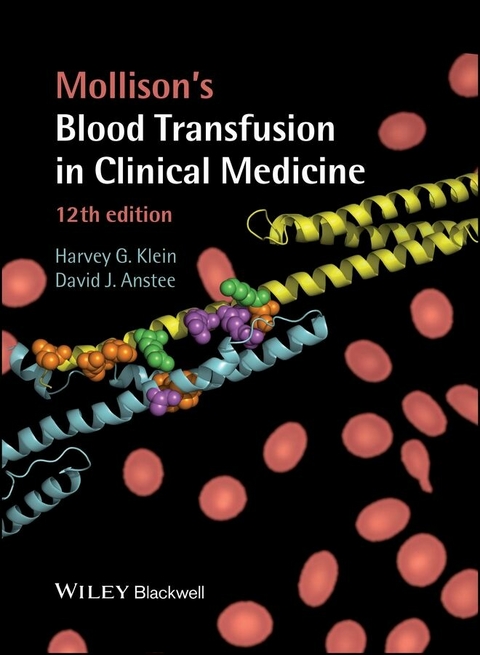
Mollison's Blood Transfusion in Clinical Medicine (eBook)
John Wiley & Sons (Verlag)
978-1-118-68995-0 (ISBN)
Harvey Klein is Chief, Department of Transfusion Medicine, NIH Warren Grant Magnuson Clinical Centre and past-President of the American Association of Blood Banks. He is a recognized leader in defining transfusion medicine as a broader-based clinical and laboratory consultative subspecialty. Dr. Klein has published widely, authoring or co-authoring more than 150 publications, including journal articles and book chapters on transfusion medicine in major textbooks on hematology, internal medicine, and blood banking. He is on the editorial boards of Transfusion and Transfusion Medicine Reviews.
Professor David Anstee is the Director of the Bristol Institute for Transfusion Sciences, as affiliated Institute of the University of Bristol which includes the International Blood Group Reference Laboratory, a World Health Organisation Collaborating Centre. He is also the Research co-ordinator for the National Blood Service in England and the former editor of the journal, Transfusion Medicine.
Mollison's Blood Transfusion in Clinical Medicine is an icon in the field of transfusion and the first edition was published in 1951. The book arose from the concept of the transfusionist, as both scientist and expert consultant. For many years, this text has provided the primary, and often the sole, reference for detailed information and practical experience in blood transfusion. The book is completely revised and updated throughout to include the latest advances and developments in the field.
Harvey Klein is Chief, Department of Transfusion Medicine, NIH Warren Grant Magnuson Clinical Centre and past-President of the American Association of Blood Banks. He is a recognized leader in defining transfusion medicine as a broader-based clinical and laboratory consultative subspecialty. Dr. Klein has published widely, authoring or co-authoring more than 150 publications, including journal articles and book chapters on transfusion medicine in major textbooks on hematology, internal medicine, and blood banking. He is on the editorial boards of Transfusion and Transfusion Medicine Reviews. Professor David Anstee is the Director of the Bristol Institute for Transfusion Sciences, as affiliated Institute of the University of Bristol which includes the International Blood Group Reference Laboratory, a World Health Organisation Collaborating Centre. He is also the Research co-ordinator for the National Blood Service in England and the former editor of the journal, Transfusion Medicine.
Preface to twelfth edition v
Preface to eleventh edition vii
Preface to first edition ix
In memoriam: Professor Mollison xi
1 Blood donors and the withdrawal of blood 1
2 Transfusion of blood, blood components and plasma alternatives in oligaemia 22
3 Immunology of red cells 53
4 ABO, H, LE, P1PK, GLOB, I and FORS blood group systems 118
5 The Rh blood group system (including LW and RHAG) 167
6 Other red cell antigens 214
7 Red cell antibodies against self-antigens, bound antigens and induced antigens 259
8 Blood grouping techniques 303
9 The transfusion of red cells 356
10 Red cell incompatibility in vivo 411
11 Haemolytic transfusion reactions 458
12 Haemolytic disease of the fetus and the newborn 499
13 Immunology of leucocytes, platelets and plasma components 549
14 The transfusion of platelets, leucocytes, haematopoietic progenitor cells and plasma components 611
15 Some unfavourable effects of transfusion 660
16 Infectious agents transmitted by transfusion 696
17 Exchange transfusion and haemapheresis 764
18 Alternatives to allogeneic transfusion 800
19 Plasma fractionation and fractionation products 846
Appendices 873
Index 892
Colour plate section facing p. 148
1
Blood Donors and the Withdrawal of Blood
Bloodletting was once the treatment for almost all maladies and, when carried out in moderation, caused little harm. This chapter includes a discussion of therapeutic phlebotomy, but is mainly concerned with the withdrawal of blood or its constituent parts from healthy donors for transfusion to patients. The chapter addresses qualification of the donor, statistics regarding collection and use, blood shortages and conditions that disqualify donors. Complications of blood donation including iron loss, syncope and needle injuries, and other less common adverse events are discussed. Some applications of therapeutic phlebotomy and blood withdrawal during neonatal exchange transfusion are outlined.
Blood Donation
The Blood Donor
General Qualifications
Qualification of blood donors has become a lengthy and detailed process, a ‘donor inquisition’ some would say. Yet blood collection depends on this system of safeguards to protect the donor from injury and the recipient from the risks of allogeneic blood (see Chapters 15 and 16). Sensitive screening tests have been considered the cornerstone of blood safety for more than four decades. However, testing represents only one component of this system. Additional ‘layers of safety’ include detailed donor education programmes prior to recruitment, pre-donation informational literature, stringent donor screening selection and deferral procedures, post-donation product quarantine, and donor tracing and notification when instances of disease transmission are detected. Each element plays a role in preventing ‘tainted’ units from entering the blood inventory. Most transfusion services use evidence-based standards and regulations for the selection of donors, such as those published in the AABB ‘Standards’ and the United Kingdom ‘Red Book’, (UKBTS/NIBSC Liaison Group 2005; AABB 2012) and quality systems to assure excellence in all phases of their application (Roback 2008). Other standards derive from ‘expert opinion’ and ‘common sense’; these latter policies need to be revisited as scientific information becomes available.
Blood donors should have the following general qualifications: they should have reached the age of consent or an age judged suitable by local regulation, most often 18 years, but lower in some countries such as the USA and the UK; donors should enjoy good health, have no history of serious illness, weigh enough to allow safe donation of a ‘unit’ and not recognize themselves as being at risk of transmitting infection (see below). Ideally, donation should be strictly voluntary and without financial incentive (see Chapter 16); however emerging evidence from studies in Sub-Saharan Africa suggests that in some developing countries, the prevalence of markers for HIV, HCV and HBV is the same for family-replacement donors as for voluntary non-remunerated donors. Some blood services impose an arbitrary upper limit on age, commonly 65 years; however, it seems curiously subjective to exclude donors on the basis of age alone if they are otherwise in good health (Schmidt 1991; Simon et al. 1991). Furthermore, it is the younger donor who is at increased risk of reactions following phlebotomy (Eder et al. 2008). The Blood Collection Service should provide informational literature for prospective blood donors. After information and counselling about criteria for donor selection, donors should consent in writing to the terms of donation, including the use of the donated blood, the extent of testing, the use of testing results (including donor notification of positive results) and the future use of any stored specimens. Donors should be told about the possibility of delayed fainting and about other significant risks of the donation procedure.
Blood donation has potential medicolegal consequences. If a donor becomes ill shortly after giving blood, the illness may be attributed to blood donation. For this reason, among others, it is important to ensure that donors have no history of medical conditions such as brittle diabetes, hypertension, poorly controlled epilepsy and unstable cardiopulmonary disease that might be associated with an adverse event following phlebotomy. Pregnancy might be adversely affected by the donation process and ordinarily excludes a donor. Donors who become ill within 2 weeks of donation should be encouraged to inform the transfusion service, which may wish to discard the donated blood, recall any plasma sent for fractionation or follow up recipients of the blood components as appropriate. Donors who develop hepatitis or HIV infection within 3–6 months of donation should certainly inform the Blood Collection Service.
Donor Interview – an Evolving Inquisition
The donor interview, once an informal set of locally-derived questions administered by well-intentioned volunteers, has become an increasingly detailed set of validated questions designed to qualify the ‘raw material’ of blood components. The process is highly regulated. Interviewers must be trained and qualified to administer questions and evaluate responses. Screening should be conducted in a setting sufficiently unhurried and private as to permit discussion of confidential information. With current practices in the USA, approximately 2% of volunteer donors still disclose risks that would have led to deferral if known at the time of donation (Sanchez et al. 2001). Non-disclosure of deferrable risks is complex. Donors may rationalize failure to acknowledge distant risk behaviour or may truly misinterpret screening questions. Some degree of non-disclosure is probably an inherent part of pre-donation screening (Glynn et al. 2001; O’Brien et al. 2009). Introduction of standardized and validated questionnaires and the application of interactive computer-assisted audiovisual health history may reduce errors and misinterpretations during conduct of the donor interview (Zuck et al. 2001).
Physical Examination
Blood collectors perform a limited physical examination designed to protect donor and recipient. Screeners routinely assess the donor’s general appearance and defer those who do not appear well or are under the influence of alcohol. Pre-donation pulse and blood pressure in the ‘normal range’ are often used as screening standards, although variances have been granted for healthy athletes. The scientific rationale supporting specific values for pulse and blood pressure is surprisingly weak and may not predict or prevent cardiovascular or cerebrovascular events in prospective blood donors (see below). Blood collectors are re-evaluating the usefulness of these screening measures. Body weight and temperature are measured by some collection services. Both arms are examined for evidence of illicit drug use and for lesions at the venepuncture site.
Volume of Donation
The volume of anticoagulant solutions in collection bags is calculated to allow for collection of a particular volume of blood, which, in the UK, is 450 ± 45 ml. In the USA often 500 ml, but in no case more than 10.5 ml/kg including the additional volume of 20–30 ml of blood collected into pilot tubes. There is concern that even these volumes may contribute to delayed fainting in smaller donors. From donors weighing 41–50 kg, only 250 ml of blood is collected into bags in which the volume of anticoagulant solution has been appropriately reduced. In some countries, the volume collected routinely is less than 450 ml, for example 350–400 ml in Turkey, Greece and Italy, and 250 ml in some Asian countries such as Japan, where donors tend to be smaller. Commercial plasma collectors routinely weigh the donor and calculate a safe volume based on the estimated blood volume.
Record-Keeping
It should be possible to trace the origin of every blood donation and records should be kept for several years, depending on the guidelines for each country. In many countries, a system employing unique bar-coded eye-readable donation numbers is now in use. This system makes it possible to link each donation to its integral containers and sample tubes and to the particular donor session record. Information concerning previous donations, such as records of blood groups and microbiology screening tests, antibodies detected, donor deferrals and adverse reactions are important for subsequent attendances. Electronic storage of donor information greatly facilitates accurate identification, release, distribution and traceability of units of blood and blood products. An international code, ISBT 128, is intended to be used by all countries for the accurate identification of donors and donations (Doughty and Flanagan 1996). These records must be protected from accidental destruction, modification or unauthorized access.
Frequency of Donors in the Population
Although in many Western countries, some 60% of the population consists of healthy adults aged 18–65 years and thus qualified to be blood donors, the highest annual frequency of donation in the world corresponds to about 10% of the population eligible to give blood donating once per year, as in Switzerland (Linden et al. 1988; Hassig 1991). The frequency in most developing countries is less than 1% (Leikola 1990).The number of units collected per 1000 US inhabitants of usual donor age (18–65) was 84.1 in 2006, 88.0 in 2001, and 80.8 in 1999. Although these numbers compare favourably with the rate of 72.2 per 1000 in 1997, they pale in comparison with the...
| Erscheint lt. Verlag | 14.11.2013 |
|---|---|
| Sprache | englisch |
| Themenwelt | Medizinische Fachgebiete ► Innere Medizin ► Hämatologie |
| Schlagworte | become • Blood • Blood Transfusion • Bluttransfusion • Bluttransfusionen • Bristol • Clinical • completely • definitive • Edition • Experience • Field • First • Hämatologie • Hämatologie • Harvey • Health • Hematology • Icon • Information • Klinische Medizin • Medical Science • Medicine • Medizin • mollisons • Practical • Reference • Transfusion |
| ISBN-10 | 1-118-68995-X / 111868995X |
| ISBN-13 | 978-1-118-68995-0 / 9781118689950 |
| Informationen gemäß Produktsicherheitsverordnung (GPSR) | |
| Haben Sie eine Frage zum Produkt? |
 EPUB (Adobe DRM)
Größe: 13,1 MB
Kopierschutz: Adobe-DRM
Adobe-DRM ist ein Kopierschutz, der das eBook vor Mißbrauch schützen soll. Dabei wird das eBook bereits beim Download auf Ihre persönliche Adobe-ID autorisiert. Lesen können Sie das eBook dann nur auf den Geräten, welche ebenfalls auf Ihre Adobe-ID registriert sind.
Details zum Adobe-DRM
Dateiformat: EPUB (Electronic Publication)
EPUB ist ein offener Standard für eBooks und eignet sich besonders zur Darstellung von Belletristik und Sachbüchern. Der Fließtext wird dynamisch an die Display- und Schriftgröße angepasst. Auch für mobile Lesegeräte ist EPUB daher gut geeignet.
Systemvoraussetzungen:
PC/Mac: Mit einem PC oder Mac können Sie dieses eBook lesen. Sie benötigen eine
eReader: Dieses eBook kann mit (fast) allen eBook-Readern gelesen werden. Mit dem amazon-Kindle ist es aber nicht kompatibel.
Smartphone/Tablet: Egal ob Apple oder Android, dieses eBook können Sie lesen. Sie benötigen eine
Geräteliste und zusätzliche Hinweise
Buying eBooks from abroad
For tax law reasons we can sell eBooks just within Germany and Switzerland. Regrettably we cannot fulfill eBook-orders from other countries.
 PDF (Adobe DRM)
Kopierschutz: Adobe-DRM
Adobe-DRM ist ein Kopierschutz, der das eBook vor Mißbrauch schützen soll. Dabei wird das eBook bereits beim Download auf Ihre persönliche Adobe-ID autorisiert. Lesen können Sie das eBook dann nur auf den Geräten, welche ebenfalls auf Ihre Adobe-ID registriert sind.
Details zum Adobe-DRM
Dateiformat: PDF (Portable Document Format)
Mit einem festen Seitenlayout eignet sich die PDF besonders für Fachbücher mit Spalten, Tabellen und Abbildungen. Eine PDF kann auf fast allen Geräten angezeigt werden, ist aber für kleine Displays (Smartphone, eReader) nur eingeschränkt geeignet.
Systemvoraussetzungen:
PC/Mac: Mit einem PC oder Mac können Sie dieses eBook lesen. Sie benötigen eine
eReader: Dieses eBook kann mit (fast) allen eBook-Readern gelesen werden. Mit dem amazon-Kindle ist es aber nicht kompatibel.
Smartphone/Tablet: Egal ob Apple oder Android, dieses eBook können Sie lesen. Sie benötigen eine
Geräteliste und zusätzliche Hinweise
Buying eBooks from abroad
For tax law reasons we can sell eBooks just within Germany and Switzerland. Regrettably we cannot fulfill eBook-orders from other countries.
aus dem Bereich