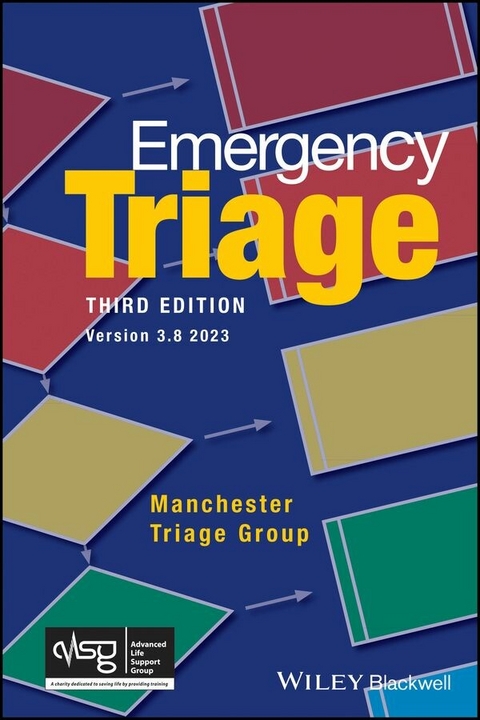
Emergency Triage (eBook)
John Wiley & Sons (Verlag)
978-1-118-29904-3 (ISBN)

The Manchester Triage System (MTS) is the most widely used triage system in the UK, Europe and Australia, with tens of millions of patients being processed through hospital emergency departments. It is also used in hospitals throughout Brazil.
Emergency Triage is the core text for the MTS, which utilises a risk averse system of prioritisation for patients in all unscheduled care settings. As such, it is an essential text for all emergency department staff using the MTS, in particular triage nurses. The book is both a training tool and a reference for daily use in the Emergency Department and prehospital settings.
This edition features revised protocols that reflect new approaches to prioritisation, with accompanying revised flowcharts - the core part of the book.
Table of Contents
Presentation flow charts index
1: Introduction
2: The decision-making process and triage
3: The triage method
4: Pain assessment as part of the triage process
5: Patient management, triage and the triage nurse
6: Auditing the triage process
7: Telephone triage
8: Beyond prioritisation to other applications
Kevin Mackway-Jones, Professor of Emergency Medicine, Manchester Royal Infirmary, Manchester, UK
Janet Marsden, Professor of Ophthalmology and Emergency Care, Manchester Metropolitan University, Manchester, UK
Jill Windle, Lecturer Practitioner in Emergency Nursing, Salford Royal Hospital, Salford, UK
The Manchester Triage System (MTS) is the most widely used triage system in the UK, Europe and Australia, with tens of millions of patients being processed through hospital emergency departments. It is also used in hospitals throughout Brazil. Emergency Triage is the core text for the MTS, which utilises a risk averse system of prioritisation for patients in all unscheduled care settings. As such, it is an essential text for all emergency department staff using the MTS, in particular triage nurses. The book is both a training tool and a reference for daily use in the Emergency Department and prehospital settings. This edition features revised protocols that reflect new approaches to prioritisation, with accompanying revised flowcharts - the core part of the book. Table of Contents Presentation flow charts index 1: Introduction 2: The decision-making process and triage 3: The triage method 4: Pain assessment as part of the triage process 5: Patient management, triage and the triage nurse 6: Auditing the triage process 7: Telephone triage 8: Beyond prioritisation to other applicationsThis Edition was updated in 2023 to Version 3.8.
Kevin Mackway-Jones, Professor of Emergency Medicine, Manchester Royal Infirmary, Manchester, UK. Janet Marsden, Professor of Ophthalmology and Emergency Care, Manchester Metropolitan University, Manchester, UK. Jill Windle, Lecturer Practitioner in Emergency Nursing, Salford Royal Hospital, Salford, UK.
Emergency Triage: Manchester Triage Group 3
Contents 7
Editors 8
Members of the original Manchester Triage Group 9
International Reference Group 10
Preface to the third edition 11
Preface to the first edition 13
CHAPTER 1 Introduction 15
Background 15
Nomenclature and definitions 15
Triage methodology 17
Priority and management 17
Training for triage 18
Triage audit 18
Beyond triage in the Emergency Department 18
Summary 19
CHAPTER 2 The decision-making process and triage 20
Introduction 20
The development of expertise 21
Decision-making strategies 21
Reasoning 21
Pattern recognition 22
Repetitive hypothesising 22
Mental representation 22
Intuition 22
Decision making during triage 23
Identify the problem 23
Gather and analyse information related to the solution 23
Evaluate all the alternatives and select one for implementation 23
Implement the selected alternative 24
Monitor the implementation and evaluate outcomes 24
Changing current decision-making practice 24
CHAPTER 3 The triage method 25
Introduction 25
Identifying the problem 25
Gathering and analysing information 26
Discriminators 27
Secondary triage 34
Evaluating alternatives and selecting one 35
Implementing the selected alternative 35
Documentation 35
Patient assessment 36
Monitoring and evaluating 38
CHAPTER 4 Pain assessment as part of the triage process 39
Introduction 39
Pain assessment at triage 40
Pain assessment in the Emergency Department 40
Pain assessment tools 40
Verbal descriptor scales 41
Visual analogue scales 41
Pain behaviour tools 42
The ideal pain assessment tool 43
The pain ruler 43
Pain assessment at triage 45
Age 45
Previous experience of pain 46
Culture 46
Anxiety 47
Disruption to patient’s usual activities 47
Other considerations 48
CHAPTER 5 Patient management, triage and the triage practitioner 49
Introduction 49
Type of patient 49
Children 49
Elders 50
Patients with physical disability or learning difficulties 50
Abusive/aggressive patients 50
Patients under the influence of alcohol 51
Frequent attenders 51
Patients who re-attend 51
Clinic patients 52
Patients referred by other agencies 52
Departmental factors 52
Fast tracking, streaming and matching resources to demand 53
Role of the triage practitioner 53
First aid/analgesia 54
Patient information 54
Health promotion 54
Disposition of patients around the department 54
Managing the waiting room 54
CHAPTER 6 Auditing the triage process 56
Introduction 56
Audit method 56
Completeness 58
Accuracy 58
Targets 58
Triage in practice 60
Example of a regional audit process 60
National triage audit 60
CHAPTER 7 Telephone triage 61
Introduction 61
Telephone triage methodology 62
Making the decision 62
Interim advice 65
Pain 66
The telephone triage practitioner 66
CHAPTER 8 Beyond prioritisation 68
Monitoring of physiological parameters 68
Other uses of the triage consultation 69
Presentation–priority matrix mapping 70
Explanation of the process 71
Completing the PPM 71
The dispositions 71
Future uses 75
Presentational flow chart index 76
Presentational flow charts 78
Discriminator dictionary 188
Index 199
General discriminators 204
Advert 206
EULA 207
Chapter 4
Pain assessment as part of the triage process
Introduction
Pain is a key issue for patients attending Emergency Departments. Pain assessment has improved since the first edition of this text, however pain assessment must remain at the forefront of the triage method so that pain continues to be assessed and managed appropriately. Pain is an important issue for a number of reasons.
- The majority of patients attending Emergency Departments have some degree of pain
- The degree of pain influences the urgency
- The adequacy of pain management is a key criterion for patient satisfaction
- Patients in pain can become agitated and aggressive
- Patients in pain are a source of distress and stress to both staff and other patients
- Patients have an expectation that their pain will be dealt with
There are many advantages in assessing pain as part of the triage process. First, it ensures that a patient's pain is managed at the earliest opportunity – the provision of appropriate analgesia and consequent reduction in pain may lead to the possibility of re-categorisation to a lower priority. Patient anxiety is reduced and communication is improved. Without pain assessment the provision of appropriate analgesia at triage is not possible.
Pain assessment at triage
Pain assessment is an integral part of the Manchester triage methodology. This is a deliberate and explicit recognition of the importance of pain and it is recognised that the result is that patients are categorised into a higher priority than was traditionally the case.
If a patient's pain is to be assessed formally at triage, and the outcome of that assessment is to help determine the urgency with which that patient is to be seen, then all triage practitioners must be competent in assessing pain, and the pain assessment must be valid and reproducible. It is unrealistic to expect that only the patient's subjective assessment will be taken into consideration during this process. By the same token it is inappropriate that the triage practitioners make their own subjective assessment of the patient's pain in isolation.
Pain assessment in the Emergency Department
This can be difficult because patients may be under pressure to say that their pain is severe so as to justify their attendance, and some patients, particularly children, may deny that they have pain to avoid having treatment or being admitted to hospital. Some practitioners' assessment and management of pain may be influenced by ‘traditional’ pathways of care. For example, patients who have fractures are offered immediate analgesia, but patients with abdominal pain may not be offered analgesia until the surgeons have seen them.
There may be concerns by staff that a patient will score pain higher if it is thought that this will result in a quicker treatment, but the objective assessment of pain will ameliorate this.
Pain assessment tools
Many Emergency Departments now use a formal pain assessment tool, but many such tools suffer from the fact that they were developed for use with postoperative and chronically ill patients.
There are three main types of pain assessment tools:
- Verbal descriptor scales
- Visual analogue scales
- Pain behaviour tools
Verbal descriptor scales
These scales consist of a number of word descriptors, usually three or five, which are numerically ranked. The most common descriptors are as follows:
- None
- Slight
- Moderate
- Severe
- Agonising
and the numerical value increases with the severity of the pain. The verbal descriptor scale is short and relatively easy for the patient to use and has been employed in the Emergency Department environment (Table 4.1).
| Advantages | Disadvantages |
| It provides a score which is easy for any practitioner to analyse | The use of a single word from a limited list may not reflect the pain that the patient is experiencing |
| It probably produces reliable data | It is not suitable for patients who do not speak English |
| It can be modified for use in children | It is the patient's subjective assessment |
Visual analogue scales
These scales usually consist of a straight line representing varying levels of pain with verbal anchors at each end.
| NO | PAIN AS BAD AS |
| PAIN | IT COULD BE |
Patients can mark anywhere on the line. Verbal descriptors can also be added beneath the line in addition to the word anchors. The line can also be broken down to facilitate scoring for evaluation or comparative purposes.
| Advantages | Disadvantages |
| Easy and fast to use and score These scales may be more sensitive than verbal descriptors If used correctly they are reproducible and reliable | Some patients choose to mark the line near one of the verbal anchors Certain patients find these scales too abstract to use, in particular those in severe pain, those with lower educational abilities or those with impaired motor coordination. The elderly can have some difficulty in using these scales |
Pain behaviour tools
These tools have been developed relying on the principle that patients who are in pain exhibit certain behaviours and physiological changes. These tools can measure the following:
- Verbal response
- Body language
- Facial expression
- Behavioural changes
- Conscious level
- Physiological changes
A number of different tools exist, each based on combining a number of the above factors, but have some disadvantages in use (Table 4.3).
| Advantages | Disadvantages |
| Can be used in patients with communication problems | Complex scales; comparison and scoring are difficult The patient's subjective assessment is not included Difficult to ensure that pain alone underlies the observed changes Time consuming, taking 5–15 minutes to use |
The ideal pain assessment tool
An ideal tool for use in the Emergency Department should be simple and quick to use, should have been validated and must give reliable, reproducible results. These results should take account of both patient and observer data.
The pain ruler
No single pain assessment tool is better than another, although some would seem to be more suited to particular clinical areas than others. The pain ruler is a well-established pain assessment tool which would seem to lend itself for use in the Emergency Department setting more than some others. In particular, the advantages are as follows:
- It measures the intensity of pain and the effects on normal function
- It combines the use of verbal descriptors and a visual analogue scale
- It is fast and easy to use
- It is easily weighted to allow pain assessment to be part of the triage process
- By helping in the normal function assessment, the triage practitioner can become involved in the pain assessment process
- It promotes dialogue, which in turn encourages patients that their pain is being taken seriously
- It produces a score facilitating ongoing assessment
- The outcome of the assessment is quick and easy to document
- It can easily be adapted for use in children
A pain ruler offers scores of 0–10 but this is grouped into no pain, mild pain, moderate pain and severe pain, which is congruent with other pain scoring tools. These descriptions are used in the presentational flow charts. A pain ruler is shown in Figure 4.1.
Figure 4.1 Pain ruler
This can be supplemented by a faces scale for use in small children as shown in Figure 4.2.
Figure 4.2 Faces scale pain ruler for use in smaller children
Pain assessment at triage
Pain assessment is a skilled process in any environment and the assessment carried out during triage is no exception. There are particular constraints in this setting reflecting the emergency nature of the patients and the lack of assessment time. Nevertheless, an accurate assessment of the patient's pain into one of the categories shown in the flow chart is essential if proper and timely care is to be given. The triage practitioner must take into account a number of factors that influence the patients' perception of their pain.
Age
Children may imagine the worst possible outcome of their pain. They use catastrophic thinking which increases their anxiety and fear and may therefore enhance their perception of pain. The practitioner must be able to recognise the signs of pain in pre-verbal children and the pain ruler can be adapted for this.
Many elderly people suffer...
| Erscheint lt. Verlag | 21.10.2013 |
|---|---|
| Reihe/Serie | Advanced Life Support Group | Advanced Life Support Group |
| Sprache | englisch |
| Themenwelt | Medizin / Pharmazie ► Allgemeines / Lexika |
| Medizin / Pharmazie ► Gesundheitsfachberufe | |
| Medizin / Pharmazie ► Medizinische Fachgebiete ► Notfallmedizin | |
| Medizin / Pharmazie ► Pflege ► Fachpflege | |
| Schlagworte | Acute, Critical & Emergency Care • Department • easytounderstand • Emergency • Emergency Medicine & Trauma • essential text • information necessary • Intensiv- u. Notfallpflege • Krankenpflege • Medical • Medical Science • Medizin • millions • MTS • Notfallmedizin u. Traumatologie • nurses • nursing • patients • Prioritisation • SAFE • Staff • System • TENS • Treatment • Triage • triage system • UK • User • year |
| ISBN-10 | 1-118-29904-3 / 1118299043 |
| ISBN-13 | 978-1-118-29904-3 / 9781118299043 |
| Informationen gemäß Produktsicherheitsverordnung (GPSR) | |
| Haben Sie eine Frage zum Produkt? |
 PDF (Adobe DRM)
Kopierschutz: Adobe-DRM
Adobe-DRM ist ein Kopierschutz, der das eBook vor Mißbrauch schützen soll. Dabei wird das eBook bereits beim Download auf Ihre persönliche Adobe-ID autorisiert. Lesen können Sie das eBook dann nur auf den Geräten, welche ebenfalls auf Ihre Adobe-ID registriert sind.
Details zum Adobe-DRM
Dateiformat: PDF (Portable Document Format)
Mit einem festen Seitenlayout eignet sich die PDF besonders für Fachbücher mit Spalten, Tabellen und Abbildungen. Eine PDF kann auf fast allen Geräten angezeigt werden, ist aber für kleine Displays (Smartphone, eReader) nur eingeschränkt geeignet.
Systemvoraussetzungen:
PC/Mac: Mit einem PC oder Mac können Sie dieses eBook lesen. Sie benötigen eine
eReader: Dieses eBook kann mit (fast) allen eBook-Readern gelesen werden. Mit dem amazon-Kindle ist es aber nicht kompatibel.
Smartphone/Tablet: Egal ob Apple oder Android, dieses eBook können Sie lesen. Sie benötigen eine
Geräteliste und zusätzliche Hinweise
Buying eBooks from abroad
For tax law reasons we can sell eBooks just within Germany and Switzerland. Regrettably we cannot fulfill eBook-orders from other countries.
aus dem Bereich