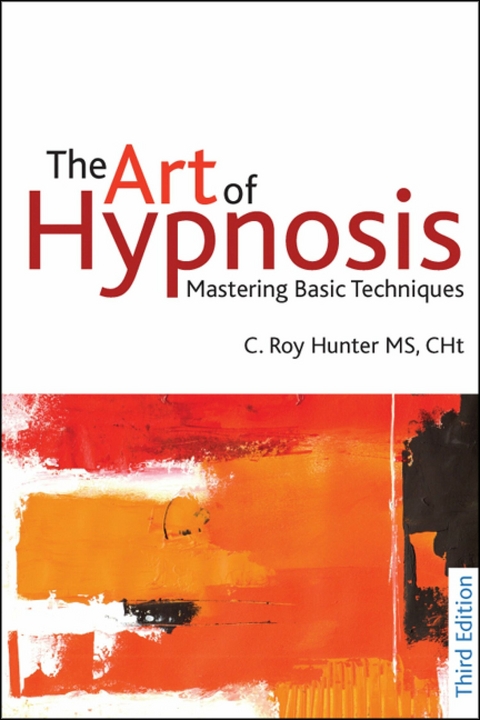
The Art of Hypnosis (eBook)
240 Seiten
Crown House Publishing (Verlag)
978-1-84590-449-4 (ISBN)
Roy Hunter, MS, Cht, teaches professional hypnosis and advanced techniques for professionals and teaches self hypnosis to groups and clients for personal or professional motivation. He was specially selected to carry on the work of the late Charles Tebbetts. He was awarded a PhD from Alpha University and California University with a major in clinical hypnotherapy.
Chapter 1
Overview
Charles Tebbetts, a living legend, demonstrated what he taught:
“All hypnosis is self-hypnosis. If you follow my simple instructions, no power on earth outside yourself can keep you from being hypnotized …”
Following these words, countless numbers of people proceeded to experience what Mr. Tebbetts called Miracles on Demand. Many lives were profoundly improved; and those of us who were privileged to study hypnotherapy directly under the “grand master” of hypnosis found our lives forever touched.
The Purpose of This Book
What is it about the Charles Tebbetts Hypnotism Training Course that inspires me to continue teaching the Tebbetts methodology when there are so many other good training courses available today? The answer is contained within these pages.
Before using hypnosis to help people, we must first master basic techniques. The purpose of this book is to help you learn the art of hypnosis by mastering the same legendary basic techniques taught by the late “grand master” himself, enhanced and modified by my experience and presented in my style − as taught to my own students at Tacoma Community College since 1987. Also, since this author finds it easier to communicate in the first-person format, the reader will notice that I do so frequently throughout this book. (My former mentor did likewise.)
Several hypnotherapists urged me to write this book originally because Miracles on Demand (written by Charles Tebbetts) went out of print in October, 1993. Charlie’s work MUST be preserved; and events of the late 1980s and early 1990s made me the best candidate for this. In 1993, Dr. Dwight Damon (President of the National Guild of Hypnotists) agreed, and encouraged me to write it, and you have the third version of the result in your hands.
The Charles Tebbetts Hypnotism Training Course was originally taught in three parts, as is my college course. The 500+ page work to back it up required two texts, and this is the first. My original title was: The Art of Hypnosis: The Charles Tebbetts Methodology as Taught by Roy Hunter. I changed the title three times since.
Furthermore, as the true artist is more interested in how to master an art instead of understanding why it works, this book strays from the usual academic writing style of typical textbooks. Rather than making this look like just another research paper, I use my own writing style − presenting the techniques of Charles Tebbetts just as I teach them to my own students.
Included are opinions of my former teacher and mentor as well as my own opinions, with updates of his work resulting from my own experience rather than on scientific research alone. Also, I write in simple language, just as my teacher taught in a friendly, easy-to-understand style. I hope you’ll find this to be a fresh, new approach to learning.
With every class I begin at Tacoma, I present a brief overview of the entire course and preface my remarks with some words about my former mentor; so I’ll do likewise here.
Who was Charles Tebbetts?
Dr. John C. Hughes, Research Editor of the National Guild of Hypnotist’s international publication entitled The Journal of Hypnotism, referred to Charles Tebbetts as one of the “grand masters” of hypnosis. In 1990 he was honored and inducted into the International Hypnosis Hall of Fame for lifetime achievement. Charles Francis, author of Counseling Hypnotherapy, states that Mr. Tebbetts “… was generally considered the oldest and most experienced hypnotherapist in the world” (p. 152) prior to his passing. Additionally, he was respected from coast to coast by members of all the large professional hypnotherapy associations, where he frequently presented his legendary parts therapy techniques.
With over six decades’ experience in the art of hypnotism, Mr. Tebbetts − who mastered many rapid-change client-centered techniques − taught that all hypnosis is self-hypnosis. In fact, Benjamin Franklin reached this same conclusion in the late 1700s, observing that Dr. Anton Mesmer’s patients were responding to Mesmer’s magnetism because of what was taking place in their own imaginations rather than because of any “mystical” power that Mesmer had. In other words, if the power resided in the minds of Mesmer’s patients, then he was only facilitating their own self-mesmerism! (I’ll discuss this further in the history chapter.) Yet instead of accepting this fact, most people since Mesmer still prefer to believe that the hypnotist has some “power” over others … and there are a few even today who attempt to use hypnosis to trick people into giving up their power.
In reality, the hypnotist is only a practitioner skilled in the art of guided self-hypnosis, as the individual creates his or her own trance state by following instructions of the artist. Yet even now, many researchers who are seriously interested in hypnotism still tend to research it only as a “science” rather than recognizing it as an art.
Mr. Tebbetts believed that if the hypnotist really mastered hypnotism as an art, this would diminish the likelihood of client resistance. Not only did he often have profound results with clients, he became a master teacher who taught hypnotherapy in a way that made him a living legend prior to his passing.
One of the most unique professional qualities about the Charles Tebbetts I knew was the way he endeavored to make things simple. He felt this was the best way to use hypnosis; and so do I, as should be evidenced by this book.
He believed that a client-centered therapist mastering a variety of simple techniques could be far more effective than the scholar of hypnosis who fails to create rapport with the client even though he/she might have a wealth of knowledge about scientific research in various applications of hypnosis.
While science tends to walk with a microscope, most clients are more interested in results than in getting bogged down with labels and scientific whys, etc. Thus, Mr. Tebbetts believed that some of the most simple concepts, once communicated effectively to the subconscious, could bring about some of the most profound changes in people’s lives. He proved this time after time in his class at Edmonds, Washington, with the way he demonstrated his mastership of the art of hypnosis.
Originally Charles Tebbetts became interested in hypnosis while playing in a band and observing a stage hypnotist; and he eventually performed the show himself when the hypnotist was unable to do so. This began a lifetime career of hypnosis, interwoven with other careers until he reached middle age. After studying hypnotherapy seriously in Southern California with Gil Boyne, he set up a full-time practice. Eventually he moved to Edmonds, Washington, where he taught professional hypnotism until the end of 1991. In 1987 he decided to expand his hypnotism training course to another city by asking me to teach it under his supervision. Then, in 1992, he moved to Arkansas where he spent most of his final months.
His passing took place among his peers in August that same year, at the annual convention of the National Guild of Hypnotists. Mr. Tebbetts was scheduled to present a workshop on his legendary parts therapy techniques, but he suffered a heart attack. He asked me to present in his behalf, and then passed on while I was quoting from his writings during his workshop. This was a very emotional experience for me; and I consider it an honor that my mentor asked me to continue his teachings.
By providing a written record of how I both utilize and teach the rapid change techniques of Charles Tebbetts, as enhanced through my own professional experience, it is my hope to preserve my late mentor’s teachings through the 21st century and beyond. Originally I assumed that my entire course would go into one book divided into three parts − but because of the length of this first book on mastering basic techniques, it seemed appropriate to publish this first volume as a separate text for the new student of hypnosis.
Now let me summarize the objectives of my entire course, which I now call Diversified Client-Centered Hypnosis, based on the course I originally started teaching at Tacoma Community College in 1987.
Part I: Learning the Art of Basic Hypnosis
The primary objective is to help the student of hypnosis to master basic skills and knowledge in the art of hypnosis. We must learn to walk before we can learn how to run and do other exercises; and the same is true with hypnosis. One must master the ART OF HYPNOSIS before effectively using hypnotic techniques to help people change habits and achieve goals − hence the title for this book.
Basic hypnotic techniques must be learned and mastered before learning the effective use of hypnotherapy techniques, because of a simple truth. All hypnotherapy employs the use of hypnosis; but not all hypnosis is hypnotherapy.
The BASIC course, as taught by Charles Tebbetts in the 1980s, was simplified and easy to learn. He incorporated suggestibility tests to help prepare a client for hypnosis. He categorized all hypnotic inductions into six basic induction types, and taught enough induction techniques to incorporate all six types.
We broke into pairs to practice all the basic techniques Tebbetts taught in the classroom, while our teacher observed and supervised the practice sessions.
After learning...
| Erscheint lt. Verlag | 30.8.2010 |
|---|---|
| Verlagsort | London |
| Sprache | englisch |
| Themenwelt | Geisteswissenschaften ► Geschichte |
| Geisteswissenschaften ► Psychologie ► Allgemeine Psychologie | |
| Geisteswissenschaften ► Psychologie ► Biopsychologie / Neurowissenschaften | |
| Geisteswissenschaften ► Psychologie ► Humanistische Psychotherapien | |
| Medizin / Pharmazie ► Medizinische Fachgebiete ► Psychiatrie / Psychotherapie | |
| Medizin / Pharmazie ► Naturheilkunde | |
| ISBN-10 | 1-84590-449-4 / 1845904494 |
| ISBN-13 | 978-1-84590-449-4 / 9781845904494 |
| Informationen gemäß Produktsicherheitsverordnung (GPSR) | |
| Haben Sie eine Frage zum Produkt? |
 EPUB (Wasserzeichen)
DRM: Digitales Wasserzeichen
Dieses eBook enthält ein digitales Wasserzeichen und ist damit für Sie personalisiert. Bei einer missbräuchlichen Weitergabe des eBooks an Dritte ist eine Rückverfolgung an die Quelle möglich.
Dateiformat: EPUB (Electronic Publication)
EPUB ist ein offener Standard für eBooks und eignet sich besonders zur Darstellung von Belletristik und Sachbüchern. Der Fließtext wird dynamisch an die Display- und Schriftgröße angepasst. Auch für mobile Lesegeräte ist EPUB daher gut geeignet.
Systemvoraussetzungen:
PC/Mac: Mit einem PC oder Mac können Sie dieses eBook lesen. Sie benötigen dafür die kostenlose Software Adobe Digital Editions.
eReader: Dieses eBook kann mit (fast) allen eBook-Readern gelesen werden. Mit dem amazon-Kindle ist es aber nicht kompatibel.
Smartphone/Tablet: Egal ob Apple oder Android, dieses eBook können Sie lesen. Sie benötigen dafür eine kostenlose App.
Geräteliste und zusätzliche Hinweise
Buying eBooks from abroad
For tax law reasons we can sell eBooks just within Germany and Switzerland. Regrettably we cannot fulfill eBook-orders from other countries.
aus dem Bereich