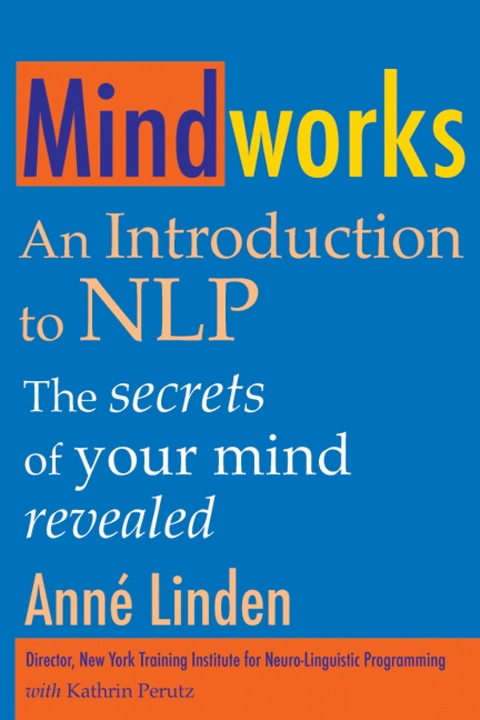
Mindworks (eBook)
288 Seiten
Crown House Publishing (Verlag)
978-1-84590-343-5 (ISBN)
After 18 years as a professional actor Anne Linden went back to college and trained to be a psychotherapist. Anne founded the New York Training Institute for NLP and the NLP Center for Psychotherapy - the first of their kind in the world. Anne introduced NLP to Europe undertaking the first NLP Practitioner Training in the Netherlands in 1982 and certifying the first European Trainers in 1985. She continues to train and teach in France, Belgium and the Netherlands.
Using the amazingly effective tools of Neuro Linguistic Programming (NLP) Mindworks shows you how to unlock the resources, abilities and creativity that you already have in order to accomplish whatever you want to do and take control of your life.
“HOW DO I LOVE THEE? Let me count the ways,” wrote Elizabeth Barrett Browning to her husband, Robert Browning. In a quiet moment, listening to the rain play a soft percussion on the roof, or watching the green and blood orange of flames playing in a winter’s fireplace, Susan and Bill might talk of love like poets, billing and cooing, speaking with their lips and words and hands.
But on a late-summer afternoon, in a hot kitchen, preparing a meal she doesn’t particularly want to make for an old schoolmate of Bill’s, Susan doesn’t feel especially loving. She didn’t hear or respond to the love Bill is trying to convey.
“I told you I love you,” he repeats, “the moment I came in. Didn’t you hear me? Why don’t you listen when I talk to you?”
“That doesn’t mean anything,” Susan tells him. “You were saying it only because you were feeling good about yourself. I don’t feel you reaching out to me at all. You don’t seem to grasp what goes on around here.”
Bill is indignant. “That’s not true, and you know it! I came over, I gave you a kiss. You must be deaf. I’m always telling you; you just never listen. I’m really trying to tune in to you.”
She hadn’t heard. Or if she did, it was a nuisance like static, coming between her and the onions she had to chop.
“That doesn’t mean anything,” she tells him. “My feet are aching, it feels like I’ve been working in this damn kitchen forever, the air’s heavy as molasses, and I certainly don’t have the sense that you’re on my wavelength or that you care about me. All you talk about is your own feelings.”
What Susan is telling Bill is that the message he thought he was sending her never got through, though she’s not aware she’s sayingthis—and he isn’t getting her gut message either. They’re speaking along different sensory pathways, passing and bypassing without noticing what the other is trying to say.
THE MEANING OF YOUR COMMUNICATION IS THE RESPONSE YOU GET, INDEPENDENT OF YOUR INTENTION.
For all of us, there’s a limited amount of attention we can consciously control.
The word consciously is key. We hear, see, feel, respond to a multitude of stimuli without being consciously aware of doing it.
Remember when you were a child, wrapped up in whatever game you were playing while your mother kept calling you to come in or come down or come to dinner, until she finally went and got you—demanding “Why don’t you answer when I call you?”—and you told her, truthfully it seemed, “I didn’t hear you”?
Technically speaking, you probably did hear her. Your ears probably registered the vibrations and frequencies of her voice. But it didn’t mean anything to you. It wasn’t part of your game; it had nothing to do with whatever you were paying attention to. You were attuned to something else and had no part of your attention left over for your mother’s call. Your brain didn’t process this particular information because the processing center was already fully utilized with something you considered more important at the time.
As we get older, many things change. We gain a greater degree of conscious control over ourselves in many ways, but we still can take in only a limited amount of information at any given moment.
Our attention span is restricted—span by definition is the distance from thumb to pinky in an outspread hand; it refers literally to what we’re able to grasp.
The conscious mind can pay attention to only seven pieces of information, plus or minus two, at any given moment. That’s a maximum of nine bits of information you can juggle at a time. Imagine taking a drink of water. You need to position each of your fingers on the glass, bring the glass to your lips, open your lips, make the necessary muscular adjustments for swallowing—all in all, a task much too complicated for anyone who would be required to do each part of it consciously.
Or think of learning to drive, particularly on a shift car. You’re cruising along in high gear, coming up a hill—and you see there’s a stop sign at the crest. Or maybe it’s a red light. It doesn’t matter; either of them can trigger a panic attack. You try to remember—the brakes, the clutch, something released, something pressed down, the gear to be shifted—and if it doesn’t happen to you when you’re slowing to a stop, it’s bound to happen when you try moving forward again: Inevitably, you’re going to stall.
A few weeks or months later you’ve learned how to do it and you no longer “think” about driving at all. The motions become automatic (even on a manual shift); your attention is freed to focus on something else.
Though our conscious attention is restricted to a minimal amount of information at any given moment, we still have a choice about which bits of information we select. We can choose where to aim our attention, directing it outward, toward another person, like the spotlight that picks out a dancer or an actor onstage, or we can shine the light of our attention back on ourselves. Our conscious mind is not set on automatic. We always have the choice of where we focus our attention, out toward others or inwardly.
When we’re sending out a message to another person (remember, this is interpersonal communication in contrast to intrapersonal, which is communication with oneself), the most effective direction to aim our conscious attention is on the other. We look and listen for specific indicators that tell us if, when, and sometimes how our message is being received.
In NLP, we call this other-orientation.
Other-orientation means paying attention to the other person, and to the signs and indications that person gives out, behavioral indicators that signify the message is received. Is he or she understanding your communication? Are you presenting what you have to say in a way that makes sense? How do you know? Does the other person give signs of seeing what you mean? Being in tune with what you’re saying? Grasping your argument? The emphasized words represent different sensory pathways through which people gather, organize, and store information: visual, auditory, and kinesthetic. We’ll be discussing this more a little later.
The information you get by paying close attention to how the other person responds tells you what part of the message was received and what wasn’t; it opens up a new range of choices in how to present or reframe your communication so it will be understood. To communicate most effectively, you need continually to reassess what you say in terms of how it is received. Communication, once started, is like a loop—between the message that’s sent out and the message that’s received. Each influences the other; each proceeds from the other. But before that can happen, you need to open the pathways between yourself and the other person and establish a foundation for communicating. That means you must first get the other’s attention. Unless the person you’re talking to is willing to listen, it doesn’t matter how brilliant or dazzling or amusing or even shocking you are. Like the child playing hopscotch at supper time, that person won’t hear you.
This doesn’t apply only to people with whom you have formal dealings; it applies to all types of communication, even with those close to you. The initial rule for communicating effectively is to get the other person’s attention.
And to do that, you must first establish rapport.
Rapport is the ability to hold someone’s attention and create a sense of trust. It means implanting the feeling that you understand each other; that you have the other’s best interests at heart and that you can be trusted to do whatever they’ve come to you for.
One way to establish rapport, something you’ve probably been doing anyway but without thinking about it, is behavioral matching. That means doing what the other person is doing—or something very similar. If the other person is sitting, you take a seat instead of standing. If the other is speaking with a soft voice, you modulate your own. It’s what we do unconsciously, particularly in new situations: following the other person’s lead, a modified form of Simon Says, without being aware that we’re doing it.
By becoming aware, which means making the choice to focus our conscious attention on matching another person, we can draw the other into a sense of rapport. You do something similar to what the other person is doing in order to create in him or her the feeling that you’re kindred beings, that you understand. Behavioral matching actually increases your understanding of the other person because you’ve aligned yourself with the other, literally put yourself in his or her position, and the increased understanding isn’t a pretense; it’s real.
This is not the same as mimicking, however, which would almost certainly have the opposite effect and break the rapport. Mimicking someone, copying the exact tonality or gait or repeating the words back verbatim is a way of teasing or making fun. Above all, it conveys disrespect. Instead, you want to create an environment of respect and understanding with the other person.
Specifically, you match posture, volume, and tempo. If the person you’re talking to is...
| Erscheint lt. Verlag | 16.8.2008 |
|---|---|
| Verlagsort | London |
| Sprache | englisch |
| Themenwelt | Sachbuch/Ratgeber ► Gesundheit / Leben / Psychologie ► Lebenshilfe / Lebensführung |
| Sachbuch/Ratgeber ► Gesundheit / Leben / Psychologie ► Psychologie | |
| Geisteswissenschaften ► Psychologie | |
| Medizin / Pharmazie ► Gesundheitsfachberufe | |
| Medizin / Pharmazie ► Medizinische Fachgebiete ► Psychiatrie / Psychotherapie | |
| ISBN-10 | 1-84590-343-9 / 1845903439 |
| ISBN-13 | 978-1-84590-343-5 / 9781845903435 |
| Informationen gemäß Produktsicherheitsverordnung (GPSR) | |
| Haben Sie eine Frage zum Produkt? |
 EPUB (Wasserzeichen)
DRM: Digitales Wasserzeichen
Dieses eBook enthält ein digitales Wasserzeichen und ist damit für Sie personalisiert. Bei einer missbräuchlichen Weitergabe des eBooks an Dritte ist eine Rückverfolgung an die Quelle möglich.
Dateiformat: EPUB (Electronic Publication)
EPUB ist ein offener Standard für eBooks und eignet sich besonders zur Darstellung von Belletristik und Sachbüchern. Der Fließtext wird dynamisch an die Display- und Schriftgröße angepasst. Auch für mobile Lesegeräte ist EPUB daher gut geeignet.
Systemvoraussetzungen:
PC/Mac: Mit einem PC oder Mac können Sie dieses eBook lesen. Sie benötigen dafür die kostenlose Software Adobe Digital Editions.
eReader: Dieses eBook kann mit (fast) allen eBook-Readern gelesen werden. Mit dem amazon-Kindle ist es aber nicht kompatibel.
Smartphone/Tablet: Egal ob Apple oder Android, dieses eBook können Sie lesen. Sie benötigen dafür eine kostenlose App.
Geräteliste und zusätzliche Hinweise
Buying eBooks from abroad
For tax law reasons we can sell eBooks just within Germany and Switzerland. Regrettably we cannot fulfill eBook-orders from other countries.
aus dem Bereich