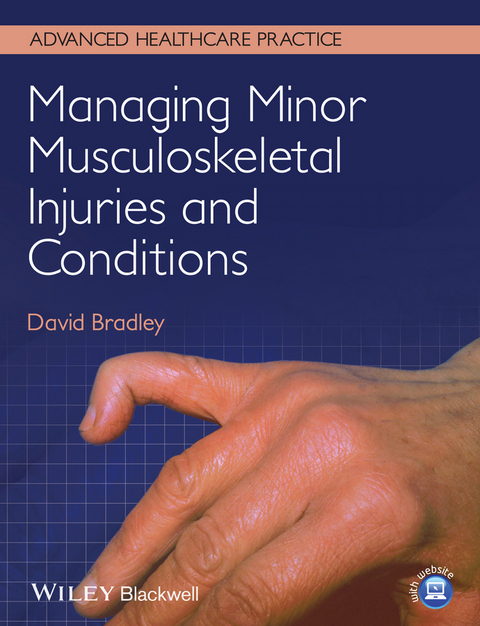
Managing Minor Musculoskeletal Injuries and Conditions (eBook)
John Wiley & Sons (Verlag)
978-1-118-51282-1 (ISBN)
Emergency care professionals are increasingly expected to work autonomously when caring for patients with minor musculoskeletal injuries and conditions. They have to be able to competently and safely take a patient's history, examine, diagnose and provide management of these conditions. Managing Minor Musculoskeletal Injuries and Conditions pulls together all these aspects of care into one practical, easy-to-read text.
Aimed principally at students undertaking minor injury and emergency care courses, this title is a comprehensive manual of minor musculoskeletal injuries and conditions, highly illustrated throughout and containing a variety of activities and exercises.
Key features:
- Includes material on study skills, distance and self-directed learning to support both students on formal courses and those working alone
- Extensive learning features, including a range of activities, hints and tips and multiple-choice questions
- Supported by a companion website with further self-assessment, downloadable X-ray PowerPoint slides, picture tutorials, practice history-taking documentation and legal scenarios
- Enables more effective management and care of patients with musculoskeletal injuries
David Bradley was formerly a Senior Lecturer in Emergency Care at Liverpool John Moores University, Liverpool, UK.
Emergency care professionals are increasingly expected to work autonomously when caring for patients with minor musculoskeletal injuries and conditions. They have to be able to competently and safely take a patient s history, examine, diagnose and provide management of these conditions. Managing Minor Musculoskeletal Injuries and Conditions pulls together all these aspects of care into one practical, easy-to-read text. Aimed principally at students undertaking minor injury and emergency care courses, this title is a comprehensive manual of minor musculoskeletal injuries and conditions, highly illustrated throughout and containing a variety of activities and exercises. Key features: Includes material on study skills, distance and self-directed learning to support both students on formal courses and those working alone Extensive learning features, including a range of activities, hints and tips and multiple-choice questions Supported by a companion website with further self-assessment, downloadable X-ray PowerPoint slides, picture tutorials, practice history-taking documentation and legal scenarios Enables more effective management and care of patients with musculoskeletal injuries
David Bradley was formerly a Senior Lecturer in Emergency Care at Liverpool John Moores University, Liverpool, UK.
Dedication, iv
Acknowledgements, v
About the companion website, vi
Part 1 The background
1 How to use this book, 3
2 Taking a patient's history, 14
3 An introduction to examining your patient, 31
4 Patient documentation for minor injuries, 45
Part 2 The upper body
5 The neck, 59
6 The shoulder, 87
7 The elbow, 132
8 The wrist and hand, 169
Part 3 The lower body
9 The lower back and hip, 235
10 The knee and leg, 271
11 The ankle and foot, 327
Answers to multiple choice questions, 373
Index, 377
"Academic tutors who teach within an emergency care course
would be recommended to review this text to consider it to either
supplement their modules or to refer to their students as an
additional learning resource that may work alongside some of their
taught modules." (Nursing Times, 16 October
2014)
1
How to use this book
Introduction
This book aims to bring together the diverse aspects of the management of minor musculoskeletal injuries and conditions. A number of texts already exist to cover subjects such as:
- anatomy and physiology
- history taking and physical examination
- minor musculoskeletal injuries
- minor musculoskeletal conditions
- patient documentation
- X-ray interpretation
- legalities and ethics.
Here I've brought several of these together into one volume for your convenience. No one can give you everything that you require, but it will provide a firm basis for your initial study and your further development.
The book
The format
The book uses a distance learning (DL) approach to study and is written in a friendly, encouraging and minimally academic tutorial style. For extra clarity, the text is supported by hundreds of illustrations. There is also a wide variety of ‘boxed activities’, which will test and deepen your understanding, providing you with added interest.
Associated with the book is a large and informative website, giving you free access to the following:
- Regional PowerPoint presentations of X-rays for interpretation.
- Multiple choice questions (MCQs) with detailed comments on answers.
- Documentation exercises.
- History taking scenarios.
- A clinical photo tutorial.
- Legal and ethical scenarios.
Who is the book designed for?
Senior nurses and paramedics are the main target groups, but A&E nurses, paramedics, school nurses, practice nurses and many physiotherapists will find a wealth of essential information, making the book a valuable resource.
How the book may be used
There are two ways of using it. Few standard texts are ever read cover to cover, or anything approaching that. So first, just pick and choose: you will find both the illustrations and the explanations clear and mostly at the level you require. If you do not need the boxed activities, just ignore them.
Second, use the book as a guide for independent organised study. To do this, start here and slowly work your way through the remainder of this chapter. Let my experience direct you to an activity, or onto our website, to have a rest or to gain clinical experience as you progress.
This approach is the next best thing to a full university ‘face-to-face’ programme and is based on my many years of experience running both diploma and degree courses.
You, the student
Organise yourself
To study to the best advantage, you have to make an initial agreement with yourself to try to complete the work in a given time and also to get into a habit of regular study.
The study habit can be difficult, because it ‘eats’ into your time (Figure 1.1).
Figure 1.1 Organise your study to fit your life; something has to go.
Making a flexible study plan is one of the better ways to start.
Each of the book's chapters would take you approximately a week of study. Note, this is not the time taken to read the book – anyone can do that in hours: it is the time when you are:
- reading text
- highlighting and making notes
- completing activities
- sampling clinical practice and receiving feedback
- using the book's specific website for tutorials
- reading suggested texts
- looking at suggested YouTube videos.
Try to avoid commencing study at times that are likely to be exceptionally stressful, such as Christmas, during overtime, when you are decorating, or perhaps when there is illness in the family. It will simply spoil your enjoyment.
Although not always practical, it is best to complete the basic examination skills for a particular region of the body before starting the next.
Record clinical accomplishments
In each of the regional chapters, there is a checklist for you to complete, or get your clinical mentor to sign to prove your competencies in this area. These tables are excellent as an aid to your memory, but also your clinical mentor can see at a glance which skills still need to be accomplished and can work towards your continuing professional development (CPD). Further information on CPD for paramedics may be found in Fellows (2008).
Let others know you are studying
Some students do not see the need to tell anyone about their self-directed study. So, if they are noticed ‘just’ reading this book, others will see no harm in asking them to do something else for them instead. They cannot understand a student's annoyance if they are not told they are studying. Studying on your own is almost impossible without the help of your family and friends. So let's make a ‘golden rule’:
When to study
No one can tell you the best way to study, or when – there are too many variables. However, I can give you some general rules students have found useful. Give them a trial and keep using them if you find them effective. Most of you don't have the luxury of choosing a time to study. More often than not it is a matter of fitting in with commitments. Try for regularity and what suits you.
Everyone reads and learns at a different rate. But never rush – I can skim read an article in minutes to update myself before a lecture, but one of my students could need about an hour.
Have frequent breaks
Whatever is the best time for you, break your study up into small portions, never longer than an hour.
Changing the type of study or having a short break is also beneficial. Don't feel guilty about having a break. I will remind you occasionally in the text.
Why?
You know that age children reach when all they do is ask you ‘why’. Why does the sun rise? Why is the sky blue? What makes it rain? Endless questions.
In some way, that is how you must act as a student studying with this book. Question all you see, hear, read and do. That includes what I write: there is not a book published without a fault. The more you ask, the more people will notice your enthusiasm and try to help. Of course, you must choose a time when people are not too busy.
Someone to help you
Embarking on a moderate level of study, such as this book, can be made far easier and more interesting by approaching a work colleague or acquaintance to act as your mentor. No formal contract is necessary: simply talk with them during a break. Say you are studying this book for a few months and ask to ‘bounce’ ideas off them, talk through experiences and seek advice (Figure 1.2).
Figure 1.2 Use a mentor to talk through experiences, ask advice and ‘bounce’ ideas off them (Dustagheer et al., 2005).
Ideally they should be more knowledgeable or experienced than you, but that is not absolutely necessary. Discussing points with a colleague at the same level can make you feel less alone in your study and add interest. Studying on your own is lonely!
Look studious
Now leave this book and go to a mirror. No, don't just read on, it sounds silly but is important: just do as I ask and go to a mirror … Ready, look into it, what do you see? That face is exactly the same face as always, you look the same. However, both you and I know you are now studying minor injuries and conditions, but it doesn't show. So, what you have to do is let people know and keep reminding them that you are studying, if you want any substantial form of support.
Another small but important point is to tell people that you are studying, not just reading, but studying. There is a very important difference: you will get no ‘Brownie points’ for reading, we all read. But, if you are studying, that's a different matter and you tend to get more help.
Having said that, what you tell a busy colleague with a waiting room full of patients or just rushing out to a call will maybe register in their mind for a matter of minutes. You have to keep on telling them, again and again, day after day. Then eventually it clicks and they remember to call you over to discuss something or see an interesting point – success!
Many years ago when studying for a degree with the Open University, I would bring study units, books, papers etc. into A&E with me on a shift. Although it would be rare to get much study done except in breaks, I used this as an opportunity to promote conversation with passing clinicians. In time people got used to the fact that I desperately wanted to learn more and they came to me with stimulation; it helped.
Follow patients through
Following your patients through hospital departments can prove rather difficult. All I can say is you must be persistent. In this context there is no legal problem with patient confidentiality: you are part of the professional team managing them and are just requiring basic diagnosis and early management details. Phoning to follow your patient's progress to find this information is often the only way of knowing if you managed your patient correctly or in some way let...
| Erscheint lt. Verlag | 17.10.2013 |
|---|---|
| Sprache | englisch |
| Themenwelt | Medizin / Pharmazie ► Gesundheitsfachberufe |
| Medizin / Pharmazie ► Medizinische Fachgebiete ► Notfallmedizin | |
| Medizin / Pharmazie ► Pflege | |
| Schlagworte | Able • Aspects • autonomously • Care • care professionals • Conditions • Emergency • expected • General Clinical Nursing • Klinische Krankenpflege • Krankenpflege • Manual • Minor • minor musculoskeletal • nursing • One • patients • patients history • Practical • principally • title • undertaking |
| ISBN-10 | 1-118-51282-0 / 1118512820 |
| ISBN-13 | 978-1-118-51282-1 / 9781118512821 |
| Informationen gemäß Produktsicherheitsverordnung (GPSR) | |
| Haben Sie eine Frage zum Produkt? |
 PDF (Adobe DRM)
Größe: 129,7 MB
Kopierschutz: Adobe-DRM
Adobe-DRM ist ein Kopierschutz, der das eBook vor Mißbrauch schützen soll. Dabei wird das eBook bereits beim Download auf Ihre persönliche Adobe-ID autorisiert. Lesen können Sie das eBook dann nur auf den Geräten, welche ebenfalls auf Ihre Adobe-ID registriert sind.
Details zum Adobe-DRM
Dateiformat: PDF (Portable Document Format)
Mit einem festen Seitenlayout eignet sich die PDF besonders für Fachbücher mit Spalten, Tabellen und Abbildungen. Eine PDF kann auf fast allen Geräten angezeigt werden, ist aber für kleine Displays (Smartphone, eReader) nur eingeschränkt geeignet.
Systemvoraussetzungen:
PC/Mac: Mit einem PC oder Mac können Sie dieses eBook lesen. Sie benötigen eine
eReader: Dieses eBook kann mit (fast) allen eBook-Readern gelesen werden. Mit dem amazon-Kindle ist es aber nicht kompatibel.
Smartphone/Tablet: Egal ob Apple oder Android, dieses eBook können Sie lesen. Sie benötigen eine
Geräteliste und zusätzliche Hinweise
Buying eBooks from abroad
For tax law reasons we can sell eBooks just within Germany and Switzerland. Regrettably we cannot fulfill eBook-orders from other countries.
 EPUB (Adobe DRM)
Kopierschutz: Adobe-DRM
Adobe-DRM ist ein Kopierschutz, der das eBook vor Mißbrauch schützen soll. Dabei wird das eBook bereits beim Download auf Ihre persönliche Adobe-ID autorisiert. Lesen können Sie das eBook dann nur auf den Geräten, welche ebenfalls auf Ihre Adobe-ID registriert sind.
Details zum Adobe-DRM
Dateiformat: EPUB (Electronic Publication)
EPUB ist ein offener Standard für eBooks und eignet sich besonders zur Darstellung von Belletristik und Sachbüchern. Der Fließtext wird dynamisch an die Display- und Schriftgröße angepasst. Auch für mobile Lesegeräte ist EPUB daher gut geeignet.
Systemvoraussetzungen:
PC/Mac: Mit einem PC oder Mac können Sie dieses eBook lesen. Sie benötigen eine
eReader: Dieses eBook kann mit (fast) allen eBook-Readern gelesen werden. Mit dem amazon-Kindle ist es aber nicht kompatibel.
Smartphone/Tablet: Egal ob Apple oder Android, dieses eBook können Sie lesen. Sie benötigen eine
Geräteliste und zusätzliche Hinweise
Buying eBooks from abroad
For tax law reasons we can sell eBooks just within Germany and Switzerland. Regrettably we cannot fulfill eBook-orders from other countries.
aus dem Bereich