


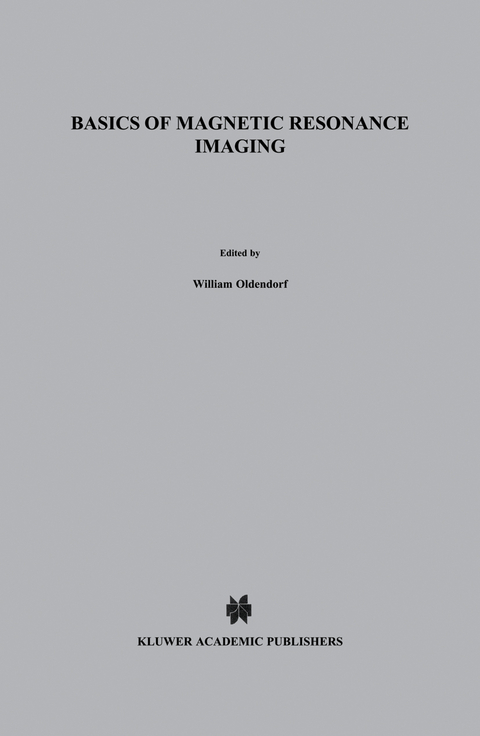
Basics of Magnetic Resonance Imaging
Seiten
2011
Springer-Verlag New York Inc.
978-1-4612-9234-0 (ISBN)
Springer-Verlag New York Inc.
978-1-4612-9234-0 (ISBN)
Chapter 1 discus ses magnetic resonance, using a compass needle as an example. In Chapter 2, the transition to the magnetic resonance of the atomic nucleus is made. In Chapter 4, the terms T 1 and T 2 are described and their relationship to tissue characterization;
This book is not intended as a general text on MRI. It is written as an intro duction to the field, for nonexperts. We present here a simple exposition of certain aspects of MRI that are important to understand to use this valuable diagnostic tool intelligently in a clinical setting. The basic principles are presented nonmathematically, using no equations and a minimum of symbols and abbreviations. For those requiring a deeper understanding of MRI, this book will help facilitate the transition to standard texts. Chapters 1 through 4 provide a general introduction to the phenomenon of nuclear magnetic resonance and how it is used in imaging. Chapter 1 discus ses magnetic resonance, using a compass needle as an example. In Chapter 2, the transition to the magnetic resonance of the atomic nucleus is made. Chapter 3 describes the principles of imaging. In Chapter 4, the terms T 1 and T 2 are described and their relationship to tissue characterization; the fun damental role of thermal magnetic noise in T 1 and T 2 is discussed.
This book is not intended as a general text on MRI. It is written as an intro duction to the field, for nonexperts. We present here a simple exposition of certain aspects of MRI that are important to understand to use this valuable diagnostic tool intelligently in a clinical setting. The basic principles are presented nonmathematically, using no equations and a minimum of symbols and abbreviations. For those requiring a deeper understanding of MRI, this book will help facilitate the transition to standard texts. Chapters 1 through 4 provide a general introduction to the phenomenon of nuclear magnetic resonance and how it is used in imaging. Chapter 1 discus ses magnetic resonance, using a compass needle as an example. In Chapter 2, the transition to the magnetic resonance of the atomic nucleus is made. Chapter 3 describes the principles of imaging. In Chapter 4, the terms T 1 and T 2 are described and their relationship to tissue characterization; the fun damental role of thermal magnetic noise in T 1 and T 2 is discussed.
Introduction: Diagnostic Probes.- 1: Magnetic Resonance: A Familiar Example.- 2: Nuclear Magnetic Resonance.- 3: Imaging.- 4: Tissue Characterization: T1 and T2.- 5: Tissue Characterization and Pulse Sequencing.- 6: The MRI Scanner.- 7: Advantages and Limitations of CT.- 8: Advantages and Limitations of MRI.- 9: The Future of MRI.- Appendix: An Introduction to Quantum Process in MRI.
| Erscheint lt. Verlag | 14.10.2011 |
|---|---|
| Reihe/Serie | Topics in Neurology ; 1 |
| Zusatzinfo | XIV, 160 p. |
| Verlagsort | New York |
| Sprache | englisch |
| Maße | 160 x 240 mm |
| Themenwelt | Medizin / Pharmazie ► Medizinische Fachgebiete ► Neurologie |
| Medizinische Fachgebiete ► Radiologie / Bildgebende Verfahren ► Nuklearmedizin | |
| Medizinische Fachgebiete ► Radiologie / Bildgebende Verfahren ► Radiologie | |
| ISBN-10 | 1-4612-9234-4 / 1461292344 |
| ISBN-13 | 978-1-4612-9234-0 / 9781461292340 |
| Zustand | Neuware |
| Informationen gemäß Produktsicherheitsverordnung (GPSR) | |
| Haben Sie eine Frage zum Produkt? |
Mehr entdecken
aus dem Bereich

aus dem Bereich
Buch | Softcover (2022)
Lehmanns Media (Verlag)
CHF 55,90
Buch | Softcover (2022)
Facultas (Verlag)
CHF 43,50


