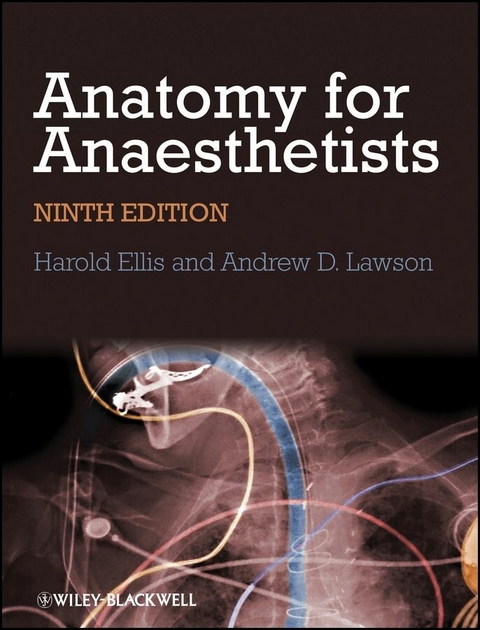
Anatomy for Anaesthetists (eBook)
John Wiley & Sons (Verlag)
978-1-118-37596-9 (ISBN)
Anaesthetists require a particularly specialized knowledge of anatomy
The anaesthetist must know intimately the respiratory passages, the major veins and the peripheral
nerves to deliver safe and effective pain control.
As one of the great teachers of anatomy, Professor Harold Ellis is eminently qualified to elegantly
provide the anatomical detail required of anaesthetists. Modern approaches to practice, including
the use of imaging to guide anaesthetic practice, add further depth to the fine full-colour anatomical
illustrations.
Designed for anaesthetists, Anatomy for Anaesthetists covers:
• The Respiratory Pathway, Lungs, Thoracic Wall and Diaphragm
• The Heart and Great Veins of the Neck
• The Peripheral Nerves
• The Autonomic Nervous System
• The Cranial Nerves
• The Anatomy of Pain
Clinical Notes throughout provide the clinical context for the anatomical detail. Designed for trainees, but of continuing relevance to practicing anaesthetists, and now in its Golden Jubilee edition, Anatomy for Anaesthetists provides a central pillar of anaesthetic knowledge.
Harold Ellis, CBE, MA, DM, MCh, FRCS, FRCP, FRCOG FACS (Hon)
Clinical Anatomist, Guy's, King's and St Thomas's School of Biomedical Sciences; and Emeritus
Professor of Surgery, Charing Cross and Westminster Medical School, London, UK
Andrew Lawson, FFARCSI, FANZCA, FRCA, MSc
Hon. Consultant in Pain Medicine, Chelsea & Westminster Hospital, London, UK
Jubilee edition of the classic text first published in 1963 Anaesthetists require a particularly specialized knowledge of anatomy The anaesthetist must know intimately the respiratory passages, the major veins and the peripheral nerves to deliver safe and effective pain control. As one of the great teachers of anatomy, Professor Harold Ellis is eminently qualified to elegantly provide the anatomical detail required of anaesthetists. Modern approaches to practice, including the use of imaging to guide anaesthetic practice, add further depth to the fine full-colour anatomical illustrations. Designed for anaesthetists, Anatomy for Anaesthetists covers: The Respiratory Pathway, Lungs, Thoracic Wall and Diaphragm The Heart and Great Veins of the Neck The Peripheral Nerves The Autonomic Nervous System The Cranial Nerves The Anatomy of Pain Clinical Notes throughout provide the clinical context for the anatomical detail. Designed for trainees, but of continuing relevance to practicing anaesthetists, and now in its Golden Jubilee edition, Anatomy for Anaesthetists provides a central pillar of anaesthetic knowledge.
Harold Ellis, CBE, MA, DM, MCh, FRCS, FRCP, FRCOG FACS (Hon) Clinical Anatomist, Guy's, King's and St Thomas's School of Biomedical Sciences; and Emeritus Professor of Surgery, Charing Cross and Westminster Medical School, London, UK Andrew Lawson, FFARCSI, FANZCA, FRCA, MSc Hon. Consultant in Pain Medicine, Chelsea & Westminster Hospital, London, UK
Anatomy for Anaesthetists 3
Contents 7
Preface to the Ninth (Jubilee) Edition 13
Foreword to the First Edition 15
Introduction to the First Edition 15
Acknowledgements to the Ninth (Jubilee) Edition 17
Part 1: The Respiratory Pathway, Lungs, Thoracic Wall and Diaphragm 19
The mouth 21
The palate 21
The nose 24
The paranasal sinuses 27
Blood supply 28
Nerve supply 29
Structure 31
The functions of the nose 31
The pharynx 33
The nasopharynx 33
The oropharynx 34
Vascular, lymphatic and nerve supply 35
The laryngopharynx 36
The structure of the pharynx 36
The muscles of the pharynx 37
Deglutition 39
The larynx 42
The laryngeal cartilages 42
The laryngeal ligaments 44
The muscles of the larynx 51
Blood supply 54
Lymph drainage 54
Nerve supply 55
Structure 60
The trachea 60
Relations 61
Vascular, lymphatic and nerve supply 64
The main bronchi 64
The pleura 66
The lines of pleural reflection 66
The intercostal spaces 69
The intercostal muscles 70
The neurovascular bundle 71
The mediastinum 74
The lungs 75
The lung lobes 79
The relationships at the root of the lung 80
The bronchopulmonary segments 81
Bronchoscopic anatomy 84
The structure of the lung and bronchial tree 85
The pulmonary blood supply 87
Lymphatics 89
Innervation 89
The development of the respiratory tract 89
The diaphragm 90
Anatomical features 90
The diaphragm as a muscle of respiration 93
The diaphragm and the 'cardiac sphincter' 93
The development of the diaphragm 94
Part 2: The Heart and Great Veins of the Neck 97
The pericardium 99
The heart 100
The chambers of the heart 102
The conducting system of the heart 106
The blood supply of the heart 107
Nerve supply 108
Surface markings 108
Developmental anatomy 110
The development of the heart 110
The development of the aortic arches and their derivatives 111
The fetal circulation 113
Congenital abnormalities of the heart and great vessels 114
The great veins of the neck 116
Part 3: The Vertebral Canal and its Contents 125
The vertebrae and sacrum 127
The vertebrae 127
The cervical vertebrae 127
The thoracic vertebrae 131
The lumbar vertebrae 132
The sacrum 138
Vertebral anomalies 143
The intervertebral ligaments 145
The spinal meninges 148
The dura mater 148
The arachnoid mater 149
The pia mater 149
The compartments related to the spinal meninges 150
The cerebrospinal fluid 154
The spinal cord 155
The structure of the cord 157
Blood supply 160
Part 4: The Peripheral Nerves 165
The spinal nerves 167
Meningeal relations 167
Vertebral relations 167
The paravertebral space 168
The posterior primary rami 169
The anterior primary rami 172
The cervical plexus 174
Formation of the plexus 174
Summary of branches 175
The stellate ganglion 179
The brachial plexus 183
Formation of the plexus 183
The relations of the brachial plexus 186
The branches of the brachial plexus 187
Supraclavicular branches of the brachial plexus 192
Infraclavicular branches of the brachial plexus 192
Variations 206
The segmental innervation of the upper limb 208
The thoracic nerves 208
Anterior primary rami 208
The lumbar plexus 210
Formation of the plexus 211
Distribution of the lumbar plexus 213
The sacral and coccygeal plexuses 219
Formation of the plexuses 220
Relations 220
Summary of the branches of the sacral plexus 222
The collateral branches 222
The terminal branches 223
The sciatic foramina 237
The coccygeal plexus 237
The segmental innervation of the lower limb 238
Part 5: The Autonomic Nervous System 241
Introduction 243
Autonomic afferents 245
The sympathetic system 246
Spinal level 246
The sympathetic trunk 246
The ganglia of the sympathetic trunk 249
The plexuses of the sympathetic system 254
Higher sympathetic centres 257
The parasympathetic system 257
The cranial outflow 257
The sacral outflow 259
Afferent parasympathetic fibres 259
Part 6: The Cranial Nerves 261
Introduction 263
The basic plan of the cranial nuclei 263
The olfactory nerve (I) 265
The optic nerve (II) 267
The oculomotor nerve (III) 269
The trochlear nerve (IV) 271
The trigeminal nerve (V) 272
The ophthalmic nerve (V') 276
The maxillary nerve (V'') 279
The mandibular nerve (V''') 286
The abducent nerve (VI) 293
The facial nerve (VII) 293
The auditory (vestibulocochlear) nerve (VIII) 297
The glossopharyngeal nerve (IX) 299
The vagus nerve (X) 302
Course and relations 303
The branches and distribution of the vagus nerve 305
The accessory nerve (XI) 307
The hypoglossal nerve (XII) 308
Part 7: Miscellaneous Zones of Interest 311
The thoracic inlet 313
Outlines and boundaries 313
The 1st rib 313
Cervical ribs 315
Surface markings 315
The antecubital fossa 316
Boundaries 316
Roof 316
Contents 316
Structures of clinical importance 318
The orbit and its contents 321
The bony orbit 321
The orbital foramina 323
The subdivisions of the orbit 323
The eyeball 324
Contents of the eyeball 326
The orbital muscles 327
The fascial sheath of the eye 328
The eyelids and conjunctiva 329
The lacrimal apparatus 330
The abdominal wall 332
Landmarks 332
Fascia 333
Muscles 333
Blood supply 337
Nerve supply 337
Part 8: The Anatomy of Pain 339
Introduction 341
Classification of pain 342
Peripheral receptors and afferent fibres 342
Peripheral sensitization 343
Cutaneous nociceptors 343
Other somatic structures 343
Visceral nociception 344
The spinal cord and central projections 344
The dorsal horn 344
Ascending systems 346
Spinothalamic tract 346
Spinoreticular tract 347
Cerebral processing and the pain matrix 347
Modulation of pain signals 348
Cortical modulation 348
Descending inhibitory pathways 349
The gate control theory of pain 350
Central sensitization of pain 350
The autonomic nervous system and pain 351
Index 353
| Erscheint lt. Verlag | 30.9.2013 |
|---|---|
| Sprache | englisch |
| Themenwelt | Medizin / Pharmazie ► Allgemeines / Lexika |
| Medizin / Pharmazie ► Gesundheitsfachberufe | |
| Medizin / Pharmazie ► Medizinische Fachgebiete ► Anästhesie | |
| Medizin / Pharmazie ► Pflege | |
| Studium ► 1. Studienabschnitt (Vorklinik) ► Anatomie / Neuroanatomie | |
| Schlagworte | Anästhesie • Anaesthetist • Anaesthetists • Anästhesie • anatomical detail • Anatomie • anatomy • anesthesia • APPROACHES • Classic • Control • Ellis • First • Great teachers • Harold • Jubilee • Knowledge • major veins • Medical Science • Medizin • particularly specialized • Peripheral • Professor • qualified • require • required • SAFE |
| ISBN-10 | 1-118-37596-3 / 1118375963 |
| ISBN-13 | 978-1-118-37596-9 / 9781118375969 |
| Informationen gemäß Produktsicherheitsverordnung (GPSR) | |
| Haben Sie eine Frage zum Produkt? |
 PDF (Adobe DRM)
Kopierschutz: Adobe-DRM
Adobe-DRM ist ein Kopierschutz, der das eBook vor Mißbrauch schützen soll. Dabei wird das eBook bereits beim Download auf Ihre persönliche Adobe-ID autorisiert. Lesen können Sie das eBook dann nur auf den Geräten, welche ebenfalls auf Ihre Adobe-ID registriert sind.
Details zum Adobe-DRM
Dateiformat: PDF (Portable Document Format)
Mit einem festen Seitenlayout eignet sich die PDF besonders für Fachbücher mit Spalten, Tabellen und Abbildungen. Eine PDF kann auf fast allen Geräten angezeigt werden, ist aber für kleine Displays (Smartphone, eReader) nur eingeschränkt geeignet.
Systemvoraussetzungen:
PC/Mac: Mit einem PC oder Mac können Sie dieses eBook lesen. Sie benötigen eine
eReader: Dieses eBook kann mit (fast) allen eBook-Readern gelesen werden. Mit dem amazon-Kindle ist es aber nicht kompatibel.
Smartphone/Tablet: Egal ob Apple oder Android, dieses eBook können Sie lesen. Sie benötigen eine
Geräteliste und zusätzliche Hinweise
Buying eBooks from abroad
For tax law reasons we can sell eBooks just within Germany and Switzerland. Regrettably we cannot fulfill eBook-orders from other countries.
aus dem Bereich