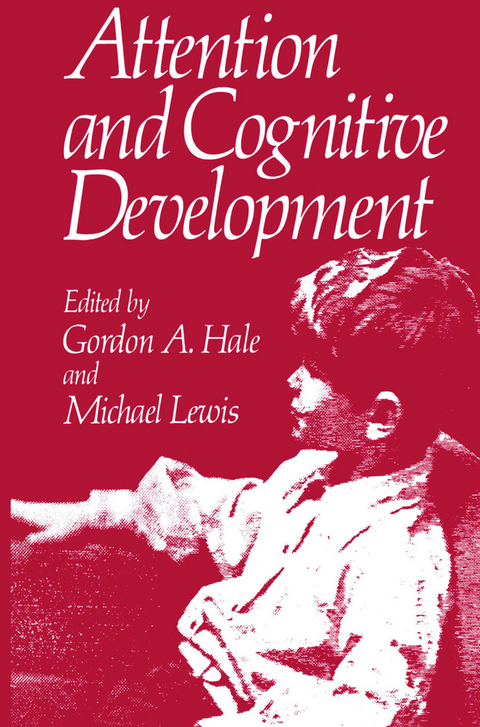
Attention and Cognitive Development
Springer-Verlag New York Inc.
978-1-4613-2987-9 (ISBN)
1 Attention: The Perceiver as Performer.- Some Examples of Attending.- What Is Attention?.- What Attention Is Not.- Restatement of the Theme.- Classic Variables of Attention.- Expectation.- How Does Attention Develop?.- Conclusion.- References.- 2 The Concept of Identity and Children’s Selective Attention.- Extent of Visual Scanning.- Relevance of Perceived Differences to Judgments of Identity.- Criteria of Identity Judgments and Scanning Strategies.- Conclusion.- References.- 3 Development of Children’s Attention to Stimulus Components.- The Component Selection Task.- Development of Children’s Disposition toward Selectivity.- Development of Flexibility in Attention to Components.- A Further Issue in Measuring Attention to Components: Dimension Preferences.- Concluding Remarks.- References.- 4 A Constructivist Account of the Development of Perception, Attention, and Memory.- The Thesis.- Empirical and Theoretical Underpinnings.- A General, Unified Cognitive System?.- Concluding Remarks.- References.- 5 Stimulus Dimensions, Problem Solving, and Piaget.- Developmental Relationships between Conservation and Attention to Dimensions.- How Attention to Dimensions Affects Conservation Performance.- Implications for an Understanding of the Development of Dimensionalization.- Summary.- References.- 6 Developmental Aspects of Selective Orientation.- From Selective Orienting to Mental Representation.- Orienting Asymmetry and the Development of Handedness.- Effect of Rightward Response Bias on Lateral Attending.- Task-Related Attentional Biases.- References.- 7 Attentional Processes and Individual Differences.- A Review of Models of Attention and Memory.- Individual Differences in Information Processing.- Conclusion.- References.- 8 Toward a Clearer Definition of theAttentional Deficit of Hyperactive Children.- Confusion Caused by Current Diagnostic Labels.- Confusion Caused by Definitions of Attention.- Selective Attention as Defined in Studies of Stimulus Reduction, Distraction, and Incidental Learning.- Sustained Attention as Defined in Vigilance Studies.- Sustained Attention as Defined in Studies of More Complex Perceptual and Conceptual Processes: A Brief Review.- References.- 9 The Cognitive Effects of Stimulant Drugs on Hyperactive Children.- Definition of the Disorder.- Background Information on Drug Treatment.- Evaluation of Diagnostic Drug Trials.- Experiments Using Paired-Associate Learning.- Other Laboratory Tests.- Problems with Drug Treatment.- Directions for Future Research.- References.- 10 Attention and Cognitive Style in Children.- The Confounding of Cognitive Style and Development.- Attention and Cognitive Style: A Developmental Lag Approach.- Style: Individual Differences in Attention Deployment.- Attention and Cognitive Style: The Developmental Lag Interpretation Reevaluated.- Cognitive Styles: Separate but Unequal?.- A Word of Caution.- References.- 11 Attention in the Classroom.- Alertness.- Selectivity.- Central Processing.- Monitoring and Fostering Attention in the Classroom.- Special Problems of Attention.- Summary.- References.- 12 Watching Children Watch Television.- When Children Begin to Watch Television.- Amount of Television Viewing.- Factors Related to Amount of Home Viewing.- Visual Attention to Television.- Attributes of Television Programs That Influence Visual Attention.- Discussion of the Attribute Effects.- Auditory Attention to Television.- A Possible Theoretical Direction for Future Research on Attention to Television.- Final Comments.- References.
| Zusatzinfo | XVI, 366 p. |
|---|---|
| Verlagsort | New York, NY |
| Sprache | englisch |
| Maße | 155 x 235 mm |
| Themenwelt | Geisteswissenschaften ► Psychologie ► Allgemeine Psychologie |
| Geisteswissenschaften ► Psychologie ► Entwicklungspsychologie | |
| Geisteswissenschaften ► Psychologie ► Verhaltenstherapie | |
| Medizin / Pharmazie ► Medizinische Fachgebiete ► Psychiatrie / Psychotherapie | |
| ISBN-10 | 1-4613-2987-6 / 1461329876 |
| ISBN-13 | 978-1-4613-2987-9 / 9781461329879 |
| Zustand | Neuware |
| Informationen gemäß Produktsicherheitsverordnung (GPSR) | |
| Haben Sie eine Frage zum Produkt? |
aus dem Bereich