


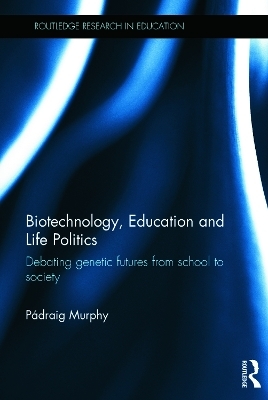
Biotechnology, Education and Life Politics
Debating genetic futures from school to society
Seiten
2014
Routledge (Verlag)
978-0-415-70735-0 (ISBN)
Routledge (Verlag)
978-0-415-70735-0 (ISBN)
This book argues that urgent and biopolitical issues should be central to how biology is taught as a subject. Life political debate is thoroughly analysed and is shown to be a way of connecting mainstream education of biology with future
What should individuals and society do when genetic screening becomes widely available and with its impact on current and future generations still uncertain? How can our education systems around the world respond to these developments?
Reproductive and genetic technologies (RGTs) are increasingly controversial and political. We are entering an era where we can design future humans, firstly, by genetic screening of "undesirable" traits or indeed embryos, but perhaps later by more radical genetic engineering. This has a profound effect on what we see as normal, acceptable and responsible.
This book argues that these urgent and biopolitical issues should be central to how biology is taught as a subject. Debate about life itself has always been at the forefront of connected molecular, genetic and social/personal identity levels, and each of these levels requires processes of communication and debate, what Anthony Giddens called in passing life politics. In this book Pádraig Murphy opens the term up, with examples from field research in schools, student responses to educational films exploring the future of RGTs, and science studies of strategic biotechnology and the lab practices of genetic screening. Life political debate is thoroughly examined and is identified as a way of connecting mainstream education of biology with future generations.
Biotechnology, Education and Life Politics will appeal to post-graduates and academics involved with science education, science communication, communication studies and the sociology of education.
What should individuals and society do when genetic screening becomes widely available and with its impact on current and future generations still uncertain? How can our education systems around the world respond to these developments?
Reproductive and genetic technologies (RGTs) are increasingly controversial and political. We are entering an era where we can design future humans, firstly, by genetic screening of "undesirable" traits or indeed embryos, but perhaps later by more radical genetic engineering. This has a profound effect on what we see as normal, acceptable and responsible.
This book argues that these urgent and biopolitical issues should be central to how biology is taught as a subject. Debate about life itself has always been at the forefront of connected molecular, genetic and social/personal identity levels, and each of these levels requires processes of communication and debate, what Anthony Giddens called in passing life politics. In this book Pádraig Murphy opens the term up, with examples from field research in schools, student responses to educational films exploring the future of RGTs, and science studies of strategic biotechnology and the lab practices of genetic screening. Life political debate is thoroughly examined and is identified as a way of connecting mainstream education of biology with future generations.
Biotechnology, Education and Life Politics will appeal to post-graduates and academics involved with science education, science communication, communication studies and the sociology of education.
Pádraig Murphy is Lecturer in Communications and Chair of the MSc in Science Communication programme at Dublin City University, Ireland. His teaching and research interests include science communication, science and technology studies, and emerging technologies, biopolitics and media in education.
1. Introduction: Biopolitical Control and the Possibilities for Life Political Education 2. Biopolitics and State in Education 3. Biopinion 4. Future Scripts and Present Bodies 5. The Bíos in Education 6. ‘Political’ Science and Framing: an Education from Media 7. Nine Genetic Futures 8. Life Politics
| Reihe/Serie | Routledge Research in Education |
|---|---|
| Zusatzinfo | 4 Tables, black and white; 1 Illustrations, black and white |
| Verlagsort | London |
| Sprache | englisch |
| Maße | 156 x 234 mm |
| Gewicht | 540 g |
| Themenwelt | Schulbuch / Wörterbuch |
| Medizin / Pharmazie ► Medizinische Fachgebiete ► Medizinethik | |
| Studium ► Querschnittsbereiche ► Geschichte / Ethik der Medizin | |
| Naturwissenschaften ► Biologie ► Genetik / Molekularbiologie | |
| Sozialwissenschaften ► Pädagogik ► Allgemeines / Lexika | |
| Sozialwissenschaften ► Pädagogik ► Bildungstheorie | |
| Sozialwissenschaften ► Pädagogik ► Schulpädagogik / Sekundarstufe I+II | |
| Sozialwissenschaften ► Soziologie | |
| Technik ► Umwelttechnik / Biotechnologie | |
| ISBN-10 | 0-415-70735-8 / 0415707358 |
| ISBN-13 | 978-0-415-70735-0 / 9780415707350 |
| Zustand | Neuware |
| Informationen gemäß Produktsicherheitsverordnung (GPSR) | |
| Haben Sie eine Frage zum Produkt? |
Mehr entdecken
aus dem Bereich



aus dem Bereich
Die Geschichte eines Weltzentrums der Medizin von 1710 bis zur …
Buch | Softcover (2021)
Lehmanns Media (Verlag)
CHF 27,90
Geschichte der Bioethik in Deutschland
Buch | Hardcover (2025)
Suhrkamp (Verlag)
CHF 109,15


