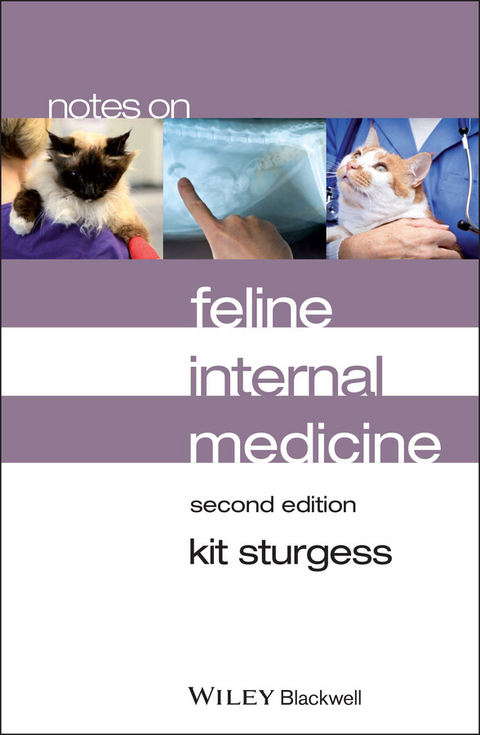
Notes on Feline Internal Medicine (eBook)
John Wiley & Sons (Verlag)
978-1-118-59771-2 (ISBN)
Helping you get started with a problem-solving approach to a sick cat.
feline internal medicine
kit sturgess
Notes on Feline Internal Medicine, second edition, is part of a popular series specifically designed, through an accessible note-based style, to ensure veterinarians and students have quick and easy access to comprehensive and practical clinical and diagnostic information.
Distinct differences exist between cats and dogs not only in their physiology and metabolism but also in the way disease tends to present. This book is a short 'pocket guide' to feline internal medicine helping you to formulate a diagnostic plan and therapeutic strategy. The focus is on evidence-based medicine where available, otherwise current best-practice is presented.
The book is divided into five sections:
- Section 1 gives an overview of some key areas of feline medicine including paediatric and geriatric medicine.
- Section 2 focuses on the approach to common presenting signs.
- Section 3 covers the differential diagnosis of commonly used haematologic and biochemical parameters.
- Section 4 presents an organ-system based approach.
- Section 5 covers feline infectious diseases.
CHANGES FOR THIS EDITION
- Stronger focus is placed on initial testing for a disease, and what changes might be expected.
- Additional sections have been added on sedation and anaesthesia, health screening, oncology and emergency and critical care.
- More diagrams have been added to aid understanding.
- Care has been taken to avoid repetition and focus on common conditions.
ABOUT THE AUTHOR
Dr Kit Sturgess is an RCVS Recognised Specialist in Small Animal Medicine (Internal Medicine). He has been seeing referral small animal medicine cases for the past 20 years both at university-based and private specialist practices. He has authored numerous articles as well as presenting lectures and research abstracts at conferences worldwide.
For full details of all our veterinary titles, including other titles in the Notes on... series, please visit our website at www.wiley.com/go/vet
feline internal medicine Helping you get started with a problem-solving approach to a sick cat. feline internal medicine kit sturgess Notes on Feline Internal Medicine, second edition, is part of a popular series specifically designed, through an accessible note-based style, to ensure veterinarians and students have quick and easy access to comprehensive and practical clinical and diagnostic information. Distinct differences exist between cats and dogs not only in their physiology and metabolism but also in the way disease tends to present. This book is a short pocket guide to feline internal medicine helping you to formulate a diagnostic plan and therapeutic strategy. The focus is on evidence-based medicine where available, otherwise current best-practice is presented. The book is divided into five sections: Section 1 gives an overview of some key areas of feline medicine including paediatric and geriatric medicine. Section 2 focuses on the approach to common presenting signs. Section 3 covers the differential diagnosis of commonly used haematologic and biochemical parameters. Section 4 presents an organ-system based approach. Section 5 covers feline infectious diseases. CHANGES FOR THIS EDITION Stronger focus is placed on initial testing for a disease, and what changes might be expected. Additional sections have been added on sedation and anaesthesia, health screening, oncology and emergency and critical care. More diagrams have been added to aid understanding. Care has been taken to avoid repetition and focus on common conditions.
ABOUT THE AUTHOR Dr Kit Sturgess is an RCVS Recognised Specialist in Small Animal Medicine (Internal Medicine). He has been seeing referral small animal medicine cases for the past 20 years both at university-based and private specialist practices. He has authored numerous articles as well as presenting lectures and research abstracts at conferences worldwide. For full details of all our veterinary titles, including other titles in the Notes on... series, please visit our website at www.wiley.com/go/vet
NOTES ON FELINE INTERNAL MEDICINE 3
CONTENTS 7
ABBREVIATIONS 10
INTRODUCTION 15
SECTION 1 KEY TOPICS IN FELINE MEDICINE 19
1.1 HEALTH SCREENING 21
1.1.1 Introduction 21
1.1.2 Which cats to screen and what screening tests to use 21
1.1.3 Interpreting the test results and developing an action plan 22
1.1.4 Screening for neoplasia 23
1.2 PREVENTATIVE MEDICINE 24
1.2.1 Vaccination 24
1.2.2 Parasite control 25
1.3 PAEDIATRICS 27
1.3.1 Introduction 27
1.3.2 Evaluating the paediatric patient 27
1.3.3 Investigation of neonatal disease 31
1.3.4 Treatment of the paediatric patient 31
1.3.5 Common infectious diseases of kittens 32
1.3.6 Neonatal isoerythrolysis 33
1.3.7 Fading kitten syndrome 33
1.3.8 Pain relief 34
1.4 GERONTOLOGY 34
1.4.1 Introduction 34
1.4.2 Effects of ageing 35
1.4.3 Nutritional changes 36
1.4.4 Common diseases of elderly cats 36
1.4.5 Assessment of the elderly cat 37
1.4.6 Therapeutic considerations 37
1.5 SUPPORTIVE CARE – FLUID THERAPY AND ANALGESIA 37
1.5.1 General principles 37
1.5.2 Fluid therapy 37
1.5.3 Analgesia 38
1.6 SEDATION AND ANAESTHESIA 42
1.6.1 Introduction 42
1.6.2 Pre-procedure assessment 42
1.6.3 Sedative protocols 43
1.6.4 Anaesthetic protocols 43
1.7 EMERGENCY AND CRITICAL CARE ALGORITHMS 46
1.7.1 Introduction 46
1.7.2 Trauma/RTA 46
1.7.3 Dyspnoea 47
1.7.4 Collapse 48
1.7.5 Urinary obstruction 48
1.7.6 Seizures 49
1.7.7 CPCR 49
SECTION 2 CLINICAL SIGNS 51
INTRODUCTION 53
2.1 ABDOMINAL ENLARGEMENT 53
2.1.1 Introduction 53
2.1.2 Causes 53
2.1.3 Key history 53
2.1.4 Focus of physical examination 53
2.1.5 Decision making 53
2.1.6 Diagnostic approach 56
2.1.7 Management and therapy 56
2.2 ANOREXIA 56
2.2.1 Introduction 56
2.2.2 Causes 57
2.2.3 Key history 57
2.2.4 Focus of physical examination 57
2.2.5 Decision making 57
2.2.6 Diagnostic approach 57
2.2.7 Management and therapy 57
2.3 ARRHYTHMIAS 58
2.3.1 Introduction 58
2.3.2 Causes (Table 15) 58
2.3.3 Key history 58
2.3.4 Focus of physical examination 58
2.3.5 Decision making 58
2.3.6 Diagnostic approach (Table 14 page 40–41) 58
2.3.7 Management and therapy 58
2.4 ASCITES AND PERITONEAL EFFUSIONS 60
2.4.1 Introduction 60
2.4.2 Causes 60
2.4.3 Key history 60
2.4.4 Focus of physical examination 60
2.4.5 Decision making 60
2.4.6 Diagnostic approach 60
2.4.7 Management and therapeutic approach 61
2.4.8 Specifi c conditions 61
2.5 ATAXIA 63
2.5.1 Introduction 63
2.5.2 Causes 63
2.5.3 Key history 64
2.5.4 Focus of physical examination 64
2.5.5 Decision making 64
2.5.6 Diagnostic approach (see table 14 page 40–41) 64
2.5.7 Management and therapy 65
2.5.8 Specifi c conditions 65
2.6 BEHAVIOURAL CHANGES 65
2.6.1 Introduction 65
2.6.2 Causes 65
2.7 BLEEDING/ COAGULOPATHIES 66
2.7.1 Introduction 66
2.7.2 Causes 66
2.7.3 Key history 66
2.7.4 Focus of physical examination 66
2.7.5 Decision making 66
2.7.6 Diagnostic approach 66
2.7.7 Management and therapy 67
2.8 BODY ODOUR 67
2.8.1 Introduction 67
2.8.2 Causes 67
2.8.3 Key history 67
2.8.4 Focus of physical examination 67
2.8.5 Decision making 67
2.8.6 Diagnostic approach 67
2.8.7 Management and therapy 68
2.9 COLLAPSE, SYNCOPE AND WEAKNESS 68
2.9.1 Introduction 68
2.9.2 Causes 68
2.9.3 Key history 69
2.9.4 Focus of physical examination 69
2.9.5 Decision making 69
2.9.6 Diagnostic approach 69
2.9.7 Management and therapy 70
2.10 CARDIAC MURMURS 70
2.10.1 Introduction 70
2.10.2 Causes 70
2.10.3 Key history 70
2.10.4 Focus of physical examination 71
2.10.5 Decision making 71
2.10.6 Diagnostic approach 71
2.10.7 Management and therapy 71
2.11 CONSTIPATION, TENESMUS AND DYSCHEZIA 72
2.11.1 Introduction 72
2.11.2 Causes 72
2.11.3 Key history 73
2.11.4 Focus of physical examination 73
2.11.5 Decision making 73
2.11.6 Diagnostic approach (Table 14 page 40–41) 73
2.11.7 Management and therapy 74
2.12 CHRONIC COUGHING 74
2.12.1 Introduction 74
2.12.2 Causes 74
2.12.3 Key history 75
2.12.4 Focus of physical examination 75
2.12.5 Decision making 75
2.12.6 Diagnostic approach 75
2.12.7 Management and therapy 76
2.12.8 Approach to the coughing cat (Figure 6) 76
2.13 DIARRHOEA 77
2.13.1 Introduction 77
2.13.2 Causes 77
2.13.3 Key history 78
2.13.4 Focus of physical examination 78
2.13.5 Decision making 78
2.13.6 Diagnostic approach (Table 17 page 40–41) 78
2.13.7 Management and therapy 79
2.14 DYSPHAGIA 79
2.14.1 Introduction 79
2.14.2 Causes 80
2.14.3 Key history 80
2.14.4 Focus of physical examination 81
2.14.5 Decision making 81
2.14.6 Diagnostic approach 81
2.14.7 Management and therapy 81
2.15 DYSPNOEA (RESPIRATORY DISTRESS) 81
2.15.1 Introduction 81
2.15.2 Causes 82
2.15.3 Key history 83
2.15.4 Focus of physical examination 83
2.15.5 Decision making (Figure 7) 83
2.15.6 Diagnostic approach 83
2.15.7 Management and therapy 84
2.15.8 Approach to the dyspnoeic cat 84
2.16 DYSURIA 84
2.16.1 Introduction 84
2.16.2 Causes 84
2.16.3 Key history 85
2.16.4 Focus of physical examination 85
2.16.5 Decision making 85
2.16.6 Diagnostic approach (Table 14 page 40–41) 85
2.16.7 Management and therapy 86
2.17 FAILURE TO GROW 86
2.17.1 Introduction 86
2.17.2 Causes 86
2.17.3 Key history 86
2.17.4 Focus of physical examination 87
2.17.5 Decision making 87
2.17.6 Diagnostic approach 87
2.17.7 Management and therapy 87
2.18 FLATULENCE 87
2.18.1 Introduction 87
2.18.2 Causes 87
2.18.3 Key history 87
2.18.4 Focus of physical examination 87
2.18.5 Decision making 88
2.18.6 Diagnostic approach 88
2.18.7 Management and therapy 88
2.19 HAEMATEMESIS, HAEMOPTYSIS AND EPISTAXIS 88
2.19.1 Introduction 88
2.19.2 Causes 88
2.19.3 Key history 88
2.19.4 Focus of physical examination 89
2.19.5 Decision making 89
2.19.6 Diagnostic approach 89
2.19.7 Management and therapy 89
2.20 HAEMATOCHEZIA AND MELAENA 89
2.20.1 Introduction 89
2.20.2 Causes 89
2.20.3 Key history 90
2.20.4 Focus of physical examination 90
2.20.5 Decision making 90
2.20.6 Diagnostic approach 90
2.20.7 Management and therapy 91
2.21 HAEMATURIA AND HAEMOGLOBINURIA 91
2.21.1 Introduction 91
2.21.2 Causes 91
2.21.3 Key history 92
2.21.4 Focus of physical examination 92
2.21.5 Decision making 92
2.21.6 Diagnostic approach (Table 14 page 40–41) 92
2.21.7 Management and therapy 92
2.22 HYPOTHERMIA 93
2.22.1 Introduction 93
2.22.2 Causes 93
2.22.3 Key history 93
2.22.4 Focus of physical examination 93
2.22.5 Decision making 93
2.22.6 Diagnostic approach 93
2.22.7 Management and therapy 93
2.23 INCONTINENCE (URINARY) 94
2.23.1 Introduction 94
2.23.2 Causes 94
2.23.3 Key history 94
2.23.4 Focus of physical examination 94
2.23.5 Decision making 94
2.23.6 Diagnostic approach 94
2.23.7 Management and therapy 95
2.24 INCONTINENCE ( FAECAL) 95
2.24.1 Introduction 95
2.24.2 Causes 95
2.24.3 Key history 95
2.24.4 Focus of physical examination 95
2.24.5 Decision making 96
2.24.6 Diagnostic approach 96
2.24.7 Management and therapy 96
2.25 INFERT I L I T Y – QUEENS 96
2.25.1 Introduction 96
2.25.2 Causes 96
2.25.3 Key history 98
2.25.4 Focus of physical examination 98
2.25.5 Decision making 98
2.25.6 Diagnostic approach (Table 14 page 40–41) 98
2.25.7 Management and therapy 98
2.26 INFERT I L I T Y – TOMCATS 98
2.26.1 Introduction 98
2.26.2 Causes 98
2.26.3 Key history 99
2.26.4 Focus of physical examination 99
2.26.5 Decision making 99
2.26.6 Diagnostic approach 99
2.26.7 Management and therapy 99
2.27 JAUNDICE (ICTERUS) 99
2.27.1 Introduction 99
2.27.2 Causes of hyperbilirubinaemia 100
2.27.3 Key history 101
2.27.4 Focus of physical examination 101
2.27.5 Decision making 101
2.27.6 Diagnostic approach 101
2.27.7 Management and therapy 101
2.28 LYMPHADENOPATHY 102
2.28.1 Introduction 102
2.28.2 Causes 102
2.28.3 Key history 102
2.28.4 Focus of physical examination 102
2.28.5 Decision making 102
2.28.6 Diagnostic approach 103
2.28.7 Management and therapy 103
2.29 OCULAR CHANGES CAUSED BY SYSTEMIC DISEASE 103
2.29.1 Introduction 103
2.29.2 Causes 103
2.29.3 History, physical examination, decision making and diagnosis 104
2.29.4 Management and therapy 104
2.30 PALLOR 104
2.30.1 Introduction 104
2.30.2 Causes (Figure 10) 104
2.30.3 Key history 104
2.30.4 Focus of physical examination 104
2.30.5 Decision making 105
2.30.6 Diagnostic approach 105
2.30.7 Management and therapy 105
2.31 PARESIS AND PARALYSIS 105
2.31.1 Introduction 105
2.31.2 Causes 105
2.31.3 Key history 106
2.31.4 Focus of physical examination 106
2.31.5 Decision making 107
2.31.6 Diagnostic approach 107
2.31.7 Management and therapy 107
2.32 POLYPHAGIA 107
2.32.1 Introduction 107
2.32.2 Causes of secondary polyphagia 107
2.32.3 Key history 107
2.32.4 Focus of physical examination 108
2.32.5 Decision making 108
2.32.6 Diagnostic approach 108
2.32.7 Management and therapy 108
2.33 POLYURIA/ POLYDIPSIA 108
2.33.1 Introduction 108
2.33.2 Causes 108
2.33.3 Key history 109
2.33.4 Focus of physical examination 109
2.33.5 Decision making 109
2.33.6 Diagnostic approach 109
2.33.7 Management and therapy 109
2.34 PTYALISM 110
2.34.1 Introduction 110
2.34.2 Causes 110
2.34.3 Key history 110
2.34.4 Focus of physical examination 110
2.34.5 Decision making 111
2.34.6 Diagnostic approach 111
2.34.7 Management and therapy 111
2.35 PYREXIA (FEVER) OF UNKNOWN ORIGIN – PUO (FUO) 111
2.35.1 Introduction 111
2.35.2 Causes 111
2.35.3 Key history 111
2.35.4 Focus of physical examination 112
2.35.5 Decision making 112
2.35.6 Diagnostic approach 112
2.35.7 Management and therapy 112
2.36 REGURGITATION 112
2.36.1 Introduction 112
2.36.2 Causes 113
2.36.3 Key history 113
2.36.4 Focus of physical examination 113
2.36.5 Decision making 113
2.36.6 Diagnostic approach 113
2.36.7 Management and therapy 114
2.37 SEIZURES 114
2.37.1 Introduction 114
2.37.2 Causes 114
2.37.3 Key history 115
2.37.4 Focus of physical examination 115
2.37.5 Decision making 116
2.37.6 Diagnostic approach 116
2.37.7 Management and therapy 116
2.38 SNEEZING AND NASAL DISCHARGE 116
2.38.1 Introduction 116
2.38.2 Causes 116
2.38.3 Key history 117
2.38.4 Focus of physical examination 117
2.38.5 Decision making 117
2.38.6 Diagnostic approach 117
2.38.7 Management and therapy 118
2.39 STIFFNESS 118
2.39.1 Introduction 118
2.39.2 Causes 118
2.39.3 Key history 118
2.39.4 Focus of physical examination 118
2.39.5 Decision making 118
2.39.6 Diagnostic approach 118
2.39.7 Management and therapy 118
2.40 STUPOR AND ALTERED STATES OF CONSCIOUSNESS 119
2.40.1 Introduction 119
2.40.2 Causes 119
2.40.3 Key history 119
2.40.4 Focus of physical examination 119
2.40.5 Decision making 120
2.40.6 Diagnostic approach 120
2.40.7 Management and therapy 120
2.41 TREMOR 120
2.41.1 Introduction 120
2.41.2 Causes 120
2.41.3 Key history 121
2.41.4 Focus of physical examination 121
2.41.5 Decision making 121
2.41.6 Diagnostic approach (see Table 14 page 40–41) 121
2.41.7 Management and therapy 121
2.42 VOMITING 121
2.42.1 Introduction 121
2.42.2 Causes 122
2.42.3 Key history 122
2.42.4 Focus of physical examination 122
2.42.5 Decision making 123
2.42.6 Diagnostic approach 123
2.42.7 Management and therapy (Table 21) 123
2.43 WEIGHT LOSS 123
2.43.1 Introduction 123
2.43.2 Causes 123
2.43.3 Key history 124
2.43.4 Focus of physical examination 124
2.43.5 Decision making 124
2.43.6 Diagnostic approach 124
2.43.7 Management and therapy 124
SECTION 3 COMMON ABNORMALITIES OF HAEMATOLOGY, BIOCHEMISTRY AND URINALYSIS 125
INTRODUCTION 127
3.1 LOW HAEMATOCRIT 127
3.1.1 Notes 128
3.1.2 Is it regenerative? 128
3.1.3 Is it haemorrhagic or haemolytic? 128
3.1.4 Why is the cat haemorrhaging? 128
3.1.5 Causes of haemolytic anaemia 128
3.1.6 Non-regenerative anaemia 128
3.2 HIGH HAEMATOCRIT 128
3.3 PLATELET ABNORMALITIES AND CLOTTING SYSTEM 129
3.3.1 Laboratory investigation 129
3.3.2 Assessment 129
3.3.3 Thrombocytopenia 130
3.3.4 Thrombocytosis 130
3.3.5 Thrombocytopathy 130
3.3.6 Clotting system 130
3.4 WHITE BLOOD CELL CHANGES 130
3.4.1 Leucocytosis 130
3.4.2 Leucopenia 131
3.4.3 Neutrophilia 131
3.4.4 Neutropenia 131
3.4.5 Lymphopenia 131
3.4.6 Lymphocytosis 131
3.4.7 Monocytosis 131
3.4.8 Eosinophilia 131
3.5 ACID–BASE DISTURBANCES 131
3.5.1 Assessment (Table 24) 131
3.5.2 TCO2 131
3.5.3 Anion gap 132
3.5.4 Base excess 132
3.5.5 Metabolic acidosis 132
3.5.6 Metabolic alkalosis 132
3.5.7 Respiratory acidosis 132
3.5.8 Respiratory alkalosis 132
3.6 AMYLASE AND LIPASE 132
3.7 AZOTAEMIA 133
3.7.1 Defi nitions 133
3.7.2 Assessment 133
3.7.3 Causes of azotaemia 133
3.8 CALCIUM IMBALANCE 134
3.8.1 Assessment 134
3.8.2 Hypocalcaemia 134
3.8.3 Hypercalcaemia 134
3.9 CHOLESTEROL AND TRIGLYCERIDE CHANGES 134
3.9.1 Assessment 134
3.9.2 Hypercholesterolaemia 135
3.9.3 Hypocholesterolaemia 135
3.9.4 Hypertriglyceridaemia 135
3.9.5 Hypotriglyceridaemia 135
3.10 ELECTROLYTE DISTURBANCES 135
3.10.1 Assessment (see Table 26) 135
3.10.2 Hypokalaemia 135
3.10.3 Hyperkalaemia 135
3.10.4 Hyponatraemia 136
3.10.5 Hypernatraemia 136
3.10.6 Hypochloraemia 136
3.10.7 Hyperchloraemia 136
3.10.8 Magnesium 136
3.11 GLUCOSE ABNORMALITIES 136
3.11.1 Assessment 136
3.11.2 Hyperglycaemia 136
3.11.3 Hypoglycaemia 137
3.12 LIVER PARAMETERS 137
3.12.1 Assessment (see Table 27) 137
3.12.2 ALKP 137
3.12.3 ALT 138
3.12.4 ?-GT (GGT) 138
3.12.5 Total bilirubin 138
3.12.6 Ammonia 138
3.12.7 Bile acids 138
3.13 MUSCLE ENZYMES 139
3.13.1 Assessment 139
3.13.2 CK 139
3.13.3 AST 139
3.13.4 LDH 139
3.14 PHOSPHATE 139
3.14.1 Assessment 139
3.14.2 Hypophosphataemia 139
3.14.3 Hyperphosphataemia 140
3.15 PROTEIN ABNORMALITIES 140
3.15.1 Assessment (see Table 28) 140
3.15.2 Hypoproteinaemia 140
3.15.3 Hyperproteinaemia 140
3.15.4 Hypoalbuminaemia 140
3.15.5 Hyperalbuminaemia 141
3.15.6 Hypoglobulinaemia 141
3.15.7 Hyperglobulinaemia 141
3.15.8 Fibrinogen 141
3.15.9 C-reactive protein (CRP) 141
3.15.10 ?1-Acid glycoprotein 141
3.15.11 Serum protein electrophoresis (Figure 12) 141
3.15.12 Monoclonal gammopathy 142
3.16 URINALYSIS 142
3.16.1 Volume 142
3.16.2 Physical characteristics 142
3.16.3 Urine solute concentration 142
3.16.4 Urine pH 142
3.16.5 Protein 143
3.16.6 Glucose 143
3.16.7 Ketones 143
3.16.8 Urobilinogen, nitrite and bacteria 143
3.16.9 Bilirubin 143
3.16.10 Blood 143
3.16.11 Bacteria 145
3.16.12 Urine microscopy 145
SECTION 4 ORGAN SYSTEMS 147
4.1 RESPIRATORY DISEASE 149
4.1.1 General examination of the respiratory system 149
4.1.2 Disease of the upper respiratory tract 150
4.1.3 Mediastinal disease 156
4.1.4 Lower airway disease – feline bronchopulmonary disease 157
4.1.5 Pleural disease 161
4.1.6 Diaphragmatic disease 166
4.1.7 Pulmonary vascular disease 167
4.2 CARDIOLOGY 168
4.2.1 Introduction 168
4.2.2 History and presentation 168
4.2.3 Diagnostic aids 171
4.2.4 Arrhythmias 180
4.2.5 Congenital heart disease 181
4.2.6 Acquired cardiac disease 186
4.2.7 Management of feline heart failure 192
4.2.8 Pericardial disease 200
4.2.9 Heartworm disease 202
4.2.10 Blood pressure monitoring and hypertension 202
4.3 GASTROINTESTINAL TRACT (GIT) DISEASE 204
4.3.1 Introduction 204
4.3.2 Oral disease 204
4.3.3 Oesophageal disease 206
4.3.4 Gastric disease 211
4.3.5 Small intestinal disease 217
4.3.6 Large intestinal disease 226
4.3.7 Pancreatic disease 229
4.3.8 Peritoneal disease 232
4.4 HEPATOBILIARY DISEASE 232
4.4.1 Introduction 232
4.4.2 Functions of the liver 232
4.4.3 Laboratory tests for liver disease 233
4.4.4 Diagnostic imaging 234
4.4.5 Tissue sampling 235
4.4.6 Portosystemic shunts 235
4.4.7 Hepatic lipidosis 237
4.4.8 Infl ammatory hepatopathies 238
4.4.9 Gall bladder and extrahepatic biliary duct disease 241
4.4.10 Hepatic neoplasia 241
4.4.11 Toxic hepatopathy 242
4.4.12 Other hepatopathies 243
4.5 RENAL DISEASE 243
4.5.1 Introduction 243
4.5.2 Physical examination 243
4.5.3 Laboratory investigation of renal disease 244
4.5.4 Imaging of the kidneys 246
4.5.5 Acute kidney injury 248
4.5.6 Chronic kidney disease 253
4.5.7 Glomerular disease 259
4.5.8 Renal neoplasia 261
4.5.9 Familial renal disease 261
4.5.10 Ureteric disease 262
4.6 LOWER URINARY TRACT DISEASE 263
4.6.1 Introduction 263
4.6.2 Clinical signs and diagnosis 263
4.6.3 Laboratory investigation 265
4.6.4 Imaging of the lower urinary tract 266
4.6.5 Managing the obstructed cat 268
4.6.6 Approach to idiopathic FLUTD (FIC) 270
4.6.7 Management of urolithiasis 274
4.6.8 Lower urinary tract infection 276
4.6.9 Lower urinary tract neoplasia 276
4.6.10 Incontinence 277
4.7 ENDOCRINE DISEASE 277
4.7.1 Introduction 277
4.7.2 Hyperthyroidism 277
4.7.3 Diabetes mellitus 282
4.7.4 Hyperdrenocorticism 290
4.7.5 Acromegaly 292
4.7.6 Parathyroid disease 293
4.7.7 Hyperaldosteronism 296
4.7.8 Other endocrine disease (Table 56) 297
4.8 NEUROLOGIC DISEASE 297
4.8.1 Introduction 297
4.8.2 Neurologic examination 297
4.8.3 Approach to the neurologic case 302
4.8.4 Diagnostic approach to neurologic case 303
4.8.5 Management of neurologic disease 307
4.8.6 Prognosis in neurologic disease 308
4.8.8 Autonomic nervous system 317
4.9 NEUROMUSCULAR AND MUSCULAR DISEASE 318
4.9.1 Introduction and general approach 318
4.9.2 Neuromuscular disease 318
4.9.3 Muscular disease 319
4.10 SKELETAL DISEASE 321
4.10.1 Introduction 321
4.10.2 Presentation and physical examination 321
4.10.3 Investigation 322
4.10.4 Bone disease 323
4.10.5 Joint disease 328
4.10.6 Intervertebral disc disease 331
4.11 DISORDERS OF THE BLOOD, HAEMOPOIETIC AND IMMUNE SYSTEM 332
4.11.1 Introduction 332
4.11.2 Anaemia 332
4.11.3 Polycythaemia 335
4.11.4 White blood cell disorders 336
4.11.5 Clotting disorders 337
4.11.6 Blood transfusion 341
4.11.7 Lymphoma 344
4.11.8 Diseases of the immune system 347
4.11.9 Inherited disorders of the coagulation, haematopoietic and immune system 349
4.12 ONCOLOGY AND CHEMOTHERAPY 350
4.12.1 Introduction 350
4.12.2 Approach to neoplasia 350
4.12.3 Dose calculation for chemotherapy agents 352
4.12.4 Nutritional management of neoplasia 352
4.12.5 Paraneoplastic syndromes 352
4.13 NUTRITION 353
4.13.1 Introduction – nutritional requirements of cats 353
4.13.2 Life stage nutrition and energy requirements 354
4.13.3 Dietary formulation 355
4.13.4 Dietary defi ciency and toxicity 356
4.13.5 Nutrition of the hospitalised cat 356
4.13.6 Nutritional management of organ-related disease 361
4.13.7 Management of obesity 363
4.14 INTOXICATION 364
4.14.1 Introduction 364
4.14.2 Approach to suspected intoxication 365
4.14.3 Specifi c intoxications 366
SECTION 5 INFECTIOUS DISEASE 369
5.1 BORDETELLOSIS 371
5.1.1 Introduction 371
5.1.2 Epidemiology 371
5.1.3 Pathogenesis 371
5.1.4 Clinical fi ndings 371
5.1.5 Diagnosis 371
5.1.6 Therapy and control 372
5.2 VIRAL UPPER RESPIRATORY TRACT DISEASE 372
5.2.1 Introduction 372
5.2.2 Epidemiology 372
5.2.3 Pathogenesis 372
5.2.4 Clinical fi ndings 372
5.2.5 Diagnosis 373
5.2.6 Therapy and control 373
5.3 AVIAN INFLUENZA 374
5.3.1 Introduction 374
5.3.2 Epidemiology 374
5.3.3 Pathogenesis 375
5.3.4 Clinical fi ndings 375
5.3.5 Diagnosis 375
5.3.6 Therapy and control 375
5.4 CHLAMYDOPHILA FELIS 375
5.4.1 Introduction 375
5.4.2 Epidemiology 375
5.4.3 Pathogenesis 376
5.4.4 Clinical fi ndings 376
5.4.5 Diagnosis 376
5.5 FELINE INFECTIOUS ANAEMIA 378
5.5.1 Introduction 378
5.5.2 Epidemiology 378
5.5.3 Pathogenesis 378
5.5.4 Clinical findings 379
5.5.5 Diagnosis 379
5.5.6 Therapy and control 379
5.6 FELINE INFECTIOUS PERITONITIS 380
5.6.1 Introduction 380
5.6.2 Epidemiology 380
5.6.3 Pathogenesis 381
5.6.4 Clinical findings 381
5.6.5 Diagnosis 382
5.6.6 Therapy and control 384
5.7 FELINE SPONGIFORM ENCEPHALOPATHY 385
5.7.1 Introduction 385
5.7.2 Epidemiology 385
5.7.3 Pathogenesis 385
5.7.4 Clinical findings 385
5.7.5 Diagnosis 385
5.7.6 Therapy and control 385
5.8 MYCOBACTERIAL INFECTIONS 386
5.8.1 Introduction 386
5.8.2 Epidemiology 386
5.8.3 Pathogenesis 386
5.8.4 Clinical findings 386
5.8.5 Diagnosis 387
5.8.6 Therapy and control 387
5.8.7 Feline leprosy syndrome 387
5.8.8 Opportunistic, non-tuberculous mycobacterial infections 388
5.9 RABIES VIRUS 388
5.9.1 Introduction 388
5.9.2 Epidemiology 388
5.9.3 Pathogenesis 389
5.9.4 Clinical findings 389
5.9.5 Diagnosis 390
5.9.6 Therapy and control 390
5.10 TOXOPLASMOSIS 392
5.10.1 Introduction 392
5.10.2 Epidemiology 392
5.10.3 Pathogenesis 392
5.10.4 Clinical findings 392
5.10.5 Diagnosis 392
5.10.6 Therapy and control 393
5.11 FELINE LEUKAEMIA VIRUS 394
5.11.1 Introduction 394
5.11.2 Epidemiology 394
5.11.3 Pathogenesis 395
5.11.4 Clinical findings 395
5.11.5 Diagnosis 397
5.11.6 Therapy and control 399
5.11.7 Other retroviruses 400
5.12 FELINE IMMUNODEFICIENCY VIRUS 401
5.12.1 Introduction 401
5.12.2 Epidemiology 401
5.12.3 Pathogenesis 402
5.12.4 Clinical findings 402
5.12.5 Diagnosis 403
5.12.6 Therapy and control 404
5.13 FELINE VIRAL ENTERITIS 405
5.13.1 Introduction 405
5.13.2 Epidemiology of FPV 406
5.13.3 Pathogenesis of FPV 406
5.13.4 Clinical fi ndings in FPV infection 407
5.13.5 Diagnosis of FPV 407
5.14 OTHER INFECTIOUS DISEASE 410
5.14.1 Viral infections 410
5.14.2 Bacterial infections 412
5.14.3 Rickettsial infections 414
5.14.4 Fungal infections 414
5.14.5 Protozoal infections 415
5.15 FELINE ZOONOSES 415
5.15.1 Introduction 415
5.15.2 At-risk groups 415
5.15.3 Methods of disease spread 416
5.15.4 Potential zoonoses and estimate of risk (Table 75) 416
FURTHER READING 417
INDEX 419
"This book will be a welcome resource for veterinary and
graduate students who are studying the fascinating and increasingly
complex subject of immunology. It is reasonably priced for
practicing veterinarians who want to review the mechanisms or
diagnosis of immune-mediated or immunodeficiency diseases or brush
up on the concepts of vaccinology." (Journal of the
American Veterinary Medical Association, 15 September
2014)
"Students will find the format more accessible than most
and will welcome this fine survey!." (Midwest Book
Review, 1 May 2014)
"This little book is an example of how 'first
impressions can be deceiving'. It is quite simply a little
gem and deserves its place on the bookshelf next to
Ettinger." (Veterinary Record, 21 December
2013)
"In this book Kit Sturgess has provided a high class
reference 'pocket guide' to feline internal medicine.
It follows an evidence-based format and is in my opinion a useful
book to have on any veterinarian's bookshelf. This book will
be viewed time and time again, and should be considered essential
reading for veterinary students and recently qualified vets in
first opinion practice." (EJCAP, 1 October 2013)
| Erscheint lt. Verlag | 27.6.2013 |
|---|---|
| Sprache | englisch |
| Themenwelt | Medizin / Pharmazie |
| Veterinärmedizin ► Kleintier | |
| Schlagworte | Innere Medizin • Katzenkrankheit • Veterinärmedizin • Veterinärmedizin / Hunde u. Katzen • Veterinärmedizin / Innere Medizin • Veterinärmedizin • Veterinärmedizin / Hunde u. Katzen • Veterinärmedizin / Innere Medizin • Veterinary Internal Medicine • Veterinary Medicine • Veterinary Medicine - Dogs & Cats |
| ISBN-10 | 1-118-59771-0 / 1118597710 |
| ISBN-13 | 978-1-118-59771-2 / 9781118597712 |
| Informationen gemäß Produktsicherheitsverordnung (GPSR) | |
| Haben Sie eine Frage zum Produkt? |
 PDF (Adobe DRM)
Kopierschutz: Adobe-DRM
Adobe-DRM ist ein Kopierschutz, der das eBook vor Mißbrauch schützen soll. Dabei wird das eBook bereits beim Download auf Ihre persönliche Adobe-ID autorisiert. Lesen können Sie das eBook dann nur auf den Geräten, welche ebenfalls auf Ihre Adobe-ID registriert sind.
Details zum Adobe-DRM
Dateiformat: PDF (Portable Document Format)
Mit einem festen Seitenlayout eignet sich die PDF besonders für Fachbücher mit Spalten, Tabellen und Abbildungen. Eine PDF kann auf fast allen Geräten angezeigt werden, ist aber für kleine Displays (Smartphone, eReader) nur eingeschränkt geeignet.
Systemvoraussetzungen:
PC/Mac: Mit einem PC oder Mac können Sie dieses eBook lesen. Sie benötigen eine
eReader: Dieses eBook kann mit (fast) allen eBook-Readern gelesen werden. Mit dem amazon-Kindle ist es aber nicht kompatibel.
Smartphone/Tablet: Egal ob Apple oder Android, dieses eBook können Sie lesen. Sie benötigen eine
Geräteliste und zusätzliche Hinweise
Buying eBooks from abroad
For tax law reasons we can sell eBooks just within Germany and Switzerland. Regrettably we cannot fulfill eBook-orders from other countries.
aus dem Bereich