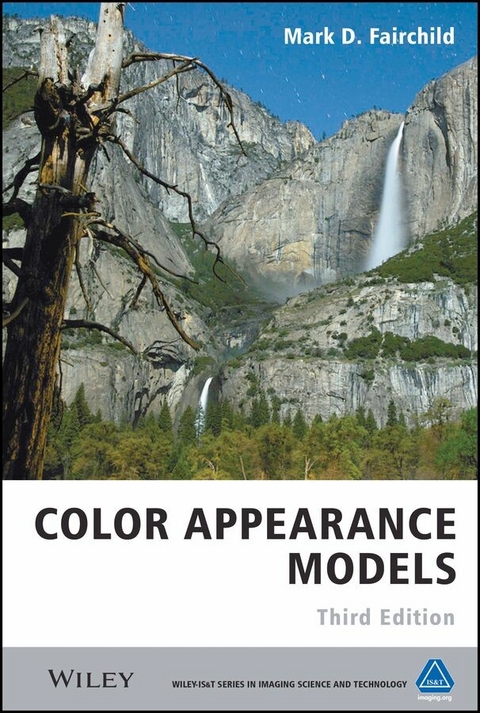
Color Appearance Models (eBook)
John Wiley & Sons (Verlag)
978-1-118-65310-4 (ISBN)
The essential resource for readers needing to understand visual perception and for those trying to produce, reproduce and measure color appearance in various applications such as imaging, entertainment, materials, design, architecture and lighting.
This book builds upon the success of previous editions, and will continue to serve the needs of those professionals working in the field to solve practical problems or looking for background for on-going research projects. It would also act as a good course text for senior undergraduates and postgraduates studying color science.
The 3rd Edition of Color Appearance Models contains numerous new and expanded sections providing an updated review of color appearance and includes many of the most widely used models to date, ensuring its continued success as the comprehensive resource on color appearance models.
Key features:
- Presents the fundamental concepts and phenomena of color appearance (what objects look like in typical viewing situations) and practical techniques to measure, model and predict those appearances.
- Includes the clear explanation of fundamental concepts that makes the implementation of mathematical models very easy to understand.
- Explains many different types of models, and offers a clear context for the models, their use, and future directions in the field.
Mark D. Fairchild, Rochester Institute of Technology, USA
Dr. Fairchild is Professor of Color Science and Imaging Science at RIT. He is an Associate Dean for Research & Graduate Education of RIT's College of Science, facilitating the growth and strengthening of the college's research activities and graduate programs. Until recently, he had been the Director of the Munsell Color Science Laboratory for the past 12 years.
Mark D. Fairchild, Rochester Institute of Technology, USA Dr. Fairchild is Professor of Color Science and Imaging Science at RIT. He is an Associate Dean for Research & Graduate Education of RIT's College of Science, facilitating the growth and strengthening of the college's research activities and graduate programs. Until recently, he had been the Director of the Munsell Color Science Laboratory for the past 12 years.
Color Appearance Models 5
Copyright 6
Contents 9
Series Preface 15
Preface 17
Acknowledgments 20
Introduction 21
1 Human Color Vision 25
1.1 Optics of the Eye 26
The Cornea 27
The Lens 27
The Humors 28
The Iris 28
The Retina 29
The Fovea 29
The Macula 30
The Optic Nerve 30
1.2 The Retina 31
Rods and Cones 32
Intrinsically Photosensitive Retinal Ganglion Cells 38
1.3 Visual Signal Processing 38
Receptive Fields 40
Processing in Area V1 41
1.4 Mechanisms of Color Vision 43
Trichromatic Theory 43
Hering’s Opponent Colors Theory 43
Modern Opponent Colors Theory 44
Adaptation Mechanisms 45
Visual Mechanisms Impacting Color Appearance 50
1.5 Spatial and Temporal Properties of Color Vision 51
The Oblique Effect 55
CSFs and Eye Movements 56
1.6 Color Vision Deficiencies 56
Protanopia, Deuteranopia, and Tritanopia 56
Anomalous Trichromacy 57
Color Vision Deficiencies and Gender 59
Screening Observers Who Make Color Judgments 60
1.7 Key Features for Color Appearance Modeling 60
2 Psychophysics 62
2.1 Psychophysics Defined 63
Two Classes of Visual Experiments 63
2.2 Historical Context 64
Weber’s Work 64
Fechner’s Work 65
Stevens’ Work 66
2.3 Hierarchy Of Scales 67
Nominal Scales 67
Ordinal Scales 67
Interval Scales 68
Ratio Scales 68
Example of the Use of Scales 68
2.4 Threshold Techniques 69
Types of Threshold Experiments 70
Method of Adjustment 70
Method of Limits 70
hod of Constant Stimuli 71
Yes–No Method 71
Forced-Choice Procedures 71
Staircase Procedures 72
Probit Analysis of Threshold Data 72
2.5 Matching Techniques 73
Asymmetric Matching 73
Memory Matching 73
2.6 One-Dimensional Scaling 74
2.7 Multidimensional Scaling 76
2.8 Design of Psychophysical Experiments 78
2.9 Importance in Color Appearance Modeling 79
3 Colorimetry 80
3.1 Basic and Advanced Colorimetry 81
3.2 Why is Color? 81
3.3 Light Sources and Illuminants 83
Spectroradiometry 83
Black-Body Radiators 84
CIE Illuminants 85
3.4 Colored Materials 87
CIE Illumination and Viewing Geometries 89
Diffuse/Normal and Normal/Diffuse 90
45/Normal and Normal/45 91
Fluorescence 92
3.5 The Human Visual Response 92
The System of Photometry 93
3.6 Tristimulus Values and Color Matching Functions 94
Tristimulus Values for Any Stimulus 95
Estimating Average Color Matching Functions 97
Two Sets of Color Matching Functions 100
3.7 Chromaticity Diagrams 101
3.8 CIE Color Spaces 103
CIELAB 104
CIELUV 104
3.9 Color Difference Specification 105
3.10 The Next Step 107
4 Color Appearance Terminology 109
4.1 Importance of Definitions 109
4.2 Color 110
4.3 Hue 112
4.4 Brightness and Lightness 112
4.5 Colorfulness and Chroma 114
4.6 Saturation 115
4.7 Unrelated and Related Colors 115
4.8 Definitions in Equations 116
4.9 Brightness–Colorfulness vs Lightness–Chroma 118
5 Color Order Systems 121
5.1 Overview and Requirements 122
5.2 The Munsell Book of Color 123
Munsell Value 123
Munsell Hue 125
Munsell Chroma 125
Munsell Book of Color 125
5.3 The Swedish NCS 128
5.4 The Colorcurve System 130
5.5 Other Color Order Systems 131
OSA Uniform Color Scales 131
DIN System 132
Ostwald System 133
5.6 Uses of Color Order Systems 133
Color Order Systems in Visual Experiments 134
Color Order Systems in Art and Design 134
Color Order Systems in Communication 134
Color Order Systems in Education 135
Color Order Systems to Evaluate Mathematical Color Appearance Models 135
Color Order Systems and Imaging Systems 136
Limitations of Color Order Systems 136
5.7 Color Naming Systems 136
The PANTONE System 137
The Trumatch System 137
Other Systems 137
6 Color Appearance Phenomena 139
6.1 What are Color Appearance Phenomena? 139
6.2 Simultaneous Contrast, Crispening, and Spreading 140
Simultaneous Contrast 140
Crispening 143
Spreading 143
6.3 Bezold–Brücke Hue Shift (Hue Changes With Luminance) 144
6.4 Abney Effect (Hue Changes with Colorimetric Purity) 145
6.5 Helmholtz–Kohlrausch Effect (Brightness Depends on Luminance and Chromaticity) 147
6.6 Hunt Effect (Colorfulness increases with Luminance) 149
6.7 Stevens Effect (Contrast Increases with Luminance) 151
6.8 Helson–Judd Effect (Hue of Non-Selective Samples) 153
6.9 Bartleson–Breneman Equations (Image Contrast changes with Surround) 155
6.10 Discounting-the-Illuminant 156
6.11 Other Context, Structural, and Psychological Effects 157
Two-Color Projections 161
6.12 Color Constancy? 164
7 Viewing Conditions 166
7.1 Configuration of the Viewing Field 166
Stimulus 167
Proximal Field 169
Background 169
Surround 170
7.2 Colorimetric Specification of the viewing field 170
7.3 Modes of Viewing 173
Illuminant 175
Illumination 177
Surface 177
Volume 177
Film 177
7.4 Unrelated and Related Colors Revisited 178
8 Chromatic Adaptation 180
8.1 Light, Dark, and Chromatic Adaptation 181
Light Adaptation 181
Dark Adaptation 182
Chromatic Adaptation 182
8.2 Physiology 183
Pupil Dilation/Constriction 185
Role of the Rods and Cones 185
Receptor Gain Control 187
Subtractive Mechanisms 187
High-Level Adpaptation Mechanisms 189
8.3 Sensory and Cognitive Mechanisms 194
Sensory Mechanisms 194
Cognitive Mechanisms 195
Hard-Copy Vs Soft-Copy Output 196
The Time-Course of Adaptation 196
8.4 Corresponding Colors Data 198
Asymmetric Matching 198
Haploscopic Matching 199
Memory Matching 199
Magnitude Estimation 199
Cross-Media Comparisons 200
8.5 Models 201
8.6 Color Inconstancy Index 202
8.7 Computational Color Constancy 203
9 Chromatic Adaptation Models 205
9.1 Von Kries Model 206
9.2 Retinex Theory 210
9.3 Nayatani et al. Model 211
MacAdam’s Model 211
Nayatani’s Model 212
9.4 Guth’s Model 214
9.5 Fairchild’s 1990 Model 216
9.6 Herding Cats 220
9.7 CAT02 221
10 Color Appearance Models 223
10.1 Definition of Color Appearance Models 223
10.2 Construction of Color Appearance Models 224
10.3 CIELAB 225
Calculating CIELAB Coordinates 225
Wrong von Kries Transform 230
10.4 Why not use just CIELAB? 234
10.5 What about CIELUV? 234
11 The Nayatani et al. Model 237
11.1 Objectives and Approach 237
11.2 Input Data 238
11.3 Adaptation Model 239
11.4 Opponent Color Dimensions 241
11.5 Brightness 242
11.6 Lightness 243
11.7 Hue 243
11.8 Saturation 244
11.9 Chroma 245
11.10 Colorfulness 245
11.11 Inverse Model 246
11.12 Phenomena Predicted 246
11.13 Why not use just the Nayatani et al. model? 247
12 The Hunt Model 249
12.1 Objectives and Approach 249
12.2 Input Data 250
12.3 Adaptation Model 252
12.4 Opponent Color Dimensions 257
12.5 Hue 258
12.6 Saturation 259
12.7 Brightness 260
12.8 Lightness 262
12.9 Chroma 262
12.10 Colorfulness 262
12.11 Inverse Model 263
12.12 Phenomena Predicted 265
12.13 Why not use just the Hunt Model? 266
13 The RLAB Model 267
13.1 Objectives and Approach 267
13.2 Input Data 269
13.3 Adaptation Model 270
13.4 Opponent Color Dimensions 272
13.5 Lightness 274
13.6 Hue 274
13.7 Chroma 276
13.8 Saturation 276
13.9 Inverse Model 276
13.10 Phenomena Predicted 278
13.11 Why not use just the RLAB Model? 278
14 Other Models 280
14.1 Overview 280
14.2 ATD Model 281
Objectives and Approach 282
Input Data 282
Adaptation Model 283
Opponent Color Dimensions 284
Perceptual Correlates 285
Phenomena Predicted 286
Why Not Use Just the ATD Model? 286
ATD04 Model 287
14.3 LLAB Model 288
Objectives and Approach 288
Input Data 289
Adaptation Model 289
Opponent Color Dimensions 291
Perceptual Correlates 292
Color Differences 293
Phenomena Predicted 293
Why Not Use Just the LLAB Model? 294
14.4 IPT Color Space 295
Why Not Use Just the IPT Model? 296
15 The CIE Color Appearance Model (1997), CIECAM97s 297
15.1 Historical Development, Objectives, and Approach 297
15.2 Input Data 300
15.3 Adaptation Model 301
15.4 Appearance Correlates 303
15.5 Inverse Model 304
15.6 Phenomena Predicted 305
15.7 The ZLAB Color Appearance Model 306
Input Data 306
Chromatic Adaptation 306
Appearance Correlates 308
15.8 Why not use just CIECAM97s? 309
16 CIECAM02 311
16.1 Objectives and Approach 311
16.2 Input Data 312
16.3 Adaptation Model 314
A Note on the CIECAM02 Chromatic Adaptation Transform 315
Remainder of CIECAM02 Adaptation Model 316
16.4 Opponent Color Dimensions 318
16.5 Hue 318
16.6 Lightness 319
16.7 Brightness 319
16.8 Chroma 319
16.9 Colorfulness 320
16.10 Saturation 320
16.11 Cartesian Coordinates 320
16.12 Inverse Model 321
16.13 Implementation Guidelines 321
16.14 Phenomena Predicted 322
16.15 Computational Issues 322
16.16 CAM02-UCS 324
16.17 Why not use just CIECAM02? 325
16.18 Outlook 325
17 Testing Color Appearance Models 327
17.1 Overview 327
17.2 Qualitative Tests 328
17.3 Corresponding-Colors Data 332
17.4 Magnitude Estimation Experiments 334
17.5 Direct Model Tests 336
17.6 Colorfulness In Projected Images 340
17.7 Munsell in Color Appearance Spaces 341
17.8 CIE Activities 342
TC1-34, Testing Colour-Appearance Models 342
TC1-27, Specification of Colour Appearance for Reflective Media and Self-Luminous Display Comparisons 344
TC1-33, Color Rendering 345
TC1-52, Chromatic Adaptation Transform 345
R1-24 Colour Appearance Models 345
TC8-01, Colour Appearance Modeling for Colour Management Applications 345
TC8-04, Adaptation Under Mixed Illumination Conditions 346
TC8-08, Testing of Spatial Colour Appearance Model 346
R8-05 Image Appearance 346
R8-06, Results of CIECAM02 346
TC8-11, CIECAM02 Mathematics 347
TC1-75, a Comprehensive Model of Colour Appearance 347
TC1-76, Unique Hue Data 347
17.9 A Pictorial Review of Color Appearance Models 347
18 Traditional Colorimetric Applications 352
18.1 Color Rendering 352
Current Techniques and Recommendations 354
Application of Color Appearance Models 355
Future Directions 355
18.2 Color Differences 357
Current Techniques and Recommendations 357
Application of Color Appearance Models 358
Future Directions 359
18.3 Indices of Metamerism 359
Current Techniques and Recommendations 360
Application of Color Appearance Models 361
Future Directions 361
18.4 A General System of Colorimetry? 361
18.5 What about Observer Metamerism? 362
19 Device-Independent Color Imaging 365
19.1 The Problem 366
19.2 Levels of Color Reproduction 367
Spectral Color Reproduction 367
Colorimetric Color Reproduction 368
Exact Color Reproduction 368
Equivalent Color Reproduction 368
Corresponding Color Reproduction 368
Preferred Color Reproduction 369
19.3 A Revised set of Objectives 369
19.4 General Solution 372
19.5 Device Calibration and Characterization 373
Three Approaches to Device Characterization 374
Physical Modeling 374
Empirical Modeling 375
Exhaustive Measurement 375
Types of Colorimetric Measurements 376
Flare, Metamerism, and Fluorescence 376
Flare 377
Metamerism 377
Fluorescence 377
19.6 The Need for Color Appearance Models 378
19.7 Definition of Viewing Conditions 379
19.8 Viewing-Conditions-Independent Color Space 381
19.9 Gamut Mapping 381
19.10 Color Preferences 385
19.11 Inverse Process 386
19.12 Example System 387
19.13 ICC Implementation 388
Profile Connection Space 389
20 Image Appearance Modeling and the Future 393
20.1 From Color Appearance to Image Appearance 394
Image Colorimetry 394
Color Difference Equations 395
Image Difference 395
olor Appearance 396
Image Appearance and Image Quality 396
Color and Image Appearance Models 399
20.2 S-CIELAB 399
20.3 The iCAM Framework 400
20.4 A Modular Image Difference Model 406
Spatial Filtering 407
Spatial Frequency Adaptation 407
Spatial Localization 409
Local Contrast Detection 409
Color Difference Map 409
20.5 Image Appearance and Rendering Applications 409
20.6 Image Difference and Quality Applications 415
20.7 iCAM06 416
20.8 Orthogonal Color Space 417
20.9 Future Directions 420
One Color Appearance Model? 420
Other Color Appearance Models 421
Ongoing Research to Test Models 421
Ongoing Model Development 422
21 High-Dynamic-Range Color Space 423
21.1 Luminance Dynamic Range 424
21.2 The HDR Photographic Survey 425
21.3 Lightness–Brightness Beyond Diffuse White 427
21.4 hdr-CIELAB 428
21.5 hdr-IPT 430
21.6 Evans, G0, and Brilliance 431
21.7 The Nayatani Theoretical Color Space 433
21.8 A New Kind of Appearance Space 433
21.9 Future Directions 440
What To Do Now 440
References 442
Index 464
| Erscheint lt. Verlag | 7.6.2013 |
|---|---|
| Reihe/Serie | The Wiley-IS&T Series in Imaging Science and Technology |
| Wiley-IS&T Series in Imaging Science and Technology | Wiley-IS&T Series in Imaging Science and Technology |
| Sprache | englisch |
| Themenwelt | Medizin / Pharmazie ► Medizinische Fachgebiete ► Neurologie |
| Technik ► Elektrotechnik / Energietechnik | |
| Schlagworte | Bildgebende Systeme u. Verfahren • Color Appearance Models, Visual Perception, Color Science, Color Phenomena, Color Appearance Measurement • Electrical & Electronics Engineering • Electrical Engineering - Displays • Elektronische Displays • Elektrotechnik u. Elektronik • Farbe • Farbmanagement • Imaging Systems & Technology |
| ISBN-10 | 1-118-65310-6 / 1118653106 |
| ISBN-13 | 978-1-118-65310-4 / 9781118653104 |
| Informationen gemäß Produktsicherheitsverordnung (GPSR) | |
| Haben Sie eine Frage zum Produkt? |
 PDF (Adobe DRM)
Größe: 15,7 MB
Kopierschutz: Adobe-DRM
Adobe-DRM ist ein Kopierschutz, der das eBook vor Mißbrauch schützen soll. Dabei wird das eBook bereits beim Download auf Ihre persönliche Adobe-ID autorisiert. Lesen können Sie das eBook dann nur auf den Geräten, welche ebenfalls auf Ihre Adobe-ID registriert sind.
Details zum Adobe-DRM
Dateiformat: PDF (Portable Document Format)
Mit einem festen Seitenlayout eignet sich die PDF besonders für Fachbücher mit Spalten, Tabellen und Abbildungen. Eine PDF kann auf fast allen Geräten angezeigt werden, ist aber für kleine Displays (Smartphone, eReader) nur eingeschränkt geeignet.
Systemvoraussetzungen:
PC/Mac: Mit einem PC oder Mac können Sie dieses eBook lesen. Sie benötigen eine
eReader: Dieses eBook kann mit (fast) allen eBook-Readern gelesen werden. Mit dem amazon-Kindle ist es aber nicht kompatibel.
Smartphone/Tablet: Egal ob Apple oder Android, dieses eBook können Sie lesen. Sie benötigen eine
Geräteliste und zusätzliche Hinweise
Zusätzliches Feature: Online Lesen
Dieses eBook können Sie zusätzlich zum Download auch online im Webbrowser lesen.
Buying eBooks from abroad
For tax law reasons we can sell eBooks just within Germany and Switzerland. Regrettably we cannot fulfill eBook-orders from other countries.
 EPUB (Adobe DRM)
Kopierschutz: Adobe-DRM
Adobe-DRM ist ein Kopierschutz, der das eBook vor Mißbrauch schützen soll. Dabei wird das eBook bereits beim Download auf Ihre persönliche Adobe-ID autorisiert. Lesen können Sie das eBook dann nur auf den Geräten, welche ebenfalls auf Ihre Adobe-ID registriert sind.
Details zum Adobe-DRM
Dateiformat: EPUB (Electronic Publication)
EPUB ist ein offener Standard für eBooks und eignet sich besonders zur Darstellung von Belletristik und Sachbüchern. Der Fließtext wird dynamisch an die Display- und Schriftgröße angepasst. Auch für mobile Lesegeräte ist EPUB daher gut geeignet.
Systemvoraussetzungen:
PC/Mac: Mit einem PC oder Mac können Sie dieses eBook lesen. Sie benötigen eine
eReader: Dieses eBook kann mit (fast) allen eBook-Readern gelesen werden. Mit dem amazon-Kindle ist es aber nicht kompatibel.
Smartphone/Tablet: Egal ob Apple oder Android, dieses eBook können Sie lesen. Sie benötigen eine
Geräteliste und zusätzliche Hinweise
Buying eBooks from abroad
For tax law reasons we can sell eBooks just within Germany and Switzerland. Regrettably we cannot fulfill eBook-orders from other countries.
aus dem Bereich