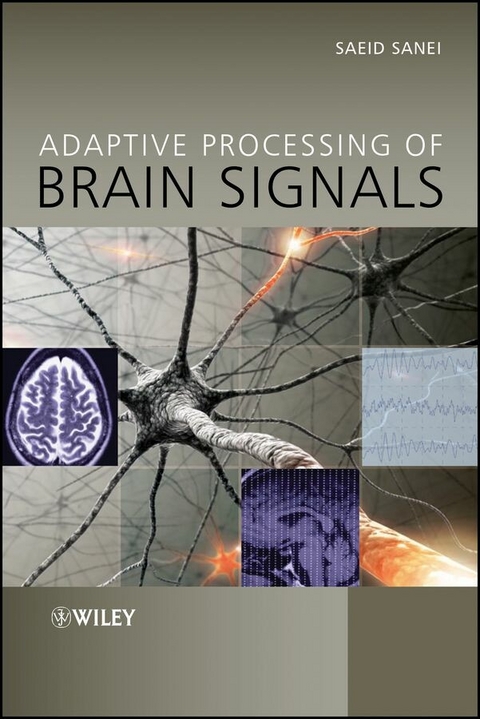
Adaptive Processing of Brain Signals (eBook)
John Wiley & Sons (Verlag)
978-1-118-62215-5 (ISBN)
Brain signal processing spans a broad range of knowledge across engineering, science and medicine, and this book brings together the disparate theory and application to create a comprehensive resource on this growing topic. It will provide advanced tools for the detection, monitoring, separation, localizing and understanding of brain functional, anatomical, and physiological abnormalities. The focus will be on advanced and adaptive signal processing techniques for the processing of electroencephalography and magneto-encephalography signals, and their correlation to the corresponding functional magnetic resonance imaging (fMRI). Multimodal processing of brain signals, the new focus for brain signal research, will also be explored. The book covers the broad remit of neuro-imaging, ensuring comprehensive coverage of all issues related to brain signal processing. Topics such as mental fatigue, brain connectivity and new recording techniques will also be covered.
This book will be a progression/follow on from Dr Sanei's first book with Wiley, EEG Signal Processing.
In this book, the field of adaptive learning and processing is extended to arguably one of its most important contexts which is the understanding and analysis of brain signals. No attempt is made to comment on physiological aspects of brain activity; instead, signal processing methods are developed and used to assist clinical findings. Recent developments in detection, estimation and separation of diagnostic cues from different modality neuroimaging systems are discussed. These include constrained nonlinear signal processing techniques which incorporate sparsity, nonstationarity, multimodal data, and multiway techniques. Key features: Covers advanced and adaptive signal processing techniques for the processing of electroencephalography (EEG) and magneto-encephalography (MEG) signals, and their correlation to the corresponding functional magnetic resonance imaging (fMRI) Provides advanced tools for the detection, monitoring, separation, localising and understanding of functional, anatomical, and physiological abnormalities of the brain Puts a major emphasis on brain dynamics and how this can be evaluated for the assessment of brain activity in various states such as for brain-computer interfacing emotions and mental fatigue analysis Focuses on multimodal and multiway adaptive processing of brain signals, the new direction of brain signal research
Dr Saeid Sanei, Reader in Biomedical Signal Processing and Deputy Head of Computing Department, Faculty of Engineering and Physical Sciences, University of Surrey, Guildford, Surrey, United Kingdom. Dr Sanei received his PhD from Imperial College of Science, Technology and Medicine, London, in Biomedical Signal and Image Processing in 1991. He has made a major contribution to Electroencephalogram (EEG) analysis; blind source separation, sparse component analysis and compressive sensing; parallel factor analysis and tensor factorization; particle filtering; chaos and time series analysis; support vector machines; hidden Markov models; and brain computer interfacing (BCI).He has published over 180 papers in refereed journals and conference proceedings, and a book on EEG Signal Processing. He has served as an editor, member of the technical committee, and reviewer for a number of journals and conferences, and has recently been selected as the Biomedical Signal Processing Track Chair for the IEEE Engineering in Medicine and Biology Conference 2009. His international collaborations involve both educational and industrial organizations, including the RIKEN Brain Science Research Institute in Japan. He also teaches extensively at both undergraduate and postgraduate level.
| Erscheint lt. Verlag | 30.5.2013 |
|---|---|
| Sprache | englisch |
| Themenwelt | Medizin / Pharmazie ► Medizinische Fachgebiete ► Neurologie |
| Medizin / Pharmazie ► Medizinische Fachgebiete ► Radiologie / Bildgebende Verfahren | |
| Technik ► Elektrotechnik / Energietechnik | |
| Schlagworte | biomedical engineering • Biomedizintechnik • Biosignal processing • Biosignalverarbeitung • Electrical & Electronics Engineering • electroencephalography, magneto-encephalography, neuro-imaging, neuroimaging, brain signal processing, fMRI, functional magnetic resonance, MRI, multisensory brain signal processing, multimodal brain imaging, multimodal brain signal processing • Elektrotechnik u. Elektronik • Neural networks • Neuronale Netze • Signal Processing • Signalverarbeitung |
| ISBN-10 | 1-118-62215-4 / 1118622154 |
| ISBN-13 | 978-1-118-62215-5 / 9781118622155 |
| Informationen gemäß Produktsicherheitsverordnung (GPSR) | |
| Haben Sie eine Frage zum Produkt? |
 EPUB (Adobe DRM)
Größe: 10,3 MB
Kopierschutz: Adobe-DRM
Adobe-DRM ist ein Kopierschutz, der das eBook vor Mißbrauch schützen soll. Dabei wird das eBook bereits beim Download auf Ihre persönliche Adobe-ID autorisiert. Lesen können Sie das eBook dann nur auf den Geräten, welche ebenfalls auf Ihre Adobe-ID registriert sind.
Details zum Adobe-DRM
Dateiformat: EPUB (Electronic Publication)
EPUB ist ein offener Standard für eBooks und eignet sich besonders zur Darstellung von Belletristik und Sachbüchern. Der Fließtext wird dynamisch an die Display- und Schriftgröße angepasst. Auch für mobile Lesegeräte ist EPUB daher gut geeignet.
Systemvoraussetzungen:
PC/Mac: Mit einem PC oder Mac können Sie dieses eBook lesen. Sie benötigen eine
eReader: Dieses eBook kann mit (fast) allen eBook-Readern gelesen werden. Mit dem amazon-Kindle ist es aber nicht kompatibel.
Smartphone/Tablet: Egal ob Apple oder Android, dieses eBook können Sie lesen. Sie benötigen eine
Geräteliste und zusätzliche Hinweise
Buying eBooks from abroad
For tax law reasons we can sell eBooks just within Germany and Switzerland. Regrettably we cannot fulfill eBook-orders from other countries.
 PDF (Adobe DRM)
Kopierschutz: Adobe-DRM
Adobe-DRM ist ein Kopierschutz, der das eBook vor Mißbrauch schützen soll. Dabei wird das eBook bereits beim Download auf Ihre persönliche Adobe-ID autorisiert. Lesen können Sie das eBook dann nur auf den Geräten, welche ebenfalls auf Ihre Adobe-ID registriert sind.
Details zum Adobe-DRM
Dateiformat: PDF (Portable Document Format)
Mit einem festen Seitenlayout eignet sich die PDF besonders für Fachbücher mit Spalten, Tabellen und Abbildungen. Eine PDF kann auf fast allen Geräten angezeigt werden, ist aber für kleine Displays (Smartphone, eReader) nur eingeschränkt geeignet.
Systemvoraussetzungen:
PC/Mac: Mit einem PC oder Mac können Sie dieses eBook lesen. Sie benötigen eine
eReader: Dieses eBook kann mit (fast) allen eBook-Readern gelesen werden. Mit dem amazon-Kindle ist es aber nicht kompatibel.
Smartphone/Tablet: Egal ob Apple oder Android, dieses eBook können Sie lesen. Sie benötigen eine
Geräteliste und zusätzliche Hinweise
Buying eBooks from abroad
For tax law reasons we can sell eBooks just within Germany and Switzerland. Regrettably we cannot fulfill eBook-orders from other countries.
aus dem Bereich