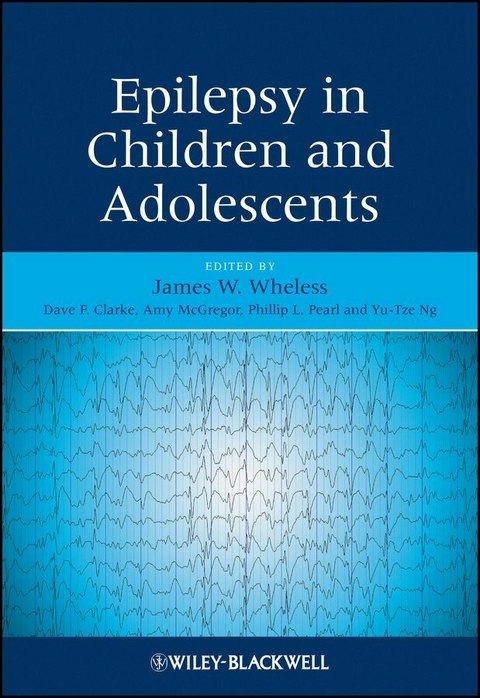
Epilepsy in Children and Adolescents (eBook)
John Wiley & Sons (Verlag)
978-1-118-38851-8 (ISBN)
David F. Clarke, MD, Dell Children's Comprehensive Epilepsy Program, Austin, TX, USA
Amy L. McGregor, MD, University of Tennessee Health Center and Le Bonheur Children’s Hospital, Memphis, TN, USA
Philip L. Pearl, MD, Children's National Medical Center, Washington, DC
Yu-Tze Ng, MD, University of Oklahoma College of Medicine, Oklahoma City, OK
Epilepsy in childhood presents a profound challenge Epilepsy is an unsettling, complex condition. There is no one size fits all option. For effective treatment a full understanding of each patient s situation and clinical history is needed. Recent remarkable improvements in our ability to image brain structures, to define physiological patterns and in treatment options has made the task of care of the child with epilepsy potentially more effective. Epilepsy in Children and Adolescents provides the contemporary, caring guidance you need to diagnose and manage seizures in a young patient. Beginning with an overview of the classification of epilepsy syndromes, the experienced authors cover: Diagnostic evaluation of childhood epilepsies Principles of treatment Generalized seizures and generalized epilepsy syndromes Partial onset seizures and localization-related epilepsy syndromes Epilepsies relative to age, etiology or duration The full range of treatment options: medical, dietary, surgical Epilepsy in Children and Adolescents takes a practical approach to a common but complex clinical challenge.
David F. Clarke, MD, Dell Children's Comprehensive Epilepsy Program, Austin, TX, USA Amy L. McGregor, MD, University of Tennessee Health Center and Le Bonheur Children's Hospital, Memphis, TN, USA Philip L. Pearl, MD, Children's National Medical Center, Washington, DC Yu-Tze Ng, MD, University of Oklahoma College of Medicine, Oklahoma City, OK
"In general, I think this book very sound. It would
be an excellent introduction for neurology residents and a good
review for general paediatric neurologists who feel a bit out of
touch with current treatments for epilepsy." (The
Canadian Journal of Neurological Sciences, 1 September
2013)
"This is an exceptional read, unlike others in the way it
addresses the treatment of children with epilepsy, rather than just
the treatment of epilepsy." (Doody's, 2
August 2013)
1
Epidemiology and common comorbidities of epilepsy in childhood
Jay Salpekar1, Matthew Byrne2 and Georgann Ferrone1
1Center for Neuroscience and Behavioral Medicine, Children's National Medical Center, Washington, DC, USA
2Uniformed Services University of the Health Sciences, Bethesda, MD, USA
Epilepsy is a common illness in childhood, and the epidemiology has been well described. However, epilepsy is also complex and controversial in terms of optimal methods for diagnosis and treatment. Classification schemes for seizures have been refined over the years and improved treatment options have allowed better outcomes for children with epilepsy. Understanding of comorbidity, particularly psychiatric comorbidity, has also improved over recent years, yet in many cases it is difficult to resolve whether psychiatric illness is coincidental or associated with the underlying seizure disorder. This chapter addresses the incidence and prevalence of childhood epilepsy and strategies for identifying and managing common psychiatric comorbidities.
1.1 Epidemiology
An epileptic seizure is defined as the clinical manifestation of abnormal or excessive discharge of neurons in the brain [1]. Epilepsy is defined as recurrent seizures, specifically two or more seizures separated by 24 hours but within 18 months of one another [1,2]. This common consensus is based on observations that children who experience one seizure have an approximately 50% chance of recurrence within 2 years [3,4]. It is important to note that febrile seizures are not included in most epidemiological studies of epilepsy.
Population-based studies concerning seizures and epilepsy have been done in numerous communities around the world. Although many international studies of prevalence are based on small communities, the results can be extrapolated to reflect wider regions of the world. In the United States, there are approximately 2.3 million people diagnosed with epilepsy, which reflects an incidence of approximately 1% of the population [5]. The pediatric population, however, has a higher prevalence of epilepsy; 4–10% of children will experience a seizure before the age of 16. Thus, a working knowledge of epilepsy is very important for primary and specialty clinicians in pediatrics, as well as for pediatric neurologists [6].
1.2 Incidence and prevalence
In the general population, the incidence of epilepsy is reported at between 40 and 70 cases per 100 000 [7]. The incidence of childhood epilepsy has been reported to be 82.2 per 100 000 children, markedly higher than that of the overall population [8]. A meta-analysis of over 40 epidemiological studies found that the highest incidence of epilepsy occurs in childhood and in the geriatric population. Interestingly, the incidence of epilepsy has been decreasing over the past 50 years. This decrease in incidence could be explained by more stringent and/or universally followed diagnostic criteria or perhaps from a decrease in exposure to epilepsy risk factors [8].
The overall number of children affected by epilepsy, or the prevalence of the disease, is higher than the incidence because of the chronic nature of epilepsy. A significant variation in prevalence is found in international epidemiology studies [9-12]. In the United States, epilepsy prevalence averages 3.83 per 1000 children, while in northern Tanzania, it is 7.39 per 1000 [13,14]. This discrepancy may result from a variety of factors including possible misclassification of a single seizure as epilepsy. Environmental factors, access to healthcare, and different methods of reporting may also account for some of the variability. The prevalence of epilepsy in varying regions across the world is described in Table 1.1.
Table 1.1 International epidemiology studies.
1.3 Gender and age
Studies have consistently found that males are diagnosed with epilepsy more often than females [18]. While the difference between the genders is slight, this trend holds true for most populations [13]. Although there are exceptions to this trend, they are rarely statistically significant in children [10,11]. Analysis of prevalence among children of varying ages found that epilepsy was most common in children under the age of 5, with a gradual decline in occurrence in older age groups [15]. Figure 1.1 demonstrates the peak of prevalence at a young age and a gradual decrease in children as they age.
FIGURE 1.1 Graph showing prevalence of epilepsy (per 1000) in children by year from age 1 to 19 [16].
1.4 Classification
When studying the epidemiology of epilepsy, means of classification must be clarified to ensure uniformity in standards. Since 1909, the International League Against Epilepsy (ILAE) has worked toward identifying, studying, and classifying all variations of seizure disorders. Epilepsy syndromes can be classified as localization-related or generalized. The syndromes are determined by multiple criteria, with particular emphasis on seizure type as well as associated patient characteristics such as age of onset, comorbidities including neurodevelopmental status, presence of associated family history, and identification of an underlying etiology [1]. Distinguishing characteristics of seizure types can range from loss or modification of consciousness and responsiveness, along with total or partial motor control impairment [2].
A 40-year detailed study done in Rochester, Minnesota, found that partial seizures are the most prevalent, followed by generalized tonic-clonic, absence, and then myoclonic. Details for prevalence are represented in Figure 1.2 [13].
FIGURE 1.2 Bar graph of relative prevalence of adolescent seizure etiologies (per 1000) [13].
1.5 Febrile seizures
Febrile seizures are a common seizure disorder for children under the age of 3 years. Between 2% and 4% of children will suffer from one febrile seizure, and only one-third of these children will have a second seizure [18]. Most importantly, a febrile seizure will not always lead to epilepsy. Between 2% and 10% of children who experience one febrile seizure will develop epilepsy [19].
1.6 Etiology
Most cases of epilepsy are of unknown etiology [12]. Recent guidelines have identified three main classifications of epilepsy etiologies: Genetic, metabolic/structural, and idiopathic/unknown [2]. Genetic disorders include diseases due to a known genetic defect in which seizures are the main manifestation of the disease. Seizures of metabolic/structural etiology can be those epilepsies attributed to lesions, which are often a result of head trauma, central nervous system (CNS) infection, or tumor [4]. Epilepsy of unknown etiology represents the most common designation for epilepsy in childhood.
1.7 Psychiatric comorbidity
Psychiatric and psychological complications are commonly associated with pediatric epilepsy [20-23]. In pediatrics, the classic Isle of Wight epidemiology study reports psychiatric illness present in 16% of patients with chronic medical illness; however, if that illness happened to be epilepsy, the psychiatric comorbidity was 29% [24]. Subsequent studies have confirmed an overrepresentation of psychiatric illness associated with epilepsy as compared to many other chronic medical illnesses. Some studies report a two- or three-fold greater prevalence of psychiatric illness associated with epilepsy as compared to diabetes or asthma [25,26]. Of particular concern is evidence showing an overrepresentation of epilepsy among children and adolescents hospitalized for suicide attempts [27]. Despite numerous reports confirming high levels of comorbidity, many children and adolescents with epilepsy do not receive treatment for psychiatric illness [28]. In many cases, the psychiatric comorbidity may be more impairing to quality of life for children and families than the seizures themselves [29].
This consistently high level of psychiatric comorbidity suggests that epilepsy is a complicated illness that may have neuropsychiatric symptoms well beyond discrete seizures. However, the etiology of psychiatric comorbidity in children and adolescents with epilepsy is still controversial. Psychiatric illness may be difficult to isolate as an independent disorder in the context of seizure events. Some symptoms may be clearly related to ictal or postictal phenomena, but more often, psychiatric symptoms occur during interictal time periods and may be viewed as only indirectly related to epilepsy pathophysiology [30]. Classic views of forced normalization, in which psychiatric symptoms increase when the epilepsy stabilizes (the EEG “normalizes”), complicate conceptualization of comorbidity in relation to epilepsy pathophysiology [31]. Nevertheless, the frequent occurrence of psychiatric disorder has raised awareness of the need for an interdisciplinary approach to management of epilepsy [32,33]. The existing literature tends to focus upon one of three potential explanations for psychiatric comorbidity: symptoms related to psychosocial stress of chronic disease; symptoms related to medication side effects; and symptoms directly related to epilepsy pathophysiology.
1.8 Psychological and psychosocial stress related to chronic disease
Studies of health-related quality of life consistently report marked psychosocial stress for...
| Erscheint lt. Verlag | 22.10.2012 |
|---|---|
| Sprache | englisch |
| Themenwelt | Medizin / Pharmazie ► Allgemeines / Lexika |
| Medizin / Pharmazie ► Medizinische Fachgebiete ► Neurologie | |
| Schlagworte | Ability • brain • Care • Child • Childhood • Effective • Epilepsie • Epilepsy • epilepsy potentially • full • History • Medical Science • Medizin • Neurologie • Neurology • One • Option • patients • Patterns • Physiological • presents • profound challenge • Psychiatrie • Psychiatry • recent remarkable • Situation • Structures • Task • Treatment • unsettling |
| ISBN-10 | 1-118-38851-8 / 1118388518 |
| ISBN-13 | 978-1-118-38851-8 / 9781118388518 |
| Informationen gemäß Produktsicherheitsverordnung (GPSR) | |
| Haben Sie eine Frage zum Produkt? |
 EPUB (Adobe DRM)
Kopierschutz: Adobe-DRM
Adobe-DRM ist ein Kopierschutz, der das eBook vor Mißbrauch schützen soll. Dabei wird das eBook bereits beim Download auf Ihre persönliche Adobe-ID autorisiert. Lesen können Sie das eBook dann nur auf den Geräten, welche ebenfalls auf Ihre Adobe-ID registriert sind.
Details zum Adobe-DRM
Dateiformat: EPUB (Electronic Publication)
EPUB ist ein offener Standard für eBooks und eignet sich besonders zur Darstellung von Belletristik und Sachbüchern. Der Fließtext wird dynamisch an die Display- und Schriftgröße angepasst. Auch für mobile Lesegeräte ist EPUB daher gut geeignet.
Systemvoraussetzungen:
PC/Mac: Mit einem PC oder Mac können Sie dieses eBook lesen. Sie benötigen eine
eReader: Dieses eBook kann mit (fast) allen eBook-Readern gelesen werden. Mit dem amazon-Kindle ist es aber nicht kompatibel.
Smartphone/Tablet: Egal ob Apple oder Android, dieses eBook können Sie lesen. Sie benötigen eine
Geräteliste und zusätzliche Hinweise
Buying eBooks from abroad
For tax law reasons we can sell eBooks just within Germany and Switzerland. Regrettably we cannot fulfill eBook-orders from other countries.
aus dem Bereich