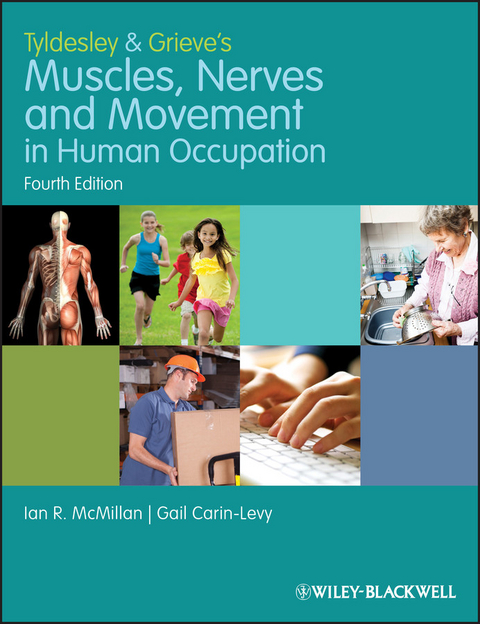
Tyldesley and Grieve's Muscles, Nerves and Movement in Human Occupation (eBook)
John Wiley & Sons (Verlag)
978-1-118-71395-2 (ISBN)
Early chapters provide a foundation for the study of movement, with the complexity of detail increasing as the book progresses. Functional anatomy is related to the movements of daily living and is supported by activities for experiencing and observing the way we perform everyday tasks. Later chapters consider the integration of sensory and motor processes for the planning and execution of movement.
This fourth edition has been extensively updated and revised. Highly illustrated and now in full colour throughout the book also includes:
• Case histories with self assessment exercises
• Summary boxes
• Key terms
• Practice notepads
About the authors
Ian R. McMillan
is Senior Lecturer in Occupational Therapy, School of Health Sciences, Queen Margaret University, Edinburgh, UK
Gail Carin-Levy
is Lecturer in Occupational Therapy, School of Health Sciences, Queen Margaret University, Edinburgh, UK
Now in its fourth edition 'Tyldesley and Grieve's Muscles, Nerves and Movement' has established itself as the leading textbook for the study of movement by occupational therapists. The book provides students with a sound understanding of the way in which bones, joints, muscles and nerves allow the body to perform movement during daily activities. Early chapters provide a foundation for the study of movement, with the complexity of detail increasing as the book progresses. Functional anatomy is related to the movements of daily living and is supported by activities for experiencing and observing the way we perform everyday tasks. Later chapters consider the integration of sensory and motor processes for the planning and execution of movement. This fourth edition has been extensively updated and revised. Highly illustrated and now in full colour throughout the book also includes: Case histories with self assessment exercises Summary boxes Key terms Practice notepads
About the authors Ian R. McMillan is Senior Lecturer in Occupational Therapy, School of Health Sciences, Queen Margaret University, Edinburgh, UK Gail Carin-Levy is Lecturer in Occupational Therapy, School of Health Sciences, Queen Margaret University, Edinburgh, UK
Cover 1
Title Page 5
Contents 7
Preface to the f ourth e dition 11
Acknowledgements 12
Section I: Introduction to movement 13
Chapter 1 Basic units, structure and function: supporting tissues, muscle and nerve 15
Framework and support: the connective tissues 16
Articulations 21
Skeletal muscle 24
Basic units of the nervous system 30
Muscle tone 39
Summary 41
Chapter 2 Movement terminology 43
The anatomical position 44
Planes and axes of movement 45
Structure and movements at synovial joints 46
Group action and types of muscle work 50
Biomechanical principles 53
Summary 61
Chapter 3 The central nervous system: the brain and spinal cord 62
PART I : THE BRAIN 63
Introduction to the form and structure 63
Cerebral hemispheres 68
Basal ganglia 77
Thalamus 78
Hypothalamus and limbic system 79
Brain stem 81
Cerebellum 83
Summary of brain areas: function in movement 85
PART II : THE SPINAL CORD 85
Position and segmentation of the spinal cord 85
Spinal reflex pathways 91
Summary of the functions of the spinal cord 94
Summary 94
Chapter 4 The peripheral nervous system: cranial and spinal nerves 96
Introduction 97
Spinal nerves 98
Peripheral nerves 102
Cranial nerves 104
Autonomic nervous system 108
Summary 111
Section II: Anatomy of movement in everyday living 113
Chapter 5 Positioning movements: the shoulder and elbow 115
Introduction 116
PART I : THE SHOULDER 117
The shoulder (pectoral) girdle 117
The shoulder (glenohumeral) joint 120
Muscles of the shoulder region 121
PART II : THE ELBOW 133
Elbow position and function 133
The elbow joint 133
Muscles moving the elbow 135
Summary of the shoulder and elbow in functional movements 139
Summary 141
Chapter 6 Manipulative movements: the forearm, wrist and hand 142
Introduction 143
Functions of the forearm and wrist 143
The forearm 143
The wrist 146
Functions of the hand 152
Movements of the hand: fingers and thumb 153
Muscles moving the hand: fingers and thumb 156
Types of grip 169
Summary of muscles of the forearm and intrinsic muscles of the hand 172
Summary 173
Chapter 7 Nerve supply of the upper lmb 174
Introduction 175
The brachial plexus 175
Terminal branches of the brachial plexus 177
Axillary nerve: shoulder movement 177
Spinal segmental innervation of the upper limb 185
Summary 186
Chapter 8 Support and propulsion: the lower limb 187
Introduction 188
Joints and movements of the pelvis, thigh and leg 188
Muscles of the thigh and leg in support, swing and propulsion 195
Functions of the foot 209
Summary of the lower limb muscles 216
Summary 216
Chapter 9 Nerve supply of the lower limb 218
Introduction 219
Lumbar plexus: position and formation 219
Terminal branches of the lumbar plexus 219
Sacral plexus: position and formation 223
Terminal branches of the sacral plexus 223
Spinal segmental innervation of the lower limb 228
Summary 228
Chapter 10 Upright posture and breathing: the trunk 230
Introduction 231
Upright posture 232
Breathing 242
Pelvic tilt and the pelvic floor 248
Nerve supply of the muscles of the neck and trunk 250
Summary of the muscles of the trunk 251
Summary 251
Section III: Sensorimotor control of movement 253
Chapter 11 Sensory background to movement 255
Somatosensory system 256
Vestibular system 266
Visual system 268
Regulation of posture 270
Summary 271
Chapter 12 Motor control 273
Introduction 274
Spinal mechanisms 274
Descending motor system 279
Planning, co-ordination and motor learning 284
Summary 289
Section IV: Human occupation 291
Chapter 13 Occupational performance skills and capacities 293
Multiple factors in control of occupational performance skills 294
Core positions and patterns of occupational performance skills 298
Summary 312
Chapter 14 Occupational performance 313
Introduction 314
Framework for understanding human occupation 314
Case scenarios 317
PART I 318
Example case scenario 318
Further case scenarios 320
Case s cenario 1: Mabel the ageing process
Case scenario 2: Mary Parkinson’s disease
Case scenario 3: John traumatic brain injury
Case scenario 4: Patrick hand injury
Case scenario 5: Christopher spinal cord injury
Case scenario 6: Susan chronic pain
PART II 325
Case scenario 1: Mabel the ageing process
Case scenario 2: Mary Parkinson’s disease
Case scenario 3: John traumatic brain injury
Case scenario 4: Patrick hand injury
Case scenario 5: Christopher spinal cord injury
Case scenario 6: Susan chronic pain
Conclusion 335
References 335
Further reading 336
Appendix I: Bones 338
Appendix II: Segmental nerve supply of muscles 348
Glossary 352
Index 366
Practice note-pad list 377
| Erscheint lt. Verlag | 20.5.2013 |
|---|---|
| Sprache | englisch |
| Themenwelt | Medizin / Pharmazie ► Naturheilkunde |
| Medizin / Pharmazie ► Physiotherapie / Ergotherapie ► Ergotherapie | |
| Studium ► 1. Studienabschnitt (Vorklinik) ► Physiologie | |
| Schlagworte | Activities • Body • Bones • Book • book provides • Chapters • Complexity • daily • Detail • Ergotherapie • Foundation • Fourth • Gesundheits- u. Sozialwesen • Health & Social Care • Human Occupation • increasing • leading • Movement • movements • Occupational • occupational therapy • perform movement • Progresses • Study • Textbook • Therapists • Way |
| ISBN-10 | 1-118-71395-8 / 1118713958 |
| ISBN-13 | 978-1-118-71395-2 / 9781118713952 |
| Informationen gemäß Produktsicherheitsverordnung (GPSR) | |
| Haben Sie eine Frage zum Produkt? |
 PDF (Adobe DRM)
Kopierschutz: Adobe-DRM
Adobe-DRM ist ein Kopierschutz, der das eBook vor Mißbrauch schützen soll. Dabei wird das eBook bereits beim Download auf Ihre persönliche Adobe-ID autorisiert. Lesen können Sie das eBook dann nur auf den Geräten, welche ebenfalls auf Ihre Adobe-ID registriert sind.
Details zum Adobe-DRM
Dateiformat: PDF (Portable Document Format)
Mit einem festen Seitenlayout eignet sich die PDF besonders für Fachbücher mit Spalten, Tabellen und Abbildungen. Eine PDF kann auf fast allen Geräten angezeigt werden, ist aber für kleine Displays (Smartphone, eReader) nur eingeschränkt geeignet.
Systemvoraussetzungen:
PC/Mac: Mit einem PC oder Mac können Sie dieses eBook lesen. Sie benötigen eine
eReader: Dieses eBook kann mit (fast) allen eBook-Readern gelesen werden. Mit dem amazon-Kindle ist es aber nicht kompatibel.
Smartphone/Tablet: Egal ob Apple oder Android, dieses eBook können Sie lesen. Sie benötigen eine
Geräteliste und zusätzliche Hinweise
Buying eBooks from abroad
For tax law reasons we can sell eBooks just within Germany and Switzerland. Regrettably we cannot fulfill eBook-orders from other countries.
aus dem Bereich