


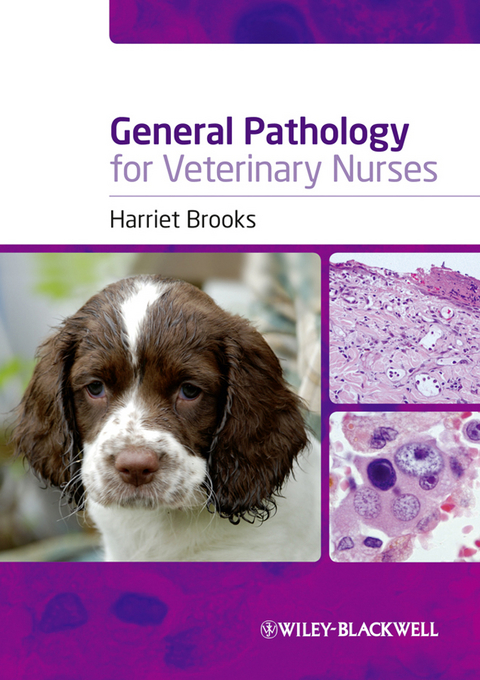
General Pathology for Veterinary Nurses (eBook)
John Wiley & Sons (Verlag)
978-1-118-69983-6 (ISBN)
This is one of the first books on general pathology designed specifically for veterinary nurses and veterinary nursing students.
Pathology underpins all you do as a veterinary nurse. Knowledge of the general pathological processes will give you a deeper understanding of every aspect of an animal's health. Building on your prior knowledge of anatomy, physiology and biochemistry, the book explains the pathological changes that occur in sick animals. It describes the various disease processes and shows you how to relate them to clinical presentation, diagnosis and prognosis, and treatment rationales. This book will give you the knowledge and confidence to develop your role within the veterinary team.
Designed as a concise, easy to read textbook, it includes:
- Detailed illustrations to explain the science behind the pathological processes
- Summary boxes of key information to aid revision
- A 'test yourself' section at the end of each chapter
Dr Harriet Brooks, BVetMed, PhD, MRCVS. Lecturer in Anatomic Pathology, The Royal Veterinary College
A good understanding of pathology will turn a competent veterinary nurse into an outstanding one. Harriet Brooks. This is one of the first books on general pathology designed specifically for veterinary nurses and veterinary nursing students. Pathology underpins all you do as a veterinary nurse. Knowledge of the general pathological processes will give you a deeper understanding of every aspect of an animal s health. Building on your prior knowledge of anatomy, physiology and biochemistry, the book explains the pathological changes that occur in sick animals. It describes the various disease processes and shows you how to relate them to clinical presentation, diagnosis and prognosis, and treatment rationales. This book will give you the knowledge and confidence to develop your role within the veterinary team. Designed as a concise, easy to read textbook, it includes: Detailed illustrations to explain the science behind the pathological processes Summary boxes of key information to aid revision A test yourself section at the end of each chapter
Dr Harriet Brooks, BVetMed, PhD, MRCVS. Lecturer in Anatomic Pathology, The Royal Veterinary College
About This Book.
Acknowledgements.
1 Introduction to Veterinary Pathology.
What is pathology?
Who 'does' pathology?
Pathology as an academic subject.
2 Aetiology.
Introduction.
Aetiology - the study of the causes of disease
3 Cell Injury.
Lesions - structural and functional changes.
Definitions of cell response or injury followingharmful
stimulus.
Cellular degeneration.
Necrosis.
Extracellular changes.
4 Inflammation.
What is inflammation?
Nomenclature.
5 Pathology and the Immune System.
The normal immune system.
Diseases of the immune system.
6 Tissue Repair.
Definition of tissue repair or healing.
Tissue repair - general and specific examples.
Healing in various tissues.
Healing regulation and control.
What can impair, prevent or alter healing?
7 Circulatory Disorders.
Special note regarding capillaries.
How does interstitial fluid gather in the tissues?
Oedema.
Impaired blood supply to tissues.
Clotting (coagulation) of blood.
Shock.
8 Disorders of Cell/Tissue Growth.
Atrophy, hypertrophy, hyperplasia and metaplasia.
Neoplasia.
Glossary.
Answers to Test Yourself Questions.
Further Reading.
Index.
"This book is comprehensible in its entirety and boasts a logical
structure. While it specifically suits UK student and qualified
veterinary nurses, given the generic content, it will also prove a
valuable resource to their international counterparts as well as to
veterinary students. It will also make a functional addition to the
bookshelf of veterinary practices and training providers."
(Veterinary Record, December 2010)
"The author has written an excellent book for the beginning
veterinary technician student, assistants or someone interested in
a good overall review of clinical pathology. The book is not
intended for veterinarians or experienced technicians unless they
would like the review. This basic information is very well
presented. I would highly recommend this text to any veterinary
technician program." (Veterinary Information Network, June
2010)
Chapter 2
Aetiology
- To define the term aetiology and discuss the main types of aetiological agents
- To discuss other factors which may act with aetiological agents in the development of disease
- To consider the main ways in which aetiological agents cause disease
Introduction to aetiology
Let us start with a few terms you may come across in your reading. Aetiology is pronounced eet-ee-ology. In American textbooks you may see it spelt without the first ‘a’ – etiology, but it is still pronounced as above.
You would have spotted that aetiology is another compound word (like the word pathology, discussed in Chapter 1) in which ‘-logy’ denotes ‘study of’ or ‘science of’. The first part comes from the Greek word ‘aitia’ meaning ‘cause’. So, aetiology means the study or science of the causes of disease.
The word pathogenesis is associated with aetiology. Pathogenesis involves ‘pathos’ again, as introduced in Chapter 1, but in this case it is linked with genesis, which comes from the Greek verb for ‘to become’ or ‘to produce, to bring forth’. Thus, pathogenesis relates to things which produce disease, and tends to be used when discussing how factors lead to disease, or the mechanisms of disease development. It describes the chain of events from the initial stimulus to the manifestation of the disease or the lesion produced.
There are some other terms we use which relate to pathogenesis. A factor which is capable of producing disease may be referred to as pathogenic, and an infectious agent (bacteria, virus and fungus) capable of causing disease may often be referred to in non-specific terms as a pathogen. The term aetiological agent is also used for a factor capable of causing disease.
Do not worry too much about these terms at this stage; you will become more familiar with their usage as you read through this book and other texts.
So, now we have got some definitions out of the way; let us start to discuss aetiology.
Aetiology – the study of the causes of disease
Diseases occur when a harmful trigger (of whatever type) causes loss of normal health or disrupts a tissue or organ. Many diseases tend to have distinct and recognisable cause(s) (aetiology), development processes (pathogenesis), lesions and clinical signs.
Let us consider a familiar example to illustrate this. Two cats have a fight, and a few days later one of them develops an abscess in the skin on its back. Now think about the features of diseases in turn and apply them to our cat:
Cause(s): bacteria from one cat’s mouth are introduced into another cat’s skin via the teeth.
Development process: the bacteria multiply and start up the process of inflammation in the skin of the bitten cat. Inflammatory cells and bacteria die and accumulate as a pool of pus1, with a rim of active inflammation around it (an abscess).
Lesion: surface skin wound and scab; abscess in the skin; heat (due to inflammation).
Clinical signs: pain, heat, swelling, pus, depression, loss of appetite, grumpiness etc.
In other cases it may be harder to clearly define diseases in this way. Many diseases involve more than one cause (aetiological agent), or they may be made more complex by other factors such as secondary infections. Development processes may be altered by other concurrent diseases. Finally, especially in veterinary patients, the lesions and clinical signs are often complicated by self-trauma – the animal licking, biting or scratching a diseased area, for instance.
We now go on to discuss some of the aetiological agents and some of the complicating factors that can affect disease development.
What are aetiological agents?
We said above that aetiological agents are factors capable of causing disease or tissue damage. Our knowledge of aetiological agents has altered as our scientific understanding has increased. In historical times, evil spirits, bad humors and foul smells were all considered to cause disease. Old rags were thought to cause bubonic plague (the Black Death) during medieval times – it was actually fleas on rats living in the rags which carried the plague bacterium.
The first microscopes were developed in the second half of the 1600s, allowing closer study of tissues and even description of bacteria, though the role of bacteria in disease was not recognised for another 200 years or so. Rudimentary, though successful, attempts at vaccination for diseases we now know to be caused by viruses, such as smallpox, were carried out from the 1770s.
Yeasts and fungi were first recognised for their roles in fermentation, and later some types of these organisms were found to be involved in disease especially in patients with weakened immune systems. The roles of nutrition and hygiene started to be taken seriously in the late 1800s and continued to gather momentum since then. By 1855, it was realised that a cholera outbreak in London was linked to a particular supply of drinking water in Lambeth, and since then our understanding of the infectious and environmental factors involved in disease development and tissue injury has grown enormously.
Sadly, the great wars have added to our understanding of physical trauma (but also have clearly illustrated the importance of emergency nursing for longer-term prognosis). More recently, molecular biology has increased our knowledge of the DNA in our genes; this has helped us to recognise the genetic basis of some diseases.
Throughout this book, we shall tend to consider aetiological agents in general terms, though we shall use a few specific examples to illustrate pathological processes. Other textbooks will be the sources of more specific information on causes of particular diseases (see Further Reading, page 238).
Classification of aetiological agents
To help our understanding we can usefully classify aetiological agents in various ways. You may see other classifications in other textbooks, but a helpful start is to consider aetiological agents as internal or external factors, such as in Box 2.1.
Box 2.1 Classification of aetiological agents
- Genetic – defects or mutations
- Immune system – defects or abnormal responses
- Aging – natural processes or premature aging
- Physical – trauma, pressure etc.
- Chemical – toxins, poisons, heavy metals etc.
- Infectious – parasites, bacteria, viruses, fungi etc.
- Environmental – nutrition (deficiencies or excesses)
Think about the table in Box 2.1 – does it work for you?
You might wish to slightly reclassify some items, for instance, in external factors (the bottom half of the table), physical and chemical factors could be classified under environmental factors. Or temperature of the environment could be considered a physical factor. Should hormones be included in the list of internal factors, after all they have detrimental effects in disorders like hyperadrenocorticism (Cushing’s disease) and diabetes mellitus?
Do not be afraid to annotate or draw up your own version of this table as you read on through this book!
Classification of diseases
Diseases can broadly be considered as follows.
Acquired diseases
These are diseases which develop at some stage during life, as a result of the effects of one or more aetiological agent acting during life.
Examples of acquired diseases would be pneumonia or dermatitis due to fleas.
Congenital diseases
These are diseases which the animal or person is born with. Congenital diseases occur because the aetiological agent acts on the developing embryo or foetus, on the uterus or placenta, or on the mother, either before or during pregnancy. Note that clinical signs of a congenital disease may not be seen at birth, but may show up later in life. They are still called congenital and not acquired because the aetiological agent actually had its effect before birth.
Developmental abnormalities, such as heart defects, and forms of muscular dystrophy in certain dog breeds, such as golden retrievers, would be examples of congenital diseases (see Box 2.2).
Some diseases, notably cancers, are a bit more difficult to divide up this way as they may involve both congenital and hereditary damage to genes and exposure to some factor(s) during life to start the cancer growing (see section on Neoplasia in Chapter 8). In diseases involving both acquired and congenital phases, we consider that the initial congenital gene mutation has made...
| Erscheint lt. Verlag | 13.5.2013 |
|---|---|
| Sprache | englisch |
| Themenwelt | Medizin / Pharmazie |
| Veterinärmedizin ► Allgemein ► Tiermedizinische Fachangestellte | |
| Veterinärmedizin ► Vorklinik | |
| Veterinärmedizin ► Klinische Fächer ► Pathologie | |
| Schlagworte | animals • Aspect • books • Competent • deeper • every • First • General • Good • Health • Nurse • nurses • nursing • outstanding • pathological • Pathology • pathology underpins • Pflege i. d. Veterinärmedizin • Pflege i. d. Veterinärmedizin • specifically • Spezialthemen Veterinärmedizin • Spezialthemen Veterinärmedizin • Understanding • Veterinärmedizin • Veterinärmedizin • Veterinary • Veterinary Medicine • Veterinary Medicine Special Topics • veterinary nurse • Veterinary Nursing & Animal Care |
| ISBN-10 | 1-118-69983-1 / 1118699831 |
| ISBN-13 | 978-1-118-69983-6 / 9781118699836 |
| Informationen gemäß Produktsicherheitsverordnung (GPSR) | |
| Haben Sie eine Frage zum Produkt? |
 EPUB (Adobe DRM)
Kopierschutz: Adobe-DRM
Adobe-DRM ist ein Kopierschutz, der das eBook vor Mißbrauch schützen soll. Dabei wird das eBook bereits beim Download auf Ihre persönliche Adobe-ID autorisiert. Lesen können Sie das eBook dann nur auf den Geräten, welche ebenfalls auf Ihre Adobe-ID registriert sind.
Details zum Adobe-DRM
Dateiformat: EPUB (Electronic Publication)
EPUB ist ein offener Standard für eBooks und eignet sich besonders zur Darstellung von Belletristik und Sachbüchern. Der Fließtext wird dynamisch an die Display- und Schriftgröße angepasst. Auch für mobile Lesegeräte ist EPUB daher gut geeignet.
Systemvoraussetzungen:
PC/Mac: Mit einem PC oder Mac können Sie dieses eBook lesen. Sie benötigen eine
eReader: Dieses eBook kann mit (fast) allen eBook-Readern gelesen werden. Mit dem amazon-Kindle ist es aber nicht kompatibel.
Smartphone/Tablet: Egal ob Apple oder Android, dieses eBook können Sie lesen. Sie benötigen eine
Geräteliste und zusätzliche Hinweise
Buying eBooks from abroad
For tax law reasons we can sell eBooks just within Germany and Switzerland. Regrettably we cannot fulfill eBook-orders from other countries.


