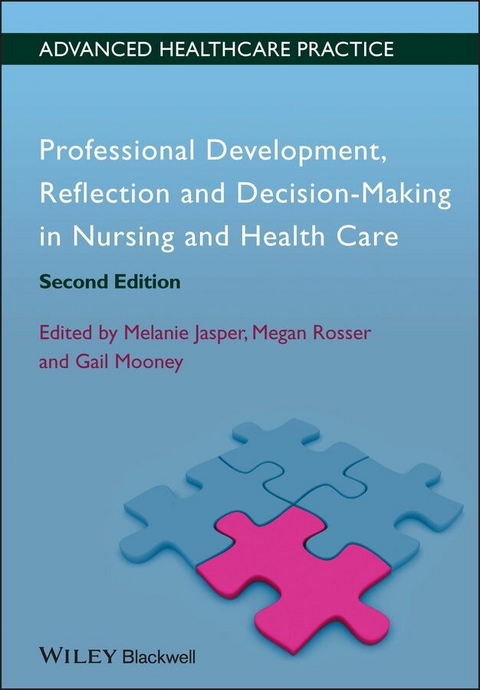
Professional Development, Reflection and Decision-Making in Nursing and Healthcare (eBook)
John Wiley & Sons (Verlag)
978-1-118-30326-9 (ISBN)
Melanie Jasper is Professor of Nursing and Head of the College of Human and Health Sciences, Swansea University, Swansea, UK.
Gail Mooney is Director of Postgraduate Studies and Associate Dean of the Academic Board (Post Graduate Taught) at the College of Human and Health Sciences, Swansea University, Swansea, UK.
Megan Rosser is Director for Continuing Professional Development at the College of Human and Health Sciences, Swansea University, Swansea, UK.
About the Editors Melanie Jasper is Professor of Nursing and Head of the College of Human and Health Sciences, Swansea University, Swansea, UK. Megan Rosser is Director for Continuing Professional Development at the College of Human and Health Sciences, Swansea University, Swansea, UK. Gail Mooney is Director of Postgraduate Studies and Associate Dean of the Academic Board (Post Graduate Taught) at the College of Human and Health Sciences, Swansea University, Swansea, UK.
Cover 1
Title page 5
Copyright page 6
Contents 7
About the Contributors 9
Introduction 11
References 15
Chapter 1: The Context of Professional Development 16
The context of professional development in Britain today 17
Governmental influences on continuing professional development 18
Summary 20
Summary 23
Summary 25
Summary 27
The role of the Nursing and Midwifery Council 28
Summary 29
Expectations of your employers 29
Summary 30
Service user expectations 30
Summary 31
Professional development activities 31
A model of professional development 33
The novice practitioner 35
Summary 39
The competent nurse 39
Summary 39
The proficient nurse 40
Summary 40
The expert nurse 41
Summary 43
A strategy for continuing professional development 43
Relevant to your needs 44
Easily defined 45
Achievable in the time you have available 45
Cost-effective 46
Timely 47
Summary 48
Chapter summary 48
References 49
Chapter 2: Reflection and Reflective Practice 51
The context of reflective practice 51
Setting the scene: Reflection, reflective learning and reflective practice 53
Summary 55
Reflective practice as professional practice and development 56
Summary 58
The benefits of practising reflectively 58
Benefits for the individual 59
Benefits for patients and service users 60
Benefits for your employer and the organisation you work for 62
Benefits for your profession 63
Summary 64
Tools for reflective practice 64
Experience, choosing a focus for reflection, the first side of the triangle 65
Summary 67
Using the reflective processes, the second side of the triangle 67
Summary 69
Summary 79
Putting the ‘Action’ into reflective practice, the third side of the triangle 79
Summary 80
Micro-methods for reflective practice 80
How you reflect, using micro-strategies 80
Using the 5WH cues 80
Summary 82
Summary 85
Borton’s framework 85
Summary 87
Developing critical thinking 87
Summary 88
Using others to help your reflective activity 88
Summary 90
Chapter summary 91
References 91
Chapter 3: Reflective Writing for Professional Development 93
Reflective writing in professional development 93
The nature of writing 94
Summary 96
When to write 96
Summary 98
Structuring reflective writing 99
Using the 5WH cues 99
Summary 100
Strategies for reflective writing 101
Summary 104
Techniques for reflective writing 104
Short-period techniques/stimulatory/getting started techniques 105
Summary 107
Medium-term and developmental techniques 107
Long-term techniques 108
Summary 109
Experienced nurses’ use of reflective writing in professional portfolios 109
Summary 110
Demonstrating accountability through reflective writing 110
Summary 113
Summary 114
Summary 116
Summary 117
Chapter summary 117
References 117
Chapter 4: Decision-Making in Professional Practice 119
Making decisions 120
Decision-making in everyday life: intuitive and analytical thinking 120
Personal and professional decision-making 121
Summary 122
The legal and social context of decision-making in health and social care 122
Summary 124
Values and the ethical context of professional practice 125
Principles to guide decision-making under the Mental Capacity Act 2005 127
The determination of (in)capacity 128
Summary 128
Decision-making models 129
Summary 131
A process model of decision-making – using the 5WH cues 131
Summary 133
Decision-making in practice 133
Summary 138
Accountability 138
Summary 140
Capacity and consent 140
Summary 142
Chapter summary 142
Summary of key points 143
References 144
Chapter 5: Work-based Learning and Portfolios 146
Work-based learning 147
Summary 150
Work-based learning and evidence-based practice 150
Developing a learning contract 152
Summary 153
What is a portfolio? 156
Qualified nurses’ use of portfolios 156
Students’ use of portfolios 157
Summary 157
The purpose of a portfolio 158
Summary 160
Structuring a portfolio 160
Summary 161
Defining the outcomes and setting objectives 161
Summary 162
Using evidence in a portfolio 162
Summary 163
Models of portfolios 164
Summary 170
A portfolio structure to document professional development and accountability as a practitioner 170
Professional development 171
Personal development 172
Critical thinking 173
Outcomes for clinical practice 174
Summary 175
Summary 175
Ethical issues to be considered in portfolios 176
Chapter summary 176
References 176
Chapter 6: Moving from Clinical Supervision to Person-centred Development: A Paradigm Change 178
Defining clinical supervision 179
The benefits of clinical supervision 182
Terminological confusion 182
Summary 184
Clinical supervision – a misunderstood term? 184
Summary 189
Redefining clinical supervision 190
Summary 192
Applying theories and approaches in health psychology to person-centred development 194
Origins and models 194
Summary 196
Using the biopsychosocial approach 196
Summary 204
Roles within the person-centred development process 205
Other roles related to the person-centred development process 207
Using person-centred development as a strategy for personal and professional development 207
For the future: Alternative models that can be applied to facilitate the person-centred development process and are consistent with a biopsychosocial perspective 208
Chapter summary 211
References 212
Chapter 7: Practising as a Professional 214
Introduction 215
What is ‘professional practice’? 215
Requiring higher education 217
Having a body of knowledge and theory 217
Providing vital human and social services 217
Possessing autonomy, control and accountability 218
Involving altruistic life work 218
Having a code of ethics 218
Summary 218
The Code: Standards of Conduct, Performance and Ethics for Nurses and Midwives (NMC 2008) 219
Accountability 220
Summary 223
The principles of the code 223
Principle one: make the care of people your first concern, treating them as individuals and respecting their dignity 223
Summary 230
Principle two: work with others to protect and promote the health and well-being of those in your care, their families and carers, and the wider community 231
Summary 233
Principle three: provide a high standard of practice and care at all times 234
Summary 237
Summary 238
Summary 240
Summary 243
Summary 245
Clause four: be open and honest, act with integrity and uphold the reputation of your profession 245
Guidance for students 247
Summary 247
Chapter summary 248
References 248
Index 251
"This text is a comprehensive and easy to navigate guide
to all aspects of professional development, reflection and decision
making in nursing and healthcare. The content is delivered in an
easy to read and understandable format." (Journal of
Perioperative Practice, 1 January 2014)
| Erscheint lt. Verlag | 13.5.2013 |
|---|---|
| Reihe/Serie | Advanced Healthcare Practice |
| Advanced Healthcare Practice | Advanced Healthcare Practice |
| Sprache | englisch |
| Themenwelt | Medizin / Pharmazie ► Pflege ► Ausbildung / Prüfung |
| Schlagworte | accountable • actions • Ausbildung u. Perspektiven i. d. Krankenpflege • Brings • clear • Concepts • EASY • Edition • Essential • Future • guidance • Healthcare • inextricably • jargonfree • Krankenpflege • linked • New • nursing • Nursing Education & Professional Development • One • Place • Practice • Professional • Professional boundaries • Range • Reader • throughout • title |
| ISBN-10 | 1-118-30326-1 / 1118303261 |
| ISBN-13 | 978-1-118-30326-9 / 9781118303269 |
| Informationen gemäß Produktsicherheitsverordnung (GPSR) | |
| Haben Sie eine Frage zum Produkt? |
 PDF (Adobe DRM)
Kopierschutz: Adobe-DRM
Adobe-DRM ist ein Kopierschutz, der das eBook vor Mißbrauch schützen soll. Dabei wird das eBook bereits beim Download auf Ihre persönliche Adobe-ID autorisiert. Lesen können Sie das eBook dann nur auf den Geräten, welche ebenfalls auf Ihre Adobe-ID registriert sind.
Details zum Adobe-DRM
Dateiformat: PDF (Portable Document Format)
Mit einem festen Seitenlayout eignet sich die PDF besonders für Fachbücher mit Spalten, Tabellen und Abbildungen. Eine PDF kann auf fast allen Geräten angezeigt werden, ist aber für kleine Displays (Smartphone, eReader) nur eingeschränkt geeignet.
Systemvoraussetzungen:
PC/Mac: Mit einem PC oder Mac können Sie dieses eBook lesen. Sie benötigen eine
eReader: Dieses eBook kann mit (fast) allen eBook-Readern gelesen werden. Mit dem amazon-Kindle ist es aber nicht kompatibel.
Smartphone/Tablet: Egal ob Apple oder Android, dieses eBook können Sie lesen. Sie benötigen eine
Geräteliste und zusätzliche Hinweise
Buying eBooks from abroad
For tax law reasons we can sell eBooks just within Germany and Switzerland. Regrettably we cannot fulfill eBook-orders from other countries.
aus dem Bereich