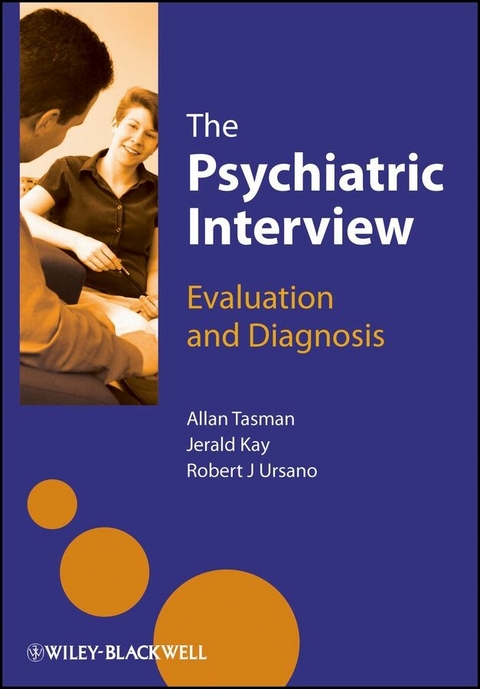
The Psychiatric Interview (eBook)
John Wiley & Sons (Verlag)
978-1-118-34097-4 (ISBN)
While the ABPN has now supplied such standards for psychiatry, psychiatric interviewing instruction has not been standardized in the US or in other countries. Similarly, the few psychiatric interviewing books available are written in textbook form, often long and often from the subpecialty perspective (e.g. psychodynamic interviewing). Critically, no interviewing guides to date take a true biopsychosocial perspective. That is, they limit themselves to “interviewing” as an isolated technique divorced from full patient assessment, which for quality patient care must include the interface of psychological and social components with biological components. Similarly, few interviewing texts are fully integrated with DSM/ICD categorical diagnostic schemata, even though these descriptive diagnostic systems represent the very core of our clinical language—the lingua franca of the mental health professions. Without good descriptive diagnoses there cannot be adequate communication of clinical data among providers.
The proposed book will meet this need for training in biopsychosocial assessment and diagnosis.
The patient interview is at the heart of psychiatric practice. Listening and interviewing skills are the primary tools the psychiatrist uses to obtain the information needed to make an accurate diagnosis and then to plan appropriate treatment. The American Board of Psychiatry and Neurology and the Accrediting Council on Graduate Medical Education identify interviewing skills as a core competency for psychiatric residents.
The Psychiatric Interview: evaluation and diagnosis is a new and modern approach to this topic that fulfills the need for training in biopsychosocial assessment and diagnosis. It makes use of both classical and new knowledge of psychiatric diagnosis, assessment, treatment planning and doctor-patient collaboration. Written by world leaders in education, the book is based on the acclaimed Psychiatry Third Edition by Tasman, Kay et al, with new chapters to address assessment in special populations and formulation. The psychiatric interview is conceptualized as integrating the patient's experience with psychological, biological, and environmental components of the illness.
This is an excellent new text for psychiatry residents at all stages of their training. It is also useful for medical students interested in psychiatry and for practicing psychiatrists who may wish to refresh their interviewing skills.
Allan Tasman, MD, is Professor and Chair of the Department of Psychiatry at the University of Louisville. An internationally known educator and psychoanalyst, he has received numerous national and international academic awards. He is the founding Senior Editor of Psychiatry, an internationally acclaimed comprehensive textbook. He is past president of the American Psychiatric Association and the Pacific Rim College of Psychiatrists. He recently completed service as Secretary for Education of the World Psychiatric Association and now leads the WPA Section on Psychotherapy. Dr. Kay is a Fellow of the American College of Psychiatrists and Distinguished Life Fellow of the American Psychiatric Association and has served as the chair of the APA Committee on Medical Student Education, the Council on Medical Education and Career Development, the Vestermark Award Board, and the Committee on the Practice of Psychotherapy. He chairs the World Psychiatric Association Task Force on Undergraduate and Post Graduate Curriculum as well as the APA Committee on College Mental Health. Dr. Kay is the immediate past chair of the Psychiatry Residency Review Committee of the ACGME and the Founding Editor of the Journal of Psychotherapy Practice and Research and Associate Editor of the American Journal of Psychotherapy. He has published extensively on the topics of medical and psychiatric education, medical ethics, child psychiatry, psychoanalysis, psychotherapy, the neurobiology of psychotherapy, and psychosocial aspects of AIDS and of cardiac transplantation, and has edited numerous books. Dr. Kay serves as the Associate Director of the Comprehensive Neuroscience Center at Wright State University. He received the 2001 APA Seymour Vestermark Award for contributions to psychiatric education. Dr. Kay's current research examines fMRI in borderline personality disordered patients with self-harm behavior.
Contributors
Preface
Acknowledgments
1 Listening to the Patient
2 Physician-Patient Relationship
3 The Cultural Context of Clinical Assessment
4 The Psychiatric Interview: Settings and Techniques
5 Psychiatric Interviews: Special Populations
Randon Welton and Jerald Kay
6 Formulation
Allison Cowan, Randon Welton and Jerald Kay
7 Clinical Evaluation and Treatment Planning: A Multimodal Approach
8 Professional Ethics and Boundaries
Index
"This book is not only a first rate introduction for psychiatric residents and medical students interested in psychiatry but arguably should be a mandatory reading for all medical students given the importance of general interviewing skills, the prominence of psychiatric issues throughout medicine, and the importance of the techniques presented for building the foundations of the physician-patient relationship." (Journal of Nervous and Mental Disease, 1 December 2014)
| Erscheint lt. Verlag | 8.5.2013 |
|---|---|
| Sprache | englisch |
| Themenwelt | Medizin / Pharmazie ► Gesundheitsfachberufe |
| Medizin / Pharmazie ► Medizinische Fachgebiete ► Psychiatrie / Psychotherapie | |
| Schlagworte | accrediting • Accurate • American • Board • Council • Education • graduate • heart • Identify • Information • Interview • interviewing • Krankenpflege • Krankenpflege i. d. Psychologie • Medical • Medical Science • Medizin • Mental Health Nursing • nursing • Patient • Primary • Psychiatric • psychiatric practice • Psychiatrie • Psychiatrist • Psychiatry • Skills • Tools • uses |
| ISBN-10 | 1-118-34097-3 / 1118340973 |
| ISBN-13 | 978-1-118-34097-4 / 9781118340974 |
| Informationen gemäß Produktsicherheitsverordnung (GPSR) | |
| Haben Sie eine Frage zum Produkt? |
 PDF (Adobe DRM)
Kopierschutz: Adobe-DRM
Adobe-DRM ist ein Kopierschutz, der das eBook vor Mißbrauch schützen soll. Dabei wird das eBook bereits beim Download auf Ihre persönliche Adobe-ID autorisiert. Lesen können Sie das eBook dann nur auf den Geräten, welche ebenfalls auf Ihre Adobe-ID registriert sind.
Details zum Adobe-DRM
Dateiformat: PDF (Portable Document Format)
Mit einem festen Seitenlayout eignet sich die PDF besonders für Fachbücher mit Spalten, Tabellen und Abbildungen. Eine PDF kann auf fast allen Geräten angezeigt werden, ist aber für kleine Displays (Smartphone, eReader) nur eingeschränkt geeignet.
Systemvoraussetzungen:
PC/Mac: Mit einem PC oder Mac können Sie dieses eBook lesen. Sie benötigen eine
eReader: Dieses eBook kann mit (fast) allen eBook-Readern gelesen werden. Mit dem amazon-Kindle ist es aber nicht kompatibel.
Smartphone/Tablet: Egal ob Apple oder Android, dieses eBook können Sie lesen. Sie benötigen eine
Geräteliste und zusätzliche Hinweise
Buying eBooks from abroad
For tax law reasons we can sell eBooks just within Germany and Switzerland. Regrettably we cannot fulfill eBook-orders from other countries.
aus dem Bereich