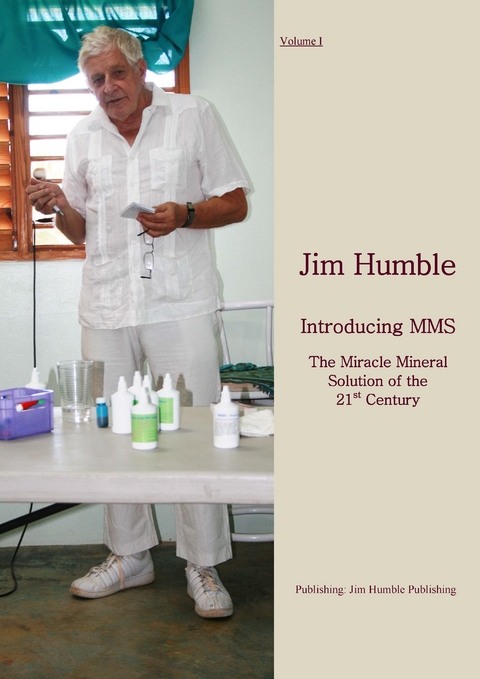
Introducing MMS (eBook)
229 Seiten
Jim Humble Verlag
978-90-8879-057-7 (ISBN)
This book will be very interesting for all “newcomers” who want to familiarize themselves with MMS and want to read about how its use has evolved. You can follow the development of MMS step by step from the day Jim Humble discovered it until today (2010). When Mr. Humble first made his discovery public more than ten years ago, he only aware that it was able to cure malaria in a matter of hours. By the time he came out with his first book, “Breakthrough,” in 1996, he could be credited with healing more than 75,000 cases of malaria with MMS.
Jim has had to travel a long, hard and lonely road in order to prove that MMS heals not only malaria but also almost all illnesses known on Earth. I met Mr. Humble in Balaka, Malawi, in late 2009, at which time he was working for a few months at clinic run by the catholic church. He worked together with a local doctor to treat 20 to 30 HIV/AIDS patients every day. Jim told me, “I treat cancer as easily as others treat a head cold.” Over time I have learned how true his statement is. For this reason, I have chosen to aid Jim Humble in spreading the word of MMS worldwide by documenting and publishing my own experiences with MMS. By archiving Jim Humble’s information, this book not only provides the reader with a background on MMS but also a historical document covering Mr. Humble’s efforts to bear witness for the future.
“Introducing MMS” explains in plain language what MMS is, what it can do and how it does it. In addition to the collection of texts, this book contains many wonderful pictures of Jim Humble which were taken in 2010 in the Dominican Republic.
1. THE DISCOVERY OF MMS
Jim Humble, from the book, The Miracle Mineral Supplement of the 21st Century
The phone was ringing at the other end of the house. It was a long narrow house and there was furniture to get around and a hallway to get through, but in spite of the obstacle course I made it. Bill Denicolo, an old friend, in Chicago was calling. We talked and he asked, “Jim, are you any good at prospecting for gold?”
I was never too modest, so I told him the truth (my truth). “Yes,” I said, “I am amongst the best, if not the best”. That was enough for him. He was a friend, and being already familiar with my work in mining, he believed me. He continued, “I’m working with a group that wants to do gold mining in the jungle in South America. We need your help and we are paying the going rate, plus you get a share of the profits”.
That was it. I agreed to leave in approximately one month. They were willing to use my gold recovery technology. This would require that I ship equipment ahead. It took the entire month to get things ready and to ready myself for the jungle. The most important thing that I took, that relates to this story, was several bottles of Stabilized Oxygen (Please don’t get the idea that Stabilized Oxygen is the miracle solution that I am writing about in this book). All water in the jungle is dangerous to drink.
In North America, water from fast-moving streams is usually quite safe to drink, but in the jungle it doesn’t matter how fast the stream is moving, it is not safe to drink. In fact, one can almost always guarantee that one or more dangerous diseases are present. Despite that knowledge, I did end up drinking from a fast-moving stream while in the jungle, and I did develop typhoid fever.
A number of people had mentioned to me that the oxygen in Stabilized Oxygen would purify water by killing the pathogens present, especially if the water was left setting overnight. I had once sent a single test off to a laboratory after treating some sewerage water with Stabilized Oxygen and the results had come back showing all pathogens dead. I was relatively confident that I could purify my drinking water in the jungle. I had actually worked with Stabilized Oxygen for some time. A friend of mine that lived a little way outside of Las Vegas used it quite a bit with his animals. He gave it to his chickens in their water to keep them healthy and he used it with his dogs. He even injected it into his dog’s veins once when it was sick and his dog was cured in several hours. I often dropped by his home to see how things were going.
Bill Denicolo sent a contract to my house in Las Vegas, Nevada, where I had retired from gold mining. The contract was quite generous. I was to be paid a reasonable salary, and I would have 20% ownership in the operation, provided I located gold in the jungle. I signed a copy of the contract and sent it off, and received an airplane ticket in return. I was 64 years old but in top condition and I would have no trouble navigating in the jungle.
The country was Guyana. The name had been changed a few years earlier from British Guyana to simply Guyana. Guyana is the country just south of Venezuela on the east coast of South America. You probably remember it from the story of Jim Jones and his cult. The entire cult committed suicide at one point or actually a few committed suicides after killing the children and many of the other adults with cyanide. Only a few survived.
I arrived in Guyana on a normal day while it was raining, about midyear of 1996. I was met by several local people who would be part of the mining operation and they led me through the lines at the airport with no waiting. We drove about 30 miles to Georgetown, Guyana’s largest city which is also the Capitol. I was taken to a local house where I was to stay until we departed for the interior, where we would prospect Guyana’s greatest rain forest and jungle.
At the house I met Mike, a local who owned the claims to a very large portion of the jungle and would also be one of the partners. Joel Kane, who lives in the eastern part of the U.S., was also one of the partners listed on the contract I signed. He was to arrive within two weeks before we departed for the jungle. There was one other partner, who was also supposed to arrive soon, but probably after we departed for the jungle. His name was Beta and he was related to a high official in the government. The high official’s name was Moses Nagamotoo, and he was the First Minister directly under the Prime Minister. (Beta’s real name was Satkumar Hemraj, but he preferred the name of Beta.)
Beta was not present, but because he was our partner I was invited to the First Minister’s (Moses Nagamotoo) house for dinner the second evening that I was there. While at his house the First Minister complained of his back problem that was almost preventing him from doing his job in the government. I explained to him that I sometimes adjusted people’s necks and I might be able to help his back. So after dinner he allowed me to adjust his neck, which I did very delicately, making sure that I did not jerk or hurt him. Within minutes his back problem began to subside. We were all amazed and soon he was walking quite easily around the house.
The next day one of the servants called me and asked if I would adjust Mose’s daughter’s neck, as she was having bad back problems as well. I agreed over the phone, so they picked me up for dinner that night which was the third evening I was there and after dinner I adjusted her neck. Her name was Angela. He had another daughter named Adila, but she did not have a problem. Angela, as amazing as it may sound, was soon walking easily and her back problem seemed to disappear. I did not always have such spectacular results, but sometimes it did happen. I was very glad that I had taken the time to learn to adjust necks. Making such a powerful friend as Moses Nagamotoo was important. I did not realize how important it was at the time, but no doubt it kept me from spending time in prison at a later date. For the record and future researchers, Sam Hinds was the Prime Minister. Jim Punwasee was the Minister of Mines whom we often went to see and occasionally visited in his home.
The government had a gold laboratory where they bought gold from local miners. The problem was that all gold that came in was completely covered with mercury. They put the gold under a hood and used a blow torch to burn off the mercury before weighing the gold. Well, as everyone knows, mercury fumes are extremely poisonous. Those fumes were going up the exhaust stack and out into the government courtyard and into the government complex area. Many people had complained of this practice and when they gave me a tour of their gold facilities this was mentioned. I offered to design a simple fume scrubber and they took me up on my offer. They had very little money for such
refinements, so I designed the scrubber from two 55 gallon barrels. It just so happened that I had several thousand ping pong balls stored in a warehouse in Las Vegas. I had them shipped to Guyana to be used in the scrubber. By the time the balls arrived, I was in the jungle, but they simply poured the ping pong balls into the barrel designed to use them, turned on the water spray, and it was working when I returned. It did the job.
As luck had it, with the mercury scrubber, and helping the first Minister and his daughter, I hit it off very well with a few officials in the government there. I had a friend that wanted to move from Russia to Guyana and I mentioned this to the Minister of mining and a couple of days later I got a call from the Minister of Immigration saying that I could call my friend and tell him to visit the Guyana Consulate in Moscow. He said there were papers waiting for my friend there that would allow him to immigrate to Guyana. So you can see, I really did have a little bit of pull. I mention this merely to illustrate my good luck. In our first expedition into the jungle we would be taking eight men who would carry the supplies and set up camp as we reached various locations. Our workers were called droggers. These men were hired by Mike and they arrived at the house about a week ahead of time to begin putting supplies and equipment together. One of the droggers was the foreman and the others, of course, were workers.
Finally the time for our expedition arrived and neither Joel nor Beta had arrived, but we couldn’t wait. The men only made $6.00 a day (U.S.money), but that still cost to keep them around and we wanted to get things done. So the final crew consisted of me, Mike the landholder, and the eight droggers.
The trip into the interior took about two days. First there was about an hour’s ride from Georgetown to the town of Parika on the Mazaruni Cuyuni River. We loaded our supplies onto a large truck and four taxies.We arrived at Parika at about 9:00 a.m. and loaded our supplies onto several large speed boats. The river at this point is more than five miles wide. Should you decide to do your own research on this part of the story, you will find that the next leg of the journey took us about four hours at what can be called high speed on that river.
We finally arrived at our next destination, the town of Bartica, which is considered the gateway to the interior of the country of Guyana. There we bought mostly food supplies. There are a number of food stores constructed like warehouses which mostly supply excursions into the interior. Our buyer bought mostly beans and rice. Normally, they buy only rice for such trips, but because I was there, they added several...
| Erscheint lt. Verlag | 4.2.2016 |
|---|---|
| Sprache | englisch |
| Themenwelt | Medizin / Pharmazie ► Naturheilkunde |
| ISBN-10 | 90-8879-057-4 / 9088790574 |
| ISBN-13 | 978-90-8879-057-7 / 9789088790577 |
| Informationen gemäß Produktsicherheitsverordnung (GPSR) | |
| Haben Sie eine Frage zum Produkt? |
 EPUB (Adobe DRM)
Größe: 1,7 MB
Kopierschutz: Adobe-DRM
Adobe-DRM ist ein Kopierschutz, der das eBook vor Mißbrauch schützen soll. Dabei wird das eBook bereits beim Download auf Ihre persönliche Adobe-ID autorisiert. Lesen können Sie das eBook dann nur auf den Geräten, welche ebenfalls auf Ihre Adobe-ID registriert sind.
Details zum Adobe-DRM
Dateiformat: EPUB (Electronic Publication)
EPUB ist ein offener Standard für eBooks und eignet sich besonders zur Darstellung von Belletristik und Sachbüchern. Der Fließtext wird dynamisch an die Display- und Schriftgröße angepasst. Auch für mobile Lesegeräte ist EPUB daher gut geeignet.
Systemvoraussetzungen:
PC/Mac: Mit einem PC oder Mac können Sie dieses eBook lesen. Sie benötigen eine
eReader: Dieses eBook kann mit (fast) allen eBook-Readern gelesen werden. Mit dem amazon-Kindle ist es aber nicht kompatibel.
Smartphone/Tablet: Egal ob Apple oder Android, dieses eBook können Sie lesen. Sie benötigen eine
Geräteliste und zusätzliche Hinweise
Buying eBooks from abroad
For tax law reasons we can sell eBooks just within Germany and Switzerland. Regrettably we cannot fulfill eBook-orders from other countries.
aus dem Bereich