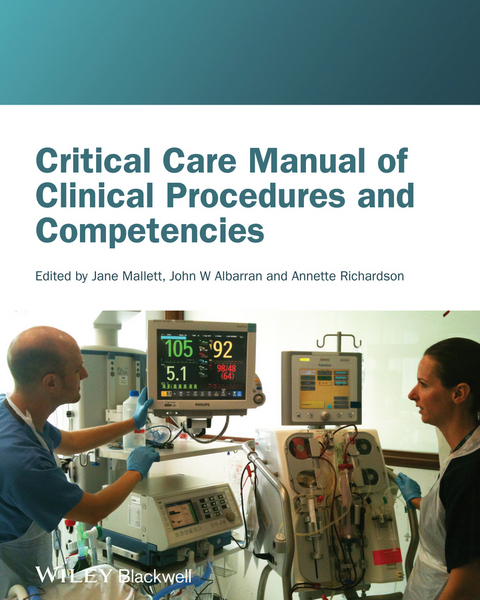
Critical Care Manual of Clinical Procedures and Competencies (eBook)
John Wiley & Sons (Verlag)
978-1-118-49612-1 (ISBN)
Ms Annette Richardson, RN, Bsc (Hons) Nursing Science, MBA
Nurse Consultant Critical Care, Newcastle upon Tyne Hospitals NHS Foundation Trust and Board Member of British Association of Critical Care Nurses
Has twenty years clinical critical care experience. Has contributed to a number of critical care and patient safety
strategies for the NPSA, World Health Organisation and the Department of Health.
Was elected to the British Association of Critical Care Nurses National Board in 2002 and is on the editorial board for the Journal Nursing in Critical Care.
In 2006 was delighted to be awarded winner of a 'Nursing Times' award in the category 'Back to Basics' for the clinical work to promote sleep for critical care patients.
John Albarran has 30 years experience as a practitioner, educator and researcher. During this time he has served on the British Association of Critical Care Nurses, European Federation of Critical Care Nursing Associations (EfCCNa) and was a founder member of the World Federation of Critical Care Nurses. Dr Albarran has published widely including a number of textbooks. He co-edits Nursing in Critical Care and has been awarded two nurse fellowships from the European Society of Cardiology and EfCCNa for outstanding and distinctive contributions to cardiac and critical care nursing.
Jane Mallett, Consultant in Health Care Development
Dr Jane Mallett trained at Guy's Hospital, London in 1980. Since that time she has worked as a practitioner, and
has had lead roles in education, research and practice development. Dr Mallett also jointly edited three editions of The Royal Marsden Hospital Manual for Clinical Nursing Procedures (1992, 1996 and 2000) and The Royal Marsden Hospital Handbook of Wound Management in Cancer Care. More recently she has been joint consultancy lead for the development of the national Essence of Care 2010.
She has a BSc in Human Biology, MSc in Social Research Methods and PhD in Nursing.
This manual is aimed at all healthcare practitioners, from novice to expert, who care for the critically ill patient, recognising that different disciplines contribute to the provision of effective care and that essential knowledge and skills are shared by all practitioners. It provides evidence-based guidelines on core critical care procedures and includes a comprehensive competency framework and specific competencies to enable practitioners to assess their abilities and expertise. Each chapter provides a comprehensive overview, beginning with basic principles and progressing to more complex ideas, to support practitioners to develop their knowledge, skills and competencies in critical care.
Ms Annette Richardson, RN, Bsc (Hons) Nursing Science, MBA Nurse Consultant Critical Care, Newcastle upon Tyne Hospitals NHS Foundation Trust and Board Member of British Association of Critical Care Nurses Has twenty years clinical critical care experience. Has contributed to a number of critical care and patient safety strategies for the NPSA, World Health Organisation and the Department of Health. Was elected to the British Association of Critical Care Nurses National Board in 2002 and is on the editorial board for the Journal Nursing in Critical Care. In 2006 was delighted to be awarded winner of a 'Nursing Times' award in the category 'Back to Basics' for the clinical work to promote sleep for critical care patients. John Albarran has 30 years experience as a practitioner, educator and researcher. During this time he has served on the British Association of Critical Care Nurses, European Federation of Critical Care Nursing Associations (EfCCNa) and was a founder member of the World Federation of Critical Care Nurses. Dr Albarran has published widely including a number of textbooks. He co-edits Nursing in Critical Care and has been awarded two nurse fellowships from the European Society of Cardiology and EfCCNa for outstanding and distinctive contributions to cardiac and critical care nursing. Jane Mallett, Consultant in Health Care Development Dr Jane Mallett trained at Guy's Hospital, London in 1980. Since that time she has worked as a practitioner, and has had lead roles in education, research and practice development. Dr Mallett also jointly edited three editions of The Royal Marsden Hospital Manual for Clinical Nursing Procedures (1992, 1996 and 2000) and The Royal Marsden Hospital Handbook of Wound Management in Cancer Care. More recently she has been joint consultancy lead for the development of the national Essence of Care 2010. She has a BSc in Human Biology, MSc in Social Research Methods and PhD in Nursing.
Cover 1
Title page 5
Copyright page 6
Contents 7
List of contributors 17
Foreword 19
Foreword 21
Preface 23
List of abbreviations 25
Chapter 1: Scope and delivery of evidence-based care 31
Importance of critical care 32
Background and classification of critically ill patients 32
National guidance 33
Evidence-based practice 33
Definitions 33
Debates on the nature of ‘evidence’ 35
Supporting evidence-based practice 37
Integrated governance 37
Using this book 38
References 39
Chapter 2: Competency-based practice 41
Introduction 42
Defining competence 42
Competence acquisition 42
Defining the specialty 43
Competency-based curriculum 43
Competency and the relationship with integrated governance 45
Assessing competence: when and how 46
Objective Structured Clinical Evaluation (OSCE) and simulation 47
Linking the technical with humanistic care 47
References and further reading 54
Chapter 3: Recognizing and managing the critically ill and ‘at risk’ patient on a ward 57
Definition 58
Aims and indications 58
Background 58
Rapid response systems 59
Assessing and managing the deteriorating patient 61
ABCDE assessment process 61
Summary 70
References and further reading 77
Chapter 4: Admitting a critically ill patient 79
Definition 80
Aims and indications 80
Background 80
Calling for appropriate assistance 82
Admission of a patient to a level 2 or 3 care facility 82
Recording status on admission 83
Establishing a rapport with the patient 84
Establishing a rapport with family and carers 84
References and further reading 91
Chapter 5: Assessment, monitoring and interventions for the respiratory system 93
Clinical Assessment 94
Chest auscultation 94
Definition 94
Indications for chest auscultation 94
Background 94
Chest auscultation in critical care 94
Arterial blood gas sampling 96
Definition 96
Indications for arterial blood gas sampling 96
Background 96
Arterial blood sampling in critical care 97
Pulse oximetry 99
Definition 99
Indications for pulse oximetry monitoring 99
Background 99
Pulse oximetry in critical care 99
Airway management and care with adjunct airways 101
Definition 101
Aims and indications 101
Background 101
Airway management in critical care 102
Monitoring Airway Adjuncts 106
Partial pressure of end tidal carbon dioxide (ETCO2) monitoring 106
Definition 106
Indications for end tidal CO2 monitoring 106
Background 106
ETCO2 monitoring in critical care 106
Measuring endotracheal/tracheostomy tube cuff pressure 107
Definition 107
Indications for measuring endotracheal/tracheostomy tube cuff pressure 107
Background 107
Endotracheal/tracheostomy tubes in critical care 108
Interventions For The Respiratory System 108
Ventilatory support 108
Indications for ventilatory support 108
Background 109
Non-invasive ventilation 110
Definition of non-invasive ventilatory (NIV) support 110
NIV in critical care – an overview 110
Invasive ventilation 112
Definition of invasive ventilator support 112
Background 113
Invasive ventilation in critical care 113
Invasive ventilation modes 113
Weaning from mechanical ventilation 117
Definition 117
Aim 117
Background 117
Reduction of mechanical support 118
Extubation/decannulation 119
Other respiratory interventions 120
Intermittent positive pressure breathing (IPPB, e.g. Bird, Bennett PR2) 120
Definition 120
Indications for intermittent positive pressure breathing 120
Contraindications 120
Complications 120
Background 120
Intermittent positive pressure breathing in critical care 120
Suctioning via a tracheal tube (endotracheal or tracheostomy) 121
Definition 121
Aim and indications 121
Background 122
Suctioning through endotracheal and tracheal tubes 123
Humidification 124
Definition 124
Aims and indications 124
Background 124
Humidifiers 124
Manual hyperinflation and hyperoxygenation 126
Definition 126
Aims and indications 126
Background 127
Manual hyperinflation and hyperoxygenation in critical care 127
Prone ventilation 128
Definition 128
Aims and indications 128
Background 128
Risks of prone ventilation 128
Chest drains 130
Definition 130
Aims and indications 130
Background 130
Pneumothorax 130
Pleural fluid 130
Chest drain insertion 131
Management of chest drains 131
Chest drain removal 133
Flexible fibreoptic bronchoscopy 135
Definition 135
Indications for flexible bronchoscopy 135
Contraindications and complications 135
Background 135
Bronchoscopy in critical care 135
Competency and troubleshooting 135
Summary 135
References and further reading 197
Chapter 6: Monitoring of the cardiovascular system: insertion and assessment 203
Introduction 204
Electrocardiogram monitoring 204
Definition 204
Aims and indications 204
Background 204
The 12-lead ECG 207
Continuous cardiac monitoring 207
Applying ECG monitoring 208
Assessing an ECG 208
Arterial blood pressure monitoring 210
Non-invasive arterial blood pressure monitoring 210
Definition 210
Aims and indications 210
Background 211
Invasive arterial blood pressure monitoring 211
Definition 211
Aims and indications 211
Background 211
Evidence and current debates 213
Insertion of and monitoring using an invasive blood pressure monitoring system 214
Central venous pressure monitoring 217
Definition 217
Aims and indications 217
Background 217
CVP trace 219
Efficacy of CVP monitoring 219
Insertion of and monitoring using a CVP monitoring system 219
Safety and risk issues 220
Advanced haemodynamic monitoring 222
Introduction 222
Definition 222
Aims and indications 222
Background 222
Haemodynamic monitoring 223
The measurement of cardiac output 223
Pulmonary thermodilution method 224
Transpulmonary dilution method 231
Summary 235
References 276
Chapter 7: Titration of inotropes and vasopressors 279
Definition 280
Aims and indications 280
Background 280
Choice of inotrope or vasopressor 281
Components of titration of inotropic drug therapies 281
Administration of inotropic drugs via syringe pumps 281
Titration of inotropic drugs to meet patient requirements 283
Changeover of inotrope and vasopressor infusions 284
Troubleshooting 285
References and further reading 305
Chapter 8: Assessment and support of hydration and nutrition status and care 307
Definition 308
Aims and indications 308
Background 308
The effect of critical illness on hydration and nutrition 311
Optimizing hydration and nutrition 313
Therapy to maintain hydration and nutrition status 313
Maintaining fluid balance in the critically ill 313
Maintaining nutrition 318
Therapy 320
Enhanced recovery programmes 320
Feeding critically ill patients 321
Glycaemic control 322
Insulin titration 322
Problems with providing hydration and nutrition 322
Overfeeding 322
Refeeding syndrome 323
Enteral feeding access in an intubated patient 323
Advantages of fine-bore and wide-bore enteral tubes 323
Risks and complications of nasogastric tube insertion 324
Parenteral nutrition 325
Complications 326
Ethical considerations 326
References and further reading 335
Chapter 9: Continuous renal replacement therapies: assessment, monitoring and care 339
Definition 340
Aims and indications 340
Anatomy and physiology of the kidney 340
Acute kidney injury 341
Indications for CCRT in acute kidney injury 343
Aims of CRRT 344
How CRRT works 344
Principles of renal replacement therapy 344
Continuous versus intermittent renal replacement therapy 344
Types of CRRT 344
CRRT priming and treatment choices 345
Maintaining the CRRT circuit 349
Assessment and monitoring of the patient on CRRT 351
Cardiovascular status and fluid management 351
Intravenous access and infection control 351
Maintaining patency of intravenous access 351
Monitoring electrolytes and metabolic status 352
Hypothermia 352
Nutritional support 352
Respiratory management 352
Neurological care 353
Monitoring and problem solving on the CRRT circuit 353
References 361
Chapter 10: Assessment and monitoring of analgesia, sedation, delirium and neuromuscular blockade levels and care 363
Pain 364
Definitions 364
Aims and indications 364
Background 364
Anatomy and physiology 364
Assessment of pain 364
Management of pain 366
Sedation 366
Definition 366
Aims of sedation 366
Background 366
Sedation hold 367
Withdrawal of sedation 367
Rescue sedation 368
Assessment of sedation 368
Monitoring of sedated patients 368
Delirium 369
Definition 369
Aims in treating patients with, or at risk of developing, delirium 369
Background 369
Drugs and delirium 370
Assessment and monitoring of delirium 370
Neuromuscular blockade 370
Definition 370
Aims and indications 370
Anatomy and physiology 371
Neuromuscular blockade 371
Assessment of neuromuscular blockade 372
Treatment 372
Drugs for sedation, analgesia and neuromuscular blockade 372
Sedation 372
Analgesia 375
Opioids 375
Neuromuscular blockade 375
Rescue sedation 376
References and further reading 385
Chapter 11: Assessment and monitoring of neurological status 387
Definition 388
Aims and indications 388
Background anatomy and physiology of the central nervous system 388
Assessment of neurological status 395
Clinical methods 395
Invasive monitoring 398
ICP monitoring devices 398
Aspects of care impacting on intracranial pressure 401
Advanced neuromonitoring 402
References 409
Chapter 12: Assessment and care of tissue viability, and mouth and eye hygiene needs 411
Tissue viability 412
Definition 412
Indications 412
Anatomy and physiology 412
Functions of the skin 413
Challenges to health of skin 414
Pressure ulcers 414
Definition 414
Indications 414
Background 414
Pressure ulcer grading 415
Extrinsic factors 416
Assessment 416
Skin inspection 416
Prevention 417
Healing pressure ulcers 420
Dressings 420
Reporting pressure ulcers 420
Conclusion 420
Useful websites 420
Mouth care 420
Definition 420
Aims and indications 427
Background 427
Anatomy and physiology 427
Oral pathophysiology 428
Problems in critical illness 428
Assessment and care of oral cavity 429
Dentures 430
Eye care 430
Definition 430
Aims and indications 430
Background 430
Anatomy and physiology 430
Problems 431
Assessment and care 433
References and further reading 445
Chapter 13: Assessment of sleep and sleep promotion 451
Definition 452
Indications 452
Background 452
The stages of sleep 452
Why is sleep important? 452
Assessment of sleep 453
Physiological sleep assessment methods 453
Non-physiological sleep assessment methods 453
Non-physiological sleep assessment tools 454
Factors that disrupt and promote sleep 455
References and further reading 462
Chapter 14: Physical mobility and exercise interventions for critically ill patients 465
Definitions 466
Aims and indications 466
Background anatomy and physiology 466
Evidence and current debates 467
Review of components of physical mobility and exercise 467
Assessment of readiness to mobilize 467
Interventions 468
During the acute phases of illness 468
Rehabilitation for patients unable to sit on the edge of the bed (i.e. ‘bed bound’) 468
Rehabilitation for patients deemed ready to sit on the edge of the bed 472
Post-critical care rehabilitation 474
Measurement of manual handling risk 474
References and further reading 496
Chapter 15: Transfer of the critically ill patient 499
Definitions 500
Aims 500
Indications 500
Background 500
Physiological effects of transfer 500
Cardiovascular system 500
Effect of movement/gravitational forces 501
Respiratory system 501
The effects of altitude: potential for hypoxia 501
The effects of altitude: expansion of air spaces 503
Physiological stress response 503
Temperature control 503
Evidence and current debates 503
Quality of patient transfers 503
Organization 504
Role of critical care networks 504
Specialist transfer teams 504
Timing of transfers 504
Components of the transfer process 504
The decision to transfer 505
Communication 505
Assessment and stabilization prior to transfer 505
Selection of transport mode 505
Preparation for transfer 506
Safe transfer 506
Handover 508
Competency statements 508
Guidelines for transfer 508
Equipment 508
References and further reading 518
Chapter 16: Rehabilitation from critical illness 519
Definition 520
Aims and indications for rehabilitation 520
Background 520
Rehabilitation and critical care 520
Effect of critical illness on patients’ families 520
Review of components of rehabilitation from critical care 521
Muscle loss and weakness 521
Cognitive deficits 521
Rehabilitation 522
Rehabilitation interventions 522
Diaries 523
Counselling 523
Summary 523
References 527
Chapter 17: Withdrawal of treatment and end of life care for the critically ill patient 529
Definition 530
Aims and indications 530
Background 530
Pre-EOLC considerations: at the beginning 531
Prognosis 531
Post prognosis: EOLC in critical care environments 532
Tools that facilitate best care at EOL 532
Guidance for EOLC 532
Assessment of need for ‘Do Not Attempt Cardiopulmonary Resuscitation’ orders 533
Process for obtaining a DNACPR order 533
Assessment of need for discussion of withdrawal of treatment 534
Avoiding prolongation of dying and decisions about transfer 534
Care around withdrawal: care in the last days and hours 535
Diagnosing dying 535
Consultation and communication of decision to withdraw treatment with patient, next of kin and significant others 536
Patients 536
Families/Next of kin/Significant others 536
Nurses and allied health professionals 537
Communication and breaking bad news: supporting the family 537
Cultural issues 538
Review of practical components of withdrawal of treatment and end of life care 538
When to withdraw 538
How and when to withdraw treatment 538
Extubation 538
Care of the dying patient during extubation 539
Further EOLC considerations in the last days and hours 539
Sudden or unexpected dying 539
Brainstem function measurement and death 539
Brainstem death 540
After-death care 540
Communicating procedures around death 540
Preparing the body of the patient who has died 541
Considerations before showing families the deceased patient (either before or after last offices) 541
Families’ time with patient in unit after the patient’s death 541
Bereavement care 541
Competencies 542
Conclusion 542
References and further reading 553
Chapter 18: Cardiopulmonary resuscitation 561
Definition 562
Aims and indications 562
Background 562
Anatomy and physiology 562
Incidence and causes of cardiac arrest 564
Evidence for guidelines 564
In-hospital resuscitation 564
Location 565
Skills of the staff who respond to the cardiac arrest 565
Number of responders 565
Equipment and medicines available 565
Resuscitation team 565
Initial management of the ‘collapsed’ patient 566
Personal safety 566
Recognizing cardiac arrest and calling for help 566
Starting CPR 567
High-quality chest compressions 567
Airway and ventilation 568
Defibrillation 569
Drugs and vascular access 570
Identifying reversible causes 571
Post-cardiac arrest care 571
Diagnosing death 571
References 580
Index 583
| Erscheint lt. Verlag | 15.5.2013 |
|---|---|
| Sprache | englisch |
| Themenwelt | Medizin / Pharmazie ► Gesundheitsfachberufe |
| Medizin / Pharmazie ► Medizinische Fachgebiete ► Intensivmedizin | |
| Pflege ► Fachpflege ► Anästhesie / Intensivmedizin | |
| Schlagworte | Best • Care • Clinical • competencies • Contribute • Critical • critical care • Different • disciplines • evidencebased • General Clinical Nursing • Guide • Healthcare • Klinische Krankenpflege • Krankenpflege • Landmark • Manual • Medical Science • Medical Sciences Special Topics • Medizin • New • NOVICE • nursing • Nursing Special Topics • Practitioners • Procedures • Provision • Public Health • roles • Skills • Spezialthemen Krankenpflege • Spezialthemen Medizin |
| ISBN-10 | 1-118-49612-4 / 1118496124 |
| ISBN-13 | 978-1-118-49612-1 / 9781118496121 |
| Informationen gemäß Produktsicherheitsverordnung (GPSR) | |
| Haben Sie eine Frage zum Produkt? |
 PDF (Adobe DRM)
Kopierschutz: Adobe-DRM
Adobe-DRM ist ein Kopierschutz, der das eBook vor Mißbrauch schützen soll. Dabei wird das eBook bereits beim Download auf Ihre persönliche Adobe-ID autorisiert. Lesen können Sie das eBook dann nur auf den Geräten, welche ebenfalls auf Ihre Adobe-ID registriert sind.
Details zum Adobe-DRM
Dateiformat: PDF (Portable Document Format)
Mit einem festen Seitenlayout eignet sich die PDF besonders für Fachbücher mit Spalten, Tabellen und Abbildungen. Eine PDF kann auf fast allen Geräten angezeigt werden, ist aber für kleine Displays (Smartphone, eReader) nur eingeschränkt geeignet.
Systemvoraussetzungen:
PC/Mac: Mit einem PC oder Mac können Sie dieses eBook lesen. Sie benötigen eine
eReader: Dieses eBook kann mit (fast) allen eBook-Readern gelesen werden. Mit dem amazon-Kindle ist es aber nicht kompatibel.
Smartphone/Tablet: Egal ob Apple oder Android, dieses eBook können Sie lesen. Sie benötigen eine
Geräteliste und zusätzliche Hinweise
Buying eBooks from abroad
For tax law reasons we can sell eBooks just within Germany and Switzerland. Regrettably we cannot fulfill eBook-orders from other countries.
aus dem Bereich