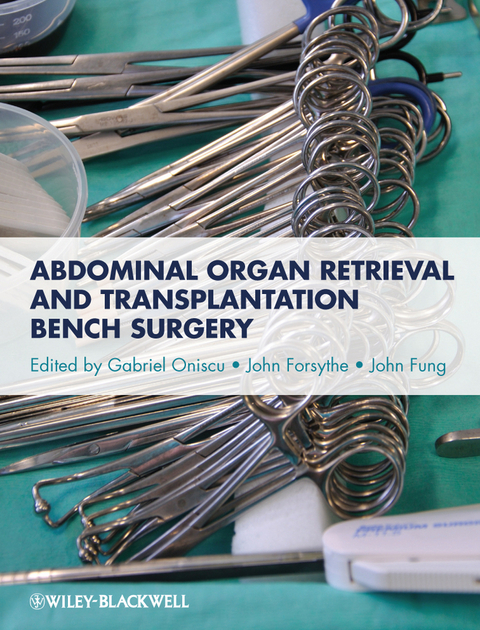
Abdominal Organ Retrieval and Transplantation Bench Surgery (eBook)
John Wiley & Sons (Verlag)
978-1-118-51314-9 (ISBN)
Abdominal organ transplantation is a complex, multi-step process that requires flawless surgery from start to finish. Training in organ retrieval and bench surgery, however, has varied from country to country and even center to center, and trainees too often must rely on hands-on experience without the benefit of extensive practical or theoretical training.
With the number of transplant programs on the rise and the demand for donor organs increasing steadily as outcomes continue to improve, there is a greater need than ever before for a practical and comprehensive reference that transplantation professionals can turn to for clear and comprehensive guidance. Abdominal Organ Retrieval and Transplantation Bench Surgery fills that need.
This important new book covers all aspects of retrieval and bench surgery of the abdominal organs. Coverage includes organ retrieval logistics and organ preservation; retrieval and bench surgery of the kidney, liver, pancreas and intestine; in situ and ex situ liver splitting; multi-organ retrieval; paediatric age-specific aspects of retrieval and bench surgery; and more. Key features include:
- Practice learning points for each procedure
- Detailed color illustrations of standard techniques
- Thorough guidance on dealing with anatomical variations
Abdominal Organ Retrieval and Transplantation Bench Surgery is the ideal guide for surgeons and donor retrieval teams alike. With its step-wise approach and practical orientation, it is a reference transplant professionals can trust to help them understand and excel at all aspects of abdominal organ retrieval, from managing potential donors and properly retrieving organs to minimizing the likelihood of common pitfalls while mastering the latest surgical techniques.
Gabriel C. Oniscu MD, FRCS, Consultant Transplant Surgeon, Honorary Clinical Senior Lecturer, Transplant Unit, Royal Infirmary of Edinburgh, Edinburgh, UK
John L. Forsythe MD, FRCS, Honorary Professor, Consultant Transplant Surgeon, Transplant Unit, Royal Infirmary of Edinburgh, Edinburgh, UK
John Fung MD, PhD, Director, Transplantation Centre, Chair, Digestive Disease Institute, Cleveland Clinic, Cleveland, OH, USA
Abdominal organ transplantation is a complex, multi-step process that requires flawless surgery from start to finish. Training in organ retrieval and bench surgery, however, has varied from country to country and even center to center, and trainees too often must rely on hands-on experience without the benefit of extensive practical or theoretical training. With the number of transplant programs on the rise and the demand for donor organs increasing steadily as outcomes continue to improve, there is a greater need than ever before for a practical and comprehensive reference that transplantation professionals can turn to for clear and comprehensive guidance. Abdominal Organ Retrieval and Transplantation Bench Surgery fills that need. This important new book covers all aspects of retrieval and bench surgery of the abdominal organs. Coverage includes organ retrieval logistics and organ preservation; retrieval and bench surgery of the kidney, liver, pancreas and intestine; in situ and ex situ liver splitting; multi-organ retrieval; paediatric age-specific aspects of retrieval and bench surgery; and more. Key features include: Practice learning points for each procedure Detailed color illustrations of standard techniques Thorough guidance on dealing with anatomical variations Abdominal Organ Retrieval and Transplantation Bench Surgery is the ideal guide for surgeons and donor retrieval teams alike. With its step-wise approach and practical orientation, it is a reference transplant professionals can trust to help them understand and excel at all aspects of abdominal organ retrieval, from managing potential donors and properly retrieving organs to minimizing the likelihood of common pitfalls while mastering the latest surgical techniques.
Gabriel C. Oniscu MD, FRCS, Consultant Transplant Surgeon, Honorary Clinical Senior Lecturer, Transplant Unit, Royal Infirmary of Edinburgh, Edinburgh, UK John L. Forsythe MD, FRCS, Honorary Professor, Consultant Transplant Surgeon, Transplant Unit, Royal Infirmary of Edinburgh, Edinburgh, UK John Fung MD, PhD, Director, Transplantation Centre, Chair, Digestive Disease Institute, Cleveland Clinic, Cleveland, OH, USA
Abdominal Organ Retrieval and Transplantation Bench Surgery 5
Copyright 6
Contents 7
List of Contributors 8
Foreword 9
Preface 10
About the Companion Website 11
1 Organ Retrieval Logistics 13
Introduction 13
Diagnosis of death – DBD and DCD donation 13
Donation after brain death (DBD) 13
Death following cessation of cardiorespiratory function – DCD donation 14
Evolution of organ donation and the legal framework governing organ donation 14
Organ retrieval teams and organ transplantation units 15
Donor coordinators 15
Organ retrieval teams 16
Transplant units 17
Patient selection for transplantation and allocation of deceased donor organs for transplantation 19
Patient selection 19
Allocation of deceased donor organs for transplantation 19
References 20
2 Strategies in Preservation of Abdominal Organs 21
Introduction 21
A touch of preservation history 22
Donor related organ injury 24
Some basic principles in organ preservation 24
Induction of hypothermia 24
Prevention of oedema 24
Prevention of acidosis 24
Neutralize the formation of reactive oxygen species 24
Hypothermia is still a key factor 25
Interstitial and cellular oedema 25
Cellular acidosis 26
Formation of oxygen free radicals 26
Preservation solutions 26
The static cold storage method of organ preservation 26
Machine perfusion revisited: a renaissance in preservation? 28
Practical consequences to consider during retrieval 31
Packaging of donor organs 32
A brief outlook on future practice 32
References 34
3 Management of the Brainstem Dead Organ Donor 36
Physiological changes associated with brainstem death 36
Organ damage 36
Clinical management and use of guidelines 37
Early guidelines 37
Standardization and wider application 37
A practical approach to brainstem dead donor management 38
Initial assessment and management 38
Respiratory management 39
Cardiovascular management 39
Hormonal changes 40
Fluid and electrolyte management 41
Blood and coagulation 41
Physiological support in the operating theatre 41
Implementation and outcomes 42
Future research and development of guidelines 42
References 42
4 Multiorgan Retrieval 44
Introduction 44
Retrieval team 44
Retrieval logistics 44
Pre-retrieval checks 45
Multiorgan retrieval technique in DBD donors 45
Technical variations 45
Retrieval technique 47
Perfusion fluids 64
In situ perfusion 64
Bench perfusion 65
Bench surgery 66
Separation of the liver–ancreas block 66
Kidney bench surgery 67
Packing of organs 67
Paperwork and documentation 68
References 68
5 Kidney Retrieval and Bench Surgery 70
General principles and logistics 70
Access 70
Anatomical variations 70
Awareness of common injuries 70
Atheroma 71
Avulsion 72
Procedure 72
Immediate bench check 75
Special considerations with kidney retrieval 76
Removal of peri-renal fat 76
Rewarming 76
Most common forms of damage following kidney retrieval 76
Polar artery cut/patch removed from artery of an aortic patch 76
Capsular damage 77
Rewarming of kidney 77
Ureter cut short or ‘skinned’ 77
Bench surgery for the kidney 78
Dealing with common bench surgery problems 80
Capsule 80
Vein 80
Artery 81
Ureter 83
Pre-implantation biopsy 83
Donation after cardiac death and kidney retrieval 83
References 84
6 Liver Retrieval and Bench Surgery 85
Liver retrieval 85
Donor information 85
Liver assessment 85
Technical aspects of liver retrieval 86
Variant arterial anatomy scenarios and solutions 92
Bench surgery 94
Donor information 94
Set-up for bench surgery 95
Liver assessment 95
Preparation for implantation 96
Dissection of the portal vein 97
References 101
7 Deceased Cardiac Donor Liver Retrieval 103
Introduction 103
Controlled DCD 103
Liver, pancreas and kidney 107
Liver and lungs 107
Normothermic regional perfusion (NRP) 107
Bench perfusion and packing 109
Uncontrolled DCD 109
Retrieval procedure technique 109
Preservation solutions 110
Assessment of DCD liver grafts 110
References 111
8 In situ Liver Splitting 113
Introduction 113
Donor and recipient evaluation 113
Surgical techniques 114
Bench preparation to separate into the left and right lobe 120
References 126
9 Ex situ Liver Splitting 128
Introduction 128
Selection of the deceased donor 128
Recipient selection 128
Left lateral liver graft 129
Extended right liver graft 129
Full right and full left hemiliver grafts 129
Technique of the ex situ left lateral split procedure 129
Quality 130
Anatomy 130
Surgical technique of left lateral ex situ split 131
Technique of the ex situ full left–full right split procedure 135
Hilar dissection 135
Outcome of split liver recipients 137
Outcome of extended right liver grafts 138
Outcome of full right–full left split liver transplantation 138
References 140
10 Pancreas Retrieval and Bench Surgery 142
Background 142
Organ procurement 142
Medical background 143
Donor procedure 143
Organ preservation 148
Bench surgery 148
Reconstruction of arterial supply 148
Preparation of the duodenum 149
Peripancreatic tissue 149
Root of the mesentery 150
Islet transplantation 150
References 151
11 Intestinal Retrieval and Bench Surgery 152
Introduction 152
Intestine donor selection 152
Intestine donor preparation 153
Isolated intestine grafts (ISO-INT) 153
Bench reconstruction 162
Liver–intestine grafts (LIV-INT) 162
Bench reconstruction 164
Multivisceral grafts (MVT) 165
Bench reconstruction 165
References 166
12 Pediatric Age-Specific Aspects of Retrieval and Bench Surgery 167
Introduction 167
Donor selection for pediatric solid organ transplantation 167
Donor to recipient weight ratio 168
Donor to recipient age ratio 168
Organ-specific donor criteria 169
Relevant aspects for organ procurement and techniques 170
Technical aspects 171
Whole liver en bloc retrieval 171
Relevant aspects for bench procedures 181
Kidneys 181
Liver 182
References 187
Index 189
| Erscheint lt. Verlag | 1.4.2013 |
|---|---|
| Sprache | englisch |
| Themenwelt | Medizin / Pharmazie ► Medizinische Fachgebiete ► Chirurgie |
| Schlagworte | Abdominal • BEnefiT • Center • Complex • Country • Donor • Experience • extensive • Finish • Flawless • Handson • Medical Science • Medizin • multistep • Number • Organs • outcomes continue • Practical • Process • Programs • requires • Start • steadily • Surgery • Transplant • Transplantation • Transplantationen |
| ISBN-10 | 1-118-51314-2 / 1118513142 |
| ISBN-13 | 978-1-118-51314-9 / 9781118513149 |
| Informationen gemäß Produktsicherheitsverordnung (GPSR) | |
| Haben Sie eine Frage zum Produkt? |
 PDF (Adobe DRM)
Kopierschutz: Adobe-DRM
Adobe-DRM ist ein Kopierschutz, der das eBook vor Mißbrauch schützen soll. Dabei wird das eBook bereits beim Download auf Ihre persönliche Adobe-ID autorisiert. Lesen können Sie das eBook dann nur auf den Geräten, welche ebenfalls auf Ihre Adobe-ID registriert sind.
Details zum Adobe-DRM
Dateiformat: PDF (Portable Document Format)
Mit einem festen Seitenlayout eignet sich die PDF besonders für Fachbücher mit Spalten, Tabellen und Abbildungen. Eine PDF kann auf fast allen Geräten angezeigt werden, ist aber für kleine Displays (Smartphone, eReader) nur eingeschränkt geeignet.
Systemvoraussetzungen:
PC/Mac: Mit einem PC oder Mac können Sie dieses eBook lesen. Sie benötigen eine
eReader: Dieses eBook kann mit (fast) allen eBook-Readern gelesen werden. Mit dem amazon-Kindle ist es aber nicht kompatibel.
Smartphone/Tablet: Egal ob Apple oder Android, dieses eBook können Sie lesen. Sie benötigen eine
Geräteliste und zusätzliche Hinweise
Buying eBooks from abroad
For tax law reasons we can sell eBooks just within Germany and Switzerland. Regrettably we cannot fulfill eBook-orders from other countries.
aus dem Bereich