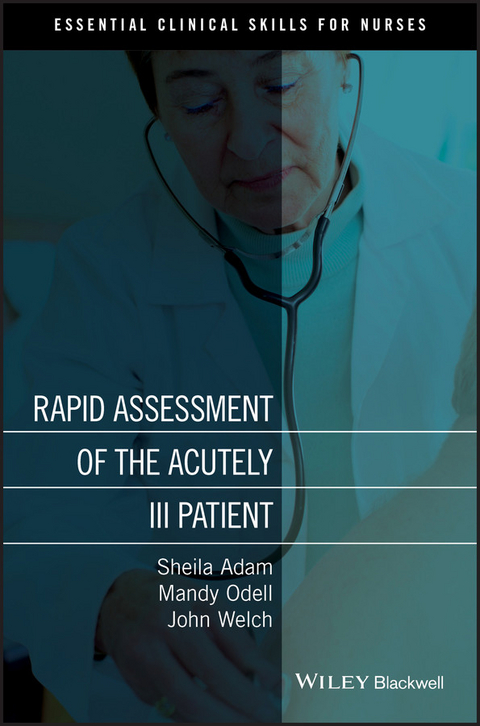
Rapid Assessment of the Acutely Ill Patient (eBook)
John Wiley & Sons (Verlag)
978-1-118-69993-5 (ISBN)
Rapid Assessment of the Acutely Ill Patient provides a framework for a systematic initial patient assessment and explores principles of effective assessment. Body systems are considered in order of life-threatening priority following the ABCDE approach, dealing with the assessment and management of airway, breathing, circulation, disability - and everything else; covering topics such as visual, palpatory and auscultatory assessment, use of additional documented information (charts, notes etc), and interpreting diagnostic investigations. Methods to ensure effective communication and team-working are also discussed.
Key features
- Part of the Essential Clinical Skills for Nurses series
- Aimed at nurses working in wards and specialist departments
- Explores the assessment skills required for a rapid response to a patient at risk of becoming acutely unwell
- Enables students and practitioners to develop practical and interpretative skills
- Provides a framework for assessment and principles of first line treatment
- Includes ‘Look’, ‘Listen’, ‘Feel’ and ‘Measure’ icons
Sheila Adam is Head of Nursing, Specialist Hospitals Board, UCL Hospitals NHS Foundation Trust and author of Nursing in Critical Care: Science and Practice (now in its 2nd edition), The Oxford Handbook of Critical Care Nursing and Nutrition in the Critically Ill.
John Welch is Nurse Consultant in Critical Care, University College London Hospitals NHS Foundation Trust, and former Chair of the National Outreach Forum.
Mandy Odell is Nurse Consultant in Critical Care, Royal Berkshire NHS Foundation Trust, Nurse and Allied Health Professional representative for the Intensive Care Society and former Chair of the British Association of Critical Care Nurses.
Rapid Assessment of the Acutely Ill Patient sets out the principles and practices needed for early recognition and assessment of patients either at risk of or showing signs of acute deterioration, or those recently relocated from higher levels of care. The focus is on patient assessment, interpretation and evaluation of data, immediate management of significant problems, ongoing and further assessments in order to improve clinical outcomes. Rapid Assessment of the Acutely Ill Patient provides a framework for a systematic initial patient assessment and explores principles of effective assessment. Body systems are considered in order of life-threatening priority following the ABCDE approach, dealing with the assessment and management of airway, breathing, circulation, disability - and everything else; covering topics such as visual, palpatory and auscultatory assessment, use of additional documented information (charts, notes etc), and interpreting diagnostic investigations. Methods to ensure effective communication and team-working are also discussed. Key features Part of the Essential Clinical Skills for Nurses series Aimed at nurses working in wards and specialist departments Explores the assessment skills required for a rapid response to a patient at risk of becoming acutely unwell Enables students and practitioners to develop practical and interpretative skills Provides a framework for assessment and principles of first line treatment Includes 'Look', 'Listen', 'Feel' and 'Measure' icons
Sheila Adam is Head of Nursing, Specialist Hospitals Board, UCL Hospitals NHS Foundation Trust and author of Nursing in Critical Care: Science and Practice (now in its 2nd edition), The Oxford Handbook of Critical Care Nursing and Nutrition in the Critically Ill. Mandy Odell is Nurse Consultant in Critical Care, Royal Berkshire NHS Foundation Trust, Nurse and Allied Health Professional representative for the Intensive Care Society and former Chair of the British Association of Critical Care Nurses. John Welch is Nurse Consultant in Critical Care, University College London Hospitals NHS Foundation Trust, and former Chair of the National Outreach Forum.
Foreword vi
Preface viii
1. Why Rapid Assessment Is Essential for Ward Staff 1
2. Track and Trigger Systems: Early Warning Scores, Calling Criteria and Rapid Response Teams 13
3. Assessment Techniques 30
4. A-B-C-D-E: Airway Assessment and Management Techniques 43
5. A-B-C-D-E: Breathing (and Failure to Breathe) 61
6. A-B-C-D-E: Circulation (and Circulatory Failure) 98
7. A-B-C-D-E: Acute Neurological Care (Disability) 153
8. A-B-C-D-E: Everything that Should Be Considered for Other Potential Problems 181
9. Patient-centred Care, Team Working and Communication 198
Appendix 1: Acid-Base Balance and Arterial Blood Gases 221
Appendix 2: Oxygen Delivery Devices 227
Index 232
1
Why Rapid Assessment Is Essential for Ward Staff
INTRODUCTION
There is an increasing emphasis in the modern health service on managing most illnesses in community settings and performing most surgery in day surgery units. Consequently, the number of inpatient beds has fallen by about 40% in the past 25 years, although in the same period numbers of hospital admissions have risen by 74% (NHS Confederation, 2006; Hospital Episode Statistics inpatient data, 2006–07). In addition, an increasing proportion of patients are admitted as emergencies: there were 4.7 million emergency admissions in 2006–2007, equating to 36% of all in-patient cases (Hospital Episode Statistics inpatient data, 2006–07). Therefore, hospital occupancy and throughput rates are generally high, and the relative numbers of acutely and critically ill patients have significantly increased. Furthermore, the proportion of older patients in hospital is also rising each year: 41% of adult inpatients were aged 65 years or more in 2006–2007 (Hospital Episode Statistics inpatient data, 2006–07), and this group often have one or more chronic conditions that increase the complexity of their care.
Factors contributing to increased acuity of general ward patients are:
- Faster throughput
- Increased numbers of emergency cases – more acute and critical illness
- Increased numbers of older patients – more complex, chronic disease
- More aggressive and invasive treatments.
Fig. 1.1 Numbers of all acute care beds and critical care beds in England 2000–2008
Despite these points, designated critical care beds in England make up less than 3% of all inpatient beds (Department of Health Performance Data and Statistics – Beds, 2008) (Figure 1.1). As a result, many patients with potential or actual serious illness are located in general wards; and the numbers of these patients continue to rise. It is difficult to gauge exactly how many patients may be in this category at any one time. In 2002, a snapshot review of 1873 ward patients in four Hospital Trusts found that 12.2% needed care over and above normal ward levels, while a follow-up audit in the same area in 2006 found that 21.3% required such care (Chellel et al, 2002; Smith et al, 2008).
LEARNING OBJECTIVES
By the end of this chapter you should be able to:
LEVELS OF CARE (INTENSIVE CARE SOCIETY, 2009)
Descriptors of the levels of care needed by different patients have been published by the Intensive Care Society (2009) – Level 2 and Level 3 patients will usually be managed in a designated critical care area – if aggressive measures are appropriate. However, as has been noted above, there are many Level 1 patients on wards: these are patients at risk of deterioration or patients recently transferred from a higher level of care whose needs can be met on an acute ward as long as there is additional advice and support from the critical care team (Intensive Care Society, 2009). In this context, it is imperative that staff working in wards are able to recognise (and intervene effectively) when patients deteriorate.
- Patients recently discharged from a higher level of care: e.g. needing at least 4-hourly vital sign observations.
- Patients in need of additional monitoring/clinical interventions, clinical input or advice: e.g. needing at least 4-hourly observations, or continuous oxygen therapy, or boluses of intravenous fluid, or epidural analgesia; or with a tracheostomy or chest drain in situ, or receiving an intravenous infusion of insulin; or needing physiotherapy to prevent or treat respiratory failure.
- Patients requiring critical care outreach service support: e.g. with abnormal vital signs but not (yet) needing a higher level of care; and those at risk of deterioration with a potential requirement for a higher level of care.
ARE WARD STAFF READY FOR THE CHALLENGE?
Nursing staff are the constant monitors of patients’ well-being. Nurses must ensure that their knowledge of the patient is not restricted to arm’s-length evaluation of data but is based on regular accurate assessments and a good understanding of the patient’s physical and mental state. In order to do this, nurses must have an appreciation of what is normal and what is not.
However, at the same time as the acute hospital patient population has changed – and generally become more challenging – there have also been a number of changes to the way that medical and nursing staff are trained and work. These developments have not helped staff to easily become competent in recognising and responding to sudden acute deterioration in patients.
Limited experience with sick patients for medical and nursing staff
Changes in the way that nurses are trained have led to a reduction in time spent gaining ‘hands-on’ experience with patients. The typical 3-year training for a nursing diploma or degree complies with the Nursing and Midwifery Council requirement for 50% theory and 50% practice (NMC, 2004). It is likely to include a maximum of 2300 hours of total practice experience – or 102 days per year (NMC, 2004) – which must cover all aspects of nursing, thus allowing only a limited time specifically with sick patients.
These changes mean that intuitive recognition of acute deterioration is likely to be less well-developed and will require teaching that is specific to subjective indicators (such as skin colour and behavioural changes) as well as better understanding of the more objective indicators (such as respiratory rate and blood pressure). Ruth-Sahd and Hendy (2005) found that novice nurses depended heavily on intuition and were unable to explain the reasoning behind their decisions. They were more likely to be correct if they were older and had a broad spectrum of social and personal experience. In a study of nurses who had called the emergency team because they were worried, Cioffi (2000) found that in the process of recognition, nurses relied heavily on past experiences and knowledge to detect differences in the patient’s condition.
Similar issues have arisen within the medical profession with concerns about the amount of clinical experience of trainee doctors and the impact of foundation year programmes and postgraduate training structures that result in far less time getting ‘hands-on’ exposure to patients (McManus et al 1998). Senior doctors are also likely to be less experienced than they used to be: a British Medical Journal editorial pointed out that it is now possible to become a consultant surgeon with 6000 hours of specialist experience, whereas previously a trainee might expect to work 30,000 hours (Chikwe et al, 2004).
Such deficits need to be addressed by focused teaching that develops and enhances the knowledge and skills required for the recognition and management of acutely ill patients. These include skills of assessment, problem and risk identification and knowledge of appropriate interventions.
PROBLEMS IN ACUTE CARE
Reports from around the world show major healthcare systems struggling to meet the challenge of providing consistently safe and effective care of acutely and critically ill patients (e.g. Australia – Wilson et al, 1995; USA – Kohn et al, 2000). In the United Kingdom, McQuillan et al (1998) examined the care of patients that had deteriorated to the point that they required transfer to intensive care. In a total of 100 patients from two hospitals, only 20 patients were judged to have been well managed, while 54 experienced sub-optimal care in the period before transfer. Outcomes were poor even among those patients considered well-managed, with a mortality rate of 35%; however, in the sub-optimal care group, the mortality rate was 56%. Importantly, the baseline characteristics of the two groups of patients were not significantly different and the difference in mortality can be attributed to the difference in quality of care rather than to differences between the patients themselves. Other studies have also shown the impact of sub-optimal ward care in prestigious teaching hospitals (McGloin et al, 1999; Vincent et al, 2001) and district general hospitals alike (Seward et al, 2003).
As recently as 2005; the National Confidential Enquiry into Patient Outcome and Death (NCEPOD) report of care in 1154 acute medical patients in 179 English hospitals found:
- Initial assessment was unacceptable in 10% of cases
- Initial treatment was delayed and inappropriate in 48% of cases
- Care was less than good practice in...
| Erscheint lt. Verlag | 27.3.2013 |
|---|---|
| Reihe/Serie | Essential Clinical Skills for Nurses |
| Essential Clinical Skills for Nurses | Essential Clinical Skills for Nurses |
| Sprache | englisch |
| Themenwelt | Medizin / Pharmazie ► Medizinische Fachgebiete |
| Medizin / Pharmazie ► Pflege ► Ausbildung / Prüfung | |
| Pflege ► Fachpflege ► Anästhesie / Intensivmedizin | |
| Studium ► 2. Studienabschnitt (Klinik) ► Anamnese / Körperliche Untersuchung | |
| Schlagworte | acutely • Assessment • Assessments • Care • Clinical outcomes • Data • Explores • focus • Framework • General Clinical Nursing • higher • Ill • immediate • Klinische Krankenpflege • Krankenpflege • levels • nursing • Nursing Special Topics • Order • Patient • Practices • Principles • recently • Recognition • significant problems • Spezialthemen Krankenpflege • systematic initial |
| ISBN-10 | 1-118-69993-9 / 1118699939 |
| ISBN-13 | 978-1-118-69993-5 / 9781118699935 |
| Informationen gemäß Produktsicherheitsverordnung (GPSR) | |
| Haben Sie eine Frage zum Produkt? |
 EPUB (Adobe DRM)
Kopierschutz: Adobe-DRM
Adobe-DRM ist ein Kopierschutz, der das eBook vor Mißbrauch schützen soll. Dabei wird das eBook bereits beim Download auf Ihre persönliche Adobe-ID autorisiert. Lesen können Sie das eBook dann nur auf den Geräten, welche ebenfalls auf Ihre Adobe-ID registriert sind.
Details zum Adobe-DRM
Dateiformat: EPUB (Electronic Publication)
EPUB ist ein offener Standard für eBooks und eignet sich besonders zur Darstellung von Belletristik und Sachbüchern. Der Fließtext wird dynamisch an die Display- und Schriftgröße angepasst. Auch für mobile Lesegeräte ist EPUB daher gut geeignet.
Systemvoraussetzungen:
PC/Mac: Mit einem PC oder Mac können Sie dieses eBook lesen. Sie benötigen eine
eReader: Dieses eBook kann mit (fast) allen eBook-Readern gelesen werden. Mit dem amazon-Kindle ist es aber nicht kompatibel.
Smartphone/Tablet: Egal ob Apple oder Android, dieses eBook können Sie lesen. Sie benötigen eine
Geräteliste und zusätzliche Hinweise
Buying eBooks from abroad
For tax law reasons we can sell eBooks just within Germany and Switzerland. Regrettably we cannot fulfill eBook-orders from other countries.
aus dem Bereich