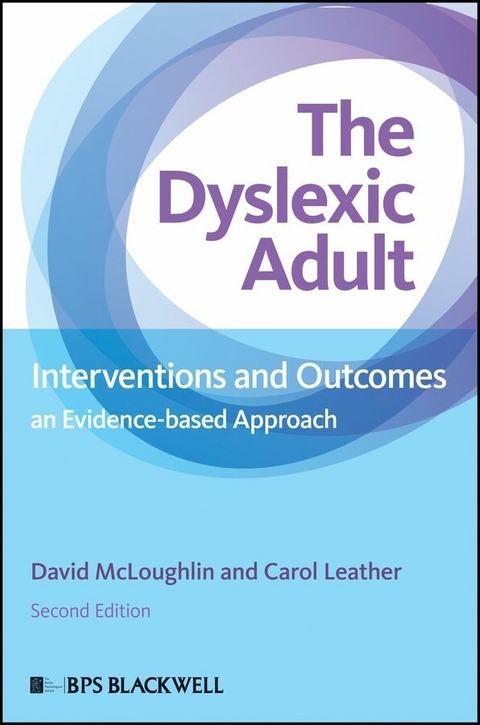
The Dyslexic Adult (eBook)
John Wiley & Sons (Verlag)
978-1-118-32333-5 (ISBN)
- The only book to look at dyslexia within the context of life span developmental psychology, including the factors that contribute to success - now fully revised and updated
- Combines an accessible style with a strong focus on evidence-based practice and a sound theoretical model on which to base assessment, counselling, teaching and training
- Provides a clear guide to the kinds of assessment that can be conducted and the ways in which dyslexic adults can be supported in selection, training, education and employment
- Includes coverage of overlapping syndromes such as dyspraxia and dyscalculia, and up-to-date check lists for syndromes that can be used as part of the assessment process
David McLoughlin is a Visiting Professor in Psychology at the University of Buckingham. He is Director of Independent Dyslexia Consultants, a UK organisation which has worked with dyslexic adults and children for 25 years.
Carol A. Leather is training director at Independent Dyslexia Consultants and a researcher at Surrey University. She has been instrumental in developing strategic approaches to support dyslexic employees in sectors including the emergency services, banking and the civil service.
Together, David and Carol edited the 2010 edition of the British Dyslexia Association's prestigious Dyslexia in Employment Handbook.
A definitive and evidence-based guide for psychologists, teachers, coaches, HR personnel and all professionals who must understand and work with dyslexic adults. The only book to look at dyslexia within the context of life span developmental psychology, including the factors that contribute to success - now fully revised and updated Combines an accessible style with a strong focus on evidence-based practice and a sound theoretical model on which to base assessment, counselling, teaching and training Provides a clear guide to the kinds of assessment that can be conducted and the ways in which dyslexic adults can be supported in selection, training, education and employment Includes coverage of overlapping syndromes such as dyspraxia and dyscalculia, and up-to-date check lists for syndromes that can be used as part of the assessment process
David McLoughlin is a Visiting Professor in Psychology at the University of Buckingham. He is Director of Independent Dyslexia Consultants, a UK organisation which has worked with dyslexic adults and children for 25 years. Carol A. Leather is training director at Independent Dyslexia Consultants and a researcher at Surrey University. She has been instrumental in developing strategic approaches to support dyslexic employees in sectors including the emergency services, banking and the civil service. Together, David and Carol edited the 2010 edition of the British Dyslexia Association's prestigious Dyslexia in Employment Handbook.
"As a guide to assessing and alleviating dyslexic difficultes in
adulthood, this book is a comprehensive and thorough guide, and can
be highly recommended." PATOSS Bulletin, Winter 2013
Dyslexia is a lifelong condition which does not disappear once a
person leaves school but continues to present challenges in
adulthood. This book contains a wealth of evidence-based
information and resources for professionals working to support
adults with dyslexia. The strategies detailed in the book will
enhance practitioners' ability to teach the skills that are
needed to meet these challenges.--Nicola Brunswick, Senior
Lecturer in Psychology at Middlesex University.
David McLoughlin and Carol Leather continue to breathe fresh air
into our understanding and support for dyslexic adults. The book
offers real insight into dyslexia at an academic and practical
level. As someone who is dyslexic I found myself identifying with
many of the examples and at the same time being kept up to date
with the latest research and viewpoints. For anyone
interested in this subject it is a 'must
read'.--Judi Stewart, former CEO British Dyslexia
Association.
Adult Dyslexia - Interventions and Outcomes, in its
second edition, continues to provide up-to-date information in an
area of dyslexia that is now rapidly changing. It is quite
comprehensive and very much "in tune" with the best thinking and
effective practices of both researchers and clinicians in the
field.--Paul J. Gerber, Professor of Special Education and
Disability Policy, Virginia Commonwealth University and the Ruth
Harris Professor of Dyslexia Studies.
2
Interventions
Synopsis. In this chapter dyslexia is considered within the context of life-span development, particularly the challenges dyslexic people face. The interventions that can assist them develop their skills, as well as the fundamental principles underlying working with them, are described.
Introduction
Interventions designed to assist dyslexic people fulfil their potential can be categorised as those that facilitate self understanding, and those which enable people to function more effectively in learning, work and social settings. There is inevitably some overlap. The professional activities involved in the former are:
- assessment;
- mentoring, coaching and counselling.
The activities involved in the second group are:
- skill development;
- compensation;
- adjustments and accommodations.
Before describing these in detail, however, it is important to consider them in the context of life-span developmental psychology, the factors research has shown to contribute to the success of dyslexic people, as well as the principles underlying education and training in the adult years.
Psychological Development in the Adult Years
Although adulthood is the longest stage of development, it is the least studied and, therefore, not particularly well understood. Nevertheless, it has been suggested that placing dyslexia within a life-span developmental perspective will provide a foundation for an understanding of the adjustment challenges faced by adults, and make the knowledge gained from research more meaningful (Gerber, 1994; Patton & Polloway, 1992; Price & Patton, 2002).
Two overriding concepts are important when placing dyslexia within a life-span perspective. The first is the basic assumptions of development, which have been identified as:
(Baltes, Reese & Lipsitt, 1980)
The second essential concept is that of the mediating factors which influence development. Patton and Polloway (1996) describe four main variables:
The last two of these are particularly important when considering dyslexic people, as previous successes and failures have an enormous impact on them. Many will consider that they have not been successful in the past and will not have felt ‘in charge’. Their experiences, positive and negative, will remain in the episodic buffer component of working memory, and this can have a major impact on their response to interventions.
There are several theories concerning life-span development, but there are common themes to them all, summarised by Smith (1996) as:
- There is a fundamental universality to human development; everyone passes through the life stages in basically the same manner.
- There is a basic sequentiality to the human experience, everyone passing through the life stages in the same order. For example, most people leave school, secure a job, find a partner and start a family.
- The life sequence leads towards a goal; we all work towards goals, whether these be in academic achievement, job satisfaction, career development, or personal happiness.
- There are adaptive, or positive, ways and maladaptive, or negative, ways of passing through the sequence of life stages.
(Smith, 1996)
To those working with dyslexic people an awareness of the last of these is particularly important.
Transitions
Everyone faces a series of transitions: that is, life changes to which we have to adjust. A transition is ‘a process of change over time – whether the change is conceptualised as being in contexts for learning or in learners’ (Colley, 2007: 428). The transition from school to further or higher education, or directly into work, is one that educationalists and teachers generally recognise. There is not, however, enough acknowledgement as to how demanding this can be for the dyslexic person. For anyone the need for independent learning skills that allow them to deal with a great deal of new information, in different environments and in changing formats, is considerable. The challenge is even greater for the dyslexic student who may feel that having left school they have put their problems behind them. Moving on to a university environment, often out of the family home where there is an inherent structure, and supportive parents who provide reminders (and clean clothes!), makes demands on independent living skills. Furthermore, there are changing demands in the learning environment, long lectures, group work, infrequent contact with tutors and different assessment methodologies. All of these require good organisational skills and confidence. It has been suggested that we need to understand transitions within the context of ‘life course’ rather than ‘life cycle’, the former acknowledging that life and career trajectories have become less linear and more fragmented, and avoiding the perception of those who do not fit into staged models as being deficient (Colley, 2007). This would certainly seem relevant to dyslexic people, as some do not follow typical educational and career paths, their development being less sequentially linear than it is for others.
After leaving formal education the transition to the workplace is another that all people face. Again the demand for independent learning skills, confidence and the ability to absorb new information and understand job tasks, work culture and procedures is considerable. Dealing with constant change is a key aspect of any job these days: for example, in-service training, job redefinition, promotion to higher levels of a job, and movement from one department to another, from job to job, from employment back to unemployment, from young adulthood to mid-life, and then to old age. All of these can be challenging, and they demand energy that enables coping and adaptation and can be stressful. It is not surprising, therefore, to learn that many people with learning difficulties report that their problems have become worse (Gerber et al., 1990).
Assisting individuals to cope with present demands at any one stage is not enough. It is as important to prepare them for what is ahead of them (Garnett, 1985) as they may not have developed the executive functioning skills referred to in Chapter 1. As Smith-Spark and Fisk (2007) have suggested, ‘working memory deficits will have a significant impact on planning, problem solving, acting under novel situations, and learning. Appropriate support must, therefore, be provided across a range of modalities for adults with dyslexia to achieve their full potential in both educational and employment settings’ (2007: 51). There is a strong case to be made for the preparation of informal or formal transition plans that predict and address needs throughout the life course. These would enable educators, special needs advisors, trainers and human resource personnel to recognise the challenges that dyslexic people may face, predict what might be difficult and provide solutions.
Transitions can be demanding for anyone, but are particularly galling for dyslexic people, as they might not have the skills necessary to effect a positive adaptation, and often these do not develop automatically. They may need coaching, teaching or training intermittently across all the developmental stages. Dyslexic people can be very successful in all aspects of their lives, but as they confront new demands, and discover that previously developed skills and strategies need adjustment for different situations they might seek assistance.
Ironically it is often at times of transition, as a result of having been successful, that many dyslexic people seek an explanation for the problems they unexpectedly face and present for an initial assessment, as well as seek help with the development of their skills. They have not suddenly become dyslexic. Promotion, for example, can place increased demands on organisational skills as well as written language tasks such as report writing. Adults face increasingly complex tasks, especially at work and in their social lives. It is perhaps unsurprising, therefore, that to some their difficulties seem to get worse (Gerber et al., 1990; White, 1992; Price & Patton, 2002).
Successful Adjustment
Risk and Resilience
Although most research has been devoted to identifying the factors that make life difficult for dyslexic people, in order to understand the successful adjustment of people with specific learning difficulties researchers have adopted a ‘risk and resilience’ framework. Having a learning difficulty such as dyslexia is regarded as a risk factor: that is, something that might impact...
| Erscheint lt. Verlag | 14.2.2013 |
|---|---|
| Sprache | englisch |
| Themenwelt | Geisteswissenschaften |
| Medizin / Pharmazie ► Gesundheitsfachberufe ► Logopädie | |
| Sozialwissenschaften ► Pädagogik ► Sonder-, Heil- und Förderpädagogik | |
| Sozialwissenschaften ► Pädagogik ► Sozialpädagogik | |
| Sozialwissenschaften ► Soziologie | |
| Schlagworte | Bildungswesen • Dyslexic adults, Disability Discrimination Act, dyspraxia, dyscalculia, educational psychologists • Education • Learning Disabilities • Lernstörung • Lernstörungen, Lernschwächen • Lernstörung • Lernstörungen, Lernschwächen |
| ISBN-10 | 1-118-32333-5 / 1118323335 |
| ISBN-13 | 978-1-118-32333-5 / 9781118323335 |
| Informationen gemäß Produktsicherheitsverordnung (GPSR) | |
| Haben Sie eine Frage zum Produkt? |
 EPUB (Adobe DRM)
Kopierschutz: Adobe-DRM
Adobe-DRM ist ein Kopierschutz, der das eBook vor Mißbrauch schützen soll. Dabei wird das eBook bereits beim Download auf Ihre persönliche Adobe-ID autorisiert. Lesen können Sie das eBook dann nur auf den Geräten, welche ebenfalls auf Ihre Adobe-ID registriert sind.
Details zum Adobe-DRM
Dateiformat: EPUB (Electronic Publication)
EPUB ist ein offener Standard für eBooks und eignet sich besonders zur Darstellung von Belletristik und Sachbüchern. Der Fließtext wird dynamisch an die Display- und Schriftgröße angepasst. Auch für mobile Lesegeräte ist EPUB daher gut geeignet.
Systemvoraussetzungen:
PC/Mac: Mit einem PC oder Mac können Sie dieses eBook lesen. Sie benötigen eine
eReader: Dieses eBook kann mit (fast) allen eBook-Readern gelesen werden. Mit dem amazon-Kindle ist es aber nicht kompatibel.
Smartphone/Tablet: Egal ob Apple oder Android, dieses eBook können Sie lesen. Sie benötigen eine
Geräteliste und zusätzliche Hinweise
Buying eBooks from abroad
For tax law reasons we can sell eBooks just within Germany and Switzerland. Regrettably we cannot fulfill eBook-orders from other countries.
aus dem Bereich