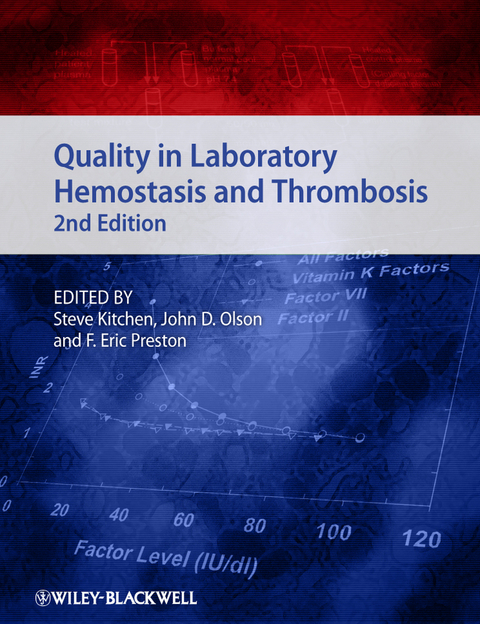
Quality in Laboratory Hemostasis and Thrombosis (eBook)
John Wiley & Sons (Verlag)
978-1-118-54348-1 (ISBN)
Quality in Laboratory Hemostasis and Thrombosis
Second Edition
Edited by
Steve Kitchen, Clinical Scientist, Sheffield Haemophilia and Thrombosis Centre, Royal Hallamshire Hospital and Scientific Director, UK National External Quality Assessment Scheme (FQAS) for Blood Coagulation, Scientific Director, WHO and WFH International External Quality Assessment Programs for Blood Coagulation, Sheffield, UK
John D Olson, Professor and Vice Chair for Clinical Affairs, Department of Pathology, University of Texas Health Sciences Centre, San Antonio, Texas, USA
F. Eric Preston, Emeritus Professsor of Haematology, University of Sheffield and Director, WHO and WFH International External Quality Assessment Programs for Blood Coagulations, Sheffield, UK
The hemostasis laboratory has a vital role in the diagnosis and management of patients with familial and acquired hemorrhagic and thrombotic disorders. Rapid changes in the number and complexity of tests in this discipline have presented challenges for laboratories, as they develop quality programs for the oversight of this testing.
Quality in Laboratory Hemostasis and Thrombosis has been completely revised and updated to reflect the changing process of managing quality. The second edition provides information on all aspects of testing, from pre-analytic to analytic and result reporting, in addition to external quality assurance. Chapters throughout the book include the development of global guidelines for methods, as well as the preparation of international standard plasmas and reagents.
Designed to capture the elements of quality at all levels of the practice of laboratory hemostasis and thrombosis, this book will guide the reader through the development of a quality program to support all activities in the hemostasis laboratory, both simple and complex.
Titles of related interest
Lee: Textbook of Hemophilia, 2e (2010)
ISBN 9781405169141
Federici: Von Willebrand Disease: Basic and Clinical Aspects, 1e (2011)
ISBN 9781405195126
Ma: Hemophilia and Hemostasis: A Case Based Approach to Management, 2e (2012)
ISBN 9780470659762
Dr Steve Kitchen, Clinical Scientist, Sheffield Hemophila and Thromobosis Centre, Royal Hallamshire Hospital and Scientific Director, UK National External Quality Assessment Scheme (FQAS) for Blood Coagulation, Scientific Director, WHO and WFH International External Quality Assessment Programs for Blood Coagulation, Sheffield, UK.
John D Olson, Professor and Vice Chair for Clinical Affairs, Department of Pathology, University of Texas Health Sciences Centre, San Antonio, Texas, USA.
F. Eric Preston, Emeritus Professsor of Hematology, University of Sheffield and Director, WHO and WFH International External Quality Assessment Programs for Blood Coagulations, Sheffield, UK.
Quality in Laboratory Hemostasis and Thrombosis Second Edition Edited by Steve Kitchen, Clinical Scientist, Sheffield Haemophilia and Thrombosis Centre, Royal Hallamshire Hospital and Scientific Director, UK National External Quality Assessment Scheme (FQAS) for Blood Coagulation, Scientific Director, WHO and WFH International External Quality Assessment Programs for Blood Coagulation, Sheffield, UK John D Olson, Professor and Vice Chair for Clinical Affairs, Department of Pathology, University of Texas Health Sciences Centre, San Antonio, Texas, USA F. Eric Preston, Emeritus Professsor of Haematology, University of Sheffield and Director, WHO and WFH International External Quality Assessment Programs for Blood Coagulations, Sheffield, UK The hemostasis laboratory has a vital role in the diagnosis and management of patients with familial and acquired hemorrhagic and thrombotic disorders. Rapid changes in the number and complexity of tests in this discipline have presented challenges for laboratories, as they develop quality programs for the oversight of this testing. Quality in Laboratory Hemostasis and Thrombosis has been completely revised and updated to reflect the changing process of managing quality. The second edition provides information on all aspects of testing, from pre-analytic to analytic and result reporting, in addition to external quality assurance. Chapters throughout the book include the development of global guidelines for methods, as well as the preparation of international standard plasmas and reagents. Designed to capture the elements of quality at all levels of the practice of laboratory hemostasis and thrombosis, this book will guide the reader through the development of a quality program to support all activities in the hemostasis laboratory, both simple and complex. Titles of related interest Lee: Textbook of Hemophilia, 2e (2010) ISBN 9781405169141 Federici: Von Willebrand Disease: Basic and Clinical Aspects, 1e (2011) ISBN 9781405195126 Ma: Hemophilia and Hemostasis: A Case Based Approach to Management, 2e (2012) ISBN 9780470659762
Dr Steve Kitchen, Clinical Scientist, Sheffield Hemophila and Thromobosis Centre, Royal Hallamshire Hospital and Scientific Director, UK National External Quality Assessment Scheme (FQAS) for Blood Coagulation, Scientific Director, WHO and WFH International External Quality Assessment Programs for Blood Coagulation, Sheffield, UK. John D Olson, Professor and Vice Chair for Clinical Affairs, Department of Pathology, University of Texas Health Sciences Centre, San Antonio, Texas, USA. F. Eric Preston, Emeritus Professsor of Hematology, University of Sheffield and Director, WHO and WFH International External Quality Assessment Programs for Blood Coagulations, Sheffield, UK.
Quality in Laboratory Hemostasis and Thrombosis 3
Contents 7
Contributors 9
Foreword 12
Preface 14
PART 1 General Quality Program 15
1 General quality planning in the hemostasis laboratory 17
Introduction 17
The principles 17
Elements of quality in the hemostasis laboratory 18
The tools 19
Six Sigma 19
Lean 20
Error detection and correction 21
Internal quality control 22
Quality assurance 22
External quality assessment 22
The application of the tools in the laboratory 23
Quality system essentials 23
Summary 25
References 25
2 Hemostasis test validation, performance, and reference intervals: international recommendations and guidelines 26
Hemostatic test validation concepts 27
Limits 28
Protocol 30
Continued performance of coagulation/hemostasis assays 30
Internal quality control 31
External quality assessment 31
Reference interval 31
Appendix: Standards and guideline developing organizations 33
Statistics 33
Acknowledgments 35
References 35
3 Causes of errors in medical laboratories 36
Overview on medical errors 36
Diagnostic errors: the laboratory scenario 37
The definition of laboratory error 37
Exploring the iceberg of laboratory errors 37
Preanalytical errors 38
Specific preanalytical issues related to coagulation testing 39
Dealing with preanalytical errors 41
Analytical errors 42
Postanalytical errors 43
Conclusion 44
References 44
4 International standards in hemostasis 46
Introduction 46
International standards and international units 46
Units of activity 46
International units 47
Establishment of international standards 47
Heparin and LMW heparin 49
Thromboplastins 50
Coagulation factors and inhibitors 51
Factor VIII 51
Factor IX 54
von Willebrand factor 54
Fibrinogen 55
Thrombin 55
Other coagulation factors and inhibitors 55
Fibrinolysis standards 56
References 56
5 Sample integrity and preanalytical variables 59
Introduction 59
Sample acquisition (specimen collection) 60
Transportation of whole blood specimens to the laboratory 65
Specimen Processing 66
Stability and storage of plasma samples 67
Controlled thawing of frozen plasma samples 67
Conclusion 68
References 68
6 Internal quality control in the hemostasis laboratory 71
Introduction 71
IQC materials 71
Frequency of IQC testing 73
Acceptable limits for IQC 74
Storage and processing of IQC results 74
Out of limits IQC results 75
Accreditation and regulatory bodies 77
Conclusion 77
References 77
7 External quality assessment in hemostasis: its importance and significance 79
Overview 79
Target values 80
The evaluation of laboratory performance 81
Monitoring results: the role of the laboratory 83
The educational role of EQA 84
Additional advantages of EQA programs 84
Recent developments 85
Establishing EQA programs in developing countries 86
The need and the challenges 86
The establishment of an EQA program in India: a successful model 87
Samples for EQAS 87
Assignment of target value 88
Profile of participants 88
Range of tests offered 88
The program and its impact 88
Extension to other developing countries 89
References 89
8 The unique challenges of hemostatic testing in children 91
Introduction 91
Normal hemostasis 91
Developmental hemostasis 93
Pediatric reference ranges: challenges and deviations 94
Local pediatric reference range development 95
The effect of the assay method 95
Test sampling 96
Preanalytical variables 96
Analytical variables 97
Postanalytical variables 97
Global hemostasis parameters 97
Thrombophilia testing 97
When is thrombophilia testing indicated in children 98
Monitoring currently administered anticoagulants 98
Unfractionated heparin 98
Low molecular weight heparin 99
Vitamin K antagonists 100
POC INR monitoring 100
New anticoagulants in children 101
Conclusion 101
References 102
PART 2 Quality in Coagulation Testing 107
9 Initial evaluation of hemostasis: reagent and method selection 109
Introduction 109
Instrument selection 109
Evaluation of the method 110
Prothrombin time method selection 111
Minimum evaluation, prothrombin time 113
Activated partial thromboplastin time method selection 113
Minimum evaluation, activated partial thromboplastin time assay 114
Fibrinogen method selection 114
Minimum evaluation, fibrinogen assay 115
Thrombin time method selection 115
Minimum evaluation, thrombin time 116
Whole blood viscoelastic assays 116
Minimum evaluation, viscoelastic assays 117
References 117
10 Assay of factor VIII and other clotting factors 119
Pretest variables 119
One-stage assay of factor VIII:C or factor IX:C 119
Assays in the presence of strong lupus anticoagulant 121
One-stage assay components 122
Factor assays in the presence of severe deficiency 123
Assay of elevated factor VIII:C 124
Two-stage clotting assay for FVIII:C 124
Chromogenic assay for factor VIII:C in plasma 125
Factor VIII:C and FIX:C assays following clotting factor infusions 126
References 126
11 Application of molecular genetics to the investigation of inherited bleeding disorders 129
Hemophilia A and B 129
The genes and their mutations 131
Most common mutations 131
Other rare bleeding disorders 133
Internal quality control 135
External quality assessment 135
Reporting 135
References 136
12 Detecting and quantifying acquired functional inhibitors in hemostasis 138
Introduction 138
Clinical manifestations of hemostasis inhibitors 139
Screening tests for inhibitor detection 139
Differential classification of inhibitors 140
Assay of inhibitors against individual coagulation factors 140
Assay principle 140
Available methods 140
Reagents 141
Equipment 141
Method 141
Evaluation of test results 142
Expected values 142
Improved sensitive assay 142
Assay characteristics 143
Pitfalls and limitations of the inhibitor assay 144
Inhibitors against other clotting factors 145
Conclusion 146
References 146
13 Standardization of D-dimer testing 150
Introduction 150
Heterogeneity of D-dimer containing fragments 150
Specificity of monoclonal antibodies directed to D-dimer motif 151
Calibrators for D-dimer assays 151
Standardization of D-dimer assays 153
Harmonization of D-dimer assays 153
Problems in daily practice 157
Reference material for D-dimer assays 158
Conclusion 159
References 159
14 Point-of-care testing in hemostasis 161
Introduction 161
Monitoring of oral anticoagulation 161
Quality assurance of point-of-care INR monitors 163
Patient self-monitoring of oral anticoagulation 164
aPTT testing 165
aCT 166
Thrombin time 166
Low molecular weight heparin monitoring 167
D-dimer 167
Thrombelastography 167
Management of POCT services 168
Conclusion 168
References 169
PART 3 Quality in Testing for Platelet Function and von Willebrand Disease 171
15 Diagnostic assessment of platelet function 173
Bleeding time 174
Prothrombin consumption 174
Platelet counting and morphology 174
The platelet function analyzer 176
The VerifyNow and point-of-care tests 177
Platelet aggregometry 177
Platelet secretion 179
Flow cytometry 179
Clot retraction 182
Signaling pathways 182
In vitro studies on thrombus formation 182
Requiring specialist procedures, this can be studied under static or flow conditions. 182
Platelet adhesion to collagen and other adhesive proteins under static conditions 182
Thrombus formation on immobilized collagen under flow conditions 183
Platelet procoagulant activity 183
New technologies 183
Proteomics and genomics 183
Gene sequencing 184
References 184
16 Laboratory evaluation of heparin-induced thrombocytopenia 188
HIT syndrome 188
Central paradigm of HIT [5] 188
Key concepts in HIT 189
Several concepts directly relate to issues of laboratory testing and the interpretation of test results. 189
Stoichiometric PF4: heparin ratios and high heparin inhibition 189
Iceberg model 189
Timeline of HIT immune response 190
Serum versus plasma 190
Positive control reagents 190
Evaluation of pretest probability 192
Platelet activation assays 193
Platelet aggregation assays 193
Washed platelet activation assays: serotonin-release assay (SRA) and heparin-induced platelet activation HIPA) test 193
Whole blood impedance aggregometry 195
PF4-dependent enzyme-immunoassays 195
PF4-dependent particle-based immunoassays (rapid assays) 198
Particle gel immunoassay 198
Particle immunofiltration assay 199
Instrumentation-based immunoassays 199
Fluid-phase immunoassays 200
Sepharose G fluid-phase EIA 200
Gold nanoparticle-based fluid-phase EIA lateral-flow immunoassay) 200
Approach of the McMaster platelet immunology laboratory 201
References 202
17 Laboratory evaluation of von Willebrand disease: phenotypic analysis 206
Introduction and background 206
Fundamental problems with the phenotypic evaluation of vWD 207
Phenotypic assays used in the diagnosis of vWD 207
Sensitive and specific laboratory assays for vWD 208
A diagnostic laboratory process for vWD 210
Recommendations and conclusions 215
Acknowledgments 215
References 215
18 Laboratory analysis of von Willebrand disease: molecular analysis 218
Introduction 218
Type 3 VWD 218
Type 2 VWD 219
Type 2A VWD 219
Type 2B VWD 220
Type 2M VWD 220
Type 2N VWD 220
Type 2 VWD summary 221
Type 1 VWD 221
Mutation analysis 222
Point mutations 222
Large deletions and duplications 222
Mutation analysis in VWD 222
Missing mutations and too many mutations 223
Prenatal diagnosis 224
Internal quality control 224
External quality control 225
External quality assessment 225
Reporting 225
Nomenclature 225
Report inclusions 225
References 226
PART 4 Quality in Thrombophilia Testing and Monitoring Anticoagulation 231
19 Quality issues in heritable thrombophilia testing 233
Introduction 233
The thrombophilia screen: what to include? 233
Which methods? 234
Antithrombin 234
Protein C 236
Protein S 237
Activated protein C resistance and factor V Leiden 240
Prothrombin G20210A mutation 241
Other tests 241
What samples and when? 242
Interpreting the results 242
Physiological and pathological variability 242
Reference ranges 243
Patient-specific interpretive comment 243
Who should be tested? 244
References 244
20 Evaluation of antiphospholipid antibodies 247
Antiphospholipid syndrome 247
The definition of antiphospholipid syndrome 247
Antiphospholipid antibodies 247
Lupus anticoagulants 249
The pivotal role of beta2 glycoprotein I 249
Lupus anticoagulant assays 249
The APTT 249
The KCT 250
The DRVVT 250
Lupus anticoagulant assay performance 251
Assay of lupus anticoagulant in subjects treated with coumarin 252
Anticardiolipin assays 253
Anticardiolipin assay performance 253
Anti-beta2 glycoprotein I antibody assays 254
Anti-beta2 glycoprotein I antibody assay performance 254
The clinical implications of positive tests for antiphospholipid antibodies 255
Summary and conclusion 255
References 255
21 Monitoring heparin therapy 258
Heparin 258
Mechanism of action 258
Limitations of heparin 258
Pharmacokinetic 258
Clinical 259
Low molecular weight heparins 259
Current techniques used to measure heparin in plasma 260
Recommended protocol 260
PS neutralization assay 261
Chromogenic Xa inhibition heparin assays 261
A generic two-stage chromogenic factor Xa heparin assay 261
Interfering substances 262
One-stage chromogenic assays 262
Xa inhibition clotting assays 262
IIa inhibition assays 263
Quality control and assurance 263
Preanalytical variables 263
Heparin calibration curves 263
Control plasmas 264
Results from quality assurance programs 264
Summary 265
Monitoring UFH 265
Monitoring LMWH 265
The Future 265
References 265
22 Monitoring oral anticoagulant therapy with vitamin K antagonists 267
Introduction 267
Thromboplastin calibration 268
WHO calibration 268
Hierarchy of WHO international reference preparations 269
Local calibration 270
Conversion of PT into INR and issues affecting results 271
Conversion of PT into INR 271
Issues affecting results 271
Limits of the INR 273
General limits 273
Specific limits 273
Implementation of the INR 274
Conclusions and future directions 275
References 275
23 Monitoring new anticoagulants 278
Introduction 278
New anticoagulants 278
Calibration for accuracy of measurement 279
Methods for monitoring indirect FXa inhibitors 279
Methods for monitoring direct Xa inhibitors 281
Methods for monitoring DTIs 281
Methods for monitoring dual inhibitor of FXa and thrombin 282
Monitoring anticoagulants using global screening tests 282
Summary 284
References 284
Index 287
| Erscheint lt. Verlag | 26.2.2013 |
|---|---|
| Sprache | englisch |
| Themenwelt | Medizin / Pharmazie ► Allgemeines / Lexika |
| Medizinische Fachgebiete ► Innere Medizin ► Hämatologie | |
| Medizinische Fachgebiete ► Innere Medizin ► Kardiologie / Angiologie | |
| Schlagworte | Blood • Clinical • coagulation • Edition • Emeritus • External • FQAS • Hämostase • Haematology • Hämostase • international external • Kitchen • laboratory hemostasis • Medical Science • Medizin • national • Pathology • Professor • professsor • Programs • quality • Sciences • texas health • Thrombose • Thrombose u. Hämostase • Thrombose u. Hämostase • Thrombosis & Hemostasis |
| ISBN-10 | 1-118-54348-3 / 1118543483 |
| ISBN-13 | 978-1-118-54348-1 / 9781118543481 |
| Informationen gemäß Produktsicherheitsverordnung (GPSR) | |
| Haben Sie eine Frage zum Produkt? |
 PDF (Adobe DRM)
Kopierschutz: Adobe-DRM
Adobe-DRM ist ein Kopierschutz, der das eBook vor Mißbrauch schützen soll. Dabei wird das eBook bereits beim Download auf Ihre persönliche Adobe-ID autorisiert. Lesen können Sie das eBook dann nur auf den Geräten, welche ebenfalls auf Ihre Adobe-ID registriert sind.
Details zum Adobe-DRM
Dateiformat: PDF (Portable Document Format)
Mit einem festen Seitenlayout eignet sich die PDF besonders für Fachbücher mit Spalten, Tabellen und Abbildungen. Eine PDF kann auf fast allen Geräten angezeigt werden, ist aber für kleine Displays (Smartphone, eReader) nur eingeschränkt geeignet.
Systemvoraussetzungen:
PC/Mac: Mit einem PC oder Mac können Sie dieses eBook lesen. Sie benötigen eine
eReader: Dieses eBook kann mit (fast) allen eBook-Readern gelesen werden. Mit dem amazon-Kindle ist es aber nicht kompatibel.
Smartphone/Tablet: Egal ob Apple oder Android, dieses eBook können Sie lesen. Sie benötigen eine
Geräteliste und zusätzliche Hinweise
Buying eBooks from abroad
For tax law reasons we can sell eBooks just within Germany and Switzerland. Regrettably we cannot fulfill eBook-orders from other countries.
aus dem Bereich