


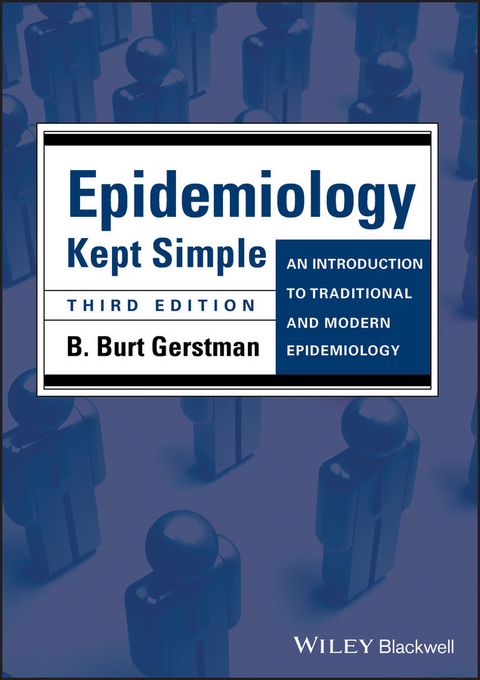
Epidemiology Kept Simple (eBook)
John Wiley & Sons (Verlag)
978-1-118-52540-1 (ISBN)
Epidemiology Kept Simple introduces the epidemiological principles and methods that are increasingly important in the practice of medicine and public health. With minimum use of technical language it fully explains terminology, concepts, and techniques associated with traditional and modern epidemiology. Topics include disease causality, epidemiologic measures, descriptive epidemiology, study design, clinical and primary prevention trials, observational cohort studies, case-control studies, and the consideration of random and systematic error in studies of causal factors. Chapters on the infectious disease process, outbreak investigation, and screening for disease are also included. The latter chapters introduce more advanced biostatistical and epidemiologic techniques, such as survival analysis, Mantel-Haenszel techniques, and tests for interaction.
This third edition addresses all the requirements of the American Schools of Public Health (ASPH) Epidemiological Competencies, and provides enhanced clarity and
readability on this difficult subject. Updated with new practical exercises, case studies and real world examples, this title helps you develop the necessary tools to interpret epidemiological data and prepare for board exams, and now also includes review questions at the end of each chapter.
Epidemiology Kept Simple continues to provide an introductory guide to the use of epidemiological methods for graduate and undergraduate students studying public health, health education and nursing, and for all practicing health professionals seeking professional development.
Epidemiology Kept Simple introduces the epidemiological principles and methods that are increasingly important in the practice of medicine and public health. With minimum use of technical language it fully explains terminology, concepts, and techniques associated with traditional and modern epidemiology. Topics include disease causality, epidemiologic measures, descriptive epidemiology, study design, clinical and primary prevention trials, observational cohort studies, case-control studies, and the consideration of random and systematic error in studies of causal factors. Chapters on the infectious disease process, outbreak investigation, and screening for disease are also included. The latter chapters introduce more advanced biostatistical and epidemiologic techniques, such as survival analysis, Mantel-Haenszel techniques, and tests for interaction. This third edition addresses all the requirements of the American Schools of Public Health (ASPH) Epidemiological Competencies, and provides enhanced clarity and readability on this difficult subject. Updated with new practical exercises, case studies and real world examples, this title helps you develop the necessary tools to interpret epidemiological data and prepare for board exams, and now also includes review questions at the end of each chapter. Epidemiology Kept Simple continues to provide an introductory guide to the use of epidemiological methods for graduate and undergraduate students studying public health, health education and nursing, and for all practicing health professionals seeking professional development.
B. Burt Gerstman, Professor in Department of Health Science, San Jose University, CA USA.
"This edition does a good job of updating the previous editions,
which have not covered the ASPH epidemiology competencies."
(Doody's, 21 February 2014)
Chapter 1
Epidemiology Past and Present
- What is epidemiology?
- What is public health?
- What is health?
- Additional useful terms
- Uses of epidemiology
- Twentieth century changes in demographics and disease patterns
- Mortality trends since 1950
- Trends in life expectancy
1.1 Epidemiology and its uses
What is epidemiology?
The word epidemiology is based on the Greek roots epi (upon), demos (the people, as in “democracy” and “demography”), and logia (“speaking of,” “the study of”). Specific use of the term in the English language dates to the mid-19th century (Oxford English Dictionary), around the time the London Epidemiological Society was founded in 1850. Since then, epidemiology has defined itself in many ways, including:
- the study of the distribution and determinants of diseases and injuries in populations (Mausner and Baum, 1974);
- the study of the occurrence of illness (Gaylord Anderson cited in Cole, 1979, p. 15);
- a method of reasoning about disease that deals with biological inferences derived from observations of disease phenomena in population groups (Lilienfeld, 1978b, p. 89);
- the quantitative analysis of the circumstances under which disease processes, including trauma, occur in population groups, and factors affecting their incidence, distribution, and host responses, and the use of this knowledge in prevention and control (Evans, 1979, p. 381).
A widely accepted contemporary definition of epidemiology identifies the discipline as “the study of the distribution and determinants of health-related states or events in specified populations, and the application of this study to control of health problems” (Last, 2001).
The word epidemiology is, of course, based on the word epidemic. This term dates back to the time of Hippocrates, circa 400 BCE. Until not too long ago, epidemic referred only to the rapid and extensive spread of an infectious disease within a population. Now, however, the term applies to any health-related condition that occurs in clear excess of normal expectancy. For example, one may hear mention of an “epidemic of teen pregnancy” or an “epidemic of violence.” This broader use of the term reflects epidemiology's expansion into areas beyond infectious disease control to include the study of health and health-related determinants in general. In this non-limiting sense, epidemiology is still the study of epidemics and their prevention (Kuller, 1991).
In addition, epidemiology is becoming increasingly integrated in biomedical research and health care. Note, however, that the main distinction between epidemiology and clinical medicine is their primary unit of concern. The primary unit of concern for the epidemiologist is “an aggregate of human beings” (Greenwood, 1935). Compare this with clinical medicine, whose main unit of concern is the individual. A metaphor that compares epidemiology with clinical medicine discusses a torrential storm that causes a break in the levees. People are being washed away in record numbers. Under such circumstances, the physician's task is to offer lifejackets to people one at a time. In contrast, the epidemiologist's task is to stem the tide of the flood to mitigate the problem and prevent future occurrences.
What is public health?
Like epidemiology, public health has been defined in many different ways including “organized community effort to prevent disease and promote health (Institute of Medicine, 1988) and “one of the efforts organized by society to protect, promote, and restore the people's health (Last 2001). By any definition, the aim of public health is to reduce injury, disability, disease, and premature death in the population. Public health is thus a mission comprising many activities, including but not limited to epidemiology. Epidemiology is a “study of” with many applications, while public health is an undertaking.
Note that epidemiology is one of the core disciplines of public health. Other core disciplines in public health include biostatistics, environmental health sciences, health policy and management, and social and behavioral sciences (Calhoun et al., 2008). The practice of public health also requires cross-cutting interdisciplinary competencies in areas such as communication, informatics, culture and diversity, and public health biology.
What is health?
Health itself is not easily defined. The standard medical definition of health is “the absence of disease.” Dis-ease, literally the absence of “ease,” is when something is wrong with a bodily or mental function. The World Health Organization in the preamble to its 1948 constitution defined health as “a state of complete physical, mental, and social well-being and not merely the absence of disease or infirmity.”
Walt Whitman (1954, p. 513), in his poetic way, defined health as:
the condition [in which] the whole body is elevated to a state by other unknown—inwardly and outwardly illuminated, purified, made solid, strong, yet buoyant. A singular charm, more than beauty, flickers out of, and over, the face—a curious transparency beams in the eyes, both in the iris and the white—temper partakes also. The play of the body in motion takes a previously unknown grace. Merely to move is then a happiness, a pleasure—to breathe, to see, is also. All the before hand gratifications, drink, spirits, coffee, grease, stimulants, mixtures, late hours, luxuries, deeds of the night seem as vexatious dreams, and now the awakening; many fall into their natural places, wholesome, conveying diviner joys.
This passage from Whitman address quality of life, an area of increasing interest to epidemiologists.
Additional useful terms
One of the ten American Schools of Public Health MPH Epidemiology competencies is to “apply the basic terminology and definitions of epidemiology” (Calhoun et al., 2008). Therefore, terminology will be introduced throughout this book. Table 1.1 lists definitions for several standard terms. For example, an epidemic is the occurrences of disease in clear excess of normalcy, while a pandemic is an epidemic that affects several countries or continents. An endemic disease is one that is consistently present in the environment. The term endemic is also used to refer to a normal or usual rate of disease. An excellent source for epidemiologic definitions is The Dictionary of Epidemiology (Porta, 2008), which is updated periodically.
Table 1.1 Selected terms briefly defined.
| Epidemiology: the study of the distribution and determinants of health-related states or events in specified populations, and the application of this study to the control of health problems |
| Public health: organized effort to prevent disease and promote health |
| Endemic: occurring at a consistent or regular rate |
| Epidemic: occurring in clear excess of normalcy |
| Pandemic: an epidemic that affects several countries or continents |
| Morbidity: related to or caused by disease or disability |
| Mortality: related to death |
Some terms used in the field are not readily defined in a singular way. For example, some sources differentiate between disease, illness, and sickness. Susser (1973) defines disease as the medically applied term for a physiological or psychological dysfunction; illness is what the patient experiences; and sickness is the state of dysfunction of the social role of an ill person. In contrast, one source considers “disease” a subtype of “illness” (Miettinen and Flegel, 2003). While yet in other contexts, “disease” is merely a general term used to refer to any health-related outcome or condition. Thus, the use of...
| Erscheint lt. Verlag | 21.2.2013 |
|---|---|
| Sprache | englisch |
| Themenwelt | Medizin / Pharmazie ► Allgemeines / Lexika |
| Studium ► Querschnittsbereiche ► Epidemiologie / Med. Biometrie | |
| Schlagworte | Addendum • Additional • association • Disease • Disease Frequency • Edition • epidemiology • Expression • First • History • Introduction • measures • Medical Science • Medical Statistics & Epidemiology • Medizin • Medizinische Statistik u. Epidemiologie • Morbidity • Patterns • Potential • study design • Third • Variability |
| ISBN-10 | 1-118-52540-X / 111852540X |
| ISBN-13 | 978-1-118-52540-1 / 9781118525401 |
| Informationen gemäß Produktsicherheitsverordnung (GPSR) | |
| Haben Sie eine Frage zum Produkt? |
 EPUB (Adobe DRM)
Kopierschutz: Adobe-DRM
Adobe-DRM ist ein Kopierschutz, der das eBook vor Mißbrauch schützen soll. Dabei wird das eBook bereits beim Download auf Ihre persönliche Adobe-ID autorisiert. Lesen können Sie das eBook dann nur auf den Geräten, welche ebenfalls auf Ihre Adobe-ID registriert sind.
Details zum Adobe-DRM
Dateiformat: EPUB (Electronic Publication)
EPUB ist ein offener Standard für eBooks und eignet sich besonders zur Darstellung von Belletristik und Sachbüchern. Der Fließtext wird dynamisch an die Display- und Schriftgröße angepasst. Auch für mobile Lesegeräte ist EPUB daher gut geeignet.
Systemvoraussetzungen:
PC/Mac: Mit einem PC oder Mac können Sie dieses eBook lesen. Sie benötigen eine
eReader: Dieses eBook kann mit (fast) allen eBook-Readern gelesen werden. Mit dem amazon-Kindle ist es aber nicht kompatibel.
Smartphone/Tablet: Egal ob Apple oder Android, dieses eBook können Sie lesen. Sie benötigen eine
Geräteliste und zusätzliche Hinweise
Buying eBooks from abroad
For tax law reasons we can sell eBooks just within Germany and Switzerland. Regrettably we cannot fulfill eBook-orders from other countries.


