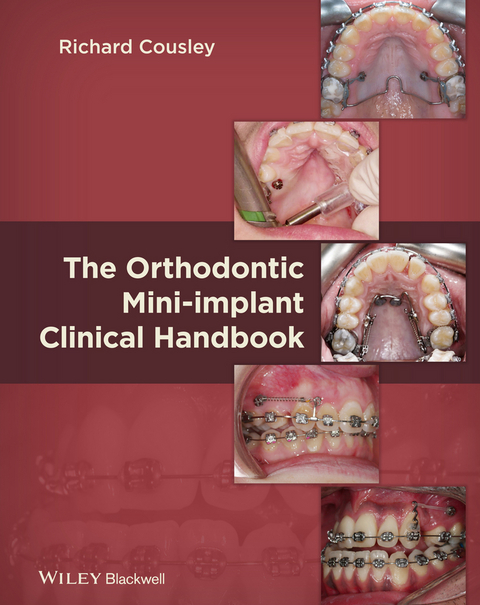
The Orthodontic Mini-implant Clinical Handbook (eBook)
John Wiley & Sons (Verlag)
978-1-118-27597-9 (ISBN)
The Orthodontic Mini-Implant Clinical Handbook is the must-have book for trainee and practicing orthodontists. It provides the essential theoretical and clinical mini-implant information to enable the clinician to easily introduce skeletal anchorage into their practice across a wide variety of common clinical scenarios.
The initial chapters cover general principles with subsequent chapters employing a step-by-step approach to guide the novice through the most common clinical uses for orthodontic mini-implants including: incisor retraction, molar distalisation, transverse and asymmetry corrections, and orthognathic surgery uses.
The Orthodontic Mini-Implant Clinical Handbook is the must-have book for trainee and practicing orthodontists. It provides the essential theoretical and clinical mini-implant information to enable the clinician to easily introduce skeletal anchorage into their practice across a wide variety of common clinical scenarios. The initial chapters cover general principles with subsequent chapters employing a step-by-step approach to guide the novice through the most common clinical uses for orthodontic mini-implants including: incisor retraction, molar distalisation, transverse and asymmetry corrections, and orthognathic surgery uses.
Richard Cousley is a Consultant Orthodontist at the Peterborough and Stamford Hospitals NHS Foundation Trust, and in private specialist practice. He is the Associate Editor for the Journal of Orthodontics and a Membership in Orthodontics examiner for the Royal College of Surgeons (England). Richard has pioneered mini-implant usage in the UK since 2003 and designed the Infinitas mini-implant system. He has published numerous clinical papers on bone anchorage techniques, and has been an invited lecturer at British, European and American orthodontic conferences and university programmes. Most recently he became the UK clinical advisor for an orthodontic aligner company.
Preface vii
1. Mini-implant Principles and Potential Complications 1
The origins of orthodontic bone anchorage 1
Using the right terminology 1
Principal design features 2
Clinical indications for mini-implants 2
Potential mini-implant complications 2
References 6
2. Maximising Mini-implant Success: Clinical Factors 9
Overall success rates 9
Factors affecting mini-implant success 9
References 13
3. Maximising Mini-implant Success: Design Factors 17
Infinitas mini-implant design features 17
The Infinitas guidance system 19
References 22
4. Introducing Mini-implants to Your Clinical Practice 25
Patient consent 25
Key points to consider for valid consent 26
Staff training 29
Patient selection 29
References 29
5. Planning and Insertion Techniques 31
Mini-implant planning 31
Mini-implant insertion 37
References 44
6. Incisor Retraction 45
Treatment options 46
Key treatment planning considerations 46
Biomechanical principles 47
Mid-treatment problems and solutions 49
Posterior mini-implant clinical steps 50
References 61
7. Molar Distalisation 63
Treatment options 63
Key treatment planning considerations 64
Biomechanical principles 64
Mid-treatment problems and solutions 64
Mandibular arch distalisation 64
Maxillary arch distalisation 68
Mid-palatal distaliser options 73
References 82
8. Molar Protraction 83
Treatment options 83
Key treatment planning considerations 83
Biomechanical principles 84
Mid-treatment problems and solutions 84
Clinical steps for molar protraction using alveolar site anchorage 87
Clinical steps for mid-palate (indirect) anchorage 96
References 98
9. Intrusion and Anterior Openbite Treatments 99
Single Tooth and Anterior Segment Intrusion Treatments 99
Treatment options 99
Relevant clinical details 99
Biomechanical principles 100
Clinical tips and technicalities 100
Anterior Openbite Treatment 104
Treatment options 105
Relevant clinical details 105
Biomechanical principles 105
Clinical tips and technicalities 106
Simultaneous mandibular molar intrusion 108
Clinical steps for maxillary molar intrusion 108
References 122
10. Transverse and Asymmetry Corrections 123
Asymmetry problems 123
Dental Centreline Correction 123
Treatment options 123
Relevant clinical details 123
Biomechanical principles 126
Clinical tips and technicalities 126
Mid-treatment problems and solutions 126
Clinical steps for centreline correction 126
Unilateral Intrusion (Vertical Asymmetry Correction) 131
Treatment options 131
Relevant clinical details 131
Biomechanical principles 131
Clinical tips and technicalities 131
Mid-treatment problems and solutions 131
Clinical steps for unilateral intrusion 132
Transverse Correction of Ectopic Teeth 137
Treatment options 137
Relevant clinical details 137
Biomechanical principles 137
Clinical tips and technicalities 138
Mid-treatment problems and solutions 138
Clinical steps for ectopic tooth alignment 138
11. Orthognathic Surgical Uses 145
Treatment options 145
Relevant clinical details 146
Biomechanical principles 146
Clinical tips and technicalities 147
Clinical steps 149
References 174
Index 175
"I strongly recommend this book to all cliniciansinterested in introducing skeletal anchorage into their practice.The book is competitively priced, particularly when considering theamount clinical material provided." (EuropeanJournal of Orthodontics, 2 October 2013)
"I have no hesitation in recommending this book as anessential read for orthodontic specialty trainees who may benefitfrom the pro-gressive approach." (BritishDental Journal, 28 September 2013)
1
Mini-implant Principles and Potential Complications
The origins of orthodontic bone anchorage
Orthodontic-specific skeletal fixtures were developed from two distinct sources:
- restorative implants
- maxillofacial surgical plating kits.1
Orthodontic implants were first produced in the 1990s by modification of dental implant designs, making them shorter (e.g. 4–6 mm length) and wider (e.g. 3 mm diameter). However, they retained the crucial requirement for osseointegration, i.e. a direct structural and functional union of bone with the implant surface causing clinical anklyosis of the fixture. In contrast, mini-plates and mini-implants (mini-screws) are derived from bone fixation technology, and primarily rely on mechanical retention rather than osseointegration. In effect, modification of the maxillofacial bone plate design, adding a transmucosal neck and intra-oral head, resulted in the mini-plate; whilst adaption of the fixation screw design produced the mini-implant. Since the start of this millennium a wide variety of customised orthodontic mini-implants have been produced and these are now used in the vast majority of orthodontic bone anchorage applications. Orthodontic implants are no longer in standard use and the invasive nature of mini-plates appears to limit their use to orthopaedic traction (e.g. Class III) cases.
Using the right terminology
Unfortunately a misleading array of terms has been used for bone anchorage devices and their applications in both journals and the commercial literature. Essentially it is best to encompass all types of fixtures which provide skeletal anchorage under the umbrella terms: Bone Anchorage Devices (BADs) or Temporary Anchorage Devices (TADs), although the latter term does not indicate the essential role of bone in this anchorage. This book covers only one of the three types of BADs: mini-implants. Whilst the terms mini-implant and mini-screw are used interchangeably in the literature, it is erroneous to use the terms micro-screws or micro-implants since these fixtures are small (mini) and not microscopic. I prefer the term mini-implant since it conveys the small size and implantable nature of these temporary fixtures.
Second, there appears to be much misunderstanding over whether mini-implants osseointegrate. Most mini-implants are made from either titanium or titanium alloy and histological studies show variable levels of bone–implant contact (BIC).2,3 However, it is misleading to refer to this as osseointegration. Rather, clinical usage and percussion indicate that mini-implants are mechanically retained (like bone fixation screws) rather than forming a clinically discernible ankylotic union with the bone (which occurs with restorative implants secondary to the initial BIC phase). Hence, mini-implants can be immediately loaded and easily unscrew, usually without anaesthetic, at any time after insertion. This may be because of their relatively smooth surface and possibly because the surface contact is more a physical phenomenon than a biochemical one.
Principal design features
Most mini-implants have three constituent parts: the head, neck and body (Fig. 1.1), and are fabricated from a titanium alloy such as surgical grade five (Ti-6Al-4V). The head is the platform which connects to orthodontic appliances or elastic traction. The neck is the part that traverses the mucosa. The body is the endosseous section with threads around a core and a tapered tip. Mini-implants were initially available only in self-tapping (non-drilling) forms whereby a full depth pilot hole had to be drilled before mini-implant insertion. However, many self-drilling screws are now available. These have a tapered body shape with sharp tips and threads, and are inserted in a corkscrew-like manner. Full depth pre-drilling is avoided, although shallow perforation of the cortex is still advantageous where the cortex is thick or dense, e.g. the posterior mandible and palate.
Figure 1.1 Diagram showing the three principal sections of a mini-implant: the head superficial to the tissues, the neck traversing the mucosa, and the threaded body within the cortical and cancellous bone.
Clinical indications for mini-implants
Mini-implant usage may be broadly divided according to the case application and form of anchorage.
Routine cases
- Cases with high anchorage demands, e.g. retraction of prominent upper incisors or centreline correction (especially where unilateral anchorage only is required). Orthodontists new to mini-implant usage may find it easiest to introduce them into their clinical practice in such cases since the other aspects of the treatment are usually uncomplicated, enabling the orthodontist to readily recognise the anchorage effects and gain experience.
- Adults and older adolescents who wouldn’t comply well with other anchorage options, especially headgear.
- Where extrusive tooth movements would be unfavourable (risking an anterior openbite or vertical excess).
Complex cases
- Where conventional biomechanics would be limited, e.g. molar intrusion to correct an anterior openbite.
- Where conventional dental anchorage is limited by an inadequate number of anchor teeth (due to tooth loss or hypodontia) or periodontal support.
Direct and indirect anchorage
- Direct loading is when traction is applied from the mini-implant’s head to an appliance, typically with elastic chain or nickel titanium (NiTi) coil springs (Fig. 1.2a).
- Indirect loading involves using the mini-implant to reinforce anchor teeth, from which traction is applied (Figs 1.2b,c). Whilst indirect anchorage avoids some potential biomechanical side-effects (as discussed in Chapter Three) it risks insidious anchorage loss through flexing of the intermediary wire and undetected tipping or bodily translation of the mini-implant. Consequently, I prefer to use direct anchorage wherever possible and this will be elucidated in the clinical scenario chapters.
Figure 1.2 (a) Direct anchorage where this grey elastomeric attachment provides traction from the mini-implant head to a powerarm on the fixed appliance for en masse retraction of the anterior teeth. (b) The maxillary mini-implant provides indirect anchorage for molar protraction in this hypodontia case. Horizontal traction is applied, using a NiTi coil spring, connected to a vertical auxiliary wire, which in turn is joined to both the main archwire (using a cross-tube attachment) and the mini-implant head (where its position is secured by composite resin). (c) Indirect anchorage of the upper incisors during unilateral molar protraction, using an elastomeric chain on the fixed appliance. This involves a 0.019 × 0.025 stainless steel auxiliary wire from the mid-palatal mini-implant’s head to the central incisors’ palatal surfaces, secured to both with composite resin.
Potential mini-implant complications
A number of risks and side-effects have been observed with mini-implant clinical usage and in the research literature. Fortunately, these are reversible in most clinical situations, but it is important to consider them in an effort to maximise success and to provide informed patient consent.
Root/periodontal damage
Multiple clinical and animal studies have shown that traumatised root surfaces are repaired within 12 weeks by cellular cementum and periodontal regeneration (provided that there is no infection portal present).4,5,6,7,8,9,10,11 Orthodontists can be reassured that there are no known reports of tooth anklyosis or loss arising from mini-implant usage. This may be because, in normal clinical usage, if a self-drilling mini-implant contacts a root then the insertion stalls and its tip is highly likely to blunt, preventing extensive penetration of the root tissues. Indeed, the patient is likely to complain of pain even before root contact. Therefore, any irreversible effect from mini-implant and tooth proximity is on the mini-implant: it fails (by becoming mobile) not the tooth.12,13,14,15
Mini-implant failure
- Primary failure occurs when a mini-implant is clinically mobile at the time of insertion. This is due to inadequate cortical bone support in terms of its thickness and density, or close mini-implant proximity to an adjacent tooth root.12,16,17
- Secondary failure refers to a situation where the mini-implant is initially stable but then exhibits mobility, usually after 1–2 months. This delayed instability is due to bone necrosis around the mini-implant threads, which may result from thermal bone damage (during pilot drilling), excessive insertion torque, excessively close proximity to a tooth root, traction overload, or a combination of these.
Perforation of nasal and maxillary sinus floors
There is no evidence that this is problematic in terms of either infection or creation of a fistula. Indeed, the consensus based on dental implant research is that a soft tissue lining forms over a perforating fixture’s end. However, in order to maximise bone engagement and minimise patient discomfort it is generally recommended that maxillary alveolar insertion sites should be within 8 mm of the alveolar crest in dentate areas, and closer where maxillary molars are absent.
Damage to neurovascular tissues
Disruption of the inferior dental, mental or greater palatine nerves and blood vessels is highly unlikely given their relative distance from standard insertion sites. The...
| Erscheint lt. Verlag | 19.2.2013 |
|---|---|
| Sprache | englisch |
| Themenwelt | Medizin / Pharmazie ► Allgemeines / Lexika |
| Medizin / Pharmazie ► Gesundheitsfachberufe | |
| Medizin / Pharmazie ► Zahnmedizin | |
| Schlagworte | Approach • Book • Chapters • Clinical • Clinician • Cover • dentistry • Essential • General Principles • Handbook • Information • initial • introduce • Kinderzahnheilkunde • miniimplant • musthave • NOVICE • Orthodontic • Orthodontics • Orthodontik • orthodontists • Pediatric Dentistry • Skeletal • stepbystep • subsequent • Trainee • Zahnmedizin |
| ISBN-10 | 1-118-27597-7 / 1118275977 |
| ISBN-13 | 978-1-118-27597-9 / 9781118275979 |
| Informationen gemäß Produktsicherheitsverordnung (GPSR) | |
| Haben Sie eine Frage zum Produkt? |
 EPUB (Adobe DRM)
Kopierschutz: Adobe-DRM
Adobe-DRM ist ein Kopierschutz, der das eBook vor Mißbrauch schützen soll. Dabei wird das eBook bereits beim Download auf Ihre persönliche Adobe-ID autorisiert. Lesen können Sie das eBook dann nur auf den Geräten, welche ebenfalls auf Ihre Adobe-ID registriert sind.
Details zum Adobe-DRM
Dateiformat: EPUB (Electronic Publication)
EPUB ist ein offener Standard für eBooks und eignet sich besonders zur Darstellung von Belletristik und Sachbüchern. Der Fließtext wird dynamisch an die Display- und Schriftgröße angepasst. Auch für mobile Lesegeräte ist EPUB daher gut geeignet.
Systemvoraussetzungen:
PC/Mac: Mit einem PC oder Mac können Sie dieses eBook lesen. Sie benötigen eine
eReader: Dieses eBook kann mit (fast) allen eBook-Readern gelesen werden. Mit dem amazon-Kindle ist es aber nicht kompatibel.
Smartphone/Tablet: Egal ob Apple oder Android, dieses eBook können Sie lesen. Sie benötigen eine
Geräteliste und zusätzliche Hinweise
Buying eBooks from abroad
For tax law reasons we can sell eBooks just within Germany and Switzerland. Regrettably we cannot fulfill eBook-orders from other countries.
aus dem Bereich