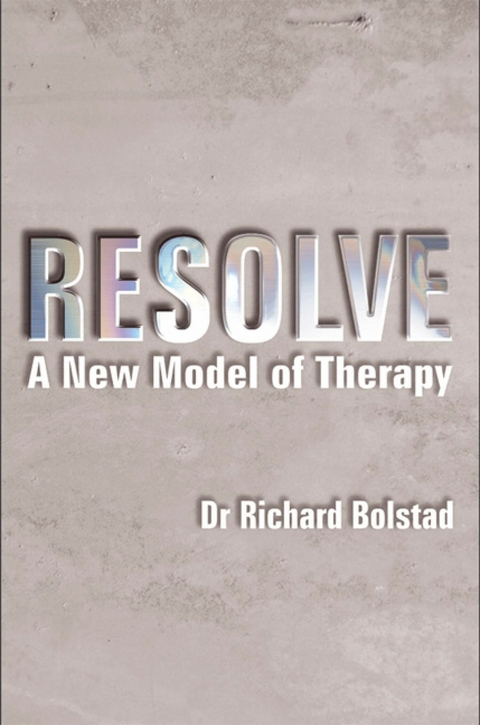
RESOLVE (eBook)
232 Seiten
Crown House Publishing (Verlag)
978-1-84590-643-6 (ISBN)
Richard Bolstad PhD is a certified trainer with the International NLP Association. He has a doctorate in clinical hypnotherapy and is a member of the New Zealand Association of Psychotherapists. He has taught the RESOLVE model to psychotherapists and counsellors around the world. He is a co-author of the acclaimed book, The Structure of Personality.The NLP Internationally Award was presented to Richard Bolstad at the NLP awards ceremony 2017.
The RESOLVE framework provides structure to NLP's brief therapy approach to personal change. Wonderfully clear and easy to follow for all therapists wishing to help clients make fundamental life changes quickly and effectively. "e;A must read for any professional trainer or psychotherapist"e; L. Michael Hall PhD, Cognitive-behavioural psychologist, author and international trainer
The Need for Effective New Models
This book is written for all those who are passionately interested in finding verifiable ways to assist human beings, as they create a life worth living. While the RESOLVE model is useful in any situation where people want to make major changes, this book emerged out of the work I did in 1998 and 1999 in the city of Sarajevo. At that time, my late partner Margot Hamblett and I were invited to teach our model of therapy to groups of psychiatrists and aid workers, who were working with Bosnian and Kosovar survivors of perhaps the worst trauma that human beings can face.
We were accustomed to teaching counsellors, health professionals and others in the comfort of a custom-designed training venue. We were used to having several weeks gradually to introduce our ways of thinking and our new techniques, from the field of NLP (or Neuro-Linguistic Programming). In Sarajevo, we worked in a hospital meeting room with shell damage still evident around the walls. We had two days, and a group of people who needed immediate and practical help. The psychiatrists themselves had lived through the terror of the war, and wanted the skills to deal with their own distress as much as with their clients. We did not speak Bosnian, and we had no personal experience of the war. We needed to be able to demonstrate that the techniques we taught were:
- Backed up by research supporting their rationale and their clinical effectiveness
- Able to be learned quickly and applied with success in real-life conditions
- Integrated into a compassionate therapeutic relationship
- Compatible with therapists’ current therapeutic modalities, which ranged from psychoanalysis to cognitive behavioural therapy
After only two days’ training, over three-quarters of those professionals who trained with us in Sarajevo said they now planned to use the methods we taught. For example, Dr Cerny Kulenovic described the model as “Definitely useful. We used it on ourselves and we treated our colleagues too. We got the predicted effects … We were well informed and gained very good results in the second day. A new treatment which was economical, short and successful.” Dr Mehmedika Suljic Enka agreed: “This training gives more practice in dealing with survivors of traumatic experiences or clients with phobias. Used with my own similar problem, it helped to relieve my fear, and I realised how I can help other people. I have improved my knowledge in psychiatry.”
But that was not the most important feedback we got. The most powerful experience we had in Sarajevo involved ordinary people whom we had the privilege of taking through the RESOLVE model of therapy. Let’s give you one example. A woman whom we will call Fatima began her session with Margot quite tearful, announcing in English, “I hate the war; and I hate talking about it!” She explained that she had had nightmares every night since the war, when many of her friends and family had been killed in front of her. Sounds were powerful triggers for her traumatic memories, and the sound of explosions sent her into sheer panic. The previous week someone had organised a fireworks display in Sarajevo. Rationally, she knew she was safe, but her panic put her right back in the war situation. She ran into a nearby house and hid in their basement until the display was over. Such experiences were deeply humiliating to her, and felt quite uncontrollable. After attempting unsuccessfully to explain the background of our method to her (her knowledge of English was limited), Margot simply took her straight through the model you’ll learn in this book, in this case specifically directed at healing her post-traumatic stress response. At the end of the session, Margot asked her to think of the fireworks and find out how it felt now. She laughed. Next, she invited Fatima to remember some of the worst times from the war, and check how those memories were. She gazed ahead with a shocked expression. “So how is it?” Margot asked. “Well,” she said, with a smile, “I’m seeing the pictures, and it’s as if they’re just over there, and I’m here.” The entire process had taken twenty minutes. On our return visit in 1999 Fatima reported that she had had no further panic attacks or nightmares, and had actually forgotten how seriously they once disabled her. She was delighted with the change in her life.
Like the psychiatrists in Sarajevo, you probably want to know how this is possible. But, much more, you’ll want to know how you can get these results yourself. Consider one of our trainees, a New Zealand counsellor named Jeff, who was previously trained in Gestalt and Client-Centred therapeutic modalities. It was a step away from the mainstream for Jeff to choose to study NLP, the modality that is central to the RESOLVE model. After using the RESOLVE process for some time, he agreed: “As a psychotherapist, my obligation is to help clients change in the ways they request. I know of no other psychotherapeutic tools more likely to accomplish this … Professionally, my work has just taken off. What a gift it is to be able to remove a person’s phobia, relieve a past trauma, halt an eating disorder, end a sense of abandonment, enhance self-esteem, instil a sense of purpose in someone’s life – and much more. The possibilities seem endless the better I get at using these understandings of how human beings function.”
NLP and the Context of Psychotherapy
Neuro-Linguistic Programming itself is a discipline studying how people achieve success in fields as diverse as sport, education, management and healthcare. Its original developers proposed in 1980 that NLP would provide the user with “a set of tools that will enable him or her to analyze and incorporate or modify any sequence of behavior that they may observe in another human being”. (Dilts et al., 1980, p. 3.) This set of tools involve an analysis of a human being’s internal and external communications (linguistics) and their effects (programming) on the functioning of the brain (neurology). Centrally, NLP analyses the structure and sequence of the person’s internal experiences: their internal images, sounds, self-talk, feelings, tastes and smells. The tools used in NLP are more fully described in Chapter 2. The use of these tools to analyse how someone achieves success is called in NLP “modelling”. Within that wider field, NLP-based “psychotherapy” is first and foremost the study of how highly successful change agents assist others to change. NLP was not originally created with the intention of developing a new “school” of therapy, so much as with the intention of understanding the patterns behind the work of highly successful psychotherapists. Psychotherapists studied in this way by NLP developers include:
- Dr Virginia Satir (Grinder and Bandler, 1975; Andreas, 1991)
- Dr Milton Erickson (Bandler and Grinder, 1975)
- Dr Fritz Perls (Grinder and Bandler, 1976, pp. 62–96)
- Dr Sigmund Freud (Dilts, 1995, pp. 1–296)
- Dr Carl Jung (James and Woodsmall, 1988, pp. 91–109)
- Dr Carl Rogers (Bolstad, 1995, pp. 24–33)
These psychotherapists were often themselves very surprised with the results of NLP-based explorations of their work. Virginia Satir says:
I do something, I feel it, I see it, my gut responds to it – that is a subjective experience. When I do it with someone else, their eyes, ears, body sense these things. What Richard Bandler and John Grinder have done is to watch the process of change over a time and to distil from it the patterns of the how process … The knowledge of the process is now considerably advanced by Richard Bandler and John Grinder, who can talk in a way that can be concretised and measured about the ingredients of the what that goes into making the how possible.” [Grinder and Bandler, 1975, pp. vii–viii.]
Milton Erickson MD said of NLP that “it is a much better explanation of how I work than I, myself, can give. I know what I do, but to explain how I do it is much too difficult for me.” (Bandler and Grinder, 1975, p. viii.)
Other psychotherapists, while not “modelled” by the NLP co-developers, have eagerly incorporated the insights of NLP into their own work. Dorothy Jongeward PhD, author of numerous books on Transactional Analysis, including Born to Win, says of the NLP text Influencing with Integrity, “It could well make the difference between success and failure in your personal and career relationships.” (Back cover, Laborde, 1987.) Hugh Prather, author of Notes to Myself and other books, says of the NLP book Heart of the Mind that it “contains a wealth of understanding that can help people become more fully human. It also contains the insight and basic honesty that ensures this knowledge is used wisely and compassionately.” (Back cover, Andreas and Andreas, 1989.)
Some psychotherapists have tended to see NLP as having an affinity with cognitive behavioural modalities. For example, in his review of the development of cognitive behavioural therapy (CBT), Albert Ellis (1989, p. 12) says that between 1975 and 1979 there was a sudden explosion in CBT and RET [Rational Emotive Therapy] literature. He adds, “So many significant texts on RET and CBT were … published...
| Erscheint lt. Verlag | 21.6.2002 |
|---|---|
| Verlagsort | London |
| Sprache | englisch |
| Themenwelt | Geisteswissenschaften ► Psychologie ► Allgemeine Psychologie |
| Geisteswissenschaften ► Psychologie ► Klinische Psychologie | |
| Medizin / Pharmazie ► Gesundheitsfachberufe | |
| Medizin / Pharmazie ► Medizinische Fachgebiete ► Psychiatrie / Psychotherapie | |
| ISBN-10 | 1-84590-643-8 / 1845906438 |
| ISBN-13 | 978-1-84590-643-6 / 9781845906436 |
| Informationen gemäß Produktsicherheitsverordnung (GPSR) | |
| Haben Sie eine Frage zum Produkt? |
 EPUB (Wasserzeichen)
DRM: Digitales Wasserzeichen
Dieses eBook enthält ein digitales Wasserzeichen und ist damit für Sie personalisiert. Bei einer missbräuchlichen Weitergabe des eBooks an Dritte ist eine Rückverfolgung an die Quelle möglich.
Dateiformat: EPUB (Electronic Publication)
EPUB ist ein offener Standard für eBooks und eignet sich besonders zur Darstellung von Belletristik und Sachbüchern. Der Fließtext wird dynamisch an die Display- und Schriftgröße angepasst. Auch für mobile Lesegeräte ist EPUB daher gut geeignet.
Systemvoraussetzungen:
PC/Mac: Mit einem PC oder Mac können Sie dieses eBook lesen. Sie benötigen dafür die kostenlose Software Adobe Digital Editions.
eReader: Dieses eBook kann mit (fast) allen eBook-Readern gelesen werden. Mit dem amazon-Kindle ist es aber nicht kompatibel.
Smartphone/Tablet: Egal ob Apple oder Android, dieses eBook können Sie lesen. Sie benötigen dafür eine kostenlose App.
Geräteliste und zusätzliche Hinweise
Buying eBooks from abroad
For tax law reasons we can sell eBooks just within Germany and Switzerland. Regrettably we cannot fulfill eBook-orders from other countries.
aus dem Bereich