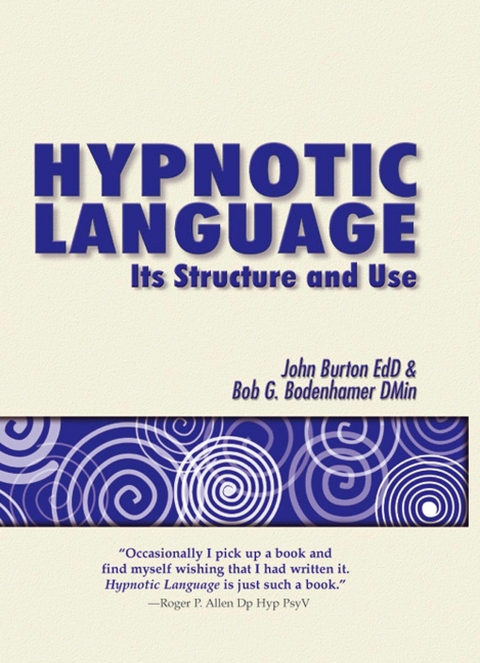
Hypnotic Language (eBook)
304 Seiten
Crown House Publishing (Verlag)
978-1-84590-526-2 (ISBN)

John Burton, EdD LPC holds a Doctorate in Human Development Counseling from Vanderbilt University as well as a Masters in Clinical Psychology. He is licensed as a Professional Counselor, Counselor Supervisor and holds certificates as a NLP Master, Clinical Hypnotherapist, and Reiki Master. He currently maintains his own counseling practice with over 30 years of professional experience. He also conducts regular workshops in the U.S. for The Sacred Sequence and Clinical Hypnotherapy. Dr. Burton co-authored one book and was sole author for two other books published by Crown House.
Anytime you concentrate on any stimuli, you go into a trance for at least a brief time to perceive, encode and store the information. Since this is the process of storing then it also needs to be the process of accessing and altering the stored information.
The next category of factors contributing to hypnotic language’s effectiveness involves the specific cognitive style of processing information. When unconscious parts form or limiting beliefs originate, they result from the brain operating in certain ways (more on beliefs in chapter 4). These parts, or limitations, require particular perception and thought in order to generate and remain supported. Anytime you pay attention to any stimuli you must go into a trance for at least a brief time to perceive, encode and store the information. Since this is the process of storing, then it also needs to be the process of accessing and altering the stored information. As an analogy, if you plan to change the shape of ice, first melt it, then decide what mold you want for the final shape, fill the mold with the water and refreeze it.
Hypnotic language returns the mind to the scene of the crime in a general way. It thaws the belief or state.
In a general way, hypnotic language returns the mind to the scene of the crime. It thaws the belief or state. When beliefs or concepts become rigid, they reach a condition known as nominalized. The word ‘educating’ nominalizes into ‘education’. ‘Depressing’ nominalizes into ‘depression’. In general, nominalizing converts a process into a rigid, frozen condition. Hypnotic language comes in a non-traditional form of language so it denominalizes, or decrystallizes a concept or belief. The hypnotic language itself comes in a denominalized form within the general guidelines of language. To comprehend the language you must dissociate (step outside of, go Meta to) from the rigid nominalized state and associate (be totally present in) into a denominalized state. So just listening or reading and processing hypnotic language dissociates you (a Meta-state) from your present, now former state. Then you can deal with specific content or states with free choice.
Actually, all effective therapy seems to involve hypnotherapy.
The client must associate into the problem state then dissociate from it, access a resource state, associate into it and apply this new resource to the problem state. John Overdurf taught me (BB) what he calls ‘The Mother of All NLP’. I have found his model most helpful and, in my opinion, true to fact. He suggests that all NLP patterns that work will consist of four basic steps. I believe that effective hypnosis follows the same patterns.
1. First the client must associate into the problem state. Most of the time clients are associated into the problem state when they arrive in your office.
2. Second, the hypnotherapist dissociates the client from his problem. This conceptually moves the client to a position Meta to the problem. From a dissociative perspective, the client can see himself within the context of the problem but outside of it. This position allows for the consideration of other alternatives. You cannot solve a problem on the level of the problem. Dissociating moves the client Meta to the problem.
3. Third, from the dissociated perspective, the hypnotherapist directs the client to discover a resource state, associate into it and apply this new resource to the problem state (Meta-stating). It is at this point that the efficient hypnotherapist becomes a Meta-stating genius. Richard Bandler offers a superb example of skill in this area.
4. Finally, the hypnotherapist Future Paces the client with the additional resources. NLP future pacing is a Meta-stating process as the hypnotherapist takes the client with his resources and applies (Meta-states) these to future occurrences. Before the therapy the client would run the old problem state in any perceived future memories but now, with the new resources, the client runs the resource state as he brings it to bear on future-oriented perceptions.
Actually, all effective therapy seems to involve hypnotherapy. Unless you and the client focus exclusively on the issue, a trance, then no real change can happen. No matter the model used in accomplishing ‘The Mother of All NLP’, hypnosis will be involved. Sometimes the process occurs overtly; at other times the induction is covert. Either way, or with any style of therapy, hypnotherapy takes place in the process of change. Hypnotic language represents one of the more direct ways of accessing the seat of change.
For change to happen in therapy, the client must first associate into the problem state. The client then dissociates from it, accesses and associates into a resource state, and applies this resource to the problem state. Sometimes the process occurs overtly, while sometimes the induction is less obvious. But either way, or with any style of therapy, hypnotherapy takes place in the process of change. Hypnotic language represents one of the more direct ways of accessing the seat of change.
More specifically, hypnotic language communicates with the brain in the same language and cognitive style that goes on while forming the problem state or belief.
More specifically, hypnotic language communicates with the brain in the same language and cognitive style that is used while forming the problem state or belief. Almost all, if not all, limiting beliefs about self, others or life form during childhood. By childhood, I mean the first 12–15 years of life.
Communicating with the mind in the way it thought during the formation of the limiting beliefs allows access to, and altering of, the contents of the ‘problem’. Hypnotic language speaks the language that was spoken when the problem formed. Thus, accessing and altering the problem becomes available. If these beliefs or states form in adulthood they still conform to certain laws of misperception—flawed laws you may call them.
Certain perceptual flaws must occur to form a limiting belief or non-resource state. These flaws dominate childhood perception and also take place when developing a ‘problem state’ in adulthood (Burton, 1999). These perceptual flaws of childhood, to be explained shortly, include:
1. Either-or thinking. Thinking in black and white terms, all or nothing. (We have discussed this earlier when we considered the nominal category of the data categories of complexity).
2. Irreversibility. Inability to perceive events as they existed before the trauma.
3. Over-generalizing. Using inductive reasoning to draw conclusions and generalize the conclusion. This is a sort of Meta-level inductive reasoning.
4. Egocentrism. A focusing on self to the exclusion of other points of view.
5. Transductive logic. Two events occurring closely in time receive cause–effect attributes.
6. Centering. Focusing on only one element of a whole, excluding other important details.
7. Inductive logic. Reasoning from a specific event and making general inferences.
8. Animism. Giving inanimate objects life. To a child, ‘Teddy Bear’ is alive and the walls can hear.
The brain utilizes these styles of thinking when forming the limiting belief or problem state in the first place. Hypnotic language also assumes the brain will use these cognitive styles when the hypnotherapist delivers the hypnotic language. And, since the brain utilized these thinking styles in formulating the problem to begin with, when the neurology of the problem is re-introduced to the same type of thinking in the hypnotic language patterns the hypnotherapist will have instant rapport with the problem. This happens because the problem-state will have familiarity with the hypnotic linguistic structure as it activates and conforms to the structure of the problem.
The purpose of therapy is to give old behaviors new choices for obtaining their outcome.
The reframing, or healing, of the problem happens as the linguistic structure of the problem-state is given new and healthier choices for obtaining its original purpose. NLP asserts that all behaviors have behind them a positive intent for the person doing the behavior. Old thinking patterns that developed during the earlier years of life when we had limited resources often fail to serve us in adult life. The purpose of therapy is to give these old behaviors new choices for obtaining their outcome.
We can utilize similar linguistic structures through hypnotic language patterns in accessing those old and limited thinking patterns and give them new choices. By giving them new choices we bring a familiar linguistically structured resource to bear on the problem. Once in place, the new perspective will take center stage and direct the individual to more constructive ways of thinking, feeling and behaving.
Hypnotic language speaks with most of the same characteristics as the perceptual flaws that form the ‘problem’. These perceptual flaws include all or nothing thinking. It is either black or white; there is no gray area. This shows up within the double-bind pattern.
Hypnotic...
| Erscheint lt. Verlag | 30.12.2009 |
|---|---|
| Verlagsort | London |
| Sprache | englisch |
| Themenwelt | Geisteswissenschaften ► Psychologie ► Allgemeine Psychologie |
| Geisteswissenschaften ► Psychologie ► Biopsychologie / Neurowissenschaften | |
| Geisteswissenschaften ► Psychologie ► Humanistische Psychotherapien | |
| Medizin / Pharmazie ► Medizinische Fachgebiete ► Psychiatrie / Psychotherapie | |
| Medizin / Pharmazie ► Naturheilkunde | |
| ISBN-10 | 1-84590-526-1 / 1845905261 |
| ISBN-13 | 978-1-84590-526-2 / 9781845905262 |
| Informationen gemäß Produktsicherheitsverordnung (GPSR) | |
| Haben Sie eine Frage zum Produkt? |
 EPUB (Wasserzeichen)
DRM: Digitales Wasserzeichen
Dieses eBook enthält ein digitales Wasserzeichen und ist damit für Sie personalisiert. Bei einer missbräuchlichen Weitergabe des eBooks an Dritte ist eine Rückverfolgung an die Quelle möglich.
Dateiformat: EPUB (Electronic Publication)
EPUB ist ein offener Standard für eBooks und eignet sich besonders zur Darstellung von Belletristik und Sachbüchern. Der Fließtext wird dynamisch an die Display- und Schriftgröße angepasst. Auch für mobile Lesegeräte ist EPUB daher gut geeignet.
Systemvoraussetzungen:
PC/Mac: Mit einem PC oder Mac können Sie dieses eBook lesen. Sie benötigen dafür die kostenlose Software Adobe Digital Editions.
eReader: Dieses eBook kann mit (fast) allen eBook-Readern gelesen werden. Mit dem amazon-Kindle ist es aber nicht kompatibel.
Smartphone/Tablet: Egal ob Apple oder Android, dieses eBook können Sie lesen. Sie benötigen dafür eine kostenlose App.
Geräteliste und zusätzliche Hinweise
Buying eBooks from abroad
For tax law reasons we can sell eBooks just within Germany and Switzerland. Regrettably we cannot fulfill eBook-orders from other countries.
aus dem Bereich