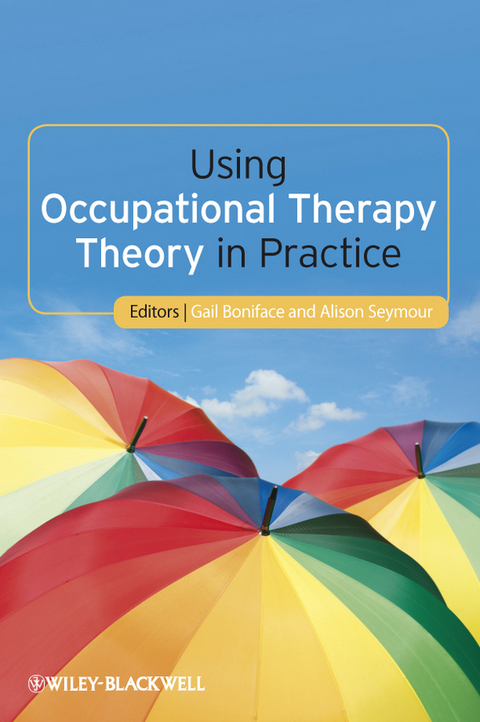
Using Occupational Therapy Theory in Practice (eBook)
John Wiley & Sons (Verlag)
978-1-4443-5567-3 (ISBN)
Every occupational therapy student worldwide needs to know about the underlying theory of their profession and its application to practice. The book particularly debates the nature of the theory of occupational therapy via the introduction of the concept of models of the profession as an umbrella for practice, all of which is brought to life via case studies incorporating expert advice, reflection exercises and assessment and evaluation forms.
Dr Gail Boniface is Senior Lecturer & Programme Manager at Cardiff University. She has been teaching theory since 1987. She developed student handouts and teaching material into short courses on models of occupational therapy. These courses included definitions of terms related to theory and were delivered across Wales and England. They were then turned into a module on the MSc in Cardiff University for qualified practitioners. She also delivered similar key note lectures and courses in Germany, Sweden, Croatia and Poland. In more recent years she has worked with Gloucestershire Primary Care Trust to instil theory and the use of a model in the occupational therapy service there.
Alison Seymour is Lecturer & Admissions Tutor at Cardiff University and currently teaches the use of models on the postgraduate diploma in occupational therapy. Over a 19 year career in occupational therapy practice in mental health she has used the Activities Therapy Model, Model of Adaptation through Occupation and The Model of Human Occupation in a variety of community and hospital settings.
Competence in any profession depends upon an understanding of the theory that underlies it. This concise and practical text for students and practitioners bridges the gap between occupational therapy theory and clinical practice, offering highly practical advice on using theory in practice in a wide range of settings. It considers the nature of professional practice and the need for a sound theoretical basis from which to plan, implement and justify interventions, and investigates the practical use of occupational therapy theory and the issues such use raises in health and social care settings from a European perspective. Every occupational therapy student worldwide needs to know about the underlying theory of their profession and its application to practice. The book particularly debates the nature of the theory of occupational therapy via the introduction of the concept of models of the profession as an umbrella for practice, all of which is brought to life via case studies incorporating expert advice, reflection exercises and assessment and evaluation forms.
Dr Gail Boniface is Senior Lecturer & Programme Manager at Cardiff University. She has been teaching theory since 1987. She developed student handouts and teaching material into short courses on models of occupational therapy. These courses included definitions of terms related to theory and were delivered across Wales and England. They were then turned into a module on the MSc in Cardiff University for qualified practitioners. She also delivered similar key note lectures and courses in Germany, Sweden, Croatia and Poland. In more recent years she has worked with Gloucestershire Primary Care Trust to instil theory and the use of a model in the occupational therapy service there. Alison Seymour is Lecturer & Admissions Tutor at Cardiff University and currently teaches the use of models on the postgraduate diploma in occupational therapy. Over a 19 year career in occupational therapy practice in mental health she has used the Activities Therapy Model, Model of Adaptation through Occupation and The Model of Human Occupation in a variety of community and hospital settings.
Using OccupationalTherapy Theoryin Practice 3
Contents 5
Contributor biographies 7
Foreword 13
1 Introduction 15
Section 1: Theory 21
2 Reconfiguring professional thinking and conduct: a challenge for occupational therapists in practice 23
3 Defining occupational therapy theory 35
4 FromStrands to The Invisibles: from a technical to a moral mode of reflective practice 52
5 The use of self in occupational therapy 63
Section 2: The Use of Theory in Practice: Some Practitioner Narratives 75
6 Developing the use of the Model of Human Occupation in a mental health service 77
7 Using Reed and Sanderson’s Model of Adaptation through Occupation: a journey 90
8 Using the Canadian Model of Occupational Performance to reconfigure an integrated occupational therapy service 105
9 Dealing with the barriers to change whilst implementing the Canadian Model of Occupational Performance 120
10 Developing occupational therapy theory in Poland 134
11 Using occupational therapy theory in Croatia 142
12 Personal reflections on understanding and using the Model of Human Occupation in practice 155
Section 3: Contemporary Discussions on the Use of Theory in Occupational Therapy Practice 167
13 Using occupational therapy theory within evidence-based practice 169
14 Occupational science and occupational therapy: a contemporary relationship 179
15 Myths around using theory in occupational therapy practice 194
Index 203
"Regardless of where you are on your career trajectory;
whether you need a gentle introduction to theory as a student or a
refresher course on models or occupational science as an
experienced practitioner, this book will have something for you. It
ensures that we can all reconnect with the concept of theory and
how it should underpin our practice." (British
Journal of Occupational Therapy, 1 February 2014)
"Overall, this edited text provides relevant food for thought
for all therapists and would challenge students to consider serious
implementation issues." (Canadian Journal of Occupational
Therapy, December 2012)
| Erscheint lt. Verlag | 20.12.2011 |
|---|---|
| Sprache | englisch |
| Themenwelt | Medizin / Pharmazie ► Naturheilkunde |
| Medizin / Pharmazie ► Pflege | |
| Medizin / Pharmazie ► Physiotherapie / Ergotherapie ► Ergotherapie | |
| Schlagworte | Basis • competence • concise • depends • Ergotherapie • GAP • Gesundheits- u. Sozialwesen • Health • Health & Social Care • highly • Nature • Occupational • occupational therapy • Practical • Practice • Profession • Professional • raises • Range • Settings • Sound • Theoretical • theory • therapy • use • wide |
| ISBN-10 | 1-4443-5567-8 / 1444355678 |
| ISBN-13 | 978-1-4443-5567-3 / 9781444355673 |
| Informationen gemäß Produktsicherheitsverordnung (GPSR) | |
| Haben Sie eine Frage zum Produkt? |
 PDF (Adobe DRM)
Kopierschutz: Adobe-DRM
Adobe-DRM ist ein Kopierschutz, der das eBook vor Mißbrauch schützen soll. Dabei wird das eBook bereits beim Download auf Ihre persönliche Adobe-ID autorisiert. Lesen können Sie das eBook dann nur auf den Geräten, welche ebenfalls auf Ihre Adobe-ID registriert sind.
Details zum Adobe-DRM
Dateiformat: PDF (Portable Document Format)
Mit einem festen Seitenlayout eignet sich die PDF besonders für Fachbücher mit Spalten, Tabellen und Abbildungen. Eine PDF kann auf fast allen Geräten angezeigt werden, ist aber für kleine Displays (Smartphone, eReader) nur eingeschränkt geeignet.
Systemvoraussetzungen:
PC/Mac: Mit einem PC oder Mac können Sie dieses eBook lesen. Sie benötigen eine
eReader: Dieses eBook kann mit (fast) allen eBook-Readern gelesen werden. Mit dem amazon-Kindle ist es aber nicht kompatibel.
Smartphone/Tablet: Egal ob Apple oder Android, dieses eBook können Sie lesen. Sie benötigen eine
Geräteliste und zusätzliche Hinweise
Buying eBooks from abroad
For tax law reasons we can sell eBooks just within Germany and Switzerland. Regrettably we cannot fulfill eBook-orders from other countries.
aus dem Bereich