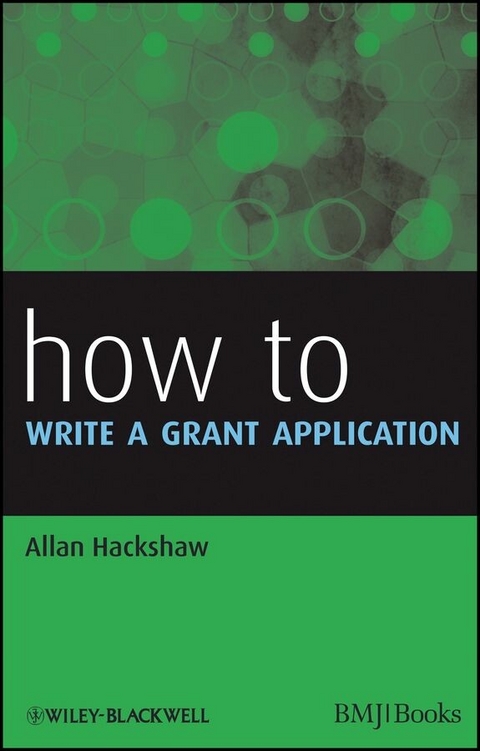
How to Write a Grant Application (eBook)
144 Seiten
John Wiley & Sons (Verlag)
978-1-4443-2967-4 (ISBN)
application, whether for a health research project or personal
training programme, and will help you be among the successful
applicants.
The author, a reviewer for grant funding organisations and
internationally respected research scientist, gives you the benefit
of his experience from both sides of the process in this
easy-to-use, readable guide. The book takes you through the grant
application process, explaining how to:
* Present the justification for the proposed project
* Describe the study design clearly
* Estimate the financial costs
* Understand a typical review process, and how this can influence
the contents of the grant application
The author provides practical advice on a range of project types
(observational studies, clinical trials, laboratory experiments,
and systematic reviews) to increase the chance that your
application will be successful. There are also tips on what to
avoid throughout the application.
With generic information about application requirements,
How to Write a Grant Application is ideal for
healthcare professionals seeking a health services or scientific
grant.
Allan Hackshaw, Deputy Director of the Cancer Research UK and University College London Cancer Trials Centre, and Reader in Epidemiology and Medical Statistics, London, UK
Foreword.
Preface.
Acknowledgements.
About the author.
Chapter 1: Overview.
1.1 Types of grants.
1.2 Types of funding organisations.
1.3 Choosing an appropriate funding body.
1.4 Contents of the grant application.
1.5 Including several studies in one application (project
grants).
1.6 Translational research sub-studies.
1.7 The application process.
1.8 Estimating timelines and a planned work schedule.
1.9 Intellectual property.
1.10 Text, grammar and format.
Chapter 2: People involved in the study.
2.1 Who should be part of the Study Team?
2.2 Other investigators, collaborators and consultants.
2.3 The host institution and Sponsor.
2.4 Commercial companies.
2.5 Oversight committees.
Chapter 3: Justifi cation for the study.
3.1 Finding background information.
3.2 Previous evidence and similar research (why the study is
needed now).
3.3 Biological plausibility.
3.4 Safety of new interventions in clinical trials.
3.5 Feasibility.
3.6 What will the study contribute?
3.7 Summary of the justifi cation for a proposed study.
Chapter 4: Describing the study design.
4.1 Abstract.
4.2 Appendices.
4.3 Study objectives and outcome measures.
4.4 Types of studies.
4.5 Observational studies in humans.
4.6 Clinical trials in humans.
4.7 Laboratory experiments.
4.8 Describing sample size.
4.9 Describing the main statistical analyses.
4.10 Systematic reviews.
Chapter 5: Associated documents with the grant
application.
5.1 Study protocol.
5.2 Participant Information Sheet.
5.3 Curricula vitae of the Chief Investigator and all
co-applicants.
5.4 Letters of support from co-applicants, centre investigators,
collaborators, or other advisors.
5.5 Letters of support from commercial companies.
5.6 Other documents specifi c to the fi eld of research.
Chapter 6: Financial costs.
6.1 Overview of items to include in the fi nancial costs.
6.2 Indirect costs or overheads (full economic costs).
6.3 Per patient (or per subject) payments.
6.4 Staff costs.
6.5 Access to core funds and resources.
6.6 Consideration of costs not to be met by the funding
body.
6.7 Grant applications associated with calls for proposals.
6.8 Observational studies in humans.
6.9 Clinical trials in humans.
6.10 Laboratory experiments.
6.11 Systematic reviews.
Chapter 7: Funding body review process.
7.1 Submitting the application.
7.2 Processing the application within the funding body.
7.3 Initial reviews (external reviewers).
7.4 Funding committee meeting.
7.5 Funding committee evaluation.
7.6 Feedback to applicants after the meeting.
7.7 Responding to the funding committee feedback.
Chapter 8: Annual reports and applying for a grant
extension.
8.1 Annual reports.
8.2 Applying for a grant extension.
Bibliography.
Index.
"Intended for those who are preparing to apply for a clinical grant, this guide covers this complex process in an accessible manner." (Booknews, 1 April 2011)
Important Details: According to a world-wide survey carried out by Elsevier, researchers now spend up to 30% of their time looking for funding and writing grant proposals, less than 15% of applications are successful, and the average age of first time National Institutes of Health (NIH) grant recipients is 40.
Funders are attaching more and more conditions to their support programs. Some, such as the National Science Foundation, channel a significant proportion of their resources only to young applicants. Others limit the number of submissions, so that competing research institutions mandate pre-screening of applications so that they can coordinate a separate screening process.
Furthermore, to get best value for their money, funders will often require that the principal investigator has assembled a research team which represents the pinnacle of multidisciplinary and international excellence. As science performance, planning and funding management become more directed by evidence-based assessment methods, so a market for scientific performance analytics emerges.
| Erscheint lt. Verlag | 11.11.2010 |
|---|---|
| Sprache | englisch |
| Themenwelt | Medizin / Pharmazie ► Allgemeines / Lexika |
| Medizin / Pharmazie ► Gesundheitswesen | |
| Schlagworte | Clinical & Experimental Medical Research • Förderantrag • Klinische u. experimentelle medizinische Forschung • Medical Science • Medizin |
| ISBN-10 | 1-4443-2967-7 / 1444329677 |
| ISBN-13 | 978-1-4443-2967-4 / 9781444329674 |
| Informationen gemäß Produktsicherheitsverordnung (GPSR) | |
| Haben Sie eine Frage zum Produkt? |
 EPUB (Adobe DRM)
Kopierschutz: Adobe-DRM
Adobe-DRM ist ein Kopierschutz, der das eBook vor Mißbrauch schützen soll. Dabei wird das eBook bereits beim Download auf Ihre persönliche Adobe-ID autorisiert. Lesen können Sie das eBook dann nur auf den Geräten, welche ebenfalls auf Ihre Adobe-ID registriert sind.
Details zum Adobe-DRM
Dateiformat: EPUB (Electronic Publication)
EPUB ist ein offener Standard für eBooks und eignet sich besonders zur Darstellung von Belletristik und Sachbüchern. Der Fließtext wird dynamisch an die Display- und Schriftgröße angepasst. Auch für mobile Lesegeräte ist EPUB daher gut geeignet.
Systemvoraussetzungen:
PC/Mac: Mit einem PC oder Mac können Sie dieses eBook lesen. Sie benötigen eine
eReader: Dieses eBook kann mit (fast) allen eBook-Readern gelesen werden. Mit dem amazon-Kindle ist es aber nicht kompatibel.
Smartphone/Tablet: Egal ob Apple oder Android, dieses eBook können Sie lesen. Sie benötigen eine
Geräteliste und zusätzliche Hinweise
Buying eBooks from abroad
For tax law reasons we can sell eBooks just within Germany and Switzerland. Regrettably we cannot fulfill eBook-orders from other countries.
aus dem Bereich