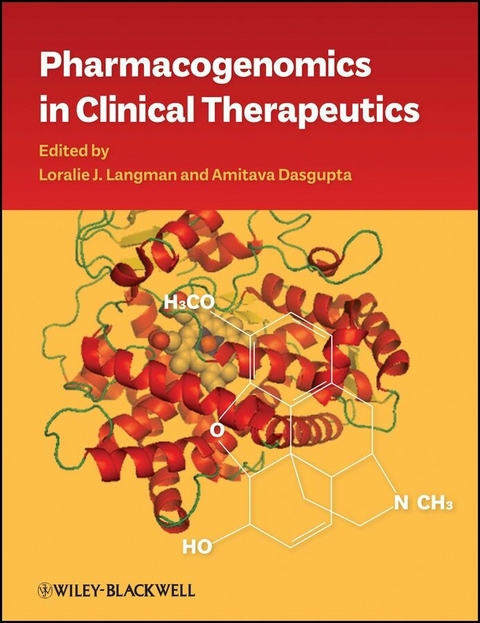
Pharmacogenomics in Clinical Therapeutics (eBook)
John Wiley & Sons (Verlag)
978-1-119-95958-8 (ISBN)
Pharmacogenomics is the basis of personalized medicine which will be the medicine of the future. Through both reducing the numbers of adverse drug reactions and improving the use of existing drugs in targeted populations, pharmacogenomics represents a real advance on traditional therapeutic drug monitoring. Pharmacogenomics in Clinical Therapeutics provides an introduction to the principles of pharmacogenomics before addressing the pharmacogenomic aspects of key therapeutic areas such as warfarin therapy, cancer chemotherapy, therapy with immunosuppressants, antiretroviral therapy, and psychoactive drugs. It also includes methods of pharmacogenomic testing and the pharmacogenomic aspects of drug drug interactions. From a team of expert contributors, Pharmacogenomics in Clinical Therapeutics is a comprehensive overview of the current state of pharmacogenomics in pharmacotherapy for all clinicians, pharmacologists and clinical laboratory professionals. It is also a guide for practicing clinicians and health care professionals to the basic principles of pharmacogenomics, laboratory tests currently available to aid clinicians, and the future promise of this developing field.
Amitava Dasgupta, Ph.D, DABCC, FACB, Professor of Pathology and Laboratory Medicine, University of Texas Health Sciences Center at Houston, Houston, TX. Loralie J. Langman, Ph.D, DABCC, FACB, Associate Professor of Laboratory Medicine, Mayo Clinic, Rochester, MN.
List of Contributors, vii
Preface, ix
1 Pharmacogenomics Principles: Introduction to Personalized
Medicine, 1
Parvaz Madadi, PhD and Gideon Koren, MD
2 Traditional Therapeutic Drug Monitoring and Pharmacogenomics:
Are They Complementary? 15
Christine L.H. Snozek, PhD, Loralie J. Langman, PhD, and Amitava
Dasgupta, Ph.D
3 Pharmacogenomics Aspect of Warfarin Therapy, 26
Matthew D. Krasowski, MD, PhD
4 Pharmacogenetics and Cancer Chemotherapy, 39
Christine L.H. Snozek
5 Pharmacogenomic Considerations in Anesthesia and Pain
Management, 53
Christine M. Formea, PharmD and Wayne T. Nicholson, MD,
PharmD
6 Pharmacogenomics of Immunosuppressants, 70
Nicolas Picard, PharmD, PhD and Pierre Marquet, MD, PhD
7 Pharmacogenomics of Cardiovascular Drugs, 98
Linnea M. Baudhuin, PhD
8 Pharmacogenomic Aspects of Antiretroviral Therapy, 127
Natella Y. Rakhmanina, MD, PhD and John N. van den Anker, MD,
PhD
9 Pharmacogenetics of Psychoactive Drugs, 144
Jorge L. Sepulveda, MD, PhD
10 Pharmacogenomic Aspects of Adverse Drug-Drug
Interactions, 176
Loralie J. Langman, PhD and Christine L.H. Snozek, PhD
11 Microarray Technology and Other Methods in Pharmacogenomics
Testing, 185
Jorge L. Sepulveda, MD, PhD
12 Pharmacogenetic Testing in the Clinical Laboratory
Environment, 201
Mark P. Borgman, PhD and Mark W. Linder, PhD
Index, 225
"This book is unique in its focus on the application of
pharmacogenomics in clinical therapeutics."
(Doody's,
19 January 2013)
Chapter 1
Pharmacogenomics Principles: Introduction to Personalized Medicine
Parvaz Madadi, PhD and Gideon Koren, MD
Division of Clinical Pharmacology and Toxicology, Hospital for Sick Children, Toronto, Canada
Introduction
Interindividual variability in drug response is a clinical reality, and one that has been long recognized by physicians and healthcare professionals. The essence of personalized medicine is the act of tailoring a treatment regimen to an individual based on their unique characteristics. However, our increasing understanding and sophistication in elucidating the causes of variability provide a new opportunity for an integrative and holistic personalized medicine – one that can synchronize all these factors together to deliver the right treatment, at the right dose, for every patient.
Although medications are typically marketed based on standard doses that are associated with safe and efficacious profiles in controlled clinical trials, these trials are not always representative of the clinical setting. In reality, patients differ widely in their response to treatment; while many may benefit from drug therapy, a proportion of individuals may be nonresponders, while others may develop adverse drug reactions. To truly deliver personalized medicine, one must have a grasp on the factors that contribute to variable outcomes in patients (Table 1.1) and how these factors may interact together in an individual. In the following sections, we will consider these sources of variation in more detail.
Table 1.1 Factors Contributing to Variability in Drug Response.
| Adherence |
| Age of the patient |
| Disease state |
| Drug–drug interactions |
| Food–drug interactions |
| Formulation |
| Gender |
| Genetics |
| Pollutants (smoking, etc.) |
| Pregnancy |
| Route of administration |
Factors that Contribute to Variability in Drug Response
Adherence, the extent to which a person's behavior – taking medication, following a diet, and/or executing lifestyle changes – corresponds with agreed recommendations from a health care provider (World Health Organization, 2003) (1), is a major, sometimes unrecognized, source of variability in the clinical setting. The term adherence is preferred over compliance, which denotes a passiveness on the part of the patient to follow the doctor's orders rather than establish a therapeutic alliance with their physician (1, 2). However, in many circumstances, the two words may be used interchangeably. Most physicians are unable to recognize nonadherence in their patients (2). Poor medication adherence accounts for 33–69% of all medication-related hospital admissions, and costs approximately $100 billion a year in the United States alone (2).
Of the different disease modalities, adherence to medications in chronic conditions is particularly low. For example, survey results in North America, the United Kingdom, and Western European countries indicate that no more than 30% of patients maintain target blood pressure levels despite receiving pharmacotherapy. Using a pill container with a computerized microchip to record the date and time the container was accessed, researchers were able to demonstrate that up to half of the “failures” in reaching these target blood pressure levels could be associated with inconsistent patterns of medication use, which was different from what was prescribed (3). Interestingly, these lapses were often unrecognized by patients. Similarly in India, more than half of type 2 diabetic patients in one study were nonadherent with their oral hypoglycemic treatment regiments. Considering that India has the highest number of people affected by diabetes in the world (expected to reach 79 million individuals by the year 2030), this is a substantial problem (4).
Clearly, adherence to pharmacotherapy is an international issue (4, 5). An essential step in this direction is to understand the factors that influence adherence in the first place. Some of these predictors are summarized in Table 1.2. These predictors could be social and economic factors, the health care team or system, characteristics of the disease and disease-related therapies, and patient-related factors (1). Going back to our example of antihypertensive medications, one study in a cohort of over 80,000 Chinese patients prescribed antihypertensive identified the following factors that were associated with better adherence amongst patients: advanced age, female gender, payment of fees, adherence for attending appointments (i.e., attendance to specialist clinics and follow-up visits), and certain concomitant medications but not others (5). Overall, Chinese patients were more adherent to their antihypertensive medications (85% good compliance) than previously reported in studies of patients of Caucasian descent.
Table 1.2 Predictors of Poor Adherence.
| Asymptomatic disease |
| Cognitive impairment |
| Complexity of treatment |
| Cost of medications |
| Inadequate follow-up or discharge |
| Patient lack of belief in the treatment |
| Psychiatric illness |
| Poor provider–patient relationship |
| Side effect of medication |
It has been postulated that increasing the effectiveness of adherence may have a far greater impact on population health than an improvement in a single area or specific treatment (6). Osterberg and Blaschke outlined four broad types of interventional methods to improve adherence: patient education (clear instructions that simplify the regimen, and information on the value of the treatment, side effects to be expected, and the effects of adherence toward achieving the health outcome), improved dosing schedules (minimizing total number of daily doses, and using medications with long half-lives or extended release formulations), increased accessibility to health care providers (longer clinic hours, shorter wait times, and removal of cost barriers), and improved communication between physicians and patients (2). Patient-tailored interventions that target adherence must be developed as part of the “personalized medicine” regimen.
Age is another important factor to consider in regard to variability in drug response. Throughout our life span, age-related physiological changes may affect the pharmacokinetics (absorption, distribution, metabolism, and elimination) of medications. Similarly, patients' response to medications (pharmacodynamics) may differ depending on age. The field of pediatric clinical pharmacology focuses on the developmental changes which influence pharmacokinetic profiles and drug response in infants and children. There are now many examples supporting the notion that children are not simply “small adults” when it comes to medication dosing requirements and response. For example, developmental changes in the gastrointestinal tract can influence the rate and extent of bioavailability (7). Gastric acidity does not reach that of adult capacity until around 3 years of age, resulting in relatively increased absorption of acid-labile drugs such as penicillin and ampicillin in neonates (8). On the other hand, neonates may require larger oral doses of drugs that are weak acids, such as phenobarbital, in order to achieve therapeutic plasma levels (7).
The ontogeny and expression profiles of transporters and drug-metabolizing enzymes, key determinants of drug distribution and metabolism respectively, are also important factors to consider in children (7). One well-studied example is the commonly prescribed opioid morphine. Age-related development in morphine glucuronidation and clearance has been shown to correspond to progressive functional maturation of the liver and kidney (9). The mean plasma morphine clearance rate is about 4–5 times higher in children as compared to neonates (10, 11), while the average rate of glucuronidation is about 6–10 times higher in the adult livers as compared to liver from second trimester fetuses (12). The expression of the primary enzyme involved in morphine glucuronidation, uridyl glucuronyl transferase 2B7 (UGT2B7) (13, 14), is expected to reach adult levels at 2 to 6 months of age (15–17). Similar developmentally regulated ontogenically profiles have been reported for transporters (such as p-glycoprotein), and other drug-metabolizing enzymes such as cytochrome P450 2D6 and 3A4.
Clearly, extrapolation from adult dose regimens to children (on mg/kg bases) is often not appropriate. Given the widening gap between the number of adult clinical trials and pediatric clinical trials (18), there are a number of new incentives and international advocacy groups that are devoting their attention to increasing the number of high-quality pediatric drug trials in children. The ultimate goal is to develop pediatric-specific data that will result in age-appropriate diagnostics and guidelines for children, while decreasing the current practice of off-label and/or unlicensed use of medications in the pediatric setting.
Underrepresentation in clinical trials also poses similar problems in the...
| Erscheint lt. Verlag | 9.1.2012 |
|---|---|
| Sprache | englisch |
| Themenwelt | Medizin / Pharmazie ► Medizinische Fachgebiete ► Pharmakologie / Pharmakotherapie |
| Studium ► 2. Studienabschnitt (Klinik) ► Humangenetik | |
| Schlagworte | Advance • Aspects • Basis • Clinical Pharmacology & Therapeutics • Drug • Drugs • Future • Introduction • Klinische Pharmakologie u. Therapie • Medical Science • Medicine • Medizin • Numbers • personalized • Pharmacogenomic • Pharmacogenomics • Pharmacology & Pharmaceutical Medicine • Pharmakogenetik • Pharmakologie u. Pharmazeutische Medizin • Populations • Reactions • Real • represents • targeted • Therapeutic • Therapeutic drug • therapeutics • Traditional • use |
| ISBN-10 | 1-119-95958-6 / 1119959586 |
| ISBN-13 | 978-1-119-95958-8 / 9781119959588 |
| Informationen gemäß Produktsicherheitsverordnung (GPSR) | |
| Haben Sie eine Frage zum Produkt? |
 EPUB (Adobe DRM)
Kopierschutz: Adobe-DRM
Adobe-DRM ist ein Kopierschutz, der das eBook vor Mißbrauch schützen soll. Dabei wird das eBook bereits beim Download auf Ihre persönliche Adobe-ID autorisiert. Lesen können Sie das eBook dann nur auf den Geräten, welche ebenfalls auf Ihre Adobe-ID registriert sind.
Details zum Adobe-DRM
Dateiformat: EPUB (Electronic Publication)
EPUB ist ein offener Standard für eBooks und eignet sich besonders zur Darstellung von Belletristik und Sachbüchern. Der Fließtext wird dynamisch an die Display- und Schriftgröße angepasst. Auch für mobile Lesegeräte ist EPUB daher gut geeignet.
Systemvoraussetzungen:
PC/Mac: Mit einem PC oder Mac können Sie dieses eBook lesen. Sie benötigen eine
eReader: Dieses eBook kann mit (fast) allen eBook-Readern gelesen werden. Mit dem amazon-Kindle ist es aber nicht kompatibel.
Smartphone/Tablet: Egal ob Apple oder Android, dieses eBook können Sie lesen. Sie benötigen eine
Geräteliste und zusätzliche Hinweise
Buying eBooks from abroad
For tax law reasons we can sell eBooks just within Germany and Switzerland. Regrettably we cannot fulfill eBook-orders from other countries.
aus dem Bereich