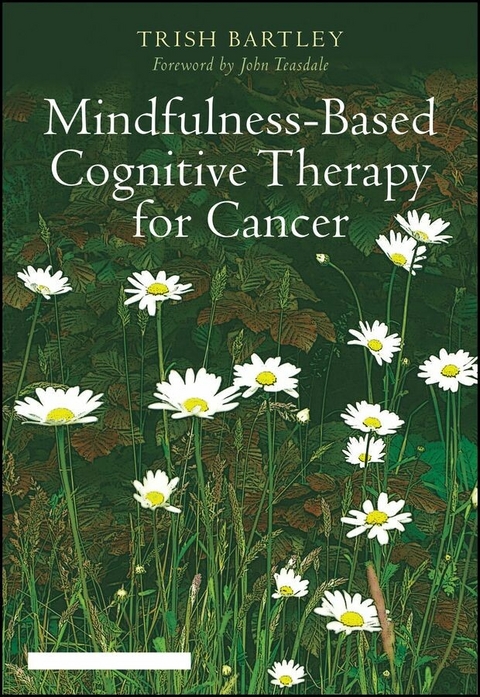
Mindfulness-Based Cognitive Therapy for Cancer (eBook)
John Wiley & Sons (Verlag)
978-1-119-95495-8 (ISBN)
- There is growing evidence of mindfulness as a successful and cost-effective intervention for reducing the negative psychological impact of cancer and treatment
- Draws upon the author's experience of working with people with cancer, and her own recent experience of using mindfulness with cancer diagnosis and treatment
- Stories from cancer patients illustrate the learning and key themes of the course
- Includes new short practices and group processes developed by the author
Trish Bartley has taught MBCT to people with cancer in a regional oncology unit in Wales since 2000. She is an Honorary Lecturer in the School of Psychology, Bangor University. She was one of the founding teachers at the Centre for Mindfulness Research and Practice, Bangor University, where she co-leads programmes for health professionals, and students on the Masters programme, to train as mindfulness-based teachers. She delivers mindfulness-based training retreats internationally.
Mindfulness-based Cognitive Therapy for Cancer presents an eight-week course for MBCT which has been tried and tested over ten years of clinical use, and is targeted specifically for people with cancer. There is growing evidence of mindfulness as a successful and cost-effective intervention for reducing the negative psychological impact of cancer and treatment Draws upon the author s experience of working with people with cancer, and her own recent experience of using mindfulness with cancer diagnosis and treatment Stories from cancer patients illustrate the learning and key themes of the course Includes new short practices and group processes developed by the author
Trish Bartley has taught MBCT to people with cancer in a regional oncology unit in Wales since 2000. She is an Honorary Lecturer in the School of Psychology, Bangor University. She was one of the founding teachers at the Centre for Mindfulness Research and Practice, Bangor University, where she co-leads programmes for health professionals, and students on the Masters programme, to train as mindfulness-based teachers. She delivers mindfulness-based training retreats internationally.
Contributors ix
Foreword xi
Preface xiii
Acknowledgements xix
Introduction 1
Personal Story - Trish 4
Part One Mindfulness and The Cancer Journey 11
1. Mindfulness and Cancer 13
2. Cancer - The Psychological Implications 23
Stirling Moorey and Ursula Bates
3. Cancer - The Medical Implications 33
Nicholas S. A. Stuart
4. The First Circle - Cancer and the Circle of Suffering
43
Personal Story - Beryl 48
Part Two The Mindfulness-Based Cognitive Therapy for Cancer
Programme 53
5. Starting Out 55
Personal Story - Sally 67
6. The Eight Week Course 72
* Week One 73
* Week Two 91
* Week Three 111
* Week Four 130
* Week Five 150
* Week Six 170
* All Day 186
* Week Seven 194
* Week Eight 215
* The Follow Up Class 230
7. The Second Circle: Mindful Awareness and the Circle of
Practice 243
Personal Story - Derek 250
8. The Practices 254
The Core Practices 255
The Short Practices 269
Personal Story - Bridget 284
9. Mindfulness In Palliative Care 289
Ursula Bates
10. After The Eight Week Course 303
11. The Third Circle - Being and the Circle of Presence
310
Part Three The Practitioner Teacher 319
12. Introducing The Teacher 321
13. Embodying The Practice 328
14. Facilitating The Learning 340
15. The Three Circle Model: A Formulation of MBCT for Cancer
(MBCT-Ca) 354
Trish Bartley and Ursula Bates
Personal Story - Geraint 364
Epilogue 370
Resources and Links 376
Bibliography 378
Sources and Permissions 388
Index 390
"The author's wish to share her expertise is commendable.
Written from a wealth of experience and conviction, the book is a
valuable tool for anyone involved in dealing with the psychological
aspects of cancer care." (Doody's, 4
January 2013)
Trish Bartley has succeeded in writing a book that speaks to the
deepest fears of cancer sufferers with such compassion that no-one
can fail to draw hope and healing from her words. Drawing on her
own experience of cancer, and on her skill as a mindfulness
teacher, she has pioneered a combination of mindfulness and
cognitive therapy that is enormously empowering for sufferers and
their families. The implications of what she says go far wider than
any clinic - to the heart of what it means to be fully
human and fully alive in the presence of our own death.
--Mark Williams, Director, Oxford Mindfulness
Centre, and Co-author of 'Mindfulness: a practical guide to
finding peace in a frantic world'
"A profoundly compassionate offering of affirmation and
possibility in the face of the difficult and the unwanted. Trish
Bartley and her colleagues are to be congratulated on a magnificent
contribution to the field of mindfulness and cancer care. May it
touch the millions who could benefit from it." --Jon
Kabat-Zinn, Professor of Medicine Emeritus, Author of Coming to
Our Senses: Healing Ourselves and the World Through
Mindfulness
"What a gift of a book. Alongside her own experience of living
with cancer, Trish Bartley also has many years experience of
teaching and developing the MBCT-Ca programme this combination of
the personal and professional makes for a beautiful combination of
personal story; a clear and practical manual for the eight-week
programme; and poems and insights from the many people Trish has
taught. This book will be invaluable to patients and health
professionals alike. Read this book carefully. It is a precious
jewel." --Vidyamala Burch, Author of Living Well
with Pain and Illness: The Mindful Way to Free Yourself From
Suffering
"As mindfulness becomes more main stream, what we need are
mindfulness developments guided by clear intentions, adapted to new
populations with creativity while maintaining the essence and
integrity of MBCT and MBSR. Mindfulness-Based Cognitive Therapy for
Cancer offers such an adaptation. It has a clear rationale,
pragmatic and clinically tested innovations, clear guidance for
MBCT teachers and poignant clinical illustrations. This book is
imbued with compassion, courage and a sense of common humanity. It
will be highly valued both by people with life threatening diseases
and health care professionals offering mindfulness classes to
people with cancer. Trish Bartley is an MBCT therapist who teaches
mindfulness with enormous heart, drawing from a well of experience
and knowledge. She writes with a clear, authoritative, compelling
and inspiring voice." --Willem Kuyken, Professor of
Clinical Psychology and Co-Founder of Mood Disorders Centre,
University of Exeter, UK
Preface
Our experience is the only experience there is. This is the ultimate teacher.
(Pema Chödrön, 1997)
I have written this book for all those who are interested in the potential of mindfulness for people with cancer. You may be a health professional wanting to learn about the relevance of mindfulness to your work. You may be a mindfulness-based teacher currently working with people with cancer – or you may be teaching in a different context, and considering translating your experience into oncology, or work with people who have life threatening or life limiting illness. You may be someone who has had cancer and want to read about mindfulness and what it might offer people like you.
Central to this book is the voice of those who are bringing mindfulness into their lives as they journey with cancer. There is an intention in writing this that their experience will inform and inspire those of us working in the fields of mindfulness and oncology – influencing our professional practice in the care of those we work for. There is also an aspiration that this book will support further research into the psychological impact of mindfulness-based interventions for people with cancer.
This is the first published outline of Mindfulness-Based Cognitive Therapy for Cancer (MBCT-Ca), which has been specifically adapted for cancer patients. The eight week programme described in detail here was developed directly out of Mindfulness-Based Cognitive Therapy (MBCT) for Depression (Segal et al., 2002) and Mindfulness-Based Stress Reduction (MBSR) (Kabat-Zinn, 1990). This book shares the learning from teaching MBCT-Ca to over thirty groups of cancer patients. It is drawn from over ten years’ experience of evaluating, developing and refining the programme. If there is any heart in these pages, it comes directly from the course participants and their courage in turning towards their experience. If there is any lack of clarity or confusion, it is entirely mine as author.
Who Am I As Teacher?
This book is also a little unusual. Most of it is written by me, a mindfulness-based teacher, who was myself a cancer patient before I trained as a teacher. This programme draws from my experience both as patient and as teacher on the same oncology unit. Whilst writing this book, I was diagnosed with another cancer and had to pause as teacher, to become a patient again.
There is a profound process within mindfulness-based teacher training programmes, where we ask ourselves, ‘Who am I as teacher?’ In reflecting on that now, I have to honour my experience of not knowing, in a new way. The boundaries between patient, teacher, practitioner and participant have become less clear for me after the experience of becoming a cancer patient again. As practitioner, I have had an opportunity to test what I teach in a real live ‘laboratory’ – namely my own mind and body. I am still teacher when leading a session – holding the process of the group and the curriculum of the programme, but with a knowing that I could be ‘patient’ again – as they could – and as we all can. We practice holding that uncertainty from moment to moment.
What this Book Is and Is Not
This book is not a definitive version of Mindfulness-Based Cognitive Therapy for Cancer (MBCT-Ca). Every time an eight week mindfulness-based course is led, there are changes and adaptations, tweaks and inspirations – in response to the group, the context, the moment, the process and the experience of the teacher. It is vital to have a map to guide us, and know the important staging posts that are needed to mark the way, but we also need awareness of the present moment to allow an organic flow to what unfolds, session by session, group by group.
If you are a mindfulness teacher – as you read this, you are bound to come across ideas or sections that are unclear, or that you may want to question or challenge. This may be all to the good. My purpose is not to lay down a prescriptive form, but to offer you an opportunity to reflect on your own approach and on the shape of this particular adaptation. See what it offers you and your participants. Use what is interesting and helpful and ignore the rest. It is up to all of us to continue to develop and deepen this work, with whoever we connect with. I hope that this book will be of some service to that process and in some way support what you do.
If you are not involved in teaching mindfulness, I hope that there will be enough signposts along the way, to enable you to get an experience of mindfulness and a taste of the course process and what it offers people with cancer. If it engages you in wanting to explore further, you may choose to participate in a mindfulness-based course yourself and perhaps look at training as a teacher in due course. In which case, there are some links at the back of the book that might help you find teachers or training resources.
Some Practical Writing Issues
I have used the feminine form ‘she’ and ‘her’ for all references to teachers and participants. Obviously, there are many teachers who are men. There are fewer men than women participants in my experience. However, to save endlessly typing ‘she or he’, I chose to keep to ‘she’.
Participants’ names have all been changed, except those in the personal stories and original poems – when only first names are used. The examples that are dotted through the chapters have all genuinely taken place in sessions. Participants were informed of my writing and were willing for me to use their experiences, if it might benefit others. I decided to refer to people within the text as patients before they joined a course and participants once they had.
After this preface, the text almost always uses ‘we’ throughout. ‘We’ are the teachers, the process, the author/s and often, the participants. The voice of people with cancer, who were participants on the course, is the most significant and vibrant. Their experience and learning is essentially what this book offers.
‘Practice’ and ‘practising’ are terms that are dotted through this book. Some mindfulness teachers happily refer to ‘meditation’ in connection with mindfulness. We prefer to use the more neutral term of ‘practice’. Some cancer patients, especially in rural areas such as North Wales, may have some tricky cultural associations and be put off by the term ‘mediation’.
A Process Focus
Working with people on cancer journeys, and as a former development worker, the process of the course is as important to me as the task of teaching the programme. A number of areas therefore receive particular attention in this intervention. This includes an emphasis on the group process – on how the learning is facilitated, not just what learning is there – and on the connection between teacher and participants. Compassion and kindness also feature strongly. People who are journeying with cancer have great need of both.
Ten years of adapting the course, reflecting on the process, and bringing this together as a book, has offered much learning. Awareness of the many ways that I fall short as teacher and practitioner helps me realize that I am barely ‘five minutes’ ahead of my participants. If fate had been different, it might well have been one of them as teacher and me as a participant. It always seems important to me to emphasize the common venture that we are engaged in, the human capacities that we share and the practice and learning that connects us.
Therefore, it is not me and them – teacher and participants with cancer – but we, who go together on these 8 week marathons. After the course, we often stay in touch in the months and years that follow. So, when recurrences occur for people, we may still be in contact and I may be able to offer some moments support. As teachers and fellow travellers, we sometimes journey together along the same path – all the way to the end, with some. When recently I became ‘patient’ again, many of the course participants who I have taught, brought me into their mindfulness practice, as at times I have brought them into mine.
Mentors and Colleagues
You may question what a development worker is doing working clinically with people with cancer. Fortune brought me to this work, and colleagues and mentors have supported my learning within it. Mark Williams generously offered his guidance and encouragement at the beginning. Jon Kabat-Zinn has been an important teacher and inspiration to me. John Teasdale, most significant of all, has been friend, mentor and supervisor for many years. He has had an important influence on my teaching and on this intervention. I have indeed been fortunate.
Ursula Bates has collaborated closely with me over this book. She has generously contributed her clarity, skill and theoretical flare. We have been lucky to find friendship and creativity in our connection. The three-circle model that captures the formulation of the MBCT-Ca is one that she and I have developed together.
Finally, my colleagues at the Centre for Mindfulness Research and Practice (CMRP) in Bangor have been very significant. I have learnt much from them over many years. When I was diagnosed, they were the ones I turned to – who sat with me, taught courses in my absence, came to clinic appointments and offered their encouragement through it all. They are my mindfulness teaching community.
A Personal Intention
When starting to draw out what underpins MBCT-Ca, Ursula Bates and I were excited to find Kristen Neff’s research on self compassion (Neff, 2003)...
| Erscheint lt. Verlag | 28.10.2011 |
|---|---|
| Vorwort | John Teasdale |
| Sprache | englisch |
| Themenwelt | Geisteswissenschaften ► Psychologie ► Allgemeine Psychologie |
| Geisteswissenschaften ► Psychologie ► Verhaltenstherapie | |
| Medizin / Pharmazie ► Medizinische Fachgebiete ► Onkologie | |
| Medizin / Pharmazie ► Medizinische Fachgebiete ► Psychiatrie / Psychotherapie | |
| Schlagworte | Cancer • Clinical • Clinical psychology • Course • eightweek • Everyday • Experiences • Field • Handbook • Health & Behavioral Clinical Psychology • Klinische Psychologie • Klinische Psychologie / Verhalten • Lives • MBCT • Medical Science • Medizin • Mindfulness • mindfulnessbased • Oncology & Radiotherapy • Onkologie u. Strahlentherapie • People • people living • Practice • Practitioner • Psychologie • Psychology • Psychooncology • specifically • Ten • therapy • use • years |
| ISBN-10 | 1-119-95495-9 / 1119954959 |
| ISBN-13 | 978-1-119-95495-8 / 9781119954958 |
| Informationen gemäß Produktsicherheitsverordnung (GPSR) | |
| Haben Sie eine Frage zum Produkt? |
 EPUB (Adobe DRM)
Kopierschutz: Adobe-DRM
Adobe-DRM ist ein Kopierschutz, der das eBook vor Mißbrauch schützen soll. Dabei wird das eBook bereits beim Download auf Ihre persönliche Adobe-ID autorisiert. Lesen können Sie das eBook dann nur auf den Geräten, welche ebenfalls auf Ihre Adobe-ID registriert sind.
Details zum Adobe-DRM
Dateiformat: EPUB (Electronic Publication)
EPUB ist ein offener Standard für eBooks und eignet sich besonders zur Darstellung von Belletristik und Sachbüchern. Der Fließtext wird dynamisch an die Display- und Schriftgröße angepasst. Auch für mobile Lesegeräte ist EPUB daher gut geeignet.
Systemvoraussetzungen:
PC/Mac: Mit einem PC oder Mac können Sie dieses eBook lesen. Sie benötigen eine
eReader: Dieses eBook kann mit (fast) allen eBook-Readern gelesen werden. Mit dem amazon-Kindle ist es aber nicht kompatibel.
Smartphone/Tablet: Egal ob Apple oder Android, dieses eBook können Sie lesen. Sie benötigen eine
Geräteliste und zusätzliche Hinweise
Buying eBooks from abroad
For tax law reasons we can sell eBooks just within Germany and Switzerland. Regrettably we cannot fulfill eBook-orders from other countries.
aus dem Bereich