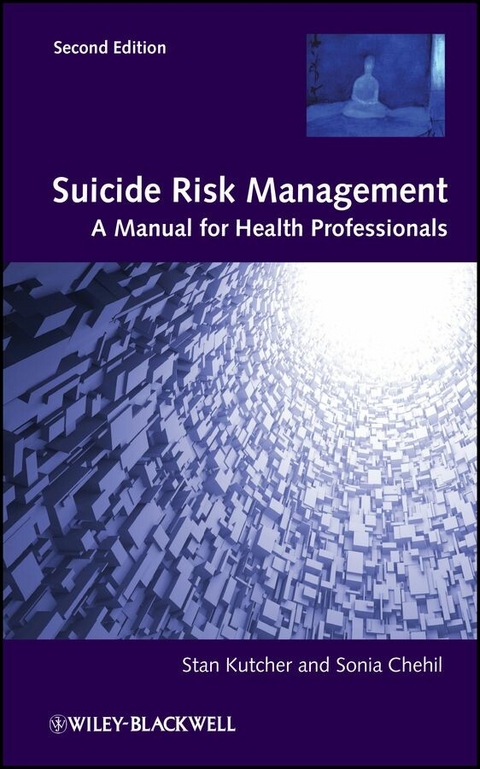
Suicide Risk Management (eBook)
John Wiley & Sons (Verlag)
978-1-119-95431-6 (ISBN)

The book opens with a review of the epidemiology, risk factors and associated aspects of suicide. It then presents two assessment tools: The Tool for Assessment of Suicide Risk (TASR) provides instruction on how to use it appropriately in the clinic. The Suicide Risk Assessment Guide (SRAG) acts as a self-study program to asess clinical evaluation skills. Both tools were created for use in the authors' own practice and are now successfully taught to and used by health professionals around the world. Refined through actual experience, these proven tools help assess and evaluate patients with confidence.
Case vignettes allow the reader to practice using the information they have learned from the book.
Throughout the book, bulleted lists, tables and flowcharts effectively describe how to use the many factors to assess the risk of suicide in an individual patient.
Sonia Chehil is Head of International Psychiatry at Dalhousie University and Associate Director of the WHO Collaborating Center in Mental Health, with joint faculty appointments in child and adolescent and international psychiatry.
Stan Kutcher is one of the world's leading authorities on child and adolescent psychiatry and is the author/editor of several successful books and over 150 scientific papers. He is Director of the WHO Collaborating Center in Mental Health Training and Policy and Associate Dean of International Medical Development and Research at Dalhousie University.
Suicide Risk Management: A Manual for Health Professionals is a short, clearly written book that provides practical guidance on how to manage the suicidal or potentially suicidal patient. Written by two expert teachers, the book has been used in courses for trainee psychiatrists and for health professionals throughout the world. Feedback from participants on these courses has informed revision of the new edition. This book is of interest for all mental health professionals who come into contact with patients who present with suicide potential, i.e. all mental health professionals, as well as general health professionals who are often the first point of contact for a suicidal patient. The book opens with a review of the epidemiology, risk factors and associated aspects of suicide. It then presents two assessment tools: The Tool for Assessment of Suicide Risk (TASR) provides instruction on how to use it appropriately in the clinic. The Suicide Risk Assessment Guide (SRAG) acts as a self-study program to asess clinical evaluation skills. Both tools were created for use in the authors own practice and are now successfully taught to and used by health professionals around the world. Refined through actual experience, these proven tools help assess and evaluate patients with confidence. Case vignettes allow the reader to practice using the information they have learned from the book. Throughout the book, bulleted lists, tables and flowcharts effectively describe how to use the many factors to assess the risk of suicide in an individual patient.
Sonia Chehil is Head of International Psychiatry at Dalhousie University and Associate Director of the WHO Collaborating Center in Mental Health, with joint faculty appointments in child and adolescent and international psychiatry. Stan Kutcher is one of the world's leading authorities on child and adolescent psychiatry and is the author/editor of several successful books and over 150 scientific papers. He is Director of the WHO Collaborating Center in Mental Health Training and Policy and Associate Dean of International Medical Development and Research at Dalhousie University.
Introduction, vii
Objectives, ix
1 The Importance of Suicide Awareness and Assessment, 1
2 Understanding Suicide Risk, 13
3 Suicide Risk Assessment, 56
4 Putting It All Together: Tool for Assessment of Suicide Risk (TASR), 88
5 Special Topics in Understanding and Evaluating Suicide Risk, 94
6 Suicide Prevention, 110
7 Suicide Intervention, 115
8 Post-suicide Intervention: Caring for Survivors, 123
9 Care for the Carer: Death of a Patient by Suicide, 130
10 Clinical Vignettes for Group or Individual Study, 135
Appendix A Tool for Assessment of Suicide Risk (TASR), 140
Appendix B 6-ITEM Kutcher Adolescent Depression Scale: KADS, 142
Appendix C My Safety Plan, 144
Index, 147
"This manual is a scholarly and comprehensive approach to suicide. Chehil and Kutcher write in a clear, organized, and engaging style that encourages the reader of any level of experience to explore their own knowledge about suicide.I highly recommend this book to health professional." (Asian Journal of Psychiatry, 2013)
| Erscheint lt. Verlag | 6.2.2012 |
|---|---|
| Sprache | englisch |
| Themenwelt | Medizin / Pharmazie ► Gesundheitswesen |
| Medizin / Pharmazie ► Medizinische Fachgebiete ► Chirurgie | |
| Medizin / Pharmazie ► Medizinische Fachgebiete ► Psychiatrie / Psychotherapie | |
| Studium ► 1. Studienabschnitt (Vorklinik) ► Anatomie / Neuroanatomie | |
| Schlagworte | Allgemeinpraxis, hausärztliche Praxis • Allgemeinpraxis, hausärztliche Praxis • Book • Clinical psychology • Courses • Edition • Expert • Feedback • General Practice/Family Practice • Health • Klinische Psychologie • Manual • Medical Science • Medizin • New • participants • Patient • potentially • Practical • Professionals • provides • Psychiatrie • psychiatrists • Psychiatry • Psychologie • Psychology • Revision • Risk • Short • Suicidal • Teachers • throughout • Trainee • two |
| ISBN-10 | 1-119-95431-2 / 1119954312 |
| ISBN-13 | 978-1-119-95431-6 / 9781119954316 |
| Informationen gemäß Produktsicherheitsverordnung (GPSR) | |
| Haben Sie eine Frage zum Produkt? |
 EPUB (Ohne DRM)
Digital Rights Management: ohne DRM
Dieses eBook enthält kein DRM oder Kopierschutz. Eine Weitergabe an Dritte ist jedoch rechtlich nicht zulässig, weil Sie beim Kauf nur die Rechte an der persönlichen Nutzung erwerben.
Dateiformat: EPUB (Electronic Publication)
EPUB ist ein offener Standard für eBooks und eignet sich besonders zur Darstellung von Belletristik und Sachbüchern. Der Fließtext wird dynamisch an die Display- und Schriftgröße angepasst. Auch für mobile Lesegeräte ist EPUB daher gut geeignet.
Systemvoraussetzungen:
PC/Mac: Mit einem PC oder Mac können Sie dieses eBook lesen. Sie benötigen dafür die kostenlose Software Adobe Digital Editions.
eReader: Dieses eBook kann mit (fast) allen eBook-Readern gelesen werden. Mit dem amazon-Kindle ist es aber nicht kompatibel.
Smartphone/Tablet: Egal ob Apple oder Android, dieses eBook können Sie lesen. Sie benötigen dafür eine kostenlose App.
Geräteliste und zusätzliche Hinweise
Buying eBooks from abroad
For tax law reasons we can sell eBooks just within Germany and Switzerland. Regrettably we cannot fulfill eBook-orders from other countries.
aus dem Bereich