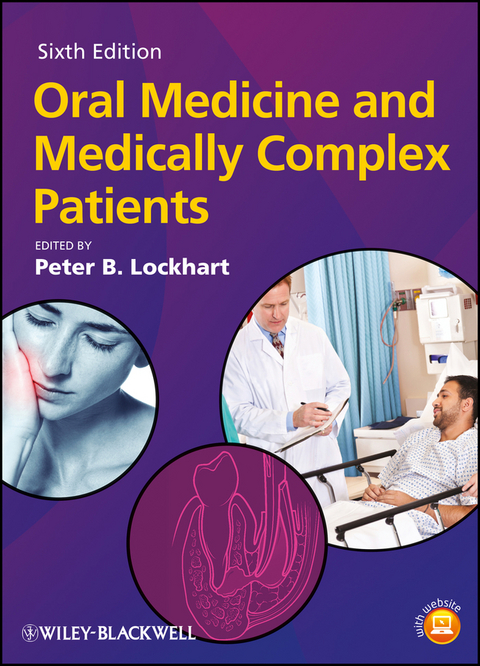
Oral Medicine and Medically Complex Patients (eBook)
John Wiley & Sons (Verlag)
978-1-118-49583-4 (ISBN)
Oral Medicine and Medically Complex Patients, Sixth Edition provides succinct, yet comprehensive information on in-hospital care and outpatient management of the medically complex dental patient, as well as the management of non-surgical problems of the maxillofacial region. Fully revised to include up-to-date information on procedures and medications, the Sixth Edition contains over 15 additional charts and tables for rapid reference and expanded coverage on maxillofacial prosthodontics and increasingly prevalent conditions, such as ONJ.
Oral Medicine and Medically Complex Patients follows a practical approach, organizing essential information into quickly referenced tables, easy-to-read diagrams and step-by-step procedures. Replete with examples of hospital charts, operative notes, and consultations, the book provides thorough coverage of the broad scope of clinical problems and patient populations encountered by dentists. A truly must-have resource Oral Medicine and Medically Complex Patients serves the needs of an increasing number of dental students, residents in general practice and specialty training, and practitioners engaged in the care of both hospitalized and ambulatory patients.
Peter B. Lockhart, DDS, FDS RCSEd, FDS RCPS, is Professor and Chair of the Department of Oral Medicine and Director of the Institute for Oral Medicine at Carolinas Medical Center in Charlotte, North Carolina. He has over 35 years of experience in various aspects of hospital-based dentistry, teaching, and research in oral medicine.
Oral Medicine and Medically Complex Patients, Sixth Edition provides succinct, yet comprehensive information on in-hospital care and outpatient management of the medically complex dental patient, as well as the management of non-surgical problems of the maxillofacial region. Fully revised to include up-to-date information on procedures and medications, the Sixth Edition contains over 15 additional charts and tables for rapid reference and expanded coverage on maxillofacial prosthodontics and increasingly prevalent conditions, such as ONJ. Oral Medicine and Medically Complex Patients follows a practical approach, organizing essential information into quickly referenced tables, easy-to-read diagrams and step-by-step procedures. Replete with examples of hospital charts, operative notes, and consultations, the book provides thorough coverage of the broad scope of clinical problems and patient populations encountered by dentists. A truly must-have resource Oral Medicine and Medically Complex Patients serves the needs of an increasing number of dental students, residents in general practice and specialty training, and practitioners engaged in the care of both hospitalized and ambulatory patients.
Peter B. Lockhart, DDS, FDS RCSEd, FDS RCPS, is Professor and Chair of the Department of Oral Medicine and Director of the Institute for Oral Medicine at Carolinas Medical Center in Charlotte, North Carolina. He has over 35 years of experience in various aspects of hospital-based dentistry, teaching, and research in oral medicine.
Contributors xi
Contributors to the Previous Edition xii
Acknowledgments xiv
Introduction xv
1. In-Hospital Care of the Dental Patient 1
2. Outpatient Management of the Medically Compromised Patient 33
3. Oral Medicine: A Problem-Oriented Approach 150
4. Consultations 195
5. Dental, Oral, and Maxillofacial Emergencies 220
6. Medical Emergencies 283
7. Maxillofacial Prosthetics 319
Appendices 333
Index 471
"I would recommend this book as a quick reference guide
for dental profes-sionals practising oral and maxillofacial
surgery and/or oral medicine, and clini-cians involved in the
daily management of hospital in-patients." (British
Dental Journal, 23 November 2013)
1
In-Hospital Care of the Dental Patient
Dental Admissions
Introduction
Both the medical health and the dental needs of patients must be considered when deciding on hospital admission. Hospital admission should be considered whenever the required treatment could threaten the patient’s well-being, or indeed life, or when the patient’s medical problems may seriously compromise the treatment.
Reasons for Admission
The reasons for admission to the hospital can be categorized into two groups: emergent hospitalizations, usually from the emergency department, or elective/scheduled hospitalizations for specific oral surgical or dental procedures.
Fractures of the Mandible/Maxillofacial Structures
Admission to the hospital is necessary for the management of multisystem injuries or injuries concomitant to mandible/maxillofacial fractures. It may be required for medically complex or special needs patients.
Infection
Admission is necessary if the patient has an infection that:
- Compromises nutrition or hydration (especially fluid intake, e.g., severe herpetic stomatitis in very young children, which might require hospitalization because of dehydration)
- Compromises the airway (e.g., Ludwig’s angina)
- Involves secondary soft tissue planes that drain or traverse potential areas of particular hazard and so are a danger to the patient (e.g., retropharyngeal or infratemporal abscesses)
Compromised Patients
Medically, mentally, or physically compromised patients who are insufficiently cooperative to be treated in an outpatient setting may be admitted to hospital for their procedure. This category includes patients who might require general anesthesia or deep sedation and/or appropriate cardiorespiratory monitoring during treatment (e.g., anxiety disorders).
Children
Young children who require treatment under deep sedation or general anesthesia because of the combination of poor cooperation and the need for a large number of dental procedures as a result of extensive caries and/or consequent infection may be admitted to the hospital.
Medical Consultations
Objectives
The objectives of medical consultations are to:
- Determine and reduce peri- and postoperative medical risk to the patient from the planned oral surgical/dental procedures
- Determine, and thus lessen or indeed prevent, the effects of the proposed surgery/procedures on any medical illness and limit possible post-procedure complications by managing and treating the patient’s underlying medical conditions
The Patient’s Medical History
The Admission Note
Introduction
There is an art to eliciting the correct, pertinent, and relevant information regarding a patient’s current medical and physical status. Taking an accurate, relevant, and concise medical history requires repeated practice and experience. The goal is to obtain sufficient information from the patient to facilitate the physical examination and, in conjunction with the examination, to arrive at a working diagnosis or diagnoses of the problem.
Old hospital records, if they exist, can be immeasurably helpful in providing information about past hospitalizations, operations (including complications), and medications, particularly if the reliability of the patient or guardian as an informant is in question.
- Record the patient’s positive and negative responses.
- Remember that the patient might not understand the need for, and value of, an accurate medical history in the dental setting.
- Be persistent and patient.
- Confirm the veracity of the information by reframing the questions (e.g., ask patients to list their current medical problems; a bit later ask for a list of their current medications; follow this up by asking the patient to detail what each specific drug/medication is used for).
- If you need to use an interpreter, try as much as possible to use a professional healthcare interpreter and not members of the patient’s family.
- If you need to gain consent for minors and intellectually impaired adults or elders, make sure that the person whose consent you gain (patient’s parent/guardian/caregiver) has the legal authority to provide consent.
Elements of the History
The following discussion of the components of the medical history is directed at providing a full and complete history. Often, a shorter form of the medical history is sufficient for a healthy patient admitted for routine care (e.g., extraction of teeth).
Informant and Reliability
Note the name of the person or material used to obtain the pertinent information (e.g., patient, parent, relative, medical/nursing record). Also note whether the informant was reliable—were your questions understood, was the informant coherent and knowledgeable, and how well does he or she know the patient?
Chief Complaint (CC)
Record what patients perceive to be the problem that brought them to the hospital. The patient’s own words should be used if possible.
History of Present Illness (HPI)
Make a chronologic description of the development of the chief complaint. Record the following:
- When the symptoms started
- The course since onset—the duration and progression
- Whether the symptoms are constant or episodic (if episodic, note the nature and duration of any periods of remission and exacerbation)
- The character of the symptoms (e.g., sharp, dull, burning, aching) and severity (e.g., impact on daily living)
- Any systemic signs and/or symptoms (e.g., weight gain or loss, chills, fever)
- Previous diagnoses and the results of previous trials (success, partial resolution, or unsuccessful) with treatment and/or medication related to the chief complaint
Past Dental History
You now need to gather as full a past dental history as possible. Ask the patient about:
- Previous oral surgery, orthodontics (age, duration), periodontics, endodontics (tooth, date, reason), prosthetics, other appliances, oral mucosal problems (e.g., secondary herpes, aphthae), dental trauma
- Frequency of dental visits (regular or emergency only)
- Frequency of dental cleanings (when were the patient’s teeth last cleaned?)
- Experience with local anesthesia/sedation (if possible, find out what type was used) and general anesthesia (e.g., allergy, syncope) (Appendix 12, Table A12-7)
- Experience with extractions—was there postoperative bleeding or infection? How well did they heal?
- History of pain, swelling, bleeding, abscess, toothaches
- Temporomandibular joint—history of pain, clicking, subluxation, trismus, crepitus
- Habits including nail-biting, thumb-sucking, clenching, bruxing, mouth-breathing
- Fluoride exposure—was this systemic or topical?
- Home care—brushing method and frequency, instruction, floss or other aids; caregiver assistance required?
- Food habits/diet—ask about form and frequency of sucrose exposure (including liquid oral medicines). For children, the history and frequency of bottle and breastfeeding as well as between-meal snacking should be included. Find out about nutritional supplements (form and consistency), liquid diets, tube feedings
- Problems with saliva (hyper-/hypo-salivation) chewing, speech
- Negative dental experiences
Past Medical History (PMH)
Direct questioning is probably the best way to elicit the patient’s past medical history.
Ask the patient “Are you being treated for anything by your doctor at the moment?” If the answer is “Yes,” ascertain how severe the condition is (the extent to which it interferes in daily living activities) and how stable it is. A severe condition (e.g., angina) might prove not to be a significant hindrance to planned dental treatment as long as it is well managed and stable. However, a patient with unstable angina should not be treated until the angina is stabilized, or if this is not practical, treatment should be planned while the patient is monitored, and possibly lightly sedated, to minimize stress and anxiety.
Ask the patient “Have you been treated in the past, or are you currently being treated for any of the following”:
- Rheumatic fever, heart murmurs, infective endocarditis, angina, heart attack, or an irregular heart beat
- Asthma, emphysema, hay fever, or allergic rhinitis or sinusitis
- Epilepsy, stroke, or nervous or psychiatric conditions?
- Diabetes or thyroid conditions
- Peptic or gastric ulcer disease or liver disease (e.g., hepatitis or cirrhosis)
- Kidney problems: Obstruction, stones, or infection
- Urinary problems: Obstruction or infection
- Gynecologic or “women’s” problems. Ask, “Are you pregnant?”
- Rheumatoid or osteoarthritis, osteoporosis, back or spinal problems
- Skin cancer or rashes
- HIV
- Infection requiring antibiotics
- Ask “Do you have a prosthetic valve or joint?”
If the patient is currently receiving treatment for cancer, find out the mode and schedule of treatment (surgery, chemotherapy, or radiotherapy). Finally, ask if the patient has ever required a blood transfusion or other blood products (platelets, plasma, or clotting factors).
Review of Systems
As part of the past medical history, you need to question the patient systematically about all of the body systems. It is...
| Erscheint lt. Verlag | 26.11.2012 |
|---|---|
| Sprache | englisch |
| Themenwelt | Medizin / Pharmazie ► Gesundheitsfachberufe |
| Medizin / Pharmazie ► Medizinische Fachgebiete | |
| Medizin / Pharmazie ► Zahnmedizin | |
| Schlagworte | Complex • Comprehensive • Contains • dental patient • dentistry • Edition • Information • inhospital care • Management • maxillofacial • Medically • Nonsurgical • patients • Problems • Prosthodontics • provides • Rapid • Reference • Region • sixth • uptodate information • Zahnheilkunde • Zahnmedizin |
| ISBN-10 | 1-118-49583-7 / 1118495837 |
| ISBN-13 | 978-1-118-49583-4 / 9781118495834 |
| Informationen gemäß Produktsicherheitsverordnung (GPSR) | |
| Haben Sie eine Frage zum Produkt? |
 EPUB (Adobe DRM)
Kopierschutz: Adobe-DRM
Adobe-DRM ist ein Kopierschutz, der das eBook vor Mißbrauch schützen soll. Dabei wird das eBook bereits beim Download auf Ihre persönliche Adobe-ID autorisiert. Lesen können Sie das eBook dann nur auf den Geräten, welche ebenfalls auf Ihre Adobe-ID registriert sind.
Details zum Adobe-DRM
Dateiformat: EPUB (Electronic Publication)
EPUB ist ein offener Standard für eBooks und eignet sich besonders zur Darstellung von Belletristik und Sachbüchern. Der Fließtext wird dynamisch an die Display- und Schriftgröße angepasst. Auch für mobile Lesegeräte ist EPUB daher gut geeignet.
Systemvoraussetzungen:
PC/Mac: Mit einem PC oder Mac können Sie dieses eBook lesen. Sie benötigen eine
eReader: Dieses eBook kann mit (fast) allen eBook-Readern gelesen werden. Mit dem amazon-Kindle ist es aber nicht kompatibel.
Smartphone/Tablet: Egal ob Apple oder Android, dieses eBook können Sie lesen. Sie benötigen eine
Geräteliste und zusätzliche Hinweise
Buying eBooks from abroad
For tax law reasons we can sell eBooks just within Germany and Switzerland. Regrettably we cannot fulfill eBook-orders from other countries.
aus dem Bereich