Human Blood Groups (eBook)
John Wiley & Sons (Verlag)
978-1-118-49354-0 (ISBN)
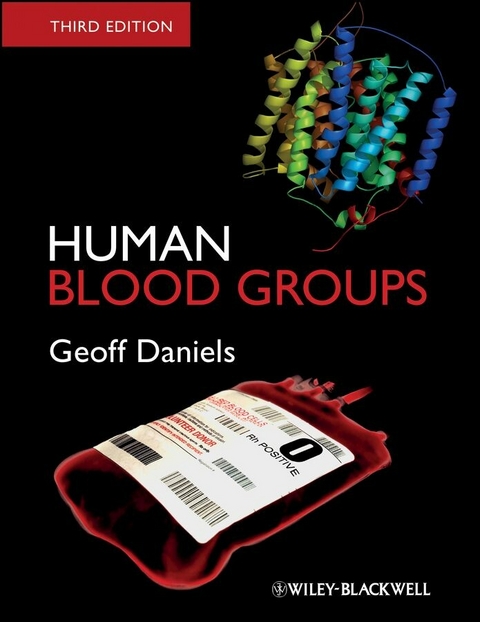
Human Blood Groups is a comprehensive and fully referenced text covering both the scientific and clinical aspects of red cell surface antigens, including: serology, inheritance, biochemistry, molecular genetics, biological functions and clinical significance in transfusion medicine.
Since the last edition, seven new blood group systems and over 60 new blood group antigens have been identified. All of the genes representing those systems have now been cloned and sequenced.
This essential new information has made the launch of a third edition of Human Blood Groups, now in four colour, particularly timely.
This book continues to be an essential reference source for all those who require clinical information on blood groups and antibodies in transfusion medicine and blood banking.
Geoff Daniels BSc, PhD, FRCPath
Head of Diagnostics, International Blood Group Reference Laboratory; Senior Research Fellow, Bristol Institute for Transfusion Sciences, NHSBT, Bristol, UK; Secretary General, International Society of Blood Transfusion
Geoff Daniels BSc, PhD, FRCPath Head of Diagnostics, International Blood Group Reference Laboratory; Senior Research Fellow, Bristol Institute for Transfusion Sciences, NHSBT, Bristol, UK; Secretary General, International Society of Blood Transfusion
Foreword, vii
Preface to the third edition, viii
Some abbreviations used, ix
1 Human blood groups: introduction, 1
2 ABO, H, and Lewis systems, 11
3 MNS blood group system, 96
4 P1PK, Globoside, and FORS blood group systems, plus some other related blood groups, 162
5 Rh and RHAG blood group systems, 182
6 Lutheran blood group system, 259
7 Kell and Kx blood group systems, 278
8 Duffy blood group system, 306
9 Kidd blood group system, 325
10 Diego blood group system, 336
11 Yt blood group system, 354
12 Xg blood group system, 359
13 Scianna blood group system, 371
14 Dombrock blood group system, 376
15 Colton blood group system, 384
16 LW blood group system, 391
17 Chido/Rodgers blood group system, 400
18 Gerbich blood group system, 410
19 Cromer blood group system, 427
20 Knops blood group system and the Cost antigens, 439
21 Indian blood group system and the AnWj antigen, 449
22 Ok blood group system, 457
23 Raph blood group system, 461
24 JMH blood group system, 465
25 I and i antigens, and cold agglutination, 469
26 Gill blood group system, 485
27 Junior and Langereis blood group systems, 487
28 Er antigens, 493
29 Low frequency antigens, 495
30 High frequency antigens, including Vel, 500
31 Sid antigen, 505
32 HLA (Human Leucocyte-Associated) Class I antigens on red cells, 512
33 Polyagglutination and cryptantigens, 515
Index, 524
"It is fascinatingly detailed, and makes a wonderful
book for browsing, with many interesting facts, often with
historical context to each blood group discovery; but its main
audience will be those working within the transfusion laboratory,
for whom this will be an invaluable reference."
(Haem Trainee, 1 August 2013)
"Get it. If you are involved in blood banking, this is a
must-have." (Doody's, 14 June 2013)
1
Human Blood Groups: Introduction
1.1 Introduction
What is the definition of a blood group? Taken literally, any variation or polymorphism detected in the blood could be considered a blood group. However, the term blood group is usually restricted to blood cell surface antigens and generally to red cell surface antigens. This book focuses on the inherited variations in human red cell membrane proteins, glycoproteins, and glycolipids. These variations are detected by alloantibodies, which occur either ‘naturally’, due to immunisation by ubiquitous antigens present in the environment, or as a result of alloimmunisation by human red cells, usually introduced by blood transfusion or pregnancy. Although it is possible to detect polymorphism in red cell surface proteins by other methods such as DNA sequence analysis, such variants cannot be called blood groups unless they are defined by an antibody.
Blood groups were discovered at the beginning of the twentieth century when Landsteiner [1,2] noticed that plasma from some individuals agglutinated the red cells from others. For the next 45 years, only those antibodies that directly agglutinate red cells could be studied. With the development of the antiglobulin test by Coombs, Mourant, and Race [3,4] in 1945, non-agglutinating antibodies could be detected and the science of blood group serology blossomed. There are now 339 authenticated blood group antigens, 297 of which fall into one of 33 blood group systems, genetically discrete groups of antigens controlled by a single gene or cluster of two or three closely linked homologous genes (Table 1.1).
Table 1.1 Blood group systems.
Most blood group antigens are synthesised by the red cell, but the antigens of the Lewis and Chido/Rodgers systems are adsorbed onto the red cell membrane from the plasma. Some blood group antigens are detected only on red cells; others are found throughout the body and are often called histo-blood group antigens.
Biochemical analysis of blood group antigens has shown that they fall into two main types:
Some antigens are defined by the amino acid sequence of a glycoprotein, but are dependent on the presence of carbohydrate for their recognition serologically. In this book the three-letter code for amino acids is mainly used, though the single-letter code is often employed in long sequences and in some figures. The code is provided in Table 1.2.
Table 1.2 The 20 common amino acids: one- and three-letter codes.
| A | Ala | Alanine |
| C | Cys | Cysteine |
| D | Asp | Aspartic acid |
| E | Glu | Glutamic acid |
| F | Phe | Phenylalanine |
| G | Gly | Glycine |
| H | His | Histidine |
| I | Ile | Isoleucine |
| K | Lys | Lysine |
| L | Leu | Leucine |
| M | Met | Methionine |
| N | Asn | Asparagine |
| P | Pro | Proline |
| Q | Gln | Glutamine |
| R | Arg | Arginine |
| S | Ser | Serine |
| T | Thr | Threonine |
| V | Val | Valine |
| W | Trp | Tryptophan |
| Y | Tyr | Tyrosine |
In recent years, molecular genetical techniques have been introduced into the study of human blood groups and now most of the genes governing blood group systems have been cloned and sequenced (Table 1.1). Many serological complexities of blood groups are now explained at the gene level by a variety of mechanisms, including point mutation, unequal crossing-over, gene conversion, and alternative RNA splicing.
Discovery of the ABO blood groups first made blood transfusion feasible and disclosure of the Rh antigens led to the understanding, and subsequent prevention, of haemolytic disease of the fetus and newborn (HDFN). Although ABO and Rh are the most important systems in transfusion medicine, many other blood group antibodies are capable of causing a haemolytic transfusion reaction (HTR) or HDFN. Red cell groups have been important tools in forensic science, although this role was diminished with the introduction of HLA testing and has recently been displaced by DNA ‘fingerprinting’. For many years blood groups were the best human genetic markers and played a major part in the mapping of the human genome.
Blood groups still have much to teach us. Because red cells are readily available and haemagglutination tests relatively easy to perform, the structure and genetics of the red cell membrane proteins and lipids are understood in great detail. With the unravelling of the complexities of blood group systems by molecular genetical techniques, much has been learnt about the mechanisms responsible for the diversification of protein structures and the nature of the human immune response to proteins of different shapes resulting from variations in amino acid sequence.
1.2 Blood Group Terminology
The problem of providing a logical and universally agreed nomenclature has dogged blood group serologists almost since the discovery of the ABO system. Before going any further, it is important to understand how blood groups are named and how they are categorised into systems, collections, and series.
1.2.1 An Internationally Agreed Nomenclature
The International Society of Blood Transfusion (ISBT) Working Party on Red Cell Immunogenetics and Blood Group Terminology was set up in 1980 to establish a uniform nomenclature that is ‘both eye and machine readable’. Part of the brief of the Working Party was to produce a nomenclature ‘in keeping with the genetic basis of blood groups’ and so a terminology based primarily around the blood group systems was devised. First the systems and the antigens they contained were numbered, then the high and low frequency antigens received numbers, and then, in 1988, collections were introduced. Numbers are never recycled: when a number is no longer appropriate it becomes obsolete.
Blood group antigens are categorised into 33 systems, seven collections, and two series. The Working Party produced a monograph in 2004 to describe the terminology [5], which was most recently updated in 2011 [6]. Details can also be found on the ISBT web site [7].
1.2.2 Antigen, Phenotype, Gene and Genotype Symbols
Every authenticated blood group antigen is given a six-digit identification number. The first three digits represent the system (001 to 033), collection (205 to 213), or series (700 for low frequency, 901 for high frequency); the second three digits identify the antigen. For example, the Lutheran system is system 005 and Lua, the first antigen in that system, has the number 005001. Each system also has an alphabetical symbol: that for Lutheran is LU. So Lua is also LU001 or, because redundant sinistral zeros may be discarded, LU1. For phenotypes, the system symbol is followed by a colon and then by a list of antigens present, each separated by a comma. If an antigen is known to be absent, its number is preceded by a minus sign. For example, Lu(a−b+) becomes LU:−1,2.
Devising a modern terminology for blood group alleles is more complex. One antigen, the absence of an antigen, or the weakness or absence of all antigens of a system may be encoded by several or many alleles. Over the last few years the Working Party has been developing a new terminology for bloods group alleles. Unfortunately at the time of publication of this book, it was still incomplete, controversial, and in draft form. Consequently, it has only partially been used in this book. Basically, alleles have the system symbol followed by an asterisk followed in turn by a number or series of numbers, separated by full stops, representing the encoded antigen and the allele number. Alternatively, in some cases a letter can be used instead of a number. For example, Lua allele can be LU*01 or LU*A. Genotypes have the symbol followed by an asterisk followed by the two alleles separated by a stroke. For example, Lua/Lub becomes LU*01/02 or LU*A/B. The letters N and M represent null and mod. For example, one of the inactive Lub alleles responsible for a null phenotype is LU*02N.01, the 02 representing the Lub allele,...
| Erscheint lt. Verlag | 16.1.2013 |
|---|---|
| Sprache | englisch |
| Themenwelt | Medizinische Fachgebiete ► Innere Medizin ► Hämatologie |
| Studium ► 1. Studienabschnitt (Vorklinik) ► Physiologie | |
| Schlagworte | Antigens • Aspects • biological functions • Blood • Cell • Clinical • Colour • Edition • Essential • Four • genes • Group • groups • Hämatologie • Hämatologie • Hematology • Human • Information • Last • Launch • Medical Science • Medizin • New • red • referenced • representing • Scientific • Third • Transfusion |
| ISBN-10 | 1-118-49354-0 / 1118493540 |
| ISBN-13 | 978-1-118-49354-0 / 9781118493540 |
| Informationen gemäß Produktsicherheitsverordnung (GPSR) | |
| Haben Sie eine Frage zum Produkt? |
 PDF (Adobe DRM)
Größe: 13,5 MB
Kopierschutz: Adobe-DRM
Adobe-DRM ist ein Kopierschutz, der das eBook vor Mißbrauch schützen soll. Dabei wird das eBook bereits beim Download auf Ihre persönliche Adobe-ID autorisiert. Lesen können Sie das eBook dann nur auf den Geräten, welche ebenfalls auf Ihre Adobe-ID registriert sind.
Details zum Adobe-DRM
Dateiformat: PDF (Portable Document Format)
Mit einem festen Seitenlayout eignet sich die PDF besonders für Fachbücher mit Spalten, Tabellen und Abbildungen. Eine PDF kann auf fast allen Geräten angezeigt werden, ist aber für kleine Displays (Smartphone, eReader) nur eingeschränkt geeignet.
Systemvoraussetzungen:
PC/Mac: Mit einem PC oder Mac können Sie dieses eBook lesen. Sie benötigen eine
eReader: Dieses eBook kann mit (fast) allen eBook-Readern gelesen werden. Mit dem amazon-Kindle ist es aber nicht kompatibel.
Smartphone/Tablet: Egal ob Apple oder Android, dieses eBook können Sie lesen. Sie benötigen eine
Geräteliste und zusätzliche Hinweise
Zusätzliches Feature: Online Lesen
Dieses eBook können Sie zusätzlich zum Download auch online im Webbrowser lesen.
Buying eBooks from abroad
For tax law reasons we can sell eBooks just within Germany and Switzerland. Regrettably we cannot fulfill eBook-orders from other countries.
 EPUB (Adobe DRM)
Kopierschutz: Adobe-DRM
Adobe-DRM ist ein Kopierschutz, der das eBook vor Mißbrauch schützen soll. Dabei wird das eBook bereits beim Download auf Ihre persönliche Adobe-ID autorisiert. Lesen können Sie das eBook dann nur auf den Geräten, welche ebenfalls auf Ihre Adobe-ID registriert sind.
Details zum Adobe-DRM
Dateiformat: EPUB (Electronic Publication)
EPUB ist ein offener Standard für eBooks und eignet sich besonders zur Darstellung von Belletristik und Sachbüchern. Der Fließtext wird dynamisch an die Display- und Schriftgröße angepasst. Auch für mobile Lesegeräte ist EPUB daher gut geeignet.
Systemvoraussetzungen:
PC/Mac: Mit einem PC oder Mac können Sie dieses eBook lesen. Sie benötigen eine
eReader: Dieses eBook kann mit (fast) allen eBook-Readern gelesen werden. Mit dem amazon-Kindle ist es aber nicht kompatibel.
Smartphone/Tablet: Egal ob Apple oder Android, dieses eBook können Sie lesen. Sie benötigen eine
Geräteliste und zusätzliche Hinweise
Buying eBooks from abroad
For tax law reasons we can sell eBooks just within Germany and Switzerland. Regrettably we cannot fulfill eBook-orders from other countries.
aus dem Bereich