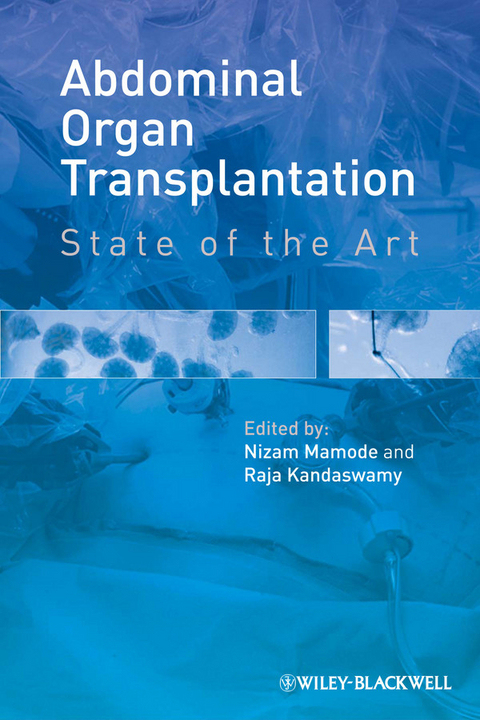
Abdominal Organ Transplantation (eBook)
John Wiley & Sons (Verlag)
978-1-118-48368-8 (ISBN)
This book summarizes the latest developments in key areas of the fast moving field of abdominal organ transplantation. It covers such vital topics as living donation (both renal and liver), laparoscopic and robotic techniques, islet and pancreas transplantation, non-heart beating transplantation, blood group incompatible and highly sensitized transplantation, high risk transplants, tolerance, stem cell therapy and novel immunosuppressive techniques. Each chapter offers an overview of the available evidence by a world renowned expert, written in an accessible, easy-to-read manner.
Nizam Mamode is Consultant Surgeon in the Renal Unit at Guy's and St Thomas's Hospital. He specialises in kidney and abdominal transplantation surgery. He has practised in leading centres worldwide including the United States (Minnesota)and Spain (Barcelona). He also works at Great Orrmonde Street Hospital performing pediatric transplant surgery. Mr Mamode is a Councillor of the British Transplant Society. Dr Raja Kandaswamy is Associate Professor and Transplant Surgeon at Amplatz Children'S Hospital, University of Minnesota, Minneapolis, USA.
List of Contributors vii
Foreword xi
Chapter 1 Living Donation: The Gold Standard 1
Leonardo V. Riella and Anil Chandraker
Chapter 2 New Surgical Techniques in Transplantation 17
Adam D. Barlow and Michael L. Nicholson
Chapter 3 Living-donor Liver Transplantation 33
Abhideep Chaudhary and Abhinav Humar
Chapter 4 Antibody-incompatible Transplantation 56
Nizam Mamode
Chapter 5 Pancreas Transplantation 80
Rajinder Singh David E.R. Sutherland and Raja Kandaswamy
Chapter 6 Allotransplantation of Pancreatic Islets 107
Maciej T. Juszczak and Paul R.V. Johnson
Chapter 7 Novel Cell Therapies in Transplantation 138
Paul G. Shiels Karen S. Stevenson Marc Gingell Littlejohn and Marc Clancy
Chapter 8 Intestinal Transplantation 150
Khalid M. Khan Tun Jie Chirag S. Desai and Rainer W.G. Gruessner
Chapter 9 Pediatric Renal Transplantation 163
Stephen D. Marks
Chapter 10 Immunosuppressive Pharmacotherapy 177
Steven Gabardi and Anil Chandraker
Chapter 11 Conclusion 209
Nizam Mamode and Raja Kandaswamy
Index 213
"Overall, this is a nice summary of abdominal
transplantation, its advances, and where the field still needs to
improve. In an ever-evolving field, this book is comparable to
other reviews of abdominal transplantation, but is unique in its
summary of up-to-date immunosuppression techniques."
(Doody's, 17 May 2013)
Chapter 1
Living Donation: The Gold Standard
Leonardo V. Riella and Anil Chandraker
Renal Division, Brigham and Women's Hospital, Harvard Medical School, USA
Introduction
The first successful transplant occurred in Boston in 1954, when a surgical team under the direction of Joseph Murray removed a kidney from a healthy donor and transplanted it into his identical twin, who had chronic glomerulonephritis [1]. The organ functioned immediately and the recipient survived for 9 years, after which time his allograft failed from what was thought to be recurrent glomerulonephritis. More than 50 years have passed since that breakthrough achievement, and transplantation has progressed from an experimental modality to standard of care. The introduction of immunosuppressive drugs such as azathioprine, prednisone, and later calcineurin inhibitors has led to better outcomes and, along with technical breakthroughs, expanded the pool of organs available to deceased and human leukocyte antigen (HLA)-mismatched donors.
Kidney transplantation has become the preferred therapeutic option for patients with end-stage kidney disease (ESKD), leading to better patient survival and quality of life. It is also more cost-effective than dialysis [2–4]. Unfortunately, the incidence of ESKD has risen steadily in the past several decades, creating a shortage of available organs for patients on the kidney-transplant waiting list (Table 1.1).
Table 1.1 Waiting list for different organs in the USA. OPTN, Organ Procurement and Transplantation Network. Data from [5].
| Waiting list candidates OPTN 2010 | Number |
| All | 107,075 |
| Kidney | 84,495 |
| Pancreas | 1,458 |
| Kidney/Pancreas | 2,182 |
| Liver | 15,948 |
| Intestine | 248 |
| Heart | 3,173 |
| Lung | 1,844 |
| Heart/Lung | 75 |
This growth in ESKD is related to the increased incidence of diabetes, obesity, and hypertension, combined with the improvement in treatment for concurrent health problems such as ischemic heart disease and stroke. The supply of organs from deceased donors has not followed the same upward trend, resulting in an ever-widening gap between eligible potential transplant recipients and available organs (Table 1.2).
Table 1.2 Growth of the kidney-transplant waiting list compared to donor type in the USA. Data from [5].
In 2009, only 18% of patients on the waiting list for kidney transplantation received an organ [5]. The average waiting time for kidneys from deceased donors in the USA is more than 3 years, and in some geographic areas it is more than 5 years (Table 1.3)—waiting times that are sometimes longer than the average life expectancy of middle-aged and older persons with ESKD [6]. In line with these numbers, a recent study indicates that even major alterations in the organ procurement process cannot reasonably be expected to meet the demand for transplantable kidneys from decreased donors [7]. The imbalance between patient demand and the supply of organs from deceased donors has refocused attention on living kidney donors.
Table 1.3 Time to transplant by organ type in the USA. Data from [5].
| Organ type | Time to transplant in 2004 (median in days) |
| Kidney | 1,219 |
| Pancreas Transplant Alone | 376 |
| Pancreas after Kidney | 562 |
| Kidney-Pancreas | 149 |
| Liver | 400 |
| Intestine | 212 |
| Heart | 166 |
| Lung | 792 |
Epidemiology
Living-donor kidney transplantation is rapidly increasing in popularity worldwide and has surpassed the number of deceased donors in many transplant centers [5]. In 2009, approximately 40% of all kidney donations were from living donors, and most major transplant centers in the USA have been increasing the proportion of living donors, reaching more than 60% of total transplants in some. However, wide variations exist worldwide in the use of living and deceased kidney donors. These differences reflect varying medical, ethical, social, and cultural values, as well as the availability of deceased-donor organs. For example, Spain has possibly the most efficient system of deceased-organ collection, with less than 5% of transplants being from living donors. At the other end of the spectrum, strong cultural barriers in Japan have led to a preponderance of living-organ transplantation. Similarly, Turkey and Greece rely mainly on living donation as a source of organ transplantation [8].
Several factors have influenced the expansion of living donation. The advent of laparoscopic nephrectomy has reduced the associated morbidity of kidney removal, making more donors receptive to an interruption of the healthy course of their lives. Just as importantly, epidemiological data have shown that irrespective of the HLA match or the donor–recipient relationship, recipients of living-donor kidneys (LDKs) fare better than those who receive deceased-donor kidneys (DDKs) (Figure 1.1). Finally, the development of stronger immunosuppression and desensitization techniques has overcome many of the biological barriers to successful transplantation, such as ABO incompatibility or the presence of low to medium titers of antidonor HLA antibodies (Abs). Today, any person who is well and willing to donate may potentially be a live-kidney donor.
Figure 1.1 Outcomes of kidney transplants according to donor type. Graft-survival estimates are adjusted for age, gender, race, and primary diagnosis, using Cox proportional-hazards models. Conditional half-life estimates depend on first-year graft survival. (Reproduced from [6] The data reported here have been supplied by the United States Renal Data System (USRDS). The interpretation and reporting of these data are the responsibility of the author(s) and in no way should be seen as an official policy or interpretation of the U.S. government)
Advantages of living-kidney donation
It is well recognized that renal dysfunction is associated with accelerated heart disease. It has been estimated that mortality associated with cardiovascular disease is increased approximately 10-fold among patients with ESKD, even after accounting for age, sex, race, and the presence of diabetes [9]. Successful kidney transplantation progressively reduces the incidence of cardiac mortality and is therefore associated with an overall survival benefit in subjects undergoing kidney transplantation [10]. Even in older transplant recipients and patients with ESKD secondary to diabetes or obesity—subgroups with higher perioperative cardiovascular complications—survival benefits persist [4, 11].
One-year survival for a functioning transplant is 90% for recipients of deceased-donor transplants and 96% for recipients of transplants from living donors. After surviving the first year with a functioning transplant, 50% of recipients of deceased- and living-donor transplants are projected to be alive with a functioning transplant at 13 and 23 years, respectively.
The waiting time on dialysis has emerged as one of the strongest independent modifiable risk factors for poor renal-transplant outcome [12], as can be seen in Figure 1.2. The presumed negative effect of prolonged dialysis is likely related to the impact of ESKD on cardiovascular morbidity and is observed in both living- and deceased-kidney recipients. However, even after a prolonged wait, patients who eventually receive a kidney transplant still have a lower mortality than those who continued on dialysis [13]. The possibility of undergoing preemptive transplantation without the need for dialysis gives the ESKD patients the best possible outcome [13–15]. With these observations in mind, until an optimal and timely source of organs is developed to decrease the prolonged waiting times, living-kidney-donor transplantation provides the best alternative for most patients [13–15].
Figure 1.2 Comparison of rates of graft loss associated with living- and deceased (cadaveric)-donor transplantation according to time on dialysis prior to transplantation [12]. (Reproduced from [12], Copyright © 2002, (C) 2002 Lippincott Williams)
Living-kidney donation is an act of profound human generosity and can be a source of much gratification for all parties involved. Many donors describe it as the most meaningful experience of their lives and the quality of life of donors after transplantation is reported to be better than or equivalent to that of controls [16]. Nonetheless, given the highly asymmetric nature of the physical benefits arising from kidney donation, a careful psychiatric evaluation of the donor is essential, to assess the coercion-free, informed, and autonomous decision to proceed with the process.
The number of sensitized recipients has increased dramatically in the past couple of years and these recipients usually face the greatest waiting times, due to the presence of preformed antibodies, and consequently have the greatest mortality. Desensitization protocols have enabled them...
| Erscheint lt. Verlag | 2.1.2013 |
|---|---|
| Sprache | englisch |
| Themenwelt | Medizin / Pharmazie ► Medizinische Fachgebiete ► Chirurgie |
| Schlagworte | abdominal organ transplants, information about abdominal organ transplants, living donation, renal transplants, liver transplants, laparoscopic transplant techniques, robotic transplant techniques, islet and pancreas transplantation, non-heart beating transplantation, blood group incompatible and highly sensitized transplantation, high risk transplants, tolerance, stem cell therapy and novel immunosuppressive techniques • Medical Science • Medizin • Transplantation • Transplantationen |
| ISBN-10 | 1-118-48368-5 / 1118483685 |
| ISBN-13 | 978-1-118-48368-8 / 9781118483688 |
| Informationen gemäß Produktsicherheitsverordnung (GPSR) | |
| Haben Sie eine Frage zum Produkt? |
 EPUB (Adobe DRM)
Größe: 5,7 MB
Kopierschutz: Adobe-DRM
Adobe-DRM ist ein Kopierschutz, der das eBook vor Mißbrauch schützen soll. Dabei wird das eBook bereits beim Download auf Ihre persönliche Adobe-ID autorisiert. Lesen können Sie das eBook dann nur auf den Geräten, welche ebenfalls auf Ihre Adobe-ID registriert sind.
Details zum Adobe-DRM
Dateiformat: EPUB (Electronic Publication)
EPUB ist ein offener Standard für eBooks und eignet sich besonders zur Darstellung von Belletristik und Sachbüchern. Der Fließtext wird dynamisch an die Display- und Schriftgröße angepasst. Auch für mobile Lesegeräte ist EPUB daher gut geeignet.
Systemvoraussetzungen:
PC/Mac: Mit einem PC oder Mac können Sie dieses eBook lesen. Sie benötigen eine
eReader: Dieses eBook kann mit (fast) allen eBook-Readern gelesen werden. Mit dem amazon-Kindle ist es aber nicht kompatibel.
Smartphone/Tablet: Egal ob Apple oder Android, dieses eBook können Sie lesen. Sie benötigen eine
Geräteliste und zusätzliche Hinweise
Zusätzliches Feature: Online Lesen
Dieses eBook können Sie zusätzlich zum Download auch online im Webbrowser lesen.
Buying eBooks from abroad
For tax law reasons we can sell eBooks just within Germany and Switzerland. Regrettably we cannot fulfill eBook-orders from other countries.
 PDF (Adobe DRM)
Kopierschutz: Adobe-DRM
Adobe-DRM ist ein Kopierschutz, der das eBook vor Mißbrauch schützen soll. Dabei wird das eBook bereits beim Download auf Ihre persönliche Adobe-ID autorisiert. Lesen können Sie das eBook dann nur auf den Geräten, welche ebenfalls auf Ihre Adobe-ID registriert sind.
Details zum Adobe-DRM
Dateiformat: PDF (Portable Document Format)
Mit einem festen Seitenlayout eignet sich die PDF besonders für Fachbücher mit Spalten, Tabellen und Abbildungen. Eine PDF kann auf fast allen Geräten angezeigt werden, ist aber für kleine Displays (Smartphone, eReader) nur eingeschränkt geeignet.
Systemvoraussetzungen:
PC/Mac: Mit einem PC oder Mac können Sie dieses eBook lesen. Sie benötigen eine
eReader: Dieses eBook kann mit (fast) allen eBook-Readern gelesen werden. Mit dem amazon-Kindle ist es aber nicht kompatibel.
Smartphone/Tablet: Egal ob Apple oder Android, dieses eBook können Sie lesen. Sie benötigen eine
Geräteliste und zusätzliche Hinweise
Buying eBooks from abroad
For tax law reasons we can sell eBooks just within Germany and Switzerland. Regrettably we cannot fulfill eBook-orders from other countries.
aus dem Bereich