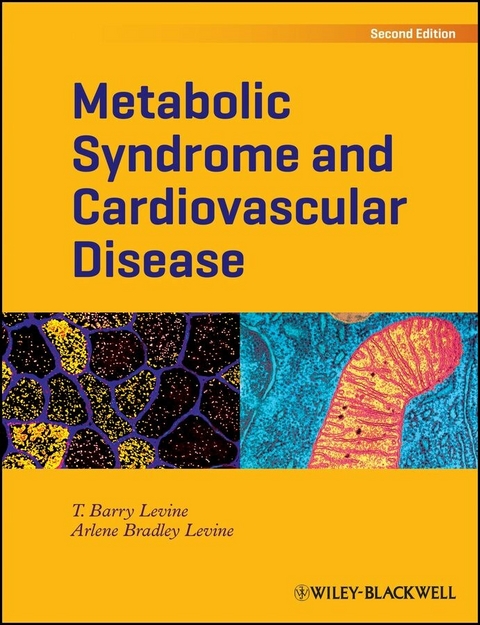
Trends indicate that the metabolic syndrome will become the leading risk factor for heart disease. Now more than ever you need an all-in-one reference that provides the tools and practical advice you need to: Identify at-risk patients Explain individual contributing factors Aid in patient education and motivation Direct comprehensive care and Choose the most appropriate interventions Comprehensively revised to reflect leading-edge research and now organized to facilitate easy access to essential information and clinically-relevant guidance, Metabolic Syndrome and Cardiovascular Disease, 2e offers this and more. Not only will you receive a solid understanding of the pathophysiology underlying the metabolic syndrome and cardiovascular disease but also the rationale for today s most effective treatments. What s new? Filled with timely new content, this updated edition covers: New discoveries that have changed our understanding of the pathogenesis and interrelationship of metabolic syndrome, cardiovascular disease (CHD), and type 2 diabetes mellitus (DM) The relevance of mitochondria and telomeres Sleep and its impact on cardiometabolic health The pivotal interplay between insulin and forkhead transcriptionfactors Calorie restriction research Bariatric surgery experiences and outcomes In addition, each chapter includes essential information on comorbidities, interventions, and pharmacotherapeutic options an exclusive feature found only in the second edition!
T. Barry Levine, MD, FACC, is Chief Medical Officer, A.B.L.E. Medical Consulting. He is Professor of Medicine at Drexel University College of Medicine in Philadelphia, PA. Dr. Levine is a Fellow of the American College of Cardiology, a member of the Scientific Advisory Board of the International Academy of Cardiology, and a board member of the Tracleer International Scientific Advisory Board. In addition, he is a member of the American Federation for Clinical Research, the American Heart Association, the International Society for Heart and Lung Transplantation, the American College of Chest Physicians, and the Heart Failure Society of America. Dr. Levine has been recognized by his peers in "Best Doctors in America" and "Top Docs in Pittsburgh". Dr. Levine has participated in numerous clinical trials, authored many articles (138), and created a variety of media presentations on heart failure, hypertension, dyslipidemia, and metabolic syndrome. He along with Dr. Arlene B. Levine has written "A Patient's Guide to Heart Failure" and has authored a textbook, "Metabolic Syndrome and Cardiovascular Disease".
Arlene Bradley Levine, MD, FACC, is CEO, A.B.L.E. Medical Consulting. She is Assistant Professor of Medicine at Michigan State University and? is board-certified in Internal Medicine and Cardiovascular Disease. Dr. Levine is a Fellow of the American College of Cardiology. She is a member of the American Heart Association, the International Society for Heart and Lung Transplantation, the American College of Chest Physicians, and the Heart Failure Society of America. Dr. Levine has authored 45 articles, and has been recognized by her peers in "Best Doctors in America" and "Top Docs in Pittsburgh".
List of Abbreviations
| AACE | American Association of Clinical Endocrinology |
| ABC | ATP-binding cassette transporter |
| ACC | acetyl CoA carboxylase |
| ACCORD | Action to Control Cardiovascular Risk in Diabetes |
| ACE | angiotensin converting enzyme |
| ACS | acetyl CoA synthetase |
| ACS | acute coronary syndrome |
| ADA | American Diabetes Association |
| ADMA | asymmetric dimethyl L-arginine |
| ADP | adenosine diphosphate |
| AF/TCAPS | Air Force/Texas Coronary Atherosclerosis Prevention Study |
| AFMK | N(1)-acetyl-N(2)-formyl-5-methoxykynuramine |
| AHA | American Heart Association |
| AICAR | 5-aminoimidazole-4-carboxamide-1-beta-D-ribofuranoside |
| AIDS | acquired immune deficiency syndrome |
| AIF | apoptosis-inducing factor |
| AIM-HIGH | Atherothrombosis Intervention in Metabolic Syndrome with Low HDL Cholesterol/High Triglyceride and Impact on Global Health Outcomes |
| AGE | advanced glycosylation end product |
| ALLHAT | Antihypertensive and Lipid-Lowering Treatment to Prevent Heart Attack |
| AMI | acute myocardial infarction |
| AMORIS | Apolipoprotein-related Mortality Risk Study |
| AMP | adenosine monophosphate |
| AMPK | 5′-AMP-activated protein kinase |
| ANT | adenine nucleotide translocase |
| AP-1 | activating protein-1 |
| ARB | angiotensin receptor blocker |
| ARBITER | Arterial Biology for the Investigation of the Treatment Effects of Reducing Cholesterol |
| ARIC | Atherosclerosis Risk in Communities |
| ASAP | Atorvastatin versus Simvastatin on Atherosclerosis Progression |
| ASCOT | Anglo-Scandinavian Cardiac Outcomes Trial |
| ASTEROID | AStudy to Evaluate the Effect of Rosuvastatin on Intravascular Ultrasound-Derived Coronary Atheroma Burden |
| AT1 | angiotensin II type 1 receptor |
| ATF | activating transcription factor |
| ATP | adenosine triphosphate |
| ATP | Adult Treatment Panel |
| BCAPS | Beta-Blocker Cholesterol-Lowering Asymptomatic Plaque Study |
| Bcl | B-cell leukemia/lymphoma |
| bFGF | basic fibroblast growth factor |
| BIP | Bezafibrate Infarction Prevention |
| BKCa | big-conductance Ca2+-activated K+ channel |
| CAC | coronary artery calcification |
| CAMKC | a2+/calmodulin-dependent protein kinase |
| CaMKK | Ca2+/calmodulin-dependent protein kinase kinase |
| cAMP | 3′-5′-cyclic adenosine monophosphate |
| CAPPPC | aptopril Prevention Project |
| CARDSC | ollaborative Atorvastatin Diabetes Study |
| CAREC | holesterol And Recurrent Events |
| CAT | cationic amino acid transporter |
| CCAAT | cytidine–cytidine–adenosine-adenosine–thymidine box motif |
| CcOX | cytochrome c oxidase |
| CDK | cyclin-dependent kinase |
| C/EBPalpha | CCAAT/enhancer-binding protein alpha |
| CETP | cholesterol-ester transfer protein |
| cGK | cGMP-dependent protein kinase |
| cGMP | 3′-5′-cyclic guanosine monophosphate |
| CHARMC | andesartan in Heart failure Assessment of Reduction in Mortality and Morbidity |
| CHD | coronary heart disease |
| CHOP | CCAAT/enhancer-binding protein (C/EBP) homologous protein |
| CNS | central nervous system |
| COMET | Carvedilol Or Metoprolol European Trial |
| COURAGE | Clinical Outcomes Utilizing Revascularization and Aggressive Drug Evaluation |
| CPT | carnitine palmitoyltransferase |
| CREB | cyclic AMP-responsive element-binding protein |
| CROSS | Candesartan Role on Obesity and on Sympathetic System |
| CPT | carnitine palmitoyl-transferase 1 |
| CSF | colony stimulating factor |
| CYP | cytochrome p450 monooxygenase |
| Cyp7a | cholesterol 7-alpha-hydroxylase |
| CYR | cysteine-rich protein |
| Daf-2 | the Caenorhabditis elegans daver formation homologue of insulin/IGF-1 |
| Daf-16 | the Caenorhabditis elegans homologue of mammalian FoxO |
| DBE | Daf-16 family protein-binding element |
| DDAH | dimethylarginine dimethylaminohydrolase |
| DECODE | Diabetes Epidemiology: Collaborative Analysis of Diagnostic Criteria in Europe |
| DISC | death-inducing signaling complex |
| DLMO | dim-light melatonin onset |
| DMH | dorsomedial hypothalamic nucleus |
| DNA | deoxyribonucleic acid |
| DOCA | deoxycorticosterone acetate |
| DPP | Diabetes Prevention Program |
| DREAM | Diabetes Reduction Assessment with Ramipril and Rosiglitazone Medication |
| EASD | European Association for the Study of Diabetes |
| EBP | enhancer binding protein |
| EDHF | endothelium-derived hyperpolarizing factor |
| EEG | electroencephalography |
| EET | epoxyeicosatrienoic acid |
| EGF | epidermal growth factor |
| EGFR | epidermal growth factor receptors |
| EGR | early growth response |
| ELVA | Effects of Long-Term Treatment of Metoprolol CR/XL on Surrogate Variables for Atherosclerotic Disease |
| eNOS | endothelial nitric oxide synthase |
| EPC | endothelial progenitor cell |
| ERK | extracellular signal-regulated kinase |
| E-selectin | endothelial-selectin |
| ETA | endothelin-1 receptor type A |
| ETC | electron transport chain |
| EUROPA | European Trial On Reduction of Cardiac Events with Perindopril in Stable Coronary Artery Disease |
| FABP | fatty acid-binding protein |
| FATS | Familial Atherosclerosis Treatment Study |
 EPUB (Adobe DRM)
Kopierschutz: Adobe-DRM
Adobe-DRM ist ein Kopierschutz, der das eBook vor Mißbrauch schützen soll. Dabei wird das eBook bereits beim Download auf Ihre persönliche Adobe-ID autorisiert. Lesen können Sie das eBook dann nur auf den Geräten, welche ebenfalls auf Ihre Adobe-ID registriert sind.
Details zum Adobe-DRM
Dateiformat: EPUB (Electronic Publication)
EPUB ist ein offener Standard für eBooks und eignet sich besonders zur Darstellung von Belletristik und Sachbüchern. Der Fließtext wird dynamisch an die Display- und Schriftgröße angepasst. Auch für mobile Lesegeräte ist EPUB daher gut geeignet.
Systemvoraussetzungen:
PC/Mac: Mit einem PC oder Mac können Sie dieses eBook lesen. Sie benötigen eine Adobe-ID und die Software Adobe Digital Editions (kostenlos). Von der Benutzung der OverDrive Media Console raten wir Ihnen ab. Erfahrungsgemäß treten hier gehäuft Probleme mit dem Adobe DRM auf.
eReader: Dieses eBook kann mit (fast) allen eBook-Readern gelesen werden. Mit dem amazon-Kindle ist es aber nicht kompatibel.
Smartphone/Tablet: Egal ob Apple oder Android, dieses eBook können Sie lesen. Sie benötigen eine Adobe-ID sowie eine kostenlose App.
Geräteliste und zusätzliche Hinweise
Buying eBooks from abroad
For tax law reasons we can sell eBooks just within Germany and Switzerland. Regrettably we cannot fulfill eBook-orders from other countries.