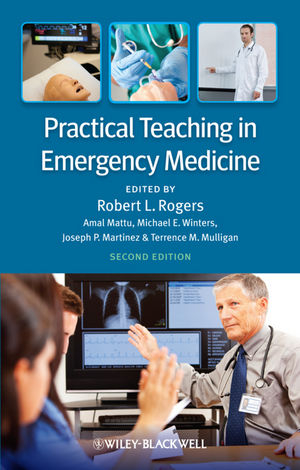
Practical Teaching in Emergency Medicine (eBook)
John Wiley & Sons (Verlag)
978-1-118-46971-2 (ISBN)
Following the introductory section, which provides important background information, the book's contents are organized into 4 sections that correspond to the core needs and interests of EM educators: Section 2 focuses on practical and ethical considerations of teaching in the ED; Section 3 provides strategies for teaching specific groups of learners; Section 4 looks at the skills that are characteristic of the best EM educators; and Section 5 looks indepthly at specific teaching techniques and strategies.
Now more than ever this book addresses the needs of physician educators from all over the world. New chapters discuss lecturing to an international audience; using simulation as a teaching tool; how to make journal club work for you, and other topics that are of broad interest to medical educators in this field. In general, each chapter has been updated and reviewed to make sure the content was something that emergency physician educators could use in any country .
The chapter contributors are widely regarded as leaders in the field of emergency medicine education and faculty development. Authors were given free rein to develop their chapters and write in their own style. They were asked to present their personal views on how to successfully teach the art of emergency medicine, rather than review evidence-based guidelines regarding medical education. As a result, most of the chapters have few references. This first-person approach to a multi-authored textbook yields a compilation that varies in style from chapter to chapter and exposes the reader to a variety of communication techniques.
Emergency medicine attendings who wish to hone their teaching skills can find a number of books on educational strategies written by physicians from other disciplines. However, until the publication of the first edition of this book, they did not have access to a text written by emergency medicine physicians on methods of teaching that are directly applicable to teaching EM. This book was compiled to meet that need. Following the introductory section, which provides important background information, the book s contents are organized into 4 sections that correspond to the core needs and interests of EM educators: Section 2 focuses on practical and ethical considerations of teaching in the ED; Section 3 provides strategies for teaching specific groups of learners; Section 4 looks at the skills that are characteristic of the best EM educators; and Section 5 looks indepthly at specific teaching techniques and strategies. Now more than ever this book addresses the needs of physician educators from all over the world. New chapters discuss lecturing to an international audience; using simulation as a teaching tool; how to make journal club work for you, and other topics that are of broad interest to medical educators in this field. In general, each chapter has been updated and reviewed to make sure the content was something that emergency physician educators could use in any country. The chapter contributors are widely regarded as leaders in the field of emergency medicine education and faculty development. Authors were given free rein to develop their chapters and write in their own style. They were asked to present their personal views on how to successfully teach the art of emergency medicine, rather than review evidence-based guidelines regarding medical education. As a result, most of the chapters have few references. This first-person approach to a multi-authored textbook yields a compilation that varies in style from chapter to chapter and exposes the reader to a variety of communication techniques.
Chief Editor Chief Editor Robert L. Rogers, FACEP, FAAEM, FACP; Associate Professor of Emergency Medicine and Medicine; Director, Undergraduate Medical Education; Director, Teaching Fellowship; Department of Emergency Medicine, The University of Maryland School of Medicine, Baltimore, MD, USA. Associate Editors Amal Mattu, MD, FAAEM, FACEP, Professor and Vice Chair; Director, Faculty Development Fellowship; Department of Emergency Medicine, University of Maryland School of Medicine, Baltimore, MD, USA. Michael E. Winters, MD, FACEP, FAAEM, Associate Professor of Emergency Medicine and Medicine; Director, Combined EM/IM Program; Co-Director, Combined EM/IM/Critical Care Program; Department of Emergency Medicine, University of Maryland School of Medicine, Baltimore, MD, USA. Joseph P. Martinez, MD, Assistant Professor of Emergency Medicine; Assistant Dean for Student Affairs, University of Maryland School of Medicine, Baltimore, MD, USA. Terrence M. Mulligan DO, MPH, FACOEP, FNVSHA, FACEP, FAAEM, FIFEM, Assistant Professor in Emergency Medicine; University of Maryland School of Medicine, Department of Emergency Medicine, Baltimore, MD, USA; Extraordinary Senior Lecturer / Visiting Assistant Professor, Stellenbosch University, Division of Emergency Medicine, Cape Town, South Africa.
Editors and Contributors xi
Preface xxi
Section 1 Background/Introduction
Chapter 1 Adult learners in the emergency department 3
Ellen J. O'Connell and Kurt C. Kleinschmidt
Chapter 2 Obstacles to teaching in the emergency department 15
David K. Duong, Esther K. Choo, and Jeffrey A. Tabas
Chapter 3 Teaching and patient care in emergency medicine 25
Michael A. Bohrn and David A. Kramer
Chapter 4 Mentoring in emergency medicine 35
Gus M. Garmel
Section 2 Teaching in the Emergency Department and Beyond
Chapter 5 Bedside teaching in the emergency department 59
Kevin G. Rodgers
Chapter 6 Teaching invasive medical procedures 72
Siamak Moayedi and Mercedes Torres
Chapter 7 Providing feedback in the emergency department 85
David A. Wald
Chapter 8 The computer as a teaching tool 98
Joshua S. Broder
Chapter 9 Educational technology: Web 2.0 118
Michael C. Bond and Robert Cooney
Chapter 10 Teaching the intangibles: professionalism and interpersonal skills/communication 137
David K. Zich and James G. Adams
Chapter 11 Teaching lifelong learning skills: journal club and beyond 151
Christopher R. Carpenter
Chapter 12 Medical podcasting 101 163
Robert Orman and Scott D. Weingart
Chapter 13 Use of simulation in emergency department education 177
Traci L. Thoureen and Sara B. Scott
Section 3 Teaching Specific Groups
Chapter 14 Teaching medical students 189
David E. Manthey
Chapter 15 Teaching residents from other services in the emergency department 203
Michelle Lin and Amer Z. Aldeen
Chapter 16 The education of resident physicians in emergency medicine 216
Jonathan G. Wagner, William K. Mallon, and Stuart P. Swadron
Chapter 17 Teaching residents how to teach 237
Carey D. Chisholm
Chapter 18 Teaching to an international audience 248
Terrence M. Mulligan
Chapter 19 The emergency department consultation: teaching physician-physician communication to improve patient outcomes 268
Chad S. Kessler, Yalda Afshar, and Albert C. Vien
Section 4 Improving as an Educator in Emergency Medicine
Chapter 20 Characteristics of great teachers 285
Jennifer Avegno and Peter M. C. DeBlieux
Chapter 21 Effective presentation skills 295
Joseph R. Lex Jr. and Zachary Repanshek
Chapter 22 Small-group discussion skills 307
Matthew D. Deibel and Mary Jo. Wagner
Chapter 23 Faculty development as a guide to becoming a better teacher 319
Gloria J. Kuhn
Section 5 Teaching Techniques and Strategies
Chapter 24 Strategies for effective clinical emergency department teaching 339
Glen W. Bandiera and Shirley Lee
Chapter 25 Pearls and pitfalls in teaching: what works what does not? 352
Brian Clyne and David G. Lindquist
Index 361
"This book is structured and organized to be an
easy-to-follow guide on becoming a better educator in emergency
medicine. . . The mechanics of treatment are thoroughly explained
in this book by leaders in emergency medicine education, providing
best practices and effectively focusing on the emergency medicine
venue." (The Annals of Pharmacotherapy, 1 July
2013)
"This is an easy-to-read book ideal for junior faculty in
emergency medicine. The summaries at the end of each chapter are
well written and high yield. The book describes practical ways of
teaching that can be easily applied and includes references for
resources to fill out the details not supplied in the book. The
advantage of the second edition is the focus on complementing
education with online resources and technology that appeal to this
generation's learners." (Doody's, 17 May
2013)
Editors and Contributors
Chief Editor
| Erscheint lt. Verlag | 18.10.2012 |
|---|---|
| Sprache | englisch |
| Themenwelt | Medizin / Pharmazie ► Allgemeines / Lexika |
| Medizin / Pharmazie ► Gesundheitsfachberufe | |
| Medizin / Pharmazie ► Medizinische Fachgebiete ► Notfallmedizin | |
| Schlagworte | Adult • Beyond • chapter bedside • Department • Emergency • Emergency Medicine & Trauma • garmel • Introduction • invasive • kleinschmidt chapter obstacles • Kramer • learners • Medical • Medical Science • Medicine • Medizin • Notfallmedizin u. Traumatologie • Patient • Procedures • section |
| ISBN-10 | 1-118-46971-2 / 1118469712 |
| ISBN-13 | 978-1-118-46971-2 / 9781118469712 |
| Informationen gemäß Produktsicherheitsverordnung (GPSR) | |
| Haben Sie eine Frage zum Produkt? |
 EPUB (Adobe DRM)
Kopierschutz: Adobe-DRM
Adobe-DRM ist ein Kopierschutz, der das eBook vor Mißbrauch schützen soll. Dabei wird das eBook bereits beim Download auf Ihre persönliche Adobe-ID autorisiert. Lesen können Sie das eBook dann nur auf den Geräten, welche ebenfalls auf Ihre Adobe-ID registriert sind.
Details zum Adobe-DRM
Dateiformat: EPUB (Electronic Publication)
EPUB ist ein offener Standard für eBooks und eignet sich besonders zur Darstellung von Belletristik und Sachbüchern. Der Fließtext wird dynamisch an die Display- und Schriftgröße angepasst. Auch für mobile Lesegeräte ist EPUB daher gut geeignet.
Systemvoraussetzungen:
PC/Mac: Mit einem PC oder Mac können Sie dieses eBook lesen. Sie benötigen eine
eReader: Dieses eBook kann mit (fast) allen eBook-Readern gelesen werden. Mit dem amazon-Kindle ist es aber nicht kompatibel.
Smartphone/Tablet: Egal ob Apple oder Android, dieses eBook können Sie lesen. Sie benötigen eine
Geräteliste und zusätzliche Hinweise
Buying eBooks from abroad
For tax law reasons we can sell eBooks just within Germany and Switzerland. Regrettably we cannot fulfill eBook-orders from other countries.
aus dem Bereich