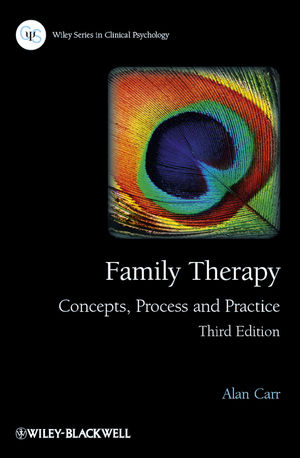
Family Therapy (eBook)
John Wiley & Sons (Verlag)
978-1-118-38427-5 (ISBN)
- Presents a unique, integrative approach to the theory and practice of family therapy
- Distinctive style addresses family behaviour patterns, family belief systems and narratives, and broader contextual factors in problem formation and resolution
- Shows how the model can be applied to address issues of childhood and adolescence (e.g. conduct problems, drug abuse) and of adulthood (e.g. marital distress, anxiety, depression)
- Student-friendly features: chapters begin with a chapter plan and conclude with a summary of key points; theoretical chapters include a glossary of new terms; case studies and further reading suggestions are included throughout
Professor Alan Carr is the director of the Doctoral training programme in clinical psychology at University College Dublin and Consultant Couple and Family Therapist at the Clanwilliam Institute in Dublin. He has published over 20 books and 200 academic papers and conference presentations in the fields of family therapy and clinical psychology. He has extensive experience in family therapy and clinical psychology, having worked in the field in the UK, Ireland, and Canada.
Professor Alan Carr is the director of the Doctoral training programme in clinical psychology at University College Dublin and Consultant Couple and Family Therapist at the Clanwilliam Institute in Dublin. He has published over 20 books and 200 academic papers and conference presentations in the fields of family therapy and clinical psychology. He has extensive experience in family therapy and clinical psychology, having worked in the field in the UK, Ireland, and Canada.
"It should continue to be considered as a valuable
'essential' text for those undertaking training in
systemic/family psychotherapy and as a key reference for
experienced therapists and educators in the field."
(Child & Family Social Work, 10 October 2014)
Chapter 1
GOALS OF FAMILY THERAPY ACROSS THE LIFECYCLE
Family therapy is a broad term for a range of methods for working with families with various biopsychosocial difficulties. Within the broad cathedral of family therapy there is a wide variety of views on what types of problems are appropriately addressed by family therapy; who defines these problems; what constitutes family therapy practices; what type of theoretical rationale underpins these practices; and what type of research supports the validity of these practices.
Some family therapists argue that all human problems are essentially relational and so family therapy is appropriate in all instances. Others argue that marital and family therapy are appropriate for specific relationship problems or as an adjunct to pharmacological treatment of particular conditions such as schizophrenia.
Some family therapists argue that problems addressed in therapy are defined by clients. That is, parents, children or marital partners seeking help. Others argue that problems are best defined by professionals in terms of psychiatric diagnoses or statutory status, such as being a family in which child abuse has occurred and which is on an at-risk register, or being a person with an alcohol problem on probation.
With respect to practices, some family therapists invite all family members to all therapy sessions. Others conduct family therapy with individuals, by empowering them to manage their relationships with family members in more satisfactory ways. Still others have broadened family therapy so that it includes members of the wider professional and social network around the family; they may refer to this approach as systemic practice.
There are many theories of family therapy. Some focus on the role of the family in predisposing people to developing problems or in precipitating their difficulties. Others focus on the role of the family in problem maintenance. But all family therapists highlight the role of the family in problem resolution. There is also considerable variability in the degree to which theories privilege the role of family patterns of interaction, family belief systems and narratives, and historical contextual and constitutional factors in the aetiology and maintenance of problems.
With respect to research, some family therapists argue that case studies or descriptive qualitative research provide adequate support for the efficacy of family therapy. On the other hand, some family therapists highlight the importance of quantitative results from controlled research trials in supporting the degree to which family therapy is effective in treating specific problems.
Within this volume an integrative and developmental approach will be taken to family therapy, and where better to start than with a consideration of family problems across the lifecycle?
Family problems occur across all stages of the lifecycle. Here are some examples:
- A 6-year-old whose parents cannot control him and who pushes his sister down the stairs.
- A 13-year-old girl who worries her parents because she will not eat and has lost a lot of weight.
- A 19-year-old boy who believes he is being poisoned and refuses to take prescribed antipsychotic medication.
- A couple in their mid-thirties who consistently argue and fight with each other.
- A blended family in which the parents have both previously been married and have difficulties managing their children’s unpredictable and confusing behaviour.
- A family in which a parent has died prematurely and in which the 13-year-old has run away from home.
- A family in which a child is terminally ill and will not follow medical advice.
- A family with traditional values in which a teenager ‘comes out’ and declares that he is gay.
- A family in which both parents are unemployed and have difficulty managing their children without getting into violent rows.
- A black family living in a predominantly white community, where the 16-year-old boy is involved in drug abuse in a delinquent peer group.
These are all complex cases which involve or affect all family members to a greater or lesser degree. A number of these cases also involve or affect members of the community in which the family lives. In some of the cases listed, other agencies including schools, hospitals, social services, law enforcement, juvenile justice or probation may be involved. Family therapy is a broad psychotherapeutic movement which offers conceptual frameworks for making sense of complex cases such as those listed here and entails approaches to clinical practice for helping families resolve complex problems.
The lifecycle is a particularly useful framework within which to conceptualise problems that may be referred for family therapy. In this chapter, normative models of the family and individual lifecycles will be described. Gender development, lifecycle issues unique to lesbian and gay people and issues of culture and class will also be discussed. The aim of the chapter is to sketch out some of the problem areas which may be addressed by family therapy across the lifecycle.
THE FAMILY LIFECYCLE
Families are unique social systems insofar as membership is based on combinations of biological, legal, affectional, geographic and historical ties. In contrast to other social systems, entry into family systems is through birth, adoption, fostering or marriage and members can leave only by death. Severing all family connections is never possible. Furthermore, while family members fulfil certain roles which entail specific definable tasks such as the provision of food and shelter, it is the relationships within families which are primary and irreplaceable.
With single-parenthood, divorce, separation and remarriage as common events, a narrow and traditional definition of the family is no longer useful (Walsh, 2012). It is more expedient to think of a person’s family as a network of people in their immediate psychosocial field. This may include household members and others who, while not members of the household, play a significant role in the person’s life. For example: a separated parent and spouse living elsewhere with whom a child has regular contact; foster parents who provide relief care periodically; a grandmother who provides informal day-care; and so forth. In clinical practice the primary concern is the extent to which this network meets the individual’s needs.
Leaving Home
Having noted the limitations of a traditional model of family structure, paradoxically the most useful available models of the family lifecycle are based upon the norm of the traditional nuclear family, with other family forms being conceptualised as deviations from this norm (McGoldrick et al., 2011). One such model is presented in Table 1.1. This model delineates the main developmental tasks to be completed by the family at each stage of family development. In the first stage, the principal concerns are with differentiating from the family of origin by completing school, developing relationships outside the family, completing one’s education and beginning a career. Problems in developing emotional autonomy from the family of origin may occur at this stage and may find expression in many ways, including depression, drug abuse and eating disorders such as anorexia and bulimia. Problems in developing economic independence may also occur where young adults have not completed their education or where limited career options are available. In these circumstances some young adults become involved in crime.
Table 1.1 Stages of the family lifecycle
Adapted from McGoldrick, M., Carter, B. & Garcia-Preto, N. (2011). The expanded family lifecycle. Individual, family and social perspectives (Fourth Edition). Boston: Allyn & Bacon. (p. 16–17).
| Stage | Emotional transition processes | Tasks essential for developmental progression |
| Leaving Home | Accepting emotional and financial responsibility for the self | Differentiating self from family of origin and developing adult-to-adult relationship with parents Developing intimate peer relationships Beginning a career and moving towards financial independence Establishing self in a community and society |
| Forming a Couple | Committing to a new system | Selecting a partner and deciding to form a long-term relationship Developing a way to live together based on reality rather than mutual projection Realigning couple’s relationships with families of origin and peers to include partners |
| Families with Young Children | Accepting new members into the system | Adjusting couple system to make space for children Arranging child-rearing, financial and housekeeping responsibilities within the couple Realigning relationships with families of origin to include parenting and grandparenting roles Realigning family relationships with community and society to accommodate new family structure |
| Families with Adolescents | Increasing the flexibility of family boundaries to accommodate adolescents’ growing independence and grandparents’ increasing constraints | Adjusting parent–child relationships to allow adolescents more autonomy Adjusting family relationships as couple takes on responsibility of caring for ageing parents Realigning family relationships with community and society to accommodate... |
| Erscheint lt. Verlag | 31.7.2012 |
|---|---|
| Reihe/Serie | Wiley Series in Clinical Psychology |
| Wiley Series in Clinical Psychology | Wiley Series in Clinical Psychology |
| Sprache | englisch |
| Themenwelt | Geisteswissenschaften ► Psychologie ► Familien- / Systemische Therapie |
| Medizin / Pharmazie ► Medizinische Fachgebiete ► Psychiatrie / Psychotherapie | |
| Schlagworte | Couples & Family Clinical Psychology • Familientherapie • Family Therapy • Klinische Psychologie / Familien u. Paare • Parents, children, family therapy practice, conflict resolution, adolescence, marriage, clinical psychology • Psychologie • Psychology • Relationships, Marriage & Family • Zwischenmenschliche Beziehungen, Ehe u. Familie |
| ISBN-10 | 1-118-38427-X / 111838427X |
| ISBN-13 | 978-1-118-38427-5 / 9781118384275 |
| Informationen gemäß Produktsicherheitsverordnung (GPSR) | |
| Haben Sie eine Frage zum Produkt? |
 EPUB (Adobe DRM)
Kopierschutz: Adobe-DRM
Adobe-DRM ist ein Kopierschutz, der das eBook vor Mißbrauch schützen soll. Dabei wird das eBook bereits beim Download auf Ihre persönliche Adobe-ID autorisiert. Lesen können Sie das eBook dann nur auf den Geräten, welche ebenfalls auf Ihre Adobe-ID registriert sind.
Details zum Adobe-DRM
Dateiformat: EPUB (Electronic Publication)
EPUB ist ein offener Standard für eBooks und eignet sich besonders zur Darstellung von Belletristik und Sachbüchern. Der Fließtext wird dynamisch an die Display- und Schriftgröße angepasst. Auch für mobile Lesegeräte ist EPUB daher gut geeignet.
Systemvoraussetzungen:
PC/Mac: Mit einem PC oder Mac können Sie dieses eBook lesen. Sie benötigen eine
eReader: Dieses eBook kann mit (fast) allen eBook-Readern gelesen werden. Mit dem amazon-Kindle ist es aber nicht kompatibel.
Smartphone/Tablet: Egal ob Apple oder Android, dieses eBook können Sie lesen. Sie benötigen eine
Geräteliste und zusätzliche Hinweise
Buying eBooks from abroad
For tax law reasons we can sell eBooks just within Germany and Switzerland. Regrettably we cannot fulfill eBook-orders from other countries.
aus dem Bereich