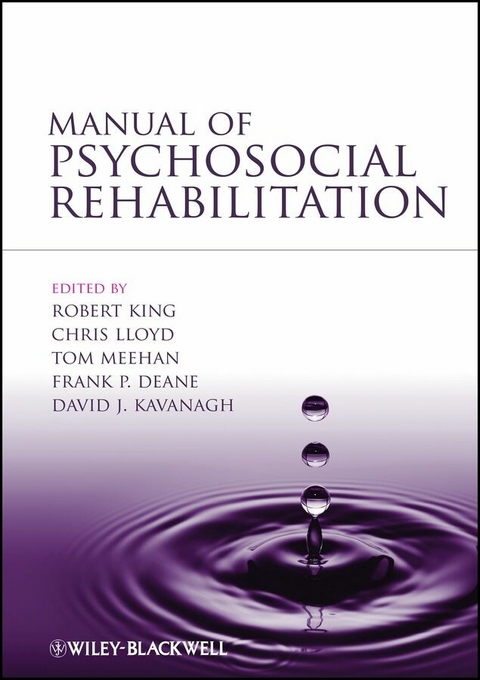
Manual of Psychosocial Rehabilitation (eBook)
John Wiley & Sons (Verlag)
978-1-118-35227-4 (ISBN)
This manual recognises the wide-ranging impact of mental illness and its ramifications on daily life, and promotes a recovery model of psychosocial rehabilitation and aims to empower clinicians to engage their clients in tailored rehabilitation plans. The book is divided into five key sections.
Section 1 looks at assessment covering tools available in the public domain, instruments, scoring systems, norms and applications for diagnosis and measurement of symptoms, cognitive functioning, impairment and recovery.
Section 2 covers the full range of therapeutic interventions and offers advice on training and supervision requirements and evaluation of process, impact and outcome.
Section 3 provides manuals and programs for interventions effectively provided as group activities.
Section 4 explains how to design a full programme that integrates therapeutic interventions with group programmes as well as services provided by other agencies.
The final section looks at peer support and self help, providing manuals and resources that support programmes and interventions not requiring professional or practitioner direction.
Robert King, Professor of Psychology and Counselling, Queensland University of Technology, Australia.
Chris Lloyd, Principal Research Fellow for the Gold Coast Health Service District, Senior Research Fellow for the Behavioural Basis of Health, Griffith University, Australia.
Tom Meehan, Associate Professor, Department of Psychiatry, University of Queensland, Director of Service Evaluation and Research at the Park, Centre for Mental Health.
Frank Deane, Professor of Psychology, Director of the Clinical Psychology programs, Director of the Illawarra Institute for Mental Health, University of Wollongong, Australia
David Kavanagh, Research Professor at the Institute of Health & Biomedical Innovation and School of Psychology and Counselling, Queensland University of Technology, Australia
Psychosocial Rehabilitation is a comprehensive ready- reference for mental health practitioners and students, providing practical advice on the full range of interventions for psychosocial rehabilitation. It contextualises the interventions described and provides pointers to enable the reader to explore the theory and research. This manual recognises the wide-ranging impact of mental illness and its ramifications on daily life, and promotes a recovery model of psychosocial rehabilitation and aims to empower clinicians to engage their clients in tailored rehabilitation plans. The book is divided into five key sections. Section 1 looks at assessment covering tools available in the public domain, instruments, scoring systems, norms and applications for diagnosis and measurement of symptoms, cognitive functioning, impairment and recovery. Section 2 covers the full range of therapeutic interventions and offers advice on training and supervision requirements and evaluation of process, impact and outcome. Section 3 provides manuals and programs for interventions effectively provided as group activities. Section 4 explains how to design a full programme that integrates therapeutic interventions with group programmes as well as services provided by other agencies. The final section looks at peer support and self help, providing manuals and resources that support programmes and interventions not requiring professional or practitioner direction.
Robert King, Professor of Psychology and Counselling, Queensland University of Technology, Australia. Chris Lloyd, Principal Research Fellow for the Gold Coast Health Service District, Senior Research Fellow for the Behavioural Basis of Health, Griffith University, Australia. Tom Meehan, Associate Professor, Department of Psychiatry, University of Queensland, Director of Service Evaluation and Research at the Park, Centre for Mental Health. Frank Deane, Professor of Psychology, Director of the Clinical Psychology programs, Director of the Illawarra Institute for Mental Health, University of Wollongong, Australia David Kavanagh, Research Professor at the Institute of Health & Biomedical Innovation and School of Psychology and Counselling, Queensland University of Technology, Australia
Manual of Psychosocial Rehabilitation 5
Contents 7
Foreword by Gary R. Bond 9
1 Introduction 11
Terminology 12
Organisation of the book 12
The authors 14
Reference 15
Part I Assessment Tools 17
2 Assessment of Symptoms and Cognition 19
Symptom rating scales 20
Measures described in this chapter 20
Self-report versus practitioner-rated measures 20
Assessment of depression 22
Non-specific measures of psychiatric symptoms 25
Cognitive functioning measures 27
Substance misuse measures 28
References 35
3 Assessment of Functioning and Disability 36
Introduction 36
Assessment of impairment 38
Assessment of daily functioning 39
Assessment of insight 43
Assessment of side-effects 45
Feedback to clients, families and carers and others in the treating team 47
References 48
4 Assessment of Recovery, Empowerment and Strengths 51
Recovery 52
Empowerment 54
Strengths 57
References 61
5 Assessing Quality of Life and Perceptions of Care 63
Quality of life 65
Satisfaction 69
References 73
Part II Therapeutic Skills and Interventions 75
6 Deciding on Life Changes: The Role of Motivational Interviewing 77
What is motivational interviewing? 78
Does motivational interviewing require the practitioner to endorse unhealthy lifestyles? 80
Making the external internal 81
Rolling with resistance 82
Introducing the bigger picture: values and priorities 84
Building self-efficacy 85
From decision to action? 86
Modifying motivational interviewing for schizophrenia 88
References 89
7 Individual Recovery Planning: Aligning Values, Strengths and Goals 91
Socialising the person to goal-setting processes 92
Building strength 97
Clarifying values and valued life directions 98
Align goals with valued life directions 100
Specify target goals 101
Identify levels of success 101
Review the goal plan 101
Collaborative action planning and monitoring 102
Action planning steps 103
References 104
8 Activation and Related Interventions 105
Introducing behavioural activation 106
Reviewing current activities and showing links with mood 107
Review of activities 111
Making a plan 112
Review how the plan went 114
Life areas, values and activities 114
Integrate the activity record with life areas, values and activities 116
Subsequent sessions 117
Ending a behavioural activation programme 118
Supplementing behavioural activation with cognitive interventions 118
References 119
9 Cognitive Remediation 120
Step 1: start with some psychoeducation 120
Step 2: get an accurate baseline assessment 121
Step 3: some further psychoeducation 124
Step 4: check motivational level 124
Step 5: designing and beginning a brain workout programme 126
Step 6: sustaining a brain workout programme 128
Step 7: integrating cognitive remediation with a broader rehabilitation programme 129
Resources 130
References 130
10 Treatment Adherence 133
Introduction and key concepts 133
Step 1: develop a hypothesis as to why Angela is experiencing difficulties with her medication at this time 135
Step 2: help Angela recognise patterns in the past and link these to Angela’s goals 136
Step 3: link Angela’s stressors and vulnerability 138
Step 4: normalise Angela’s experiences and link changes to personally relevant goals 139
Step 5: develop and implement an intervention that will work for Angela 141
References 143
Part III Reconnecting to the Community 145
11 Social Skills and Employment 147
Useful topics to explore with Sam 148
Useful tools and resources for social skills training 149
Individual sessions 151
A social skills group programme: talking shop 152
Employment 158
The role of the service 159
Individual sessions 159
References 161
12 Healthy Lifestyles 162
Step 1: Start with an assessment of Sam (Table 12.1 ) 162
Step 2: Deciding on a program for Sam 165
Home visits 176
References 177
13 Living Skills 179
Money managing/budgeting group 180
Transportation 184
Cooking 185
Resources 191
Part IV Peer Support and Self-Help 193
14 Peer Support in a Mental Health Service Context 195
Introduction 195
Definitions of peer support 195
Forms of peer support initiatives 196
Necessary tensions in peer support contexts 198
Summary of evidence from peer support programmes 198
Example of a peer support service 199
Recommendations regarding implementation of peer support initiatives 200
References 202
15 Supporting Families and Carers 204
Introduction 204
Burden of care 204
Psychoeducation 207
Relational empowerment 209
Problem solving 212
Strengths 213
Peer support 214
References 216
16 Self-Help: Bibliotherapy and Internet Resources 218
Step 1: Clarify the need for and context of self-help 218
Step 2: Identifying appropriate self-help resources 220
Step 3: Supporting the person to use the resources 223
Step 4: Evaluating the effects of bibliotherapy 223
Internet self-help 223
References 225
Part V Bringing It All Together 229
17 Reviewing and Clarifying an Individual Rehabilitation Programme 231
18 Programme Evaluation and Benchmarking 239
Approaches used in evaluating rehabilitation programmes 240
Evaluation methods 243
Benchmarking rehabilitation services 246
Resource 248
References 248
Index 250
"In summary an interesting, thought-provoking read, well worth
having in the departmental library." (Occupational
Medicine, 30 May 2013)
| Erscheint lt. Verlag | 25.7.2012 |
|---|---|
| Sprache | englisch |
| Themenwelt | Medizin / Pharmazie ► Gesundheitsfachberufe |
| Medizin / Pharmazie ► Gesundheitswesen | |
| Medizin / Pharmazie ► Medizinische Fachgebiete ► Psychiatrie / Psychotherapie | |
| Medizin / Pharmazie ► Physiotherapie / Ergotherapie ► Rehabilitation | |
| Schlagworte | aligning • Assessing • Assessment • bond vii • brennan part • Care • Chris • crowe • DEANE • Gesundheits- u. Sozialwesen • Health & Social Care • Interventions • introduction robert • Kavanagh • kavanagh individual • King • Life • Mental Health • Part • Psychische Gesundheit • quality • Recovery • remediation • Robert • Therapeutic • Tools • William |
| ISBN-10 | 1-118-35227-0 / 1118352270 |
| ISBN-13 | 978-1-118-35227-4 / 9781118352274 |
| Informationen gemäß Produktsicherheitsverordnung (GPSR) | |
| Haben Sie eine Frage zum Produkt? |
 PDF (Adobe DRM)
Kopierschutz: Adobe-DRM
Adobe-DRM ist ein Kopierschutz, der das eBook vor Mißbrauch schützen soll. Dabei wird das eBook bereits beim Download auf Ihre persönliche Adobe-ID autorisiert. Lesen können Sie das eBook dann nur auf den Geräten, welche ebenfalls auf Ihre Adobe-ID registriert sind.
Details zum Adobe-DRM
Dateiformat: PDF (Portable Document Format)
Mit einem festen Seitenlayout eignet sich die PDF besonders für Fachbücher mit Spalten, Tabellen und Abbildungen. Eine PDF kann auf fast allen Geräten angezeigt werden, ist aber für kleine Displays (Smartphone, eReader) nur eingeschränkt geeignet.
Systemvoraussetzungen:
PC/Mac: Mit einem PC oder Mac können Sie dieses eBook lesen. Sie benötigen eine
eReader: Dieses eBook kann mit (fast) allen eBook-Readern gelesen werden. Mit dem amazon-Kindle ist es aber nicht kompatibel.
Smartphone/Tablet: Egal ob Apple oder Android, dieses eBook können Sie lesen. Sie benötigen eine
Geräteliste und zusätzliche Hinweise
Buying eBooks from abroad
For tax law reasons we can sell eBooks just within Germany and Switzerland. Regrettably we cannot fulfill eBook-orders from other countries.
aus dem Bereich