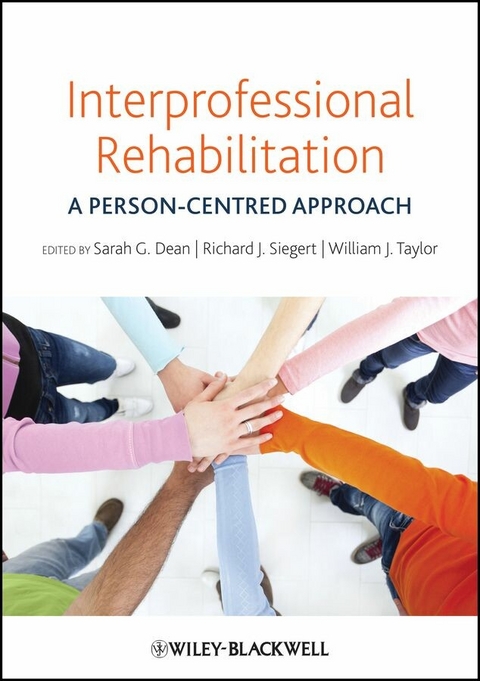
Interprofessional Rehabilitation (eBook)
John Wiley & Sons (Verlag)
978-1-118-35140-6 (ISBN)
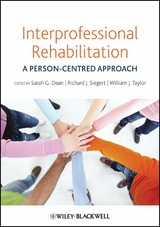
Interprofessional Rehabilitation: a Person-Centred Approach is a concise and readable introduction to the principles and practice of a person-centred interprofessional approach to rehabilitation, based upon a firm scientific evidence base.
Written by a multi-contributor team of specialists in physiotherapy, occupational therapy, nursing, psychology and rehabilitation medicine, this text draws together common themes that cut across the different professional groups and the spectrum of health conditions requiring rehabilitation, and sets out a model of practice that is tailored to the specific needs of the client. Showing interprofessionalism at work in a range of clinical contexts, the book argues that effective rehabilitation is best conducted by well-integrated teams of specialists working in an interdisciplinary way, with the client or patient actively involved in all stages of the process.
This book will be essential reading for students preparing for practice in an increasingly interprofessional environment, and will be of interest to any health care practitioner keen to understand how an integrated approach to rehabilitation can benefit their clients.
About the Editors
Sarah G Dean is a senior lecturer in health services research, based at the University of Exeter, UK, with a background in physiotherapy and health psychology. She has a particular interest in the psychology of exercise-based rehabilitation for people with long term conditions.
Richard J Siegert has a background in clinical psychology and neuropsychology and a special interest in the application of psychometrics to measurement in rehabilitation settings. A Reader in Rehabilitation at King's College London, he is soon to take up a Chair in Psychology and Rehabilitation at AUT University in Auckland, New Zealand.
William J Taylor is an academic rehabilitation physician and rheumatologist in Wellington, New Zealand, where he teaches a postgraduate interdisciplinary course in rehabilitation and continues to work at the coal-face of clinical practice.
About the Editors Sarah G Dean is a senior lecturer in health services research, based at the University of Exeter, UK, with a background in physiotherapy and health psychology. She has a particular interest in the psychology of exercise-based rehabilitation for people with long term conditions. Richard J Siegert has a background in clinical psychology and neuropsychology and a special interest in the application of psychometrics to measurement in rehabilitation settings. A Reader in Rehabilitation at King's College London, he is soon to take up a Chair in Psychology and Rehabilitation at AUT University in Auckland, New Zealand. William J Taylor is an academic rehabilitation physician and rheumatologist in Wellington, New Zealand, where he teaches a postgraduate interdisciplinary course in rehabilitation and continues to work at the coal-face of clinical practice.
Interprofessional Rehabilitation: A Person-Centred Approach 5
Contents 7
About the editors 11
About the contributors 13
Foreword by Professor Gerold Stucki 17
Preface 19
Acknowledgements 21
1 Introduction 23
1.1 What is rehabilitation? 23
1.2 Setting boundaries – or what we don’t mean by rehabilitation 24
1.3 Some definitions of rehabilitation 25
1.4 Some other issues in defining rehabilitation 26
Therapy versus rehabilitation 26
Disabling societies 27
1.5 The core themes 28
1.6 A word about terminology 29
1.7 Summary 29
2 A rehabilitation framework: the International Classification of Functioning, Disability and Health 31
2.1 There is a need for a common language of functioning 31
2.2 The ICF is both a model and a classification system 34
Introduction 34
The ICF as a model 34
Components of the ICF model 35
The ICF as a classification 36
2.3 The origins of the ICF 39
2.4 Using the ICF in practice – ICF core sets, rehabilitation cycle and ICF tools 41
Introduction 41
ICF core sets 42
The rehabilitation cycle and ICF tools 45
The ICF assessment sheet 45
The ICF categorical profile 45
The ICF intervention table 47
The ICF evaluation display 47
2.5 Can the ICF be used to measure functioning – both the ‘what’ and the ‘how’? Controversies – to measure or to classify that is the question 52
2.6 Controversies – classification of ‘participation restrictions’ versus ‘activity limitations’ 53
2.7 Controversies – is the ICF a framework for understanding ‘QoL’? 56
2.8 Future developments of the ICF 58
3 An interprofessional approach to rehabilitation 67
3.1 Introduction and setting the scene 67
3.2 Terminology and interprofessional working within rehabilitation 68
3.3 Characteristics of good teamwork 73
Teams that work well and teams that work less well 73
The tensions of working in teams 79
Thinking outside the professional box 81
3.4 Team membership and roles 83
Team leadership 85
Specific team roles 86
3.5 Processes of teamwork 87
Interprofessional team assessment 87
Team meetings 88
Team evaluation 90
3.6 The role of interprofessional education in rehabilitation 91
3.7 Collaborative rehabilitation research 94
3.8 The future for interprofessional rehabilitation teams 95
3.9 Conclusion 96
4 Processes in rehabilitation 101
4.1 Introduction 101
4.2 Assessment 102
4.3 Goal planning 106
What is a rehabilitation goal? 107
What is ‘goal setting’ and ‘goal planning’? 108
Application of goal planning to rehabilitation 109
Setting long-term goals 111
Setting short-term goals 113
Considerations for goal planning 116
4.4 Interventions 119
Classification of rehabilitation interventions 119
Motivation and adherence 121
4.5 Evaluation 124
4.6 Discharge planning and transitions from hospital to community 125
4.7 Conclusion 125
5 Outcome measurement in rehabilitation 131
5.1 Introduction 131
Why do we use outcome measures in rehabilitation? 132
What are the important outcomes to measure? 135
ICF level of functioning and outcome measurement 135
QoL in rehabilitation 137
Who decides which outcomes are the important ones? 138
What makes a good outcome measure? 139
5.2 Psychometrics – a primer 140
Measurement 140
Utility 141
Reliability 142
Validity 143
Responsiveness 145
Recent advances in psychometrics 147
5.3 Applying outcome measures in clinical practice 147
Using ‘indicators’ 147
Normative comparison values 148
The use of national/international core sets 148
Scoring 148
Cultural relevance 149
Personal impact for patients 150
5.4 Conclusion 150
6 The person in context 157
6.1 Introduction 157
6.2 Who are the stakeholders in rehabilitation? 158
6.3 Key terms 159
Person and personhood 159
Person-centredness, patient-centredness and personalization 160
Personal factors 161
6.4 The lived experience of acquired disability 162
6.5 Rehabilitation as a personal journey of reconstruction or transformation of the self 163
6.6 Understanding rehabilitation as ‘work’ and the role of participation 168
6.7 Clinical services guiding and supporting personal rehabilitation journeys 170
6.8 Placing the person in their family context and involving families in rehabilitation 174
6.9 Ideas for making clinical rehabilitation processes and practices person-centred 176
Idea 1: Get to know yourself 176
Idea 2: Authentically seek to understand the person who is the patient within the context of their life story 177
Idea 3: Take responsibility for building a trusting relationship that enables patients to do the physical and biographical work of rehabilitation 179
Idea 4: Consider ways of incorporating into your practice strategies that empower, or ‘activate’ patients 179
Idea 5: Acknowledge, value, respect and support the biographical as well as the physical and psychological work of rehabilitation 179
6.10 Can we do person-centred rehabilitation? 181
7 Conclusion: rethinking rehabilitation 189
7.1 Introduction 189
7.2 The ICF as a theoretical framework and language for rehabilitation 189
7.3 Interprofessional teamwork in rehabilitation 190
7.4 Processes in rehabilitation: goal setting and its mediators 190
7.5 Outcome measurement to evaluate rehabilitation and show it makes a difference 191
7.6 The importance of the individual person in their context and how to do person-centred rehabilitation 191
7.7 Using the ICF as a way to map interprofessional rehabilitation 192
7.8 Revisiting the definition of rehabilitation 198
7.9 Limitations related to the scope of this textbook 200
7.10 Future directions of interprofessional rehabilitation 201
7.11 Conclusion 205
Index 207
"The key message of this book is that there is great value
in person-centred rehabilitation. This book is well
laid out, easy to read, and summarizes vast amounts of research and
reference material. Use of case studies helps students and
clinicians understand how to incorporate this integrated approach
to benefit their clients. Controversies are also outlined
that clearly support the need for additional research in this
field. Overall, the book is considered a thought-provoking
read and one that will benefit any clinician with an interest in
interprofessional rehabilitation." (Canadian Journal
of Occupational Therapy, 29 October 2013)
| Erscheint lt. Verlag | 11.7.2012 |
|---|---|
| Sprache | englisch |
| Themenwelt | Medizin / Pharmazie ► Gesundheitsfachberufe |
| Medizin / Pharmazie ► Medizinische Fachgebiete | |
| Medizin / Pharmazie ► Naturheilkunde | |
| Medizin / Pharmazie ► Physiotherapie / Ergotherapie ► Rehabilitation | |
| Schlagworte | across • Approach • Base • Common • concise • Conditions • CUT • different professional • Draws • Ergotherapie • Evidence • firm scientific • Gesundheits- u. Sozialwesen • Health • Health & Social Care • interprofessional • Introduction • Medical Science • Medizin • multicontributor • occupational therapy • personcentred • Physical rehabilitation • Physikalische Medizin u. Rehabilitation • Physiotherapie • physiotherapy • Practice • Principles • specialists • Team |
| ISBN-10 | 1-118-35140-1 / 1118351401 |
| ISBN-13 | 978-1-118-35140-6 / 9781118351406 |
| Informationen gemäß Produktsicherheitsverordnung (GPSR) | |
| Haben Sie eine Frage zum Produkt? |
 PDF (Adobe DRM)
Kopierschutz: Adobe-DRM
Adobe-DRM ist ein Kopierschutz, der das eBook vor Mißbrauch schützen soll. Dabei wird das eBook bereits beim Download auf Ihre persönliche Adobe-ID autorisiert. Lesen können Sie das eBook dann nur auf den Geräten, welche ebenfalls auf Ihre Adobe-ID registriert sind.
Details zum Adobe-DRM
Dateiformat: PDF (Portable Document Format)
Mit einem festen Seitenlayout eignet sich die PDF besonders für Fachbücher mit Spalten, Tabellen und Abbildungen. Eine PDF kann auf fast allen Geräten angezeigt werden, ist aber für kleine Displays (Smartphone, eReader) nur eingeschränkt geeignet.
Systemvoraussetzungen:
PC/Mac: Mit einem PC oder Mac können Sie dieses eBook lesen. Sie benötigen eine
eReader: Dieses eBook kann mit (fast) allen eBook-Readern gelesen werden. Mit dem amazon-Kindle ist es aber nicht kompatibel.
Smartphone/Tablet: Egal ob Apple oder Android, dieses eBook können Sie lesen. Sie benötigen eine
Geräteliste und zusätzliche Hinweise
Buying eBooks from abroad
For tax law reasons we can sell eBooks just within Germany and Switzerland. Regrettably we cannot fulfill eBook-orders from other countries.
aus dem Bereich