• Completely revised content and updated format
• The author is the current Chairman of the NEBDN and a member of its ‘New Exam Project' Question Writing Team.
• 14 chapters in 4 sections covering the whole curriculum
• 2 types of multiple choice question throughout :
- 1 of 5 single best answer questions
- New scenario-based extended matching questions
• Clear explanation of answers
• Invaluable resource for independent revision
• Boosts confidence of readers preparing for examinations
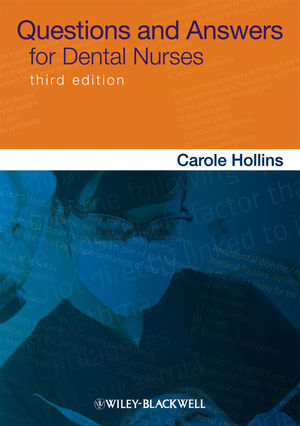
Questions and Answers for Dental Nurses has been completely revised and updated for its third edition. Encompassing the significant changes to the NEBDN National Certificate, this book now includes both standard Multiple Choice Questions and the new style Extended Matching Questions with helpful explanatory information on responses. As a self-assessment tool this revision guide is a must-have for all trainee dental nurses looking to sit either the NEBDN examination or the NVQ in Oral Healthcare, up to level 3. Completely revised content and updated format The author is the current Chairman of the NEBDN and a member of its 'New Exam Project' Question Writing Team. 14 chapters in 4 sections covering the whole curriculum 2 types of multiple choice question throughout: 1 of 5 single best answer questions New scenario-based extended matching questions Clear explanation of answers Invaluable resource for independent revision Boosts confidence of readers preparing for examinations
Carole Hollins is a dental practitioner and member of the British Dental Association. She is the current Chairman of the National Examining Board for Dental Nurses (NEBDN). She is the author of Levison's Textbook for Dental Nurses.
Foreword by Beverley Coker vii
Introduction ix
How to Use this Book xi
Domain 1: Clinical 1
1 General Anatomy and Physiology 3
Medical conditions
Medications
2 Oral Anatomy and Physiology 23
3 Dental Pathology and Microbiology 39
Risks to health
4 Assessment and Diagnosis 65
History-taking
Charting
5 Restorative Dentistry and Dental Materials 85
Fillings
Endodontics
Prosthodontics
6 Minor Oral Surgery, Local Anaesthesia and Anxiety Control 113
Domain 2: Professionalism 127
7 GDC Standards 129
8 Legal and Ethical Issues 139
Legislation
Regulations
Domain 3: Communication 155
9 Oral Health Instruction 157
Disease prevention
Health advice
10 Pre- and Post-operative Advice 173
11 Consent and Record-keeping 189
Domain 4: Management and Leadership 197
12 Health and Safety 199
13 Teamwork 219
Chair-side support
Reception duties
14 Medical Emergencies 233
First aid
Index 245
"This book should be used by students once subjects are learnt using their textbooks and lecture notes; this will then test their knowledge and understanding. This book is a must-have for trainee dental nurses; my peers and I working towards our National Diploma have found it extremely informative and an invaluable revision aid." (Vital, 13 September 2012)
How to Use this Book
Details of the two question styles for the written paper, as well as an overview of the practical OSCEs is given below. Students are advised to read this section in full before attempting to use the book as a revision aid, as the new style of written questions and practical assessments are quite different from those used for the old National Certificate examination.
Multiple choice questions
The full title of the new style MCQ is 1 of 5 single best answer MCQ. They follow the form shown below.
- The question itself is usually one or two sentences long.
- The first sentence introduces the topic of the question.
- The final sentence asks the question.
- They are designed to test the application of the relevant knowledge.
- Key words or phrases are not highlighted.
- There are always five answer options.
- Only one of those five will be the ‘best’, and therefore the correct, answer.
- The answers are always homologous – of the same form (so, all microorganisms, all periodontal instruments, all filling materials, and so on).
- They are always set out alphabetically or numerically in ascending order.
As the question style always follows the same pattern, it is not possible for candidates to ‘work out by elimination’ or ‘guess’ the correct answer – they must have the relevant knowledge and the understanding to be able to apply it to the scenario of the question. Only then can the single best answer be identified.
Similarly, as a logical alphabetical or numerical order is always followed in the answers, the correct answer cannot be determined by seeing how many times, say, option (d) has been an answer and therefore not choosing it again. The single best answer will be at whichever option letter it falls at alphabetically or numerically only. So it is quite feasible for an examination to have option (d) as the correct answer for every question asked, if the correct answer happens to fall at option (d) alphabetically or numerically. Consequently, the candidate is unable to guess the answer.
Candidates mark their single answer choice on an optical marking sheet for each question, by pencilling in a small box through their chosen option. Only one box must be filled in, otherwise the computer will reject that question. Similarly, the box must be filled in horizontally – drawing a circle around it or marking an answer option with a cross will also cause the computer to reject that question.
Below are three examples of the new style MCQs used in the new NEBDN National Diploma examination.
The correct answer is (d). The question clearly states that only the buccal gingivae of the upper premolar teeth will be involved in the procedure, so the nerve supplying this area simply needs identifying from the options listed. Only the middle superior dental nerve is relevant to the question.
The correct answer is (a). The question asks for the instrument used specifically to remove subgingival calculus. Although an ultrasonic scaler can be used for this purpose, it is not specifically so, and can be used to remove supragingival calculus too. All the other options listed are used to remove supragingival calculus only and therefore option (a) is the single best answer.
The correct answer is (b). The candidate must know what COSHH stands for, and is relevant to, before being able to choose the single best answer from the options list.
Extended matching questions
This style of question follows a similar layout to the MCQ in some respects and was introduced to replace the short answer style question. The short answer style question, such as those used in Section 3 of Part A in the National Certificate examination, allowed candidates to supply their own answer in the space provided. This then created many ‘partially correct’ answers, which had to be considered and either included or discounted from a definitive marking guide before the paper could be marked.
With extended matching questions, this problem is overcome as all candidates have the same definitive option list provided for each set of questions in the examination paper. There is no opportunity for candidates to create an answer, as only the options listed can be used.
Each options list has several questions (a question set) attached to it. The EMQ style questions follow the form shown below.
- The topic covered by the question set is stated, to help focus the candidate’s thoughts.
- A lead-in statement is then given which explains what candidates are required to do, and how many options they are required to choose from the list, for each question.
- The option list is then given, and it will usually contain a minimum of eight options.
- The options are always homologous – of the same form (so all surgical instruments, all microorganisms, and so on).
- They are always set out alphabetically or numerically in ascending order.
- The questions are set out as several sentences giving a detailed scenario.
- They are designed to test analytical and reasoning skills, as well as requiring a more detailed and concise application of knowledge.
- Key words or phrases are not highlighted.
- Each topical option list has several questions set to it.
The candidate is required to understand the question and apply detailed knowledge to be able to reason the answer(s) from the option list. Below are two different examples of a question set, each with its own option list, of the EMQ style of question used in the new NEBDN National Diploma examination:
Topic: Dental pathology
For each of the following dental pathology questions, select the single most appropriate microorganism from the option list. Each option might be used once, more than once, or not at all.
The correct answer is (a). The clinical scenario describes the signs and symptoms of the condition, and then states the disease present. Candidates must then apply their knowledge of microorganisms that cause this condition, and locate it from the option list. With a more extensive option list, the lead-in statement could ask for two appropriate microorganisms from the list, making it a harder question still.
Alternatively, the name of the disease diagnosed could be left out of the question, so that the candidate then has to determine it from the signs and symptoms described, before being able to choose the correct option from the list. Again, this would then become a harder question still.
The correct answer is (g). As the question stem states, many microorganisms have been linked to chronic periodontal disease, but the only one listed as an option is Porphyromonas gingivalis. Others include Actinomyces species, Prevotella intermedia and Treponema denticola. Again, if any of these had been added to the option list, the question could have asked for more than one...
| Erscheint lt. Verlag | 10.4.2012 |
|---|---|
| Sprache | englisch |
| Themenwelt | Medizin / Pharmazie ► Allgemeines / Lexika |
| Medizin / Pharmazie ► Gesundheitsfachberufe | |
| Medizin / Pharmazie ► Zahnmedizin | |
| Schlagworte | Anaesthesia • Anxiety • Beverley • Book • changes • Clinical • coker • Control • Dental Nursing • dentistry • Domain • GDC • Health • instruction • Introduction • Ix • legislation regulations • Local • Medical • national certificate • nebdn • Oral • Praxis der Zahnarzthelferin • Professionalism • significant • Style • VII • Zahnmedizin |
| ISBN-13 | 9781118341537 / 9781118341537 |
| Informationen gemäß Produktsicherheitsverordnung (GPSR) | |
| Haben Sie eine Frage zum Produkt? |
 EPUB (Adobe DRM)
Kopierschutz: Adobe-DRM
Adobe-DRM ist ein Kopierschutz, der das eBook vor Mißbrauch schützen soll. Dabei wird das eBook bereits beim Download auf Ihre persönliche Adobe-ID autorisiert. Lesen können Sie das eBook dann nur auf den Geräten, welche ebenfalls auf Ihre Adobe-ID registriert sind.
Details zum Adobe-DRM
Dateiformat: EPUB (Electronic Publication)
EPUB ist ein offener Standard für eBooks und eignet sich besonders zur Darstellung von Belletristik und Sachbüchern. Der Fließtext wird dynamisch an die Display- und Schriftgröße angepasst. Auch für mobile Lesegeräte ist EPUB daher gut geeignet.
Systemvoraussetzungen:
PC/Mac: Mit einem PC oder Mac können Sie dieses eBook lesen. Sie benötigen eine
eReader: Dieses eBook kann mit (fast) allen eBook-Readern gelesen werden. Mit dem amazon-Kindle ist es aber nicht kompatibel.
Smartphone/Tablet: Egal ob Apple oder Android, dieses eBook können Sie lesen. Sie benötigen eine
Geräteliste und zusätzliche Hinweise
Buying eBooks from abroad
For tax law reasons we can sell eBooks just within Germany and Switzerland. Regrettably we cannot fulfill eBook-orders from other countries.
aus dem Bereich