


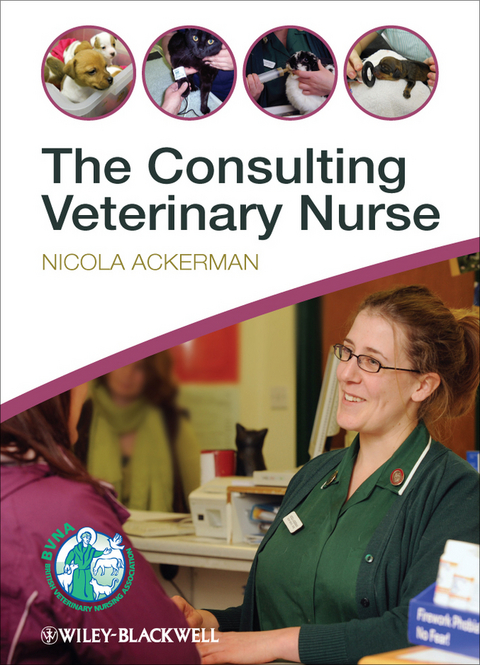
The Consulting Veterinary Nurse (eBook)
John Wiley & Sons (Verlag)
978-1-118-34094-3 (ISBN)
Written by an experienced senior veterinary nurse, this is a vital guide for all veterinary nurses seeking to develop their consulting role and contribute effectively to the long-term success of their practice.
KEY FEATURES
- Provides a comprehensive guide to the role of the consulting veterinary nurse
- Details specific nutritional, medical and behavioural clinics run by nurses
- Includes advice on presentation, marketing and communicating with clients
- Discusses client compliance and internal procedure and protocol
- Contains sample diet history sheets and unit conversion charts for use in practice
- Endorsed by the British Veterinary Nursing Association
Nicola Ackerman is Senior Medical Nurse at The Veterinary Hospital Group Ltd in Plymouth and holds a Certificate in Small Animal and Exotic Nutrition. She was the 2010 BVNA Veterinary Nurse of the Year, and the 2011 Blue Cross Veterinary Nurse of the Year.
The Consulting Veterinary Nurse is an invaluable source of information for all veterinary nurses setting up and conducting their own nursing clinics in small animal practice. From the basics of setting up the consulting room to running and marketing individual clinics, this book provides a comprehensive coverage of the role of the consulting veterinary nurse. A large section of the book details specific clinics run by nurses, including nutritional assessments, behavioural clinics, puppy parties, seasonal information campaigns, senior pet clinics and medical clinics for a full range of conditions from arthritis and dental problems to epilepsy and cancer. A chapter specifically on rabbit clinics is also included. Written by an experienced senior veterinary nurse, this is a vital guide for all veterinary nurses seeking to develop their consulting role and contribute effectively to the long-term success of their practice. KEY FEATURES Provides a comprehensive guide to the role of the consulting veterinary nurse Details specific nutritional, medical and behavioural clinics run by nurses Includes advice on presentation, marketing and communicating with clients Discusses client compliance and internal procedure and protocol Contains sample diet history sheets and unit conversion charts for use in practice Endorsed by the British Veterinary Nursing Association
Nicola Ackerman is Senior Medical Nurse at The Veterinary Hospital Group Ltd in Plymouth and holds a Certificate in Small Animal and Exotic Nutrition. She was the 2010 BVNA Veterinary Nurse of the Year, and the 2011 Blue Cross Veterinary Nurse of the Year.
Foreword by Helen Farrant vii
Abbreviations viii
Introduction x
Acknowledgements xi
Part I The Role of the Nurse in the Veterinary Practice
1
1 Ethics 3
2 Consulting Room and Literature 6
3 The Consultation 9
4 Diagnostic Clinics 19
5 Marketing 29
6 Named Nurse and Protocol Writing 32
Part II Nutrition and Diet 35
7 Food and Feeding 37
8 Feeding Behaviours 51
9 Nutrition for Puppies and Kittens 56
10 Nutritional Assessment 67
11 Dietary Transitions 72
12 Methods of Increasing Water Consumption 74
13 Dietary Supplements 76
14 Rabbit Nutrition 80
Part III Behavioural Issues 85
15 Puppy and Kitten Behaviour 87
16 Noise Phobias and Fireworks 100
Part IV 'Well Pet' Clinics 107
17 Vaccination Clinics 109
18 Post-Neutering Clinics 111
19 Senior Pet Clinics 113
Part V Medical Clinics 117
20 Arthritis 119
21 Cancer 129
22 Cardiac Disorders 135
23 Cognitive Dysfunction 143
24 Dental Problems 146
25 Diabetes 153
26 Epilepsy 161
27 Gastrointestinal Disorders 164
28 Hepatobiliary Disorders 176
29 Obesity 185
30 Pancreatic Disorders 196
31 Renal Disorders 202
32 Nutrition-Related Skin Disorders 211
33 Urinary Tract Disorders 218
Appendix 1 Diet history sheet 233
Appendix 2 Unit Conversion Tables 235
Glossary 238
Index 241
"This book will enable VNs to become more involved in
clinics and will ensure their skills are utilised. Certainly
a book for every VN to have in the library."
(BSAVA, 1 March 2014)
"To summarise, The Consulting Veterinary Nurse will be a
useful book for many nurses, especially those who have a keen
interest in clinical nutrition, and those looking to promote
nutrition within the practice . . . It may also offer some
suggestions for medical clinics that may not have otherwise been
considered." (The Veterinary Record, 1 October
2013)
"From handling senior pet clinics to client compliance and
education, this covers clinics organized for a range of animal
conditions and is written by an experienced senior vet nurse. Any
veterinary collection will find this filled
with specifics." (Bookwatch, 1 January
2013)
"The Consulting Veterinary Nurse' is a highly
informative, well-written book and deserves its place in the
practice library or, better still, the nurses' consultation
room." (Veterinary Record, 2 February 2013)
The Consulting Veterinary Nurse is a useful reference for
all veterinary nurses who run clinics in their practice. The
Author, Nicola Ackerman, is an experienced Registered Veterinary
Nurse and she has drawn on her knowledge to provide a comprehensive
guide, which includes information on how to run efficient and
effective well pet clinics and medical clinics. The book contains a
wealth of information on all aspects of running a clinic,
including: how to provide clients and patients with an excellent
level care; the answers to questions which clients frequently ask
in a clinic; how to gather a patient's history; carrying out
an examination and the necessary equipment for this - along with a
list of common abbreviations. Nicola also discusses the role
of the veterinary nurse and the consideration of nutritional and
behavioral issues within the setting of a veterinary nurse-lead
clinic. This book will be a useful reference for veterinary nurses
who are experienced in running clinics and those who are just
starting out, alike. - Helen Farrant on behalf of the BVNA
3
The Consultation
Several frameworks for consulting have been developed for medical education, but none has been developed specifically for veterinary use. There is considerable overlap between the two fields, so it was decided to adapt a widely used medical consultation model to the veterinary context, taking account of the likely differences between veterinary and medical consultations. The Cambridge-Calgary consulting model (Figure 3.1) has been adapted by the National Unit for the Advancement of Veterinary Communication Skills (NUVACS), and is therefore the most relevant to the veterinary profession.
Figure 3.1 Adapted Cambridge-Calgary model of veterinary consultation skills.
Preparation
Before starting any consultation it is important to prepare adequately. Any equipment required for the consultation should be prepared (see Chapter 2) and the consulting room needs to be clean. You should read through the clinical history of the animal, as you need to be fully aware of any relevant previous history. Whether or not the consultation is about the previous clinical history of the animal, if you mention or ask how the animal has been since the incident, the client feels that you care about their pet. It is always worth checking vaccination status, last time of worming, and other parasite control. If any relevant comments have been noted in the clinical history, the client should be reminded about these. For example, if the veterinary surgeon has requested repeat blood sampling or a repeat clinical examination in a specified period of time, the client should be reminded about it. Make a note of the animal’s name, sex and age, and use this information when talking to the client.
Your appearance is also a highly important factor in the client’s perception of you. The nurse’s uniform needs to be as clean as possible and hair should be kept tidy; long hair should be tied back. All staff members should wear name badges, which should be visible. Even though you tell the client your name at the time, many clients are stressed and do not remember many important facts, let alone the nurse’s name. When writing down any future appointment times, write your name next to the time. Photographs of staff members can be useful for clients, and help to increase the recognition of the role of the veterinary nurse within the veterinary practice (Figure 3.2).
Figure 3.2 A display of the practice nurses and their roles can help to raise the recognition of the veterinary nurse.
Initiating the Consultation
The consultation should start with your confirming the name of the client when calling them through from the waiting area. Always introduce yourself, and confirm what the appointment is for. For example, ‘Hello, my name is Nicola, I am your nurse for today. Have you brought Timmy for his blood test?’ There are many occasions when the client will make an appointment for one cat, and then bring the other instead as the initial cat hasn’t made it into the cat transport box. There are also occasions when the reason for the consultation can change, but this only becomes apparent when the animal is presented. If there has been a delay in the starting time of the appointment, you should apologise for this. Clients (and pets) don’t like to be kept waiting, and not acknowledging it can make the situation worse.
You should also acquaint themselves with the animal. Dogs should be patted and cats removed from transport baskets. Use of the pet’s name is vital. If a cat is not willing to come out of its basket, removing the top half of the basket is helpful. The cat can then be examined in the bottom half of the basket, or lifted out on its blanket on to the consulting table (Figure 3.3). This is why cat owners are always recommended to purchase cat transport boxes that can be opened from the top.
Figure 3.3 A cat less stressed in the bottom half of its transportation box.
This stage is very important for creating rapport with the client and their pet. Remember to use names, shake hands with the client, greet the pet and, most importantly, involve the pet. In order to create good rapport, veterinary nurses need to empathise with pet owners. Owners need to see, hear and feel these emotions from the practice as a whole, not just from the veterinary nurse that they see in the nurse consultations. In most cases they think of their pet as part of the family, and this special bond needs to be respected.
Information Gathering
Background information can be gained from the clinical history, but in many cases additional information is required and is obtained through questioning. Many clients are more than happy to offer information, whether it is relevant or not, but sometimes you will need specific questioning in order to get the required information. Both open and closed questioning should be used when conducting a consultation, as they will provide different types of answers (see Box 3.1). Questioning also helps provide information on the client’s expectations, concerns, wants and needs. It allows you to demonstrate your professionalism and knowledge, while helping to build rapport and show empathy. Questions also help to give you time to think and time to focus. Ensure that you show genuine interest in what the client is saying; listen to what the client is saying and if necessary repeat what they are saying back to them in order to confirm details (Box 3.2).
- They ask the respondent to think and reflect.
- They give you opinions and feelings.
- They hand control of the conversation to the respondent.
- They give you facts.
- They are easy to answer.
- They are quick to answer.
- They keep control of the conversation with the questioner.
- Seek clarification
- Take notes
- Avoid distractions
- Use pauses and silences
- Restate and summarise
This is a very important stage of the consultation, and one that is often overlooked or not fully completed. Sometimes when the consultation has finished the client often asks, ‘… and another thing’. This is an indication that questioning was not sufficiently thorough in the early stage of the consultation.
In some cases the client will ask for multiple procedures to be completed, or will have a very long list of questions. Your job is to find out what all of the client’s concerns are and then prioritise which are the most important, to you as a veterinary professional and to the client. What you feel is the most important factor and what the client feels is the most important may be two different things. For example, the client may feel that having the pet’s nails clipped is what they have presented their pet for, and this is the most important thing to be done in the consultation. You, however, may feel that the animals’s dramatic weight loss and polydipsia are the most important factors to be considered. In this situation you need to ensure the client understands why you feel that these factors need to be prioritised over the nail clipping.
If the client has a long list of non-emergency questions or procedures, the consulting nurse and the client need to agree on which things are to be completed first. A subsequent appointment can be made on another day in order to complete the rest. This must be done in agreement with the client, and they must understand why some things are being deferred to another day, for the following reasons:
- Insufficient time to correctly cover all the items that the client wishes
- Too much information for the client to retain in one appointment
- The pet becoming stressed (e.g. at having all the mats combed out of its hair in one session)
- To aid in compliance.
For example, if you want to demonstrate to a client how to brush a dog’s teeth, in the first consultation you can introduce the concept of the toothpaste or gel; the second consultation is to ensure that the client is managing stage 1 and is ready to move on to stage 2.
Physical Examination
When initiating the physical examination it is important to be aware of the clinical history. If the animal is known to have a tender abdomen, or arthritic joints, it is important not to exacerbate any discomfort. With larger dogs, or those that do not like being on the consulting table, the physical examination can be conducted on the floor.
While carrying out the clinical examination it is important to...
| Erscheint lt. Verlag | 19.6.2012 |
|---|---|
| Sprache | englisch |
| Themenwelt | Medizin / Pharmazie |
| Veterinärmedizin ► Allgemein ► Tiermedizinische Fachangestellte | |
| Schlagworte | Animal nutrition, veterinary nurse, veterinary technician, consulting, clinics • Pflege i. d. Veterinärmedizin • Pflege i. d. Veterinärmedizin • Veterinärmedizin • Veterinärmedizin • Veterinary Medicine • Veterinary Nursing & Animal Care |
| ISBN-10 | 1-118-34094-9 / 1118340949 |
| ISBN-13 | 978-1-118-34094-3 / 9781118340943 |
| Informationen gemäß Produktsicherheitsverordnung (GPSR) | |
| Haben Sie eine Frage zum Produkt? |
 EPUB (Adobe DRM)
Kopierschutz: Adobe-DRM
Adobe-DRM ist ein Kopierschutz, der das eBook vor Mißbrauch schützen soll. Dabei wird das eBook bereits beim Download auf Ihre persönliche Adobe-ID autorisiert. Lesen können Sie das eBook dann nur auf den Geräten, welche ebenfalls auf Ihre Adobe-ID registriert sind.
Details zum Adobe-DRM
Dateiformat: EPUB (Electronic Publication)
EPUB ist ein offener Standard für eBooks und eignet sich besonders zur Darstellung von Belletristik und Sachbüchern. Der Fließtext wird dynamisch an die Display- und Schriftgröße angepasst. Auch für mobile Lesegeräte ist EPUB daher gut geeignet.
Systemvoraussetzungen:
PC/Mac: Mit einem PC oder Mac können Sie dieses eBook lesen. Sie benötigen eine
eReader: Dieses eBook kann mit (fast) allen eBook-Readern gelesen werden. Mit dem amazon-Kindle ist es aber nicht kompatibel.
Smartphone/Tablet: Egal ob Apple oder Android, dieses eBook können Sie lesen. Sie benötigen eine
Geräteliste und zusätzliche Hinweise
Buying eBooks from abroad
For tax law reasons we can sell eBooks just within Germany and Switzerland. Regrettably we cannot fulfill eBook-orders from other countries.


