


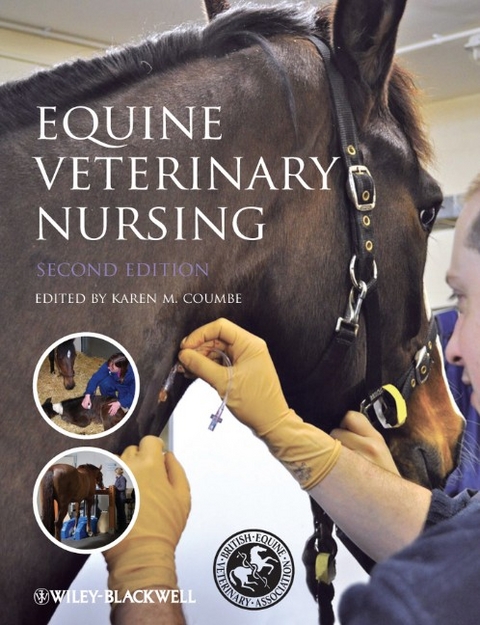
Equine Veterinary Nursing (eBook)
John Wiley & Sons (Verlag)
978-1-118-33626-7 (ISBN)
The breadth and depth of expertise essential for equine veterinary nursing today is provided in this definitive textbook. Thoroughly revised and updated in its second edition, and now fully illustrated in colour. This book covers the content of the ever-expanding equine nursing syllabus, while still succinctly covering all the basics that veterinary nurses specialising in other species need to know. The key subjects included are: basic equine management, medical and surgical equine nursing, nutrition, reproduction and foal care, emergency first aid, and the theory underpinning these and other important topics.
Equine Veterinary Nursing Second Edition is presented in a clear and user-friendly manner, appropriate for all those involved in equine nursing. A practical approach is used throughout and procedures are illustrated with a large number of line diagrams and clinical photographs. It is an essential manual for all student and qualified equine veterinary nurses and all those involved in the care of horses.
KEY FEATURES
- Includes a new chapter on the equine nurse's professional responsibilities
- Major revisions to the chapters on diagnostic imaging and surgical nursing to reflect advances in technology and techniques
- All information on health and safety management updated in keeping with new regulations
- Authors include both vets and experienced equine nurses
- Endorsed by the British Equine Veterinary Association
'With the increasing demands of equine practice has come the need for well trained and competent equine nurses. There have been significant improvements in and expansion of the equine Veterinary Nurse training syllabus over the past few years to meet these demands. This new and updated edition of Equine Veterinary Nursing covers all aspects of the new syllabus with well written and illustrated chapters from a wide range of knowledgable and experienced authors. The British Equine Veterinary Association is pleased to endorse this text as a 'must have' for all trainee equine veterinary nurses and their training practices.' - Deidre M Carson BVSc(Syd) MRCVS
Immediate Past President, BEVA
Karen Coumbe, MA VetMB CertEP CertVA MRCVS, trained as a veterinary surgeon at the University of Cambridge and has more than 25 years experience in equine veterinary practice. She has worked at Bell Equine Veterinary Clinic, an equine hospital in Kent, since it started, and is responsible for nurse training. She has been involved in developing the UK's equine veterinary nursing qualification and has also been an equine nursing examiner for the Royal College of Veterinary Surgeons.
The breadth and depth of expertise essential for equine veterinary nursing today is provided in this definitive textbook. Thoroughly revised and updated in its second edition, and now fully illustrated in colour. This book covers the content of the ever-expanding equine nursing syllabus, while still succinctly covering all the basics that veterinary nurses specialising in other species need to know. The key subjects included are: basic equine management, medical and surgical equine nursing, nutrition, reproduction and foal care, emergency first aid, and the theory underpinning these and other important topics. Equine Veterinary Nursing Second Edition is presented in a clear and user-friendly manner, appropriate for all those involved in equine nursing. A practical approach is used throughout and procedures are illustrated with a large number of line diagrams and clinical photographs. It is an essential manual for all student and qualified equine veterinary nurses and all those involved in the care of horses. KEY FEATURES Includes a new chapter on the equine nurse s professional responsibilities Major revisions to the chapters on diagnostic imaging and surgical nursing to reflect advances in technology and techniques All information on health and safety management updated in keeping with new regulations Authors include both vets and experienced equine nurses Endorsed by the British Equine Veterinary Association "e;With the increasing demands of equine practice has come the need for well trained and competent equine nurses. There have been significant improvements in and expansion of the equine Veterinary Nurse training syllabus over the past few years to meet these demands. This new and updated edition of Equine Veterinary Nursing covers all aspects of the new syllabus with well written and illustrated chapters from a wide range of knowledgable and experienced authors. The British Equine Veterinary Association is pleased to endorse this text as a 'must have' for all trainee equine veterinary nurses and their training practices."e; - Deidre M Carson BVSc(Syd) MRCVS Immediate Past President, BEVA
Karen Coumbe, MA VetMB CertEP CertVA MRCVS, trained as a veterinary surgeon at the University of Cambridge and has more than 25 years experience in equine veterinary practice. She has worked at Bell Equine Veterinary Clinic, an equine hospital in Kent, since it started, and is responsible for nurse training. She has been involved in developing the UK's equine veterinary nursing qualification and has also been an equine nursing examiner for the Royal College of Veterinary Surgeons.
List of contributors, vii
Foreword, ix
Preface to the second edition, x
Abbreviations and Acronyms, xi
1 Basic equine management, 1
W. Linnenkohl & D.C. Knottenbelt
2 Anatomy and physiology, 25
P.D. Clegg, N. Townsend & R.C. Conwell
3 Genetics, 69
G. Munroe
4 Reproduction, 78
J.F. Pycock
5 Nutrition, 97
P.A. Harris
6 Clinical nutrition, 121
P.A. Harris
7 Basic first aid, 134
M. Smith & S.J. Haylock
8 General nursing, 153
K. Snalune & A. Paton
9 Safety management in the practice, 176
A. Jones & A. Barr
10 The equine nurse's professional responsibilities,
184
S. Pullen
11 Medicines and their management, 191
C.A. Roberts, L. Loines & K. Tillett
12 Laboratory diagnostics, 201
R.J. Naylor, L.L. Hillyer & M.H. Hillyer
13 Fluid therapy, 226
V.E.N. Copas & J.C. Boswell
14 Medical nursing, 246
J.D. Slater & E.J. Knowles
15 Foal nursing, 286
S.J. Stoneham
16 Equine orthopaedic nursing, 303
E.D. Barr & E. Jones
17 Diagnostic imaging, 332
M.A. Smith, K. Holmes & N. Turley
18 General surgical nursing, 382
S. Boys Smith & B.M. Millar
19 Theatre practice, 407
D.P. McHugh
20 Anaesthesia, 432
J.C. Murrell & V. Ford-Fennah
Index, 461
"With the increasing demands of equine practice has come the need for well trained and competent equine nurses. There have been significant improvements in and expansion of the equine Veterinary Nurse training syllabus over the past few years to meet these demands. This new and updated edition of Equine Veterinary Nursing covers all aspects of the new syllabus with well written and illustrated chapters from a wide range of knowledgable and experienced authors. The British Equine Veterinary Association is pleased to endorse this text as a 'must have' for all trainee equine veterinary nurses and their training practices." - Deidre M Carson BVSc(Syd) MRCVS, Immediate Past President, BEVA
1
Basic Equine Management
W. Linnenkohl1 & D.C. Knottenbelt2
1Cornell University College of Veterinary Medicine, Ithaca, New York, USA;
2Philip Leverhulme Equine Hospital, Liverpool, UK
General Horse Behaviour
Horses have evolved as a flight species and therefore, whenever a horse is to be handled, it should be remembered that it will try to escape from any uncomfortable or unfamiliar situation by running away. In instances where a horse feels that it is unable to escape, it may resort to kicking or biting as a form of defence. When handling unfamiliar horses, or horses in an unfamiliar or stressful situation (i.e. in a hospital setting), knowledge of how horses might react and proper methods of restraint are imperative for everyone’s safety.
Most horses behave better if handled with confidence, firmness and kindness. Only deliberate bad behaviour should incur reprimand, and this should be immediate; hitting or kicking horses is completely counterproductive. A firm verbal reprimand is usually enough to make a horse pay attention. When persuading horses to do something unfamiliar or frightening, their primitive instincts for food and companionship can be utilised. If a horse is objecting to a particular task it is being asked to perform, it is important to understand whether its actions are motivated by fear or bad behaviour, since punishing a fearful horse will often make the situation worse. When horses flatten their ears, bare their teeth and lunge towards other animals or people, this is usually a sign of aggression rather than fear. A frightened horse may flatten its ears, yet turn away.
As horses are instinctively creatures of flight, it is important to understand the concept of a flight zone (Fig. 1.1). The flight zone can be thought of as the horse’s personal space. The size of the flight zone is determined by the tameness of the horse; well-trained animals will usually have a small flight zone whilst wild horses invariably have a large one. The point of balance, which determines which direction a horse will flee from an approaching person, is at the shoulder. When the flight zone is entered from the head, the horse will move backward and vice versa. It is important to be aware that it is best to approach a horse from the left, if possible, in a slow and calm manner using your voice to let the animal know you are there.
Fig. 1.1a&b. The flight zone of a horse is the distance at which the horse will choose to flee when approached by a human (or in the wild, a predator). See Box 1.1.
- The flight zone can be thought of as a horse’s ‘personal space’. Movement into this area is likely to make a horse move away.
- The size of the flight zone depends primarily on the familiarity of the horse with the handler. With frequent handling, the flight zone decreases in size and may even disappear.
- A horse that is approached head-on has a larger flight zone than if it is approached from the side. A head-on approach by another horse or human is considered threatening.
- The edge of the flight zone can be determined by slowly walking up to the horse. The point at which the horse begins to move away is the edge of the flight zone.
- When working with a horse, there is a point-of-balance for moving the horse backward or forward. The point-of-balance is at the shoulder, perpendicular to the length of the body. If you want the horse to move backwards, start in front of the point-of-balance and move into the horse’s flight zone. If you want the horse to move forward, move into the horse’s space from behind the point-of-balance.
- If a handler enters the flight zone suddenly, the horse will either bolt and run away or turn back and run over the person.
- It is important to be aware of the flight zone and the horse’s response to the handler within and near the flight zone. This will help to ensure safety at all times for the handler.
Vices, Stereotypies and Redirected Behaviour
In the past, certain types of abnormal behaviour were known as vices. We now know that many ‘vices’ are the horse’s attempts to cope with a stressful environment. Their significance to equine health is widely disputed, e.g. the link between colic and crib-biting is a good example of the controversy. Whilst there is a proven correlation between crib-biting and colic caused by epiploic foramen entrapment, the link with flatulent (gassy) colic is much less convincing.
Stereotypies are invariant and repetitive behaviour patterns with no apparent function. Examples of stereotypies include weaving, box-walking, and wind-sucking or crib-biting (Fig. 1.2a,b&c). Redirected behaviour occurs when a certain type of motivational behaviour is prevented. The horse will perform another type of behaviour to replace the missing behaviour pattern. Self-mutilation is a compulsive behaviour that is seen occasionally, particularly in stallions. Psychogenic polydipisia (drinking water for no physiological reason) can be alarming and can result in significant renal physiological compromise.
Fig. 1.2(a) Stereotypical behaviour: horse cribbing or crib-biting on a fence post, which is when a horse holds fixed objects with its teeth, arches the neck as shown and makes a grunting sound, usually as they gulp in air. Wind-sucking is when they do this without holding onto a fixed object. (b) Worn incisor teeth as a result of crib-biting (USA term = cribbing). (c) A horse box-walking.
Certain behaviours, such as pawing, digging or door-kicking, may be reinforced by attention. Stereotypical and redirected behaviours do not consistently cause direct harm to the horse. They are usually considered undesirable and may represent a welfare problem. Recent research has shown that some stereotypies may have a physiological basis. The relationship between gastric ulceration and cribbing is an example of this. It is thought that cribbing in some cases at least starts as a result of gastric discomfort when feeding methods are not natural; the horse cribs to induce salivation which acts as buffer for gastric acidity. Preventing a horse from cribbing can therefore be regarded as a harmful procedure. In addition there is some evidence that horses ‘get some psychological satisfaction’ from the behaviour and so, again, prevention could be viewed as harmful. There is still much debate on the basis of most of these behaviour patterns.
General Horse Handling
Basic Technique
When approaching a horse, and particularly a nervous animal, it is important to always speak to let it know of your presence. Approach from the front and slightly to the side, and walk towards the shoulder. Horses have a blind spot directly behind them. Handle the horse first on the lower neck or shoulder, and then put a lead rope around its neck. At this stage many animals will consider themselves ‘caught’. Difficult individuals should wear a headcollar when turned out or even in the stable until they learn to be caught submissively. Headcollars with leather pieces that break if the headcollar snags on something are ideal to prevent injury (Fig. 1.3).
Fig. 1.3 a,b &c How to approach a horse and fit a headcollar, all from left (near) side of the horse.
Food is a useful bribe for most horses, although they should not always come to expect it. Placing the noseband of a headcollar around the inside of a bucket may help when catching a difficult animal. Speed and technique are always important in such situations but it is also important to avoid sudden (potentially threatening) movements that might frighten the horse.
Horses are trained to respond to pressure cues. A well-trained horse knows to move away from pressure as well as to respect a human’s personal space. Young or untrained horses often do not understand these boundaries, particularly in stressful environments. Care and patience should be maintained when handling these types of horses. It is often better to allow the horse to ‘come’ to the handler. The horse is naturally inquisitive and will usually make an approach to a person standing in the vicinity in a quiet and non-threatening manner.
When being led, the horse should walk forward freely. Traditionally horses are led from the left (i.e. the ‘near’ side), although they should be trained to accept approaches from both left and right. The lead rope should be held near the horse’s head, with the free end in the other hand. The rope should never be wound around the hand. Ideally gloves should be worn.
Handling Mares and Foals
When handling mares and foals, the handler must be aware of the mare’s attitude. Even the most well-mannered mares can become aggressive when they have a foal at their side, particularly a maiden mare with her first foal. Conversely, some mares show inadequate maternal behaviour and may even reject their foal.
Young foals often have larger flight zones than mature horses if they are not accustomed to human interaction. The foal has highly developed hearing, good eyesight and is sensitive to touch. If properly handled, a foal will quickly become accustomed to people and will learn to trust them. In recent years, the concept of imprinting has gained popularity....
| Erscheint lt. Verlag | 25.6.2012 |
|---|---|
| Sprache | englisch |
| Themenwelt | Medizin / Pharmazie |
| Veterinärmedizin ► Allgemein ► Tiermedizinische Fachangestellte | |
| Veterinärmedizin ► Pferd | |
| Schlagworte | Equine nursing, veterinary nursing, veterinary techicinan, horse nursing • Pflege i. d. Veterinärmedizin • Pflege i. d. Veterinärmedizin • Veterinärmedizin • Veterinärmedizin f. Pferde • Veterinärmedizin • Veterinärmedizin f. Pferde • Veterinary Medicine • Veterinary Medicine - Equine • Veterinary Nursing & Animal Care |
| ISBN-10 | 1-118-33626-7 / 1118336267 |
| ISBN-13 | 978-1-118-33626-7 / 9781118336267 |
| Informationen gemäß Produktsicherheitsverordnung (GPSR) | |
| Haben Sie eine Frage zum Produkt? |
 EPUB (Adobe DRM)
Kopierschutz: Adobe-DRM
Adobe-DRM ist ein Kopierschutz, der das eBook vor Mißbrauch schützen soll. Dabei wird das eBook bereits beim Download auf Ihre persönliche Adobe-ID autorisiert. Lesen können Sie das eBook dann nur auf den Geräten, welche ebenfalls auf Ihre Adobe-ID registriert sind.
Details zum Adobe-DRM
Dateiformat: EPUB (Electronic Publication)
EPUB ist ein offener Standard für eBooks und eignet sich besonders zur Darstellung von Belletristik und Sachbüchern. Der Fließtext wird dynamisch an die Display- und Schriftgröße angepasst. Auch für mobile Lesegeräte ist EPUB daher gut geeignet.
Systemvoraussetzungen:
PC/Mac: Mit einem PC oder Mac können Sie dieses eBook lesen. Sie benötigen eine
eReader: Dieses eBook kann mit (fast) allen eBook-Readern gelesen werden. Mit dem amazon-Kindle ist es aber nicht kompatibel.
Smartphone/Tablet: Egal ob Apple oder Android, dieses eBook können Sie lesen. Sie benötigen eine
Geräteliste und zusätzliche Hinweise
Buying eBooks from abroad
For tax law reasons we can sell eBooks just within Germany and Switzerland. Regrettably we cannot fulfill eBook-orders from other countries.


